
Free Knowledge
The whole game, in the order it makes sense
33 articles written as one course, in 8 stages. Every number comes from the solver and every figure is a screenshot of the real product. Free to read, no account, nothing gated.
These articles are written in English. The reading order and the stage descriptions are translated; the 33 articles are not.
- 33articles you can read now
- 8stages live, of 8 written
- 63,863words, end to end
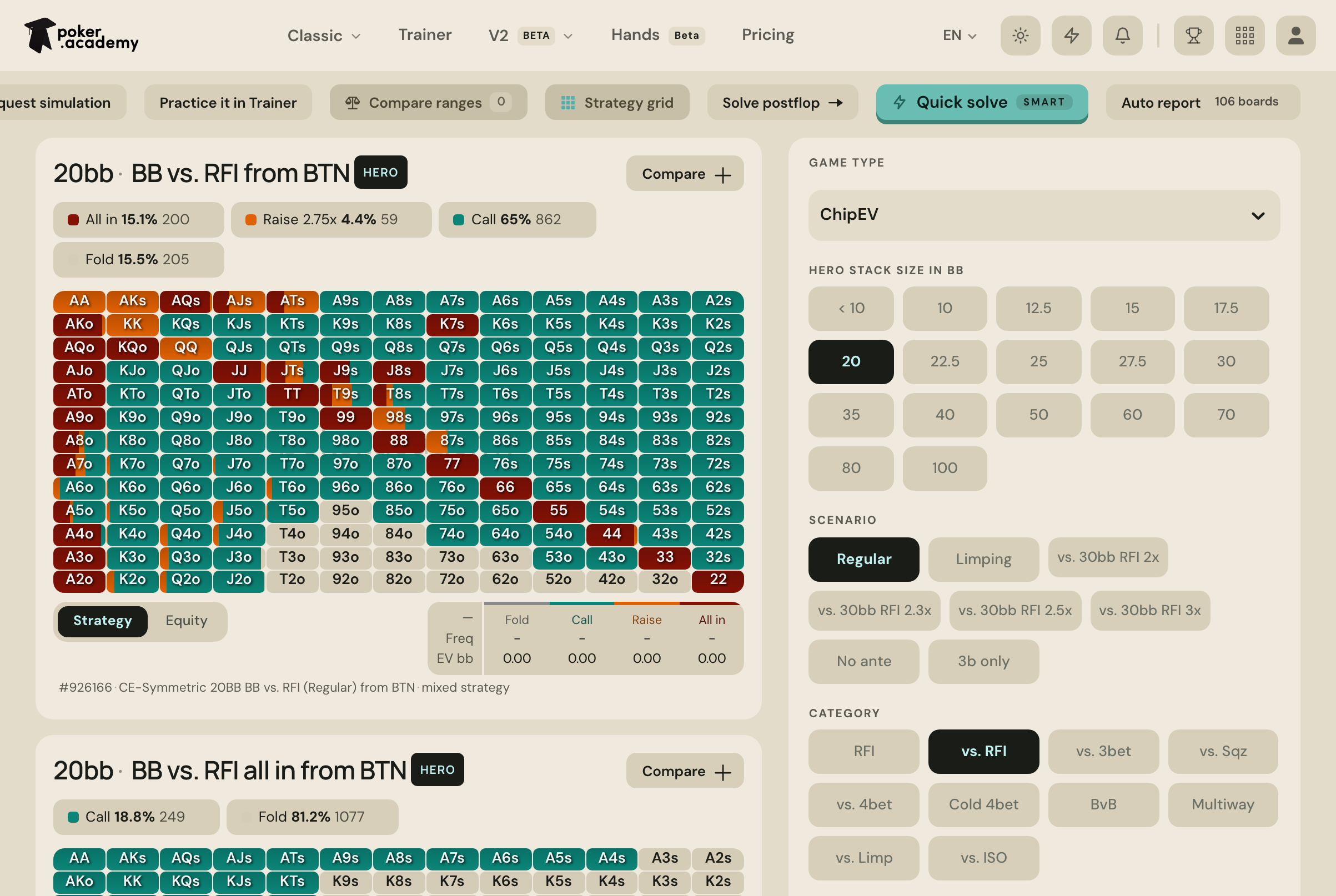
- 224screenshots of the real app
- 4free tools, no sign-up
- 0accounts needed
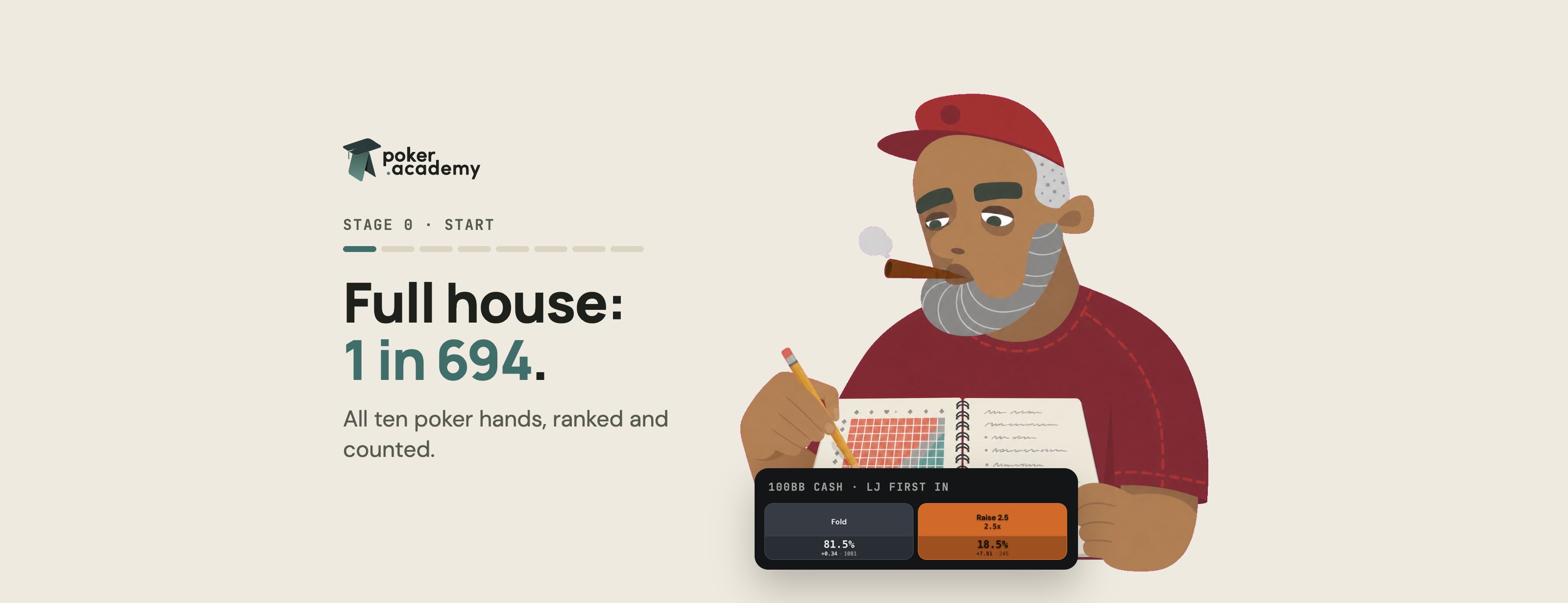
Start
the rules, the hands, the arithmetic
- 1Poker hand rankings explained: every hand, how rare it is and why
Every hand rank, how rare each one is, and the ten best starting hands by solver EV.
- 2Poker starting hands: 1,326 combos, 169 hands, and how to write them down
1,326 combos, 169 hands, and how to write a range down so it means one thing.
- 3Introduction to Basic Poker Math
Equity, pot odds, alpha, MDF, EV and outs, each calculated in full.
- 4Texas Hold’em rules and positions: how a hand actually works
How a hand is dealt and played, every seat name, and why acting last is worth money.
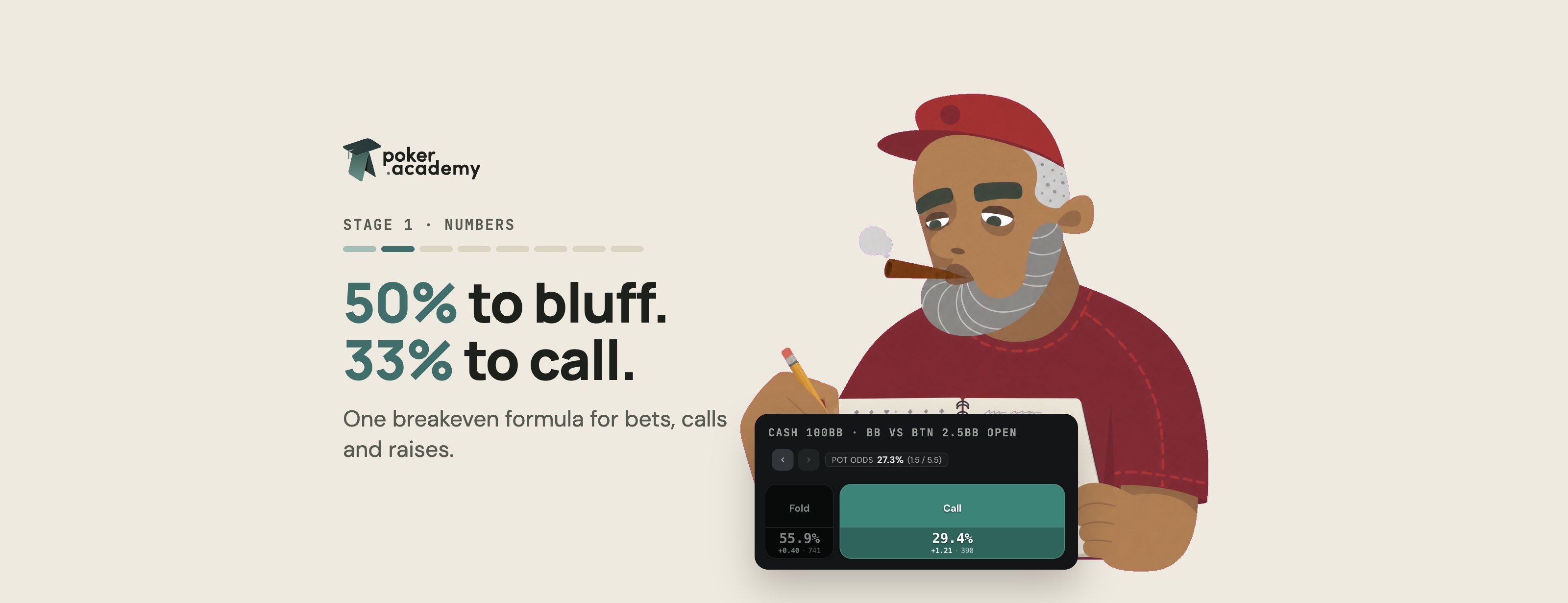
Numbers
the four formulas every decision reduces to
- 1Risk / (risk + reward): the breakeven formula behind every bluff, call and raise
Risk / (risk + reward): the one breakeven number behind every bluff, call and raise.
- 2Equity realization (EQR) in poker: what it measures and how to read it
Why two hands with the same equity are not worth the same, and how the app measures it.
- 3Poker variance in tournaments: downswings, breakeven stretches and the bankroll you actually need
How deep a normal downswing goes, and how many buy-ins keeps you in the game.
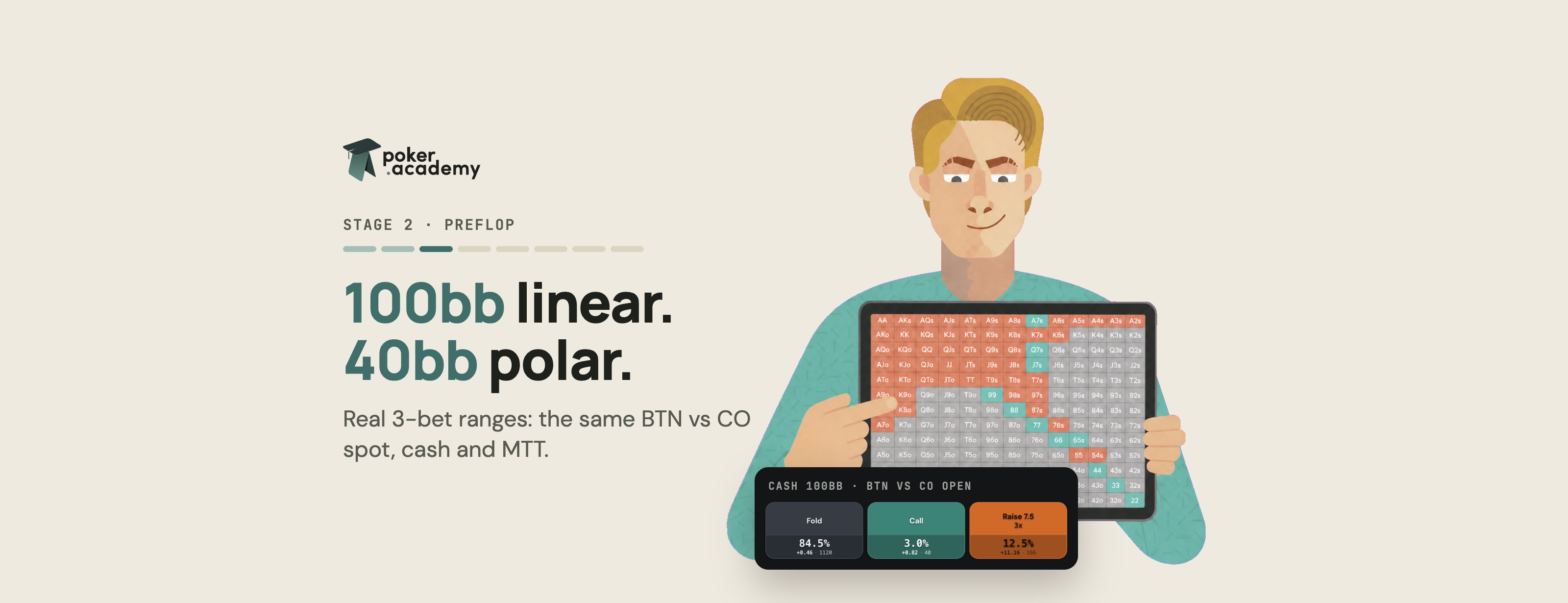
Preflop
the ranges
- 1What is a 3-bet in poker: real 3-bet ranges for cash and tournaments
Real 3-bet ranges for cash and tournaments, and when they are linear or polarised.
- 2Big blind defence in poker: pot odds, blind vs blind and limped pots
The price to defend, blind versus blind, and what the ante does to both.
- 3How to play pocket pairs from the big blind at 25bb
Pair by pair from the big blind at 25bb: call, jam or fold, and when set-mining pays.
- 440bb 3-bet all-in from the small blind: chipEV vs ICM ranges
3-bet jamming 40bb, chipEV against ICM, with the fold equity it needs.
- 5Poker ranges and RFI: how to open from every position
Thinking in ranges, and the first chart you need: what to open from every seat.
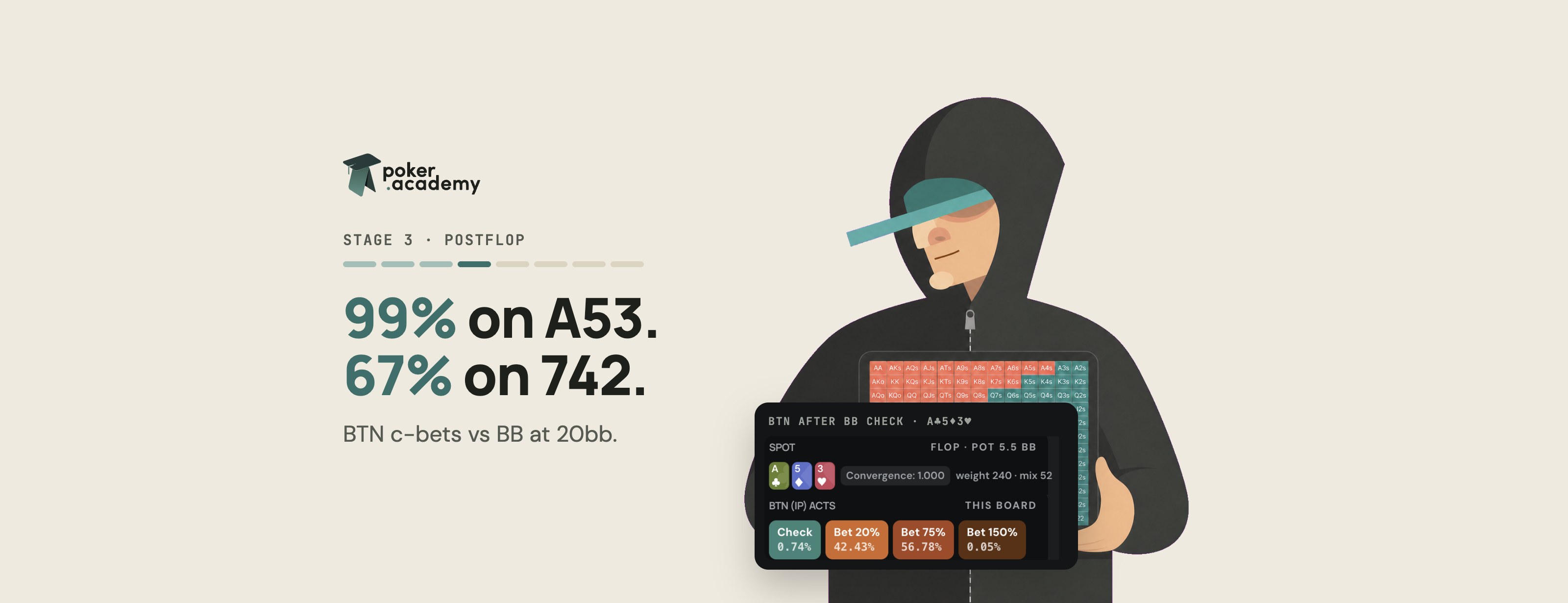
Postflop
boards, sizes, c-bets
- 1Continuation bets: how often and how big, by board texture
How often and how big to c-bet, texture by texture, from solved reports.
- 2The $12.1 million hand: the WSOP 2023 Main Event final hand, street by street
The WSOP 2023 final hand, street by street, with the price of every decision.
- 3Board texture and range advantage: how to read a flop
Reading a flop, and counting who actually holds the strong hands on it.
- 4Bet sizing and SPR: why the size belongs to the spot
Why the size belongs to the spot, and what SPR changes about it.
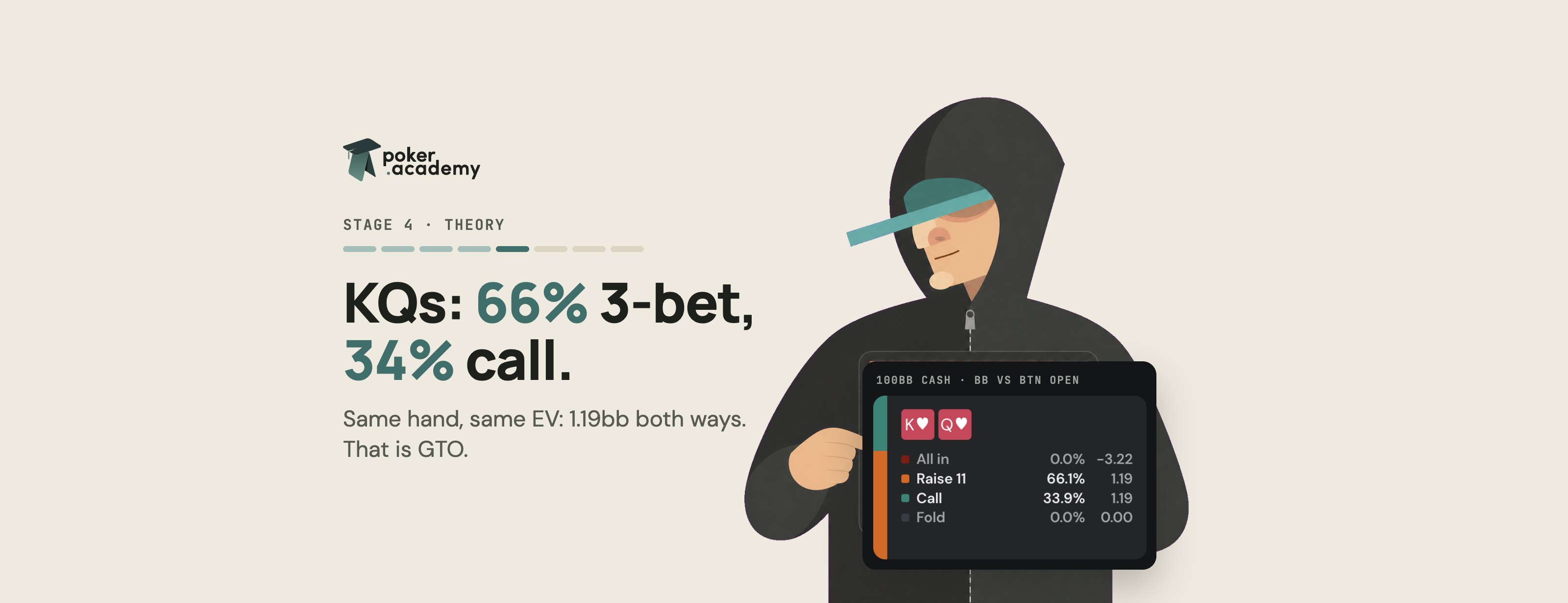
Theory
what GTO is and what it is not
- 1What is GTO in poker? Equilibrium, mixing and balance with real solver numbers
Equilibrium, mixing and balance, shown with solver output instead of slogans.
- 2GTO vs exploitative poker: MDF, node locking and when to deviate
MDF, node locking, and how much a real leak is worth once you attack it.
- 3Is simplifying poker strategy the road to success? I measured the cost
What a simplified strategy costs, measured in big blinds per hand.
- 4How poker solvers evolved: from Los Alamos to CFR, Libratus and today’s solvers
From Los Alamos to CFR, Libratus and Pluribus, and to the solver you can open now.
- 5Super System vs the solver: six pieces of Doyle Brunson’s 1979 advice, checked
Six pieces of 1979 advice checked against the solver: three hold, three do not.
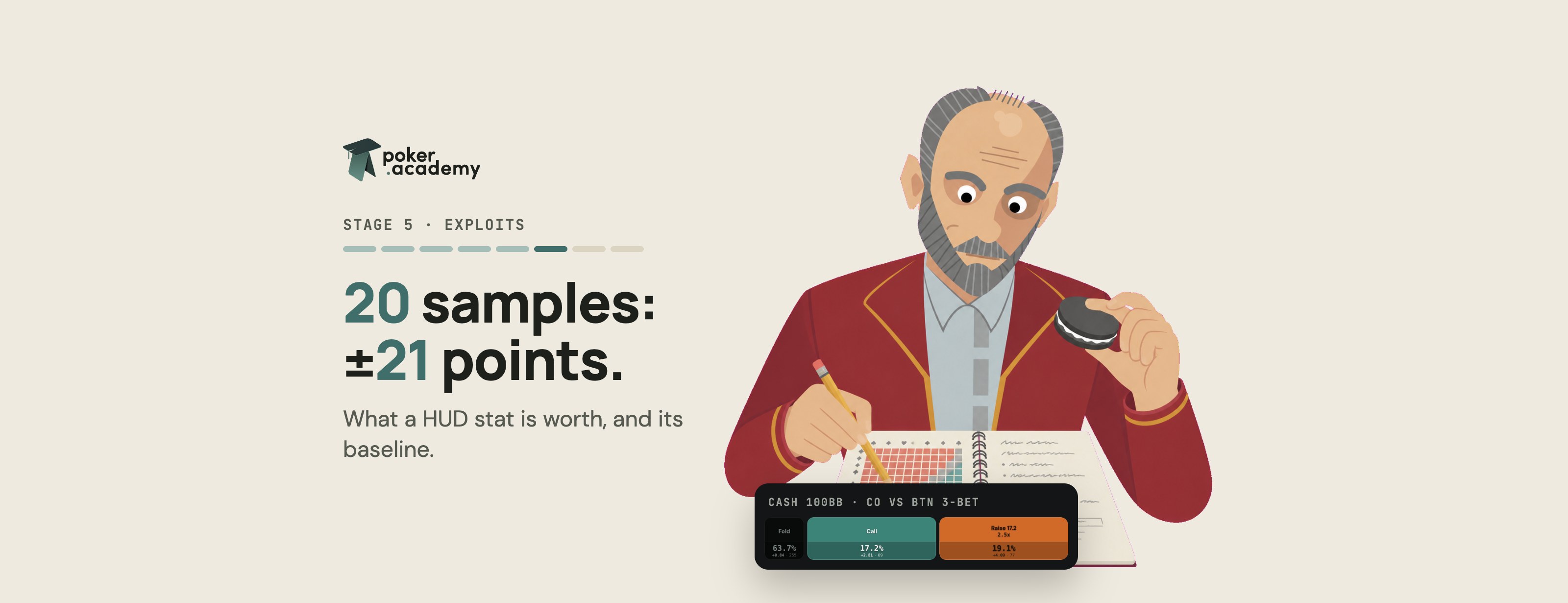
Exploits
playing the player
- 1Poker HUD stats explained: VPIP, PFR, 3-bet, and how many hands you need to trust them
What each HUD stat means, the solver baseline for it, and how many hands you need.
- 2How to exploit nits: steal their blinds, fold to their raises, stop value-betting thin
Steal their blinds, fold to their raises, and stop value-betting thin.
- 3How to exploit calling stations: thinner value, fewer bluffs, bigger bets
Thinner value, fewer bluffs, bigger bets, with the maths for each.
- 4How to play against poker maniacs: bluff-catching, 3-bet defense and a solver lock
Bluff-catching, defending 3-bets, and what the solver does against too much aggression.
- 5Timing tells in poker: what they really tell you, and how to stop giving your own
What timing really tells you, how weak the evidence is, and how to give none away.
- 6What keeps you stuck at low stakes in poker: five leaks, measured in the app
Five leaks you can measure, rake included, and where the app shows each one.
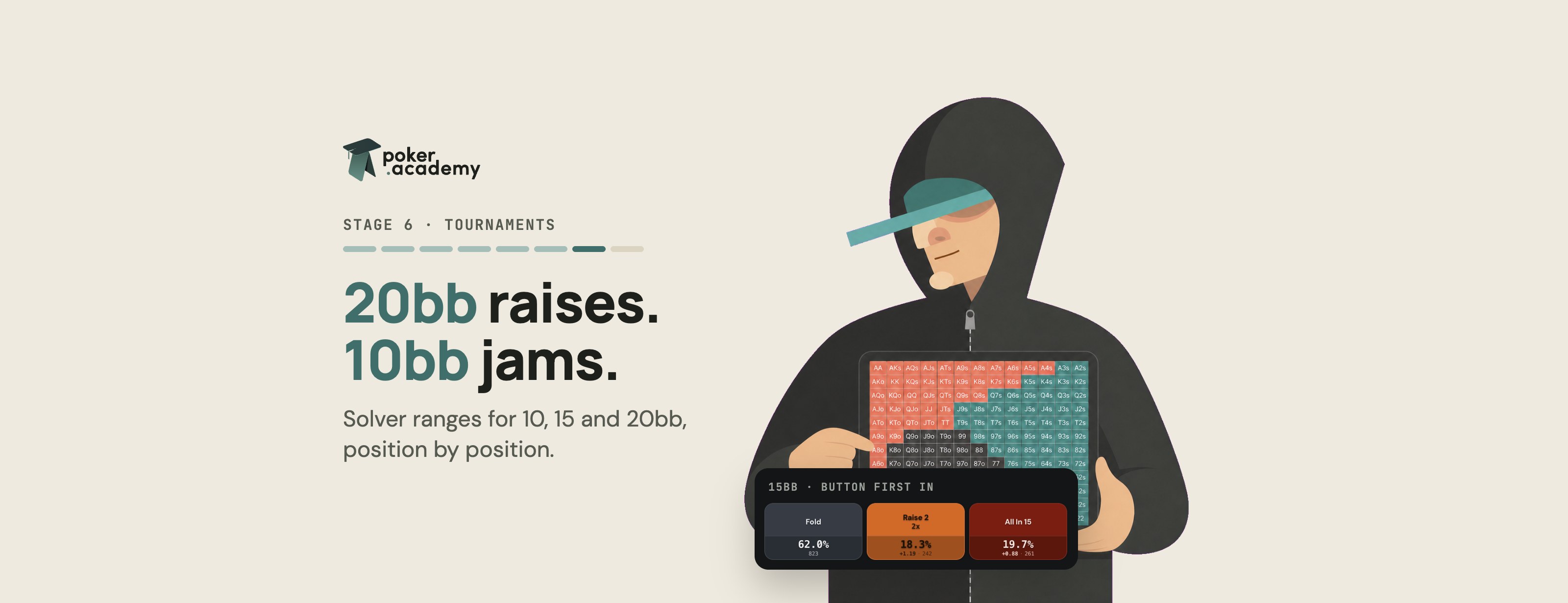
Tournaments
ICM, short stacks, bounties
- 1Short stack poker strategy: how to play 10, 15 and 20bb in tournaments
Solver ranges for 10, 15 and 20bb: when to min-raise and when to jam.
- 2ICM and uneven stacks: why tournament ranges change when the stacks do
What ICM is, what bubble factor does, and why uneven stacks change every range.
- 3BB Ante Explained: Why Your Preflop Sims Are Costing You Money
Big-blind ante against classic ante, and the ranges that move because of it.
- 4PKO strategy: how to turn bounties into chips and adjust your ranges
Turning a bounty into chips, and how much wider that lets you call.
- 5Heads-up poker strategy in tournaments: solver ranges from 10bb to 100bb
Button and big blind from 10bb to 100bb, limps included.
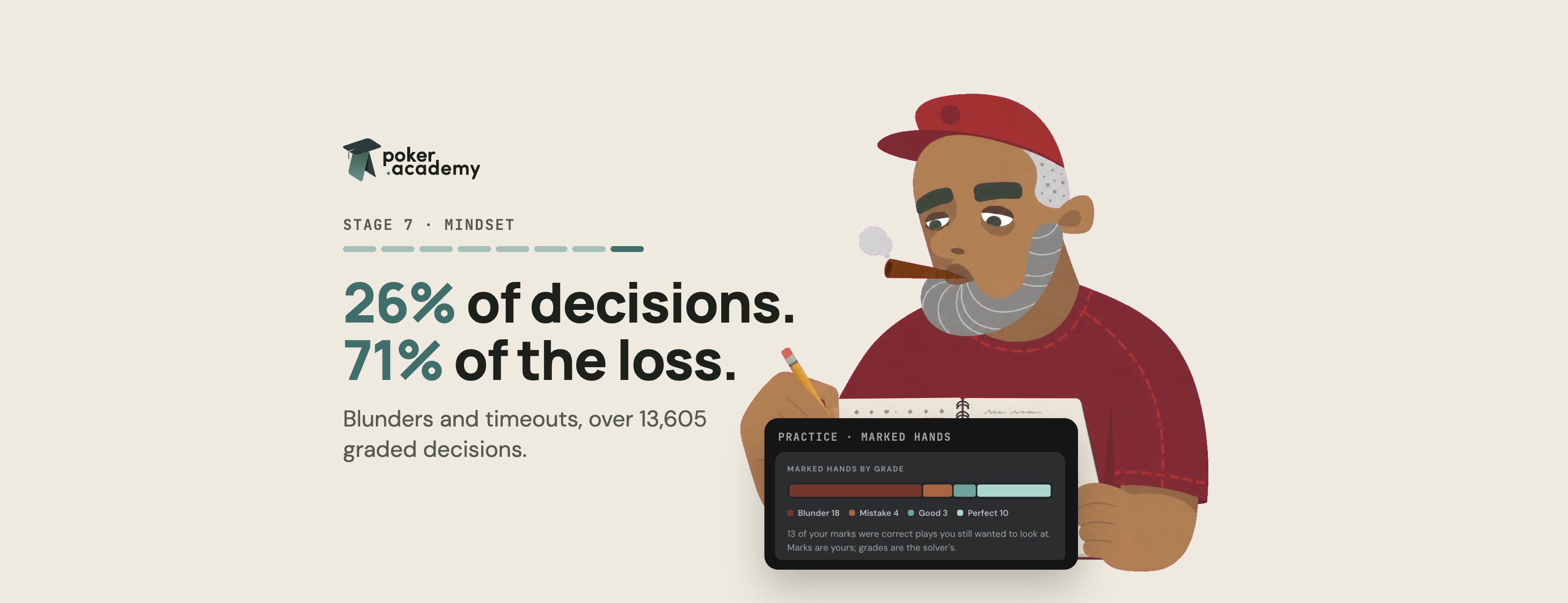
Mindset
study routine, tilt and the long run
- 1A poker study routine that survives tilt: review your own hands, repeat the spots, set a stopping rule
Reviewing your own hands, repeating the spots, and a stopping rule that holds.
Every number comes from the app
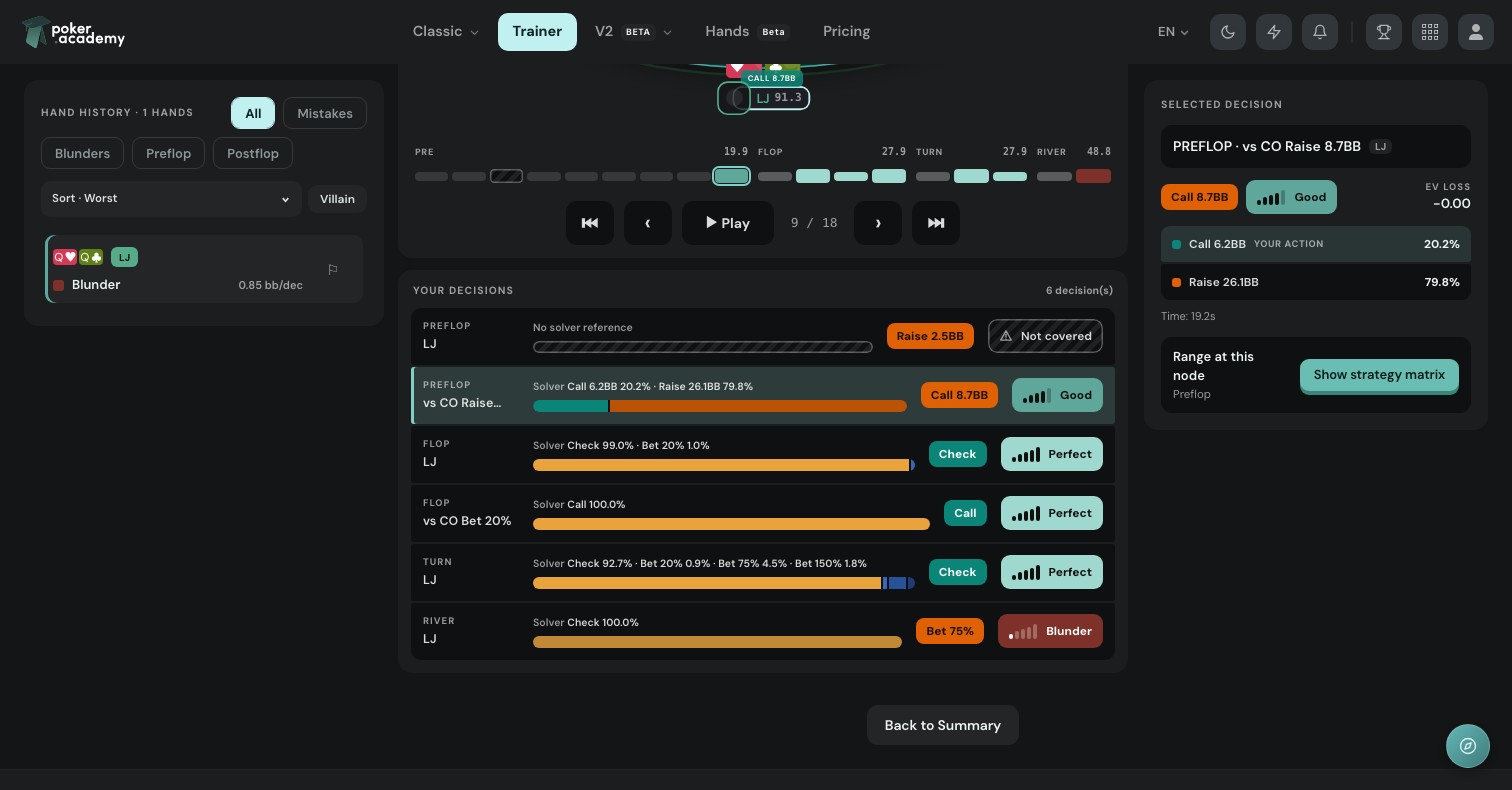
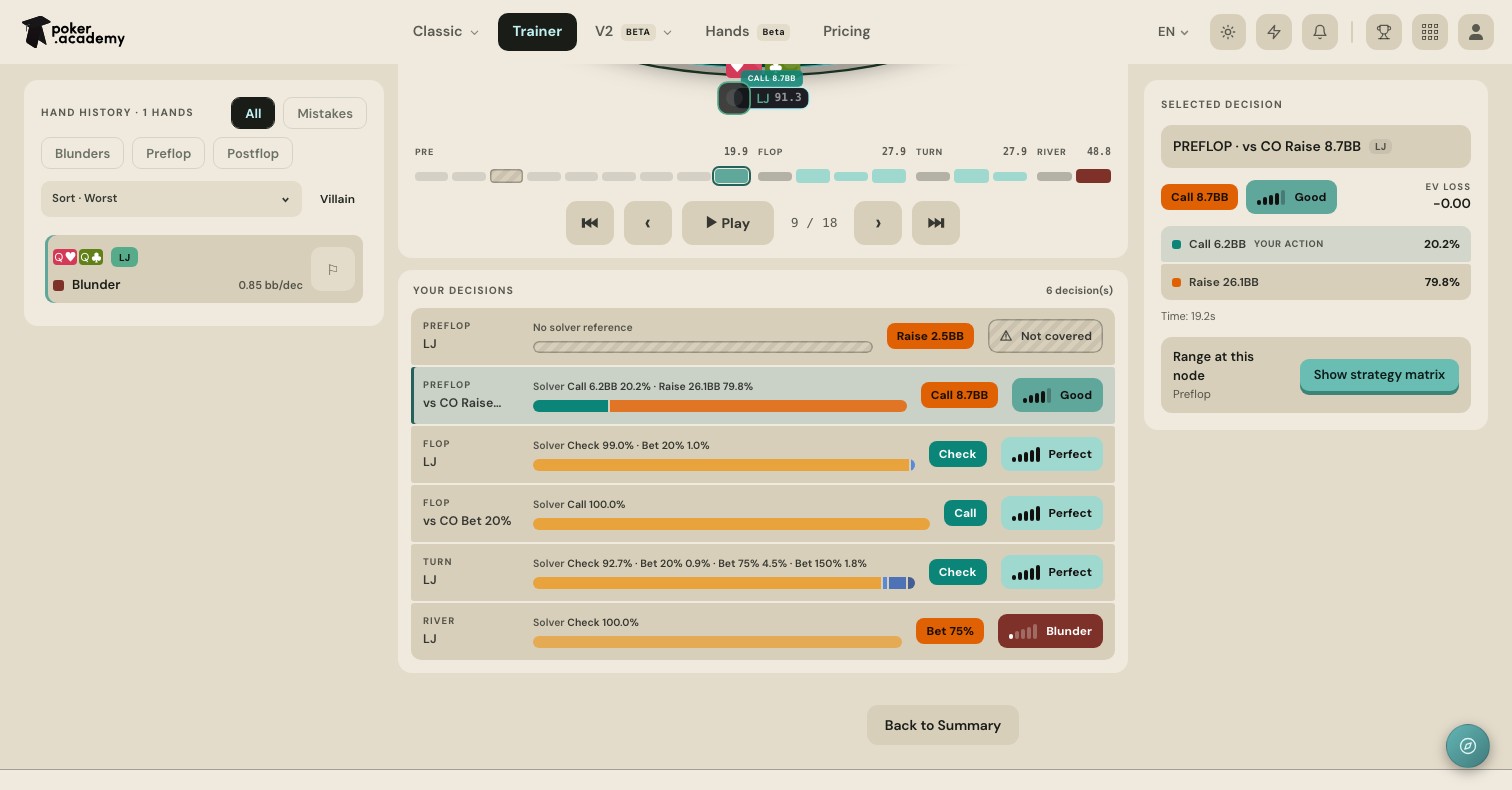
224 screenshots across the 33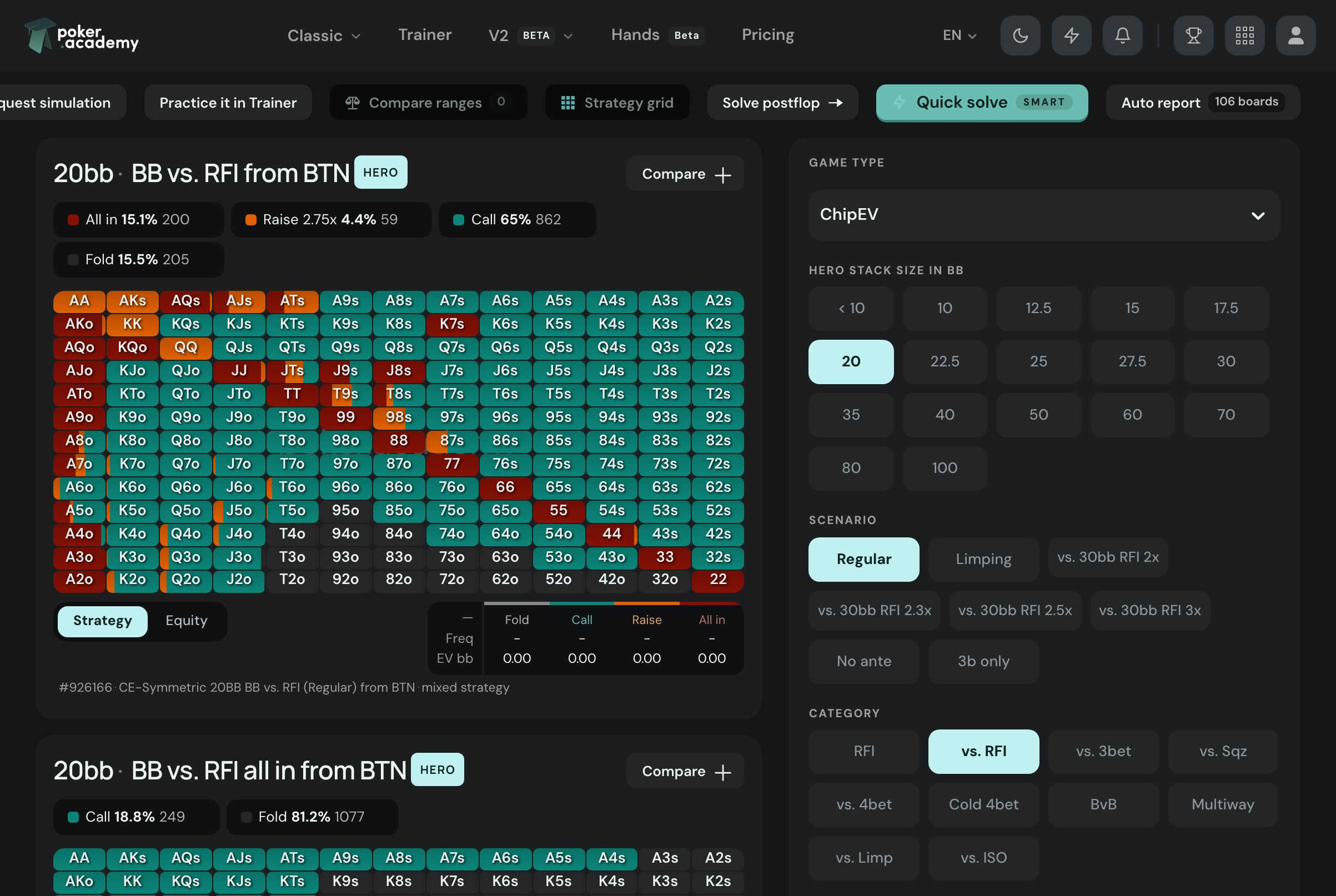
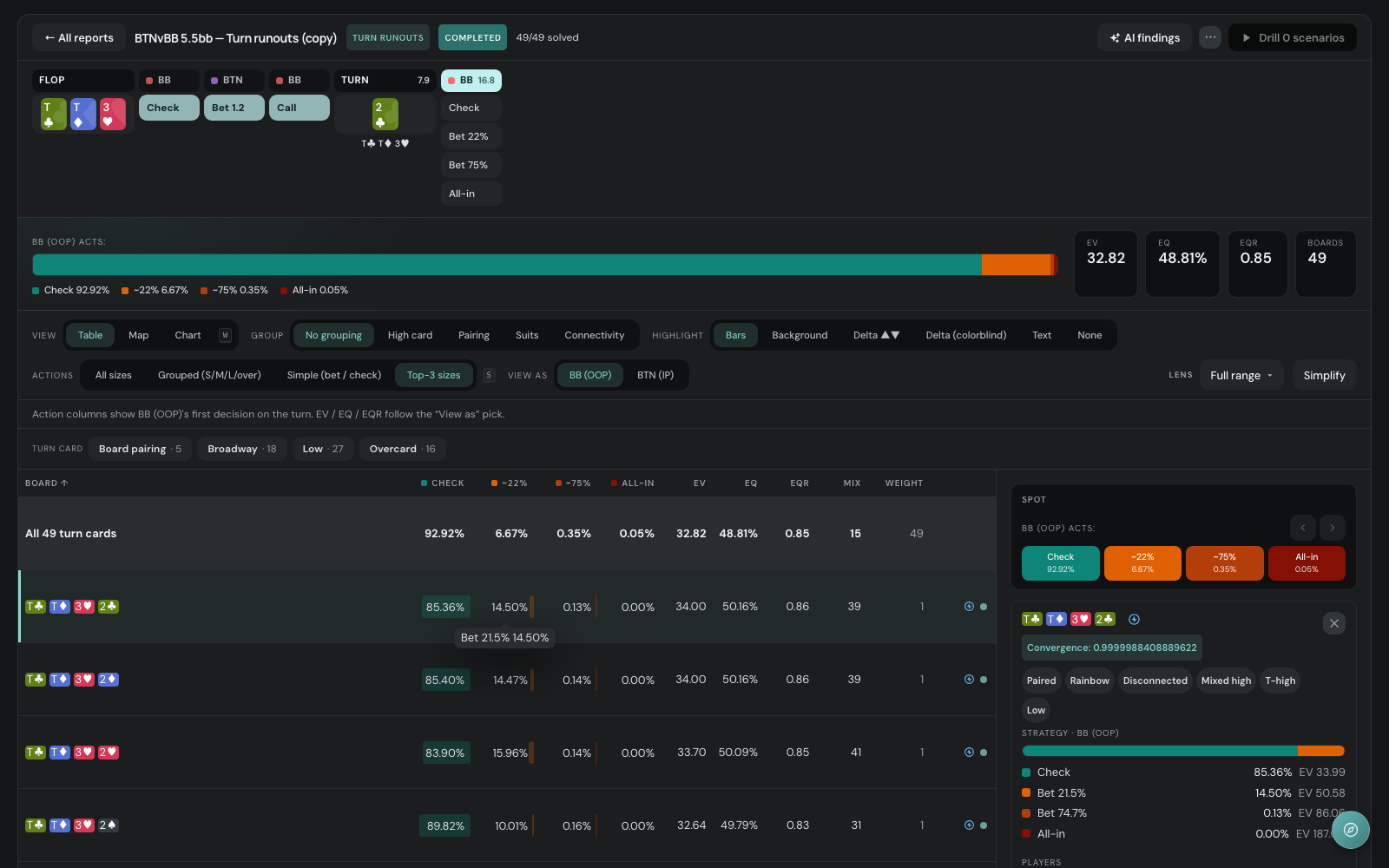
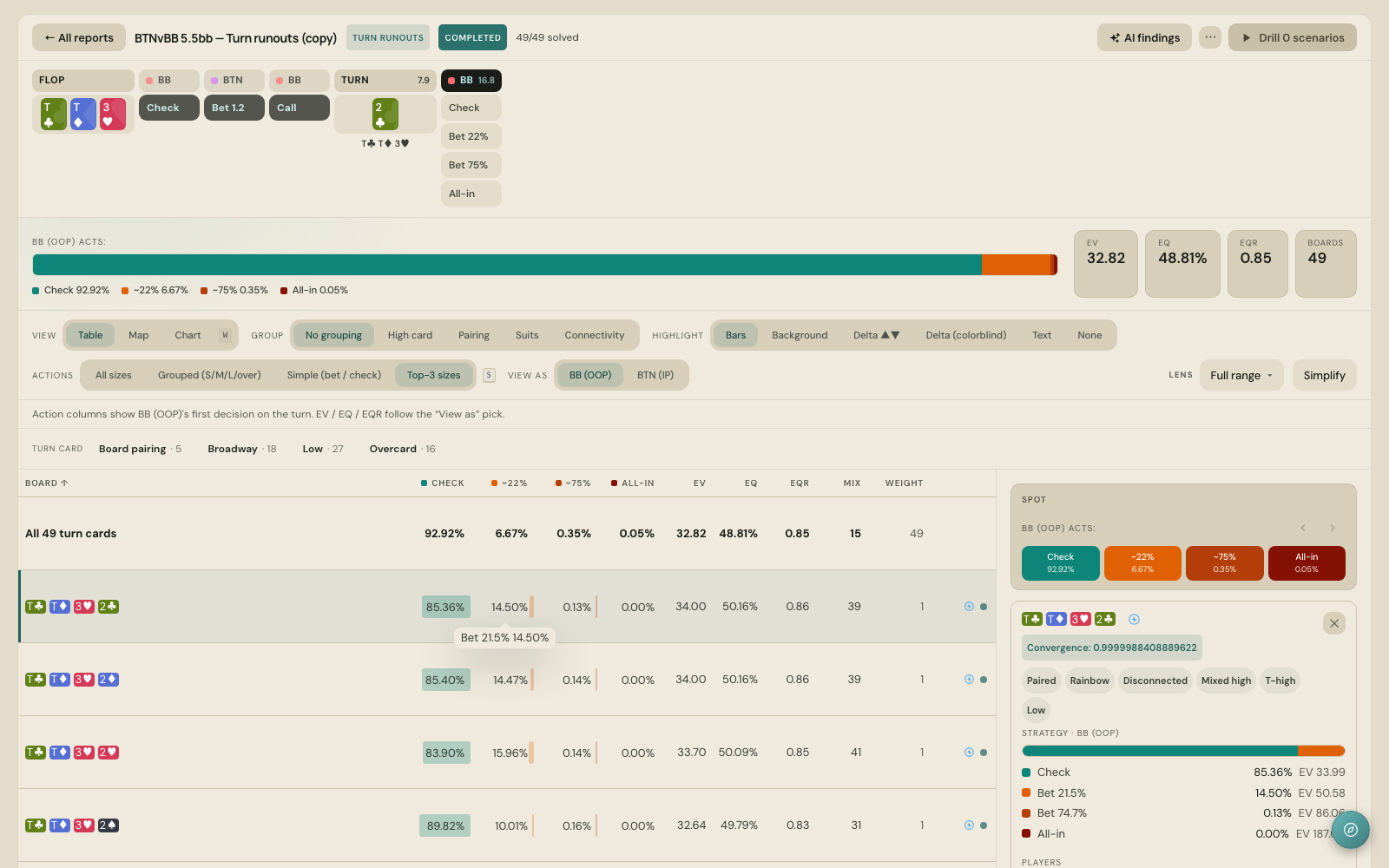
4 free tools, no account
three of them are linked from the articles/tools/equity-calculatorVariance CalculatorHow deep a downswing is normal./variance-calculatorBreakeven CalculatorRisk / (risk + reward), solved./breakeven-calculatorThe reading is free. The trainer is the next step.
Every article ends in the tool it describes. When you want the solver to grade your own decisions, start the 3-day trial: full Premium access, a reminder email 24 hours before the first charge, and cancel in 2 clicks with no fee.