
Texas Hold’em rules and positions: how a hand actually works
 Jan Przysucha
Founder of Poker Academy. Writes the product guides and updates on this blog.
Updated· first published ~9 min read
This is lesson 1 of the Poker Academy study path. It covers one thing: what actually happens in a hand of No-Limit Texas Hold’em, and why the seat you are sitting in changes what you should do with the same two cards.
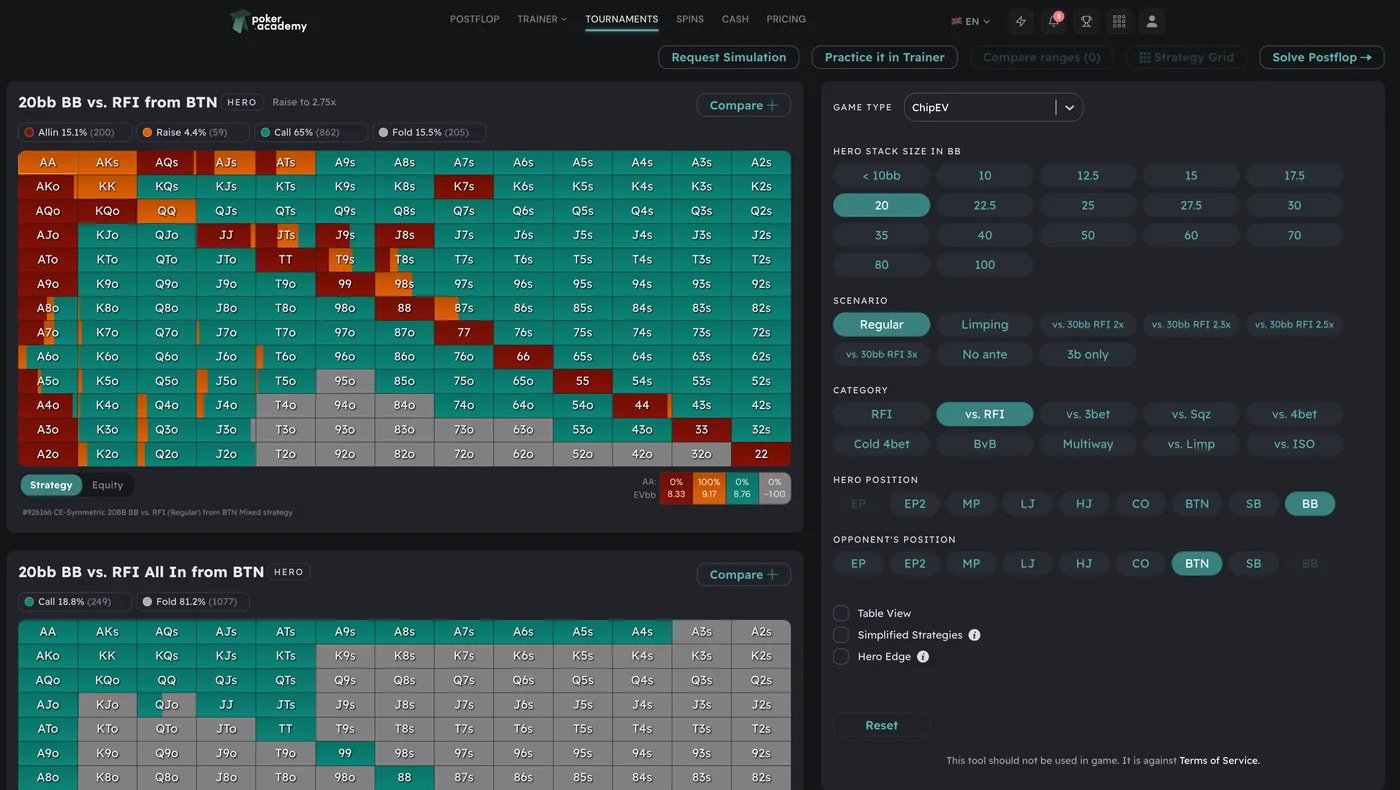
I’ll use the app’s own tables for the pictures, because the numbers on them are real: the pot, the stacks, the seat names and the solver’s answer are the same ones you’ll see when you open a spot yourself.
The goal of a hand
You get two private cards. Up to five shared cards go face up in the middle. At the end you make the best five-card hand out of your two cards and the five shared ones. You can use both of your cards, one of them, or neither.
Which five-card hands beat which is a separate lesson: poker hand rankings. Everything below assumes you know that a flush beats a straight.
Having the best hand is not what wins the money. You win what is in the middle, either by being called at the end with the best hand or by betting enough that everyone else folds.
Before any cards: the button, the blinds and the ante
One seat holds the dealer button. It moves one seat to the left after every hand, so everybody takes every seat in turn.
The two seats immediately to the left of the button put money in before they see anything:
- the small blind (SB) posts half a big blind in every structure in this article,
- the big blind (BB) posts one big blind.
Stacks in poker are counted in big blinds, not in chips. A 5,000-chip stack at 25/50 is 100bb. Every number in this article is in big blinds for that reason: it makes a $25 table and a $2,000 table the same problem.
Tournaments usually add an ante on top of the blinds. Two formats exist and they are not the same thing:
- Standard ante: every player at the table posts a small amount, and the dealer collects all of them.
- Big-blind ante: only the player in the big blind posts, but they post the whole table’s ante in one go, usually one big blind. The total in the middle is the same; it just saves time.
So a 9-handed tournament table with a 1bb big-blind ante starts every hand with this much already in the pot, before anyone has decided anything:
Starting pot, 9-handed MTT with a 1bb big-blind ante
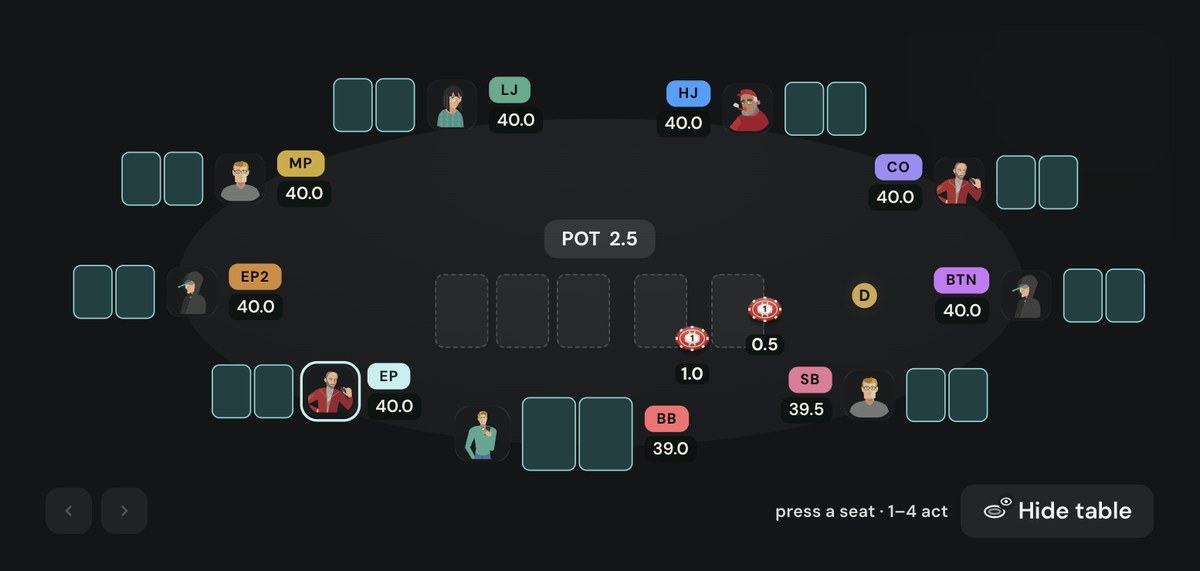
Cash games are usually played without an ante, so the pot starts at 1.5bb instead. That single difference changes how many hands are worth playing, which is why the charts further down are labelled with the format.
The four betting rounds
A hand has four betting rounds, and cards arrive between them.
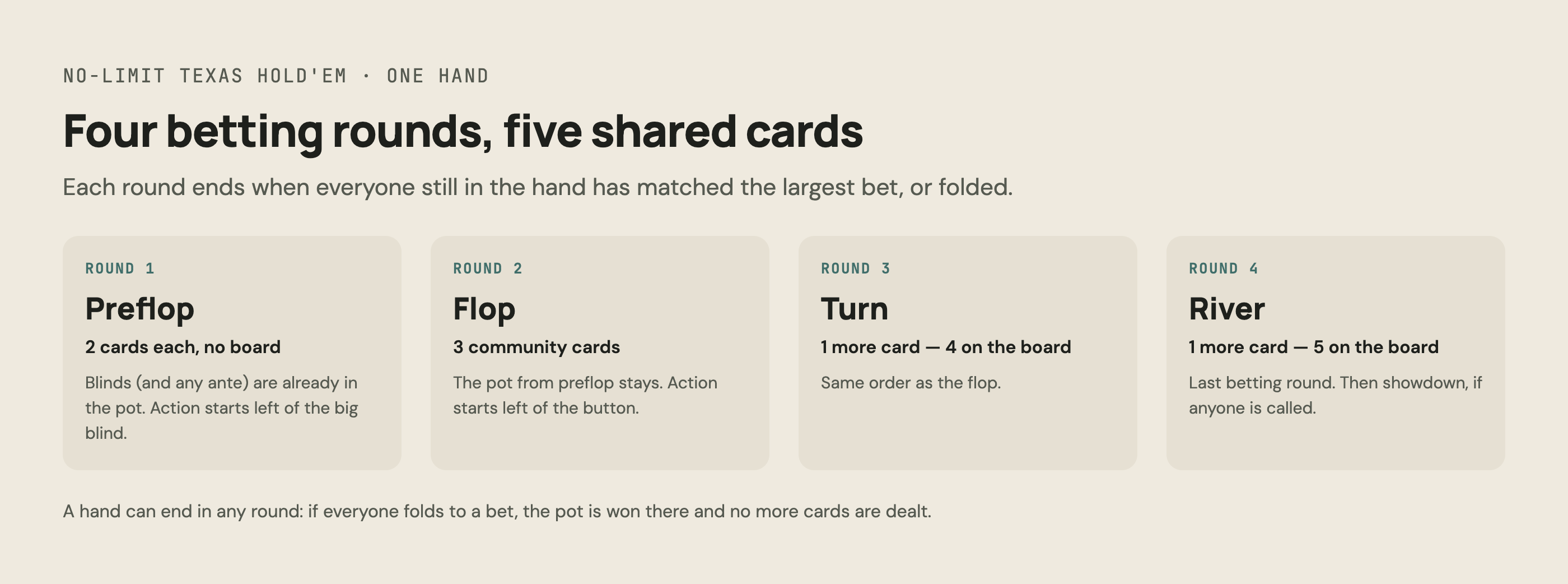
You will hear the rounds called streets. “Preflop” and “first street” mean the same thing.
What you can actually do
On your turn you have a small, fixed set of options. Which ones are available depends only on whether somebody has already bet in this round.
Nobody has bet yet:
- Check: put in nothing and pass the turn. It costs you nothing and you stay in the hand.
- Bet: put chips in. Everyone after you now has to match them, raise, or fold.
Somebody has bet:
- Fold: throw the hand away. You lose whatever you already put in, and nothing more.
- Call: match the largest bet.
- Raise: put in more than the largest bet.
- All-in: push your whole stack. “No-Limit” means you may do this at any point, on any street.
Preflop is the one round where nobody can check to start: the big blind counts as a bet, so the first player to act is already facing 1bb. That is why the first voluntary action is called an open or a raise first in, and why the big blind is the only seat that gets to check preflop when everyone just calls.
The round ends when every player still in the hand has either folded or put in the same amount.
The min-raise rule
You can bet or raise as much as you like, up to your stack. There is only a floor: a raise has to be at least as big as the last bet or raise before it.
Play this spot instead of reading about it
Start Free TrialThe trainer deals the situations this article describes and grades every decision you make. Try it free for 3 days.
Take the spot below: 6-max cash, 100bb, the big blind is 1bb and the cutoff has raised to 2.5bb. The raise increment was 1.5bb, so the smallest legal re-raise is 4bb:
Minimum re-raise over a 2.5bb open
The app offers 7.5bb there, not 4bb. That is a strategy choice; the rule only says 4bb or more.
One exception worth knowing: if a player goes all-in for less than a full raise, that is always allowed, but it may not reopen the betting for players who have already acted.
How big is the pot?
The pot is just the sum of everything put in so far. Same spot, 6-max cash, no ante, and the cutoff has opened to 2.5bb:
Pot after a 2.5bb open, 6-max cash, no ante
The button is now deciding whether to put 2.5bb in. The price of that call is the call itself divided by what the pot will be after the call. The call is part of the denominator, and forgetting that is the most common beginner mistake here:
Pot odds for the button
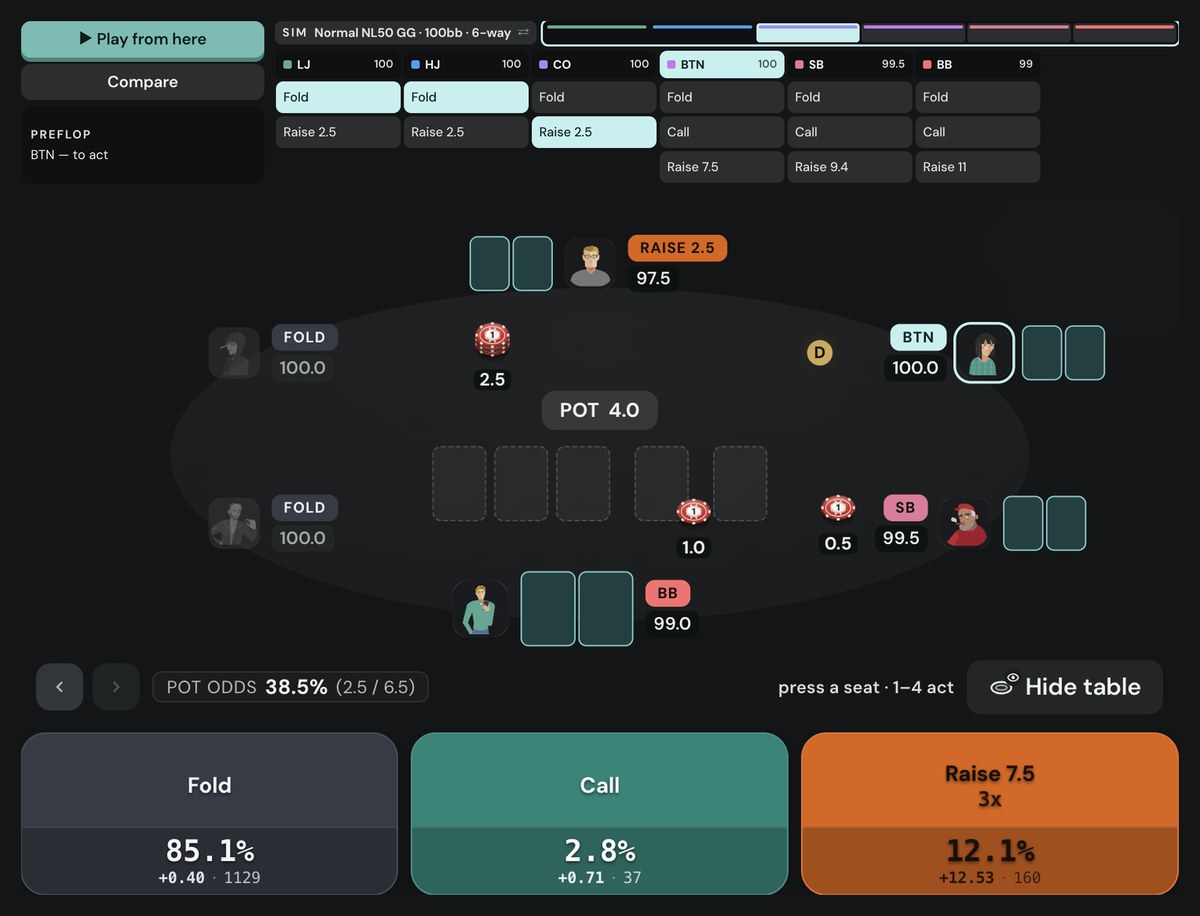
That 38.5% is not the equity you need to win at showdown, because there are still three streets to play. It is the break-even number for the immediate call, and it’s the starting point for everything in basic poker math.
For the record, the solver folds the button 85.1% of the time here, calls 2.8% and raises to 7.5bb with 12.1%. Even with position and the best seat at the table, most hands are not worth 2.5bb.
Showdown and split pots
If two or more players are still in after the river betting round, the cards go face up and the best five-card hand wins. If everyone folds before that, the last player standing wins without showing anything.
Pots get split when the best five-card hands are exactly equal. Suits never break a tie in Hold’em, so A♠︎K♦︎ and A♥︎K♣︎ on a board where no flush is possible are the same hand and split the pot. It can also happen that the five shared cards are the best hand for everyone. That is called playing the board, and everyone still in splits.
The seats and their names
Positions are named by how far you are from the button. Poker Academy uses these names, from the first seat to act preflop to the last:
- 9-handed: EP, EP2, MP, LJ, HJ, CO, BTN, SB, BB.
- 6-max: LJ, HJ, CO, BTN, SB, BB. The same list with the three earliest seats removed.
LJ is the lojack, HJ the hijack, CO the cutoff, BTN the button. You will see “UTG” used elsewhere for the first seat; this product calls it EP, and EP2 for the one after it.
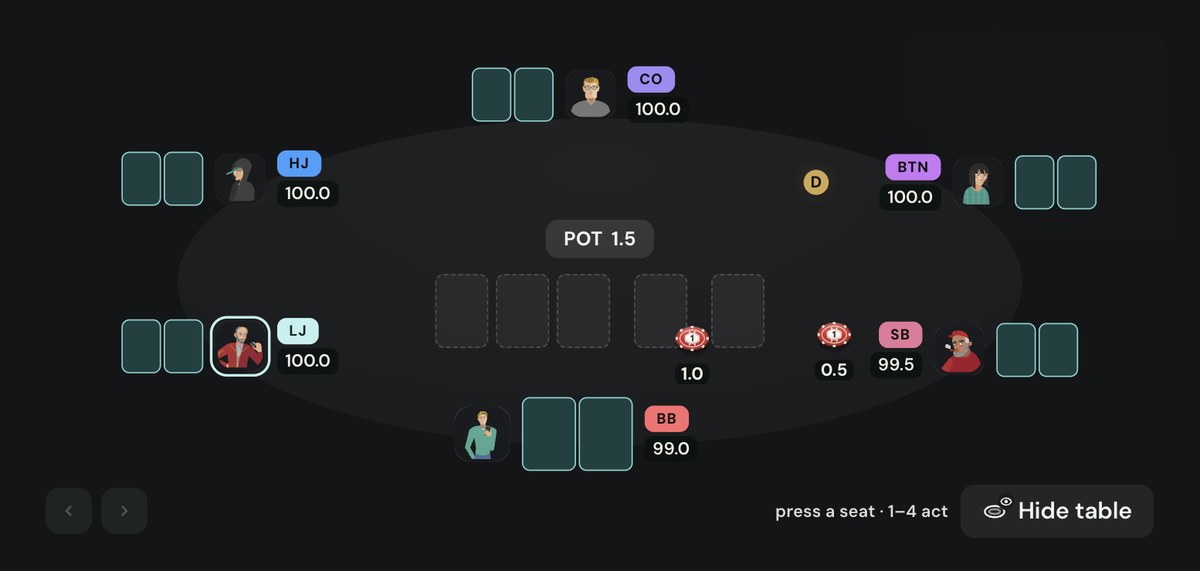
Compare it with the 9-handed table above: the button, the blinds and the rules are identical. Only the number of players between you and the blinds changes, and that is what all the strategy below is about.
Why acting last is worth so much
The action moves clockwise. Preflop it starts to the left of the big blind, so the blinds speak last. From the flop onwards it restarts to the left of the button, so the button speaks last on every remaining street.
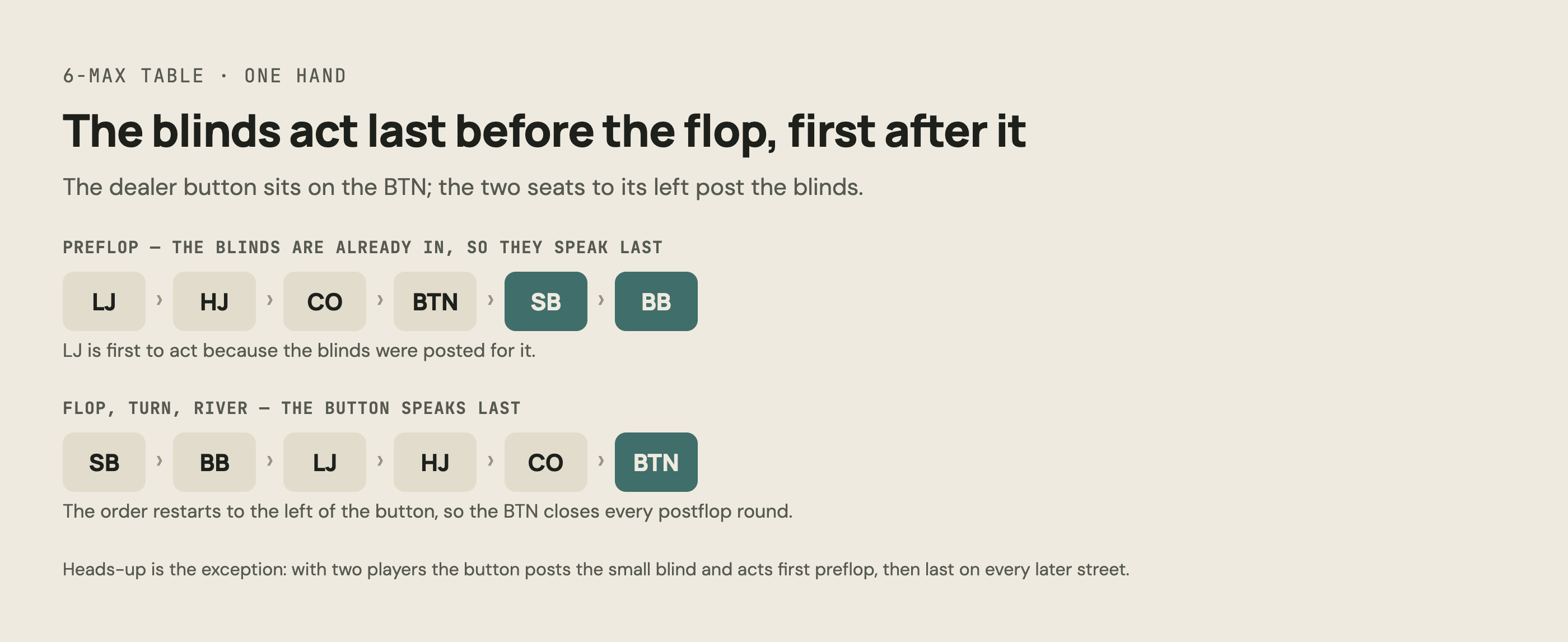
Acting last means you make three of your four decisions already knowing what everyone else did. That is worth real money, and you can measure it: this is how many of the 1,326 possible starting hands the solver plays from each seat when the action folds to it.
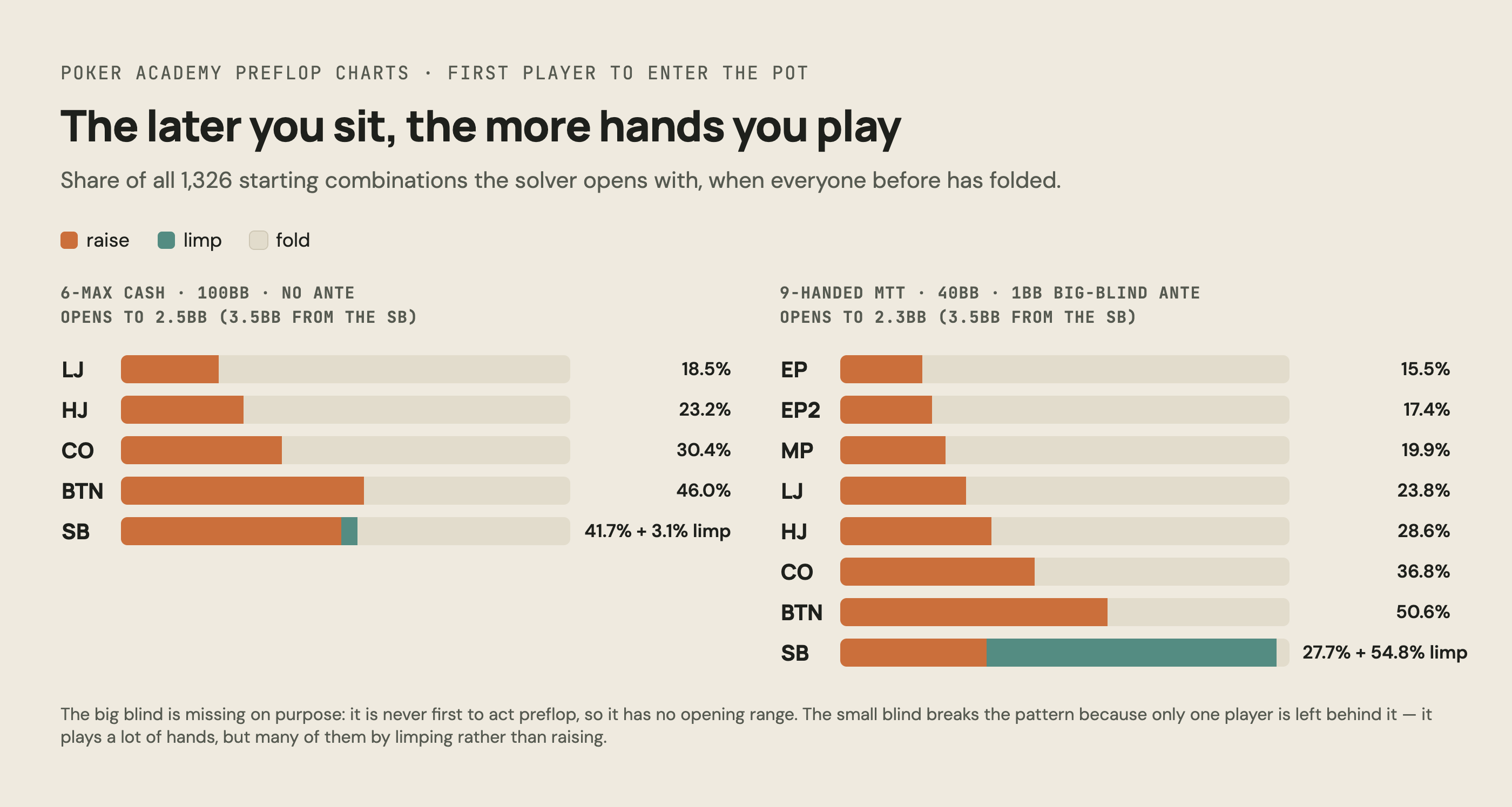
In the 6-max cash game the button opens 46.0% of all hands and the lojack opens 18.5%. That is two and a half times as many hands from the same cards, purely because of where the chips are sitting. The 9-handed tournament chart says the same thing over a longer ladder: 15.5% from EP, 50.6% from the button.
Two reasons, and they are separate ones. Fewer players are left behind you, so your raise is less likely to run into a better hand. And if you do get called, you will be the one acting last for the rest of the hand.
The small blind is the odd one out. Only one player is left behind it, so it plays a lot of hands, and it is still out of position on every later street. That is why so much of its range is a limp rather than a raise.
Heads-up: the one exception
When only two players are left, the positions flip. The button posts the small blind, the other player posts the big blind, and the button acts first before the flop and last on the flop, turn and river.
It looks like a contradiction, but it follows the same rule as a full table: preflop, action starts to the left of the big blind, and with two players that seat is the button.
What to learn next
Once the mechanics are automatic, the next question is which two cards you actually want to play. That is lesson 2: starting hands, the 1,326 combinations and how to write them down. After that comes basic poker math, where the 38.5% above turns into a decision rule you can use at the table.
And whenever a rule here feels abstract, open the same spot in the app. Every table in this article is a live screen you can click through: change the seat, change the stack, and watch how many hands the solver is willing to play.
Cheers! 🙂
Keep reading
All posts
Poker Academy
Stop guessing preflop.
1,500,000+ GTO preflop solutions. Try them free for 3 days.
Start Free TrialCancel anytime.