
Poker starting hands: 1,326 combos, 169 hands, and how to write them down
 Jan Przysucha
Founder of Poker Academy. Writes the product guides and updates on this blog.
~5 min read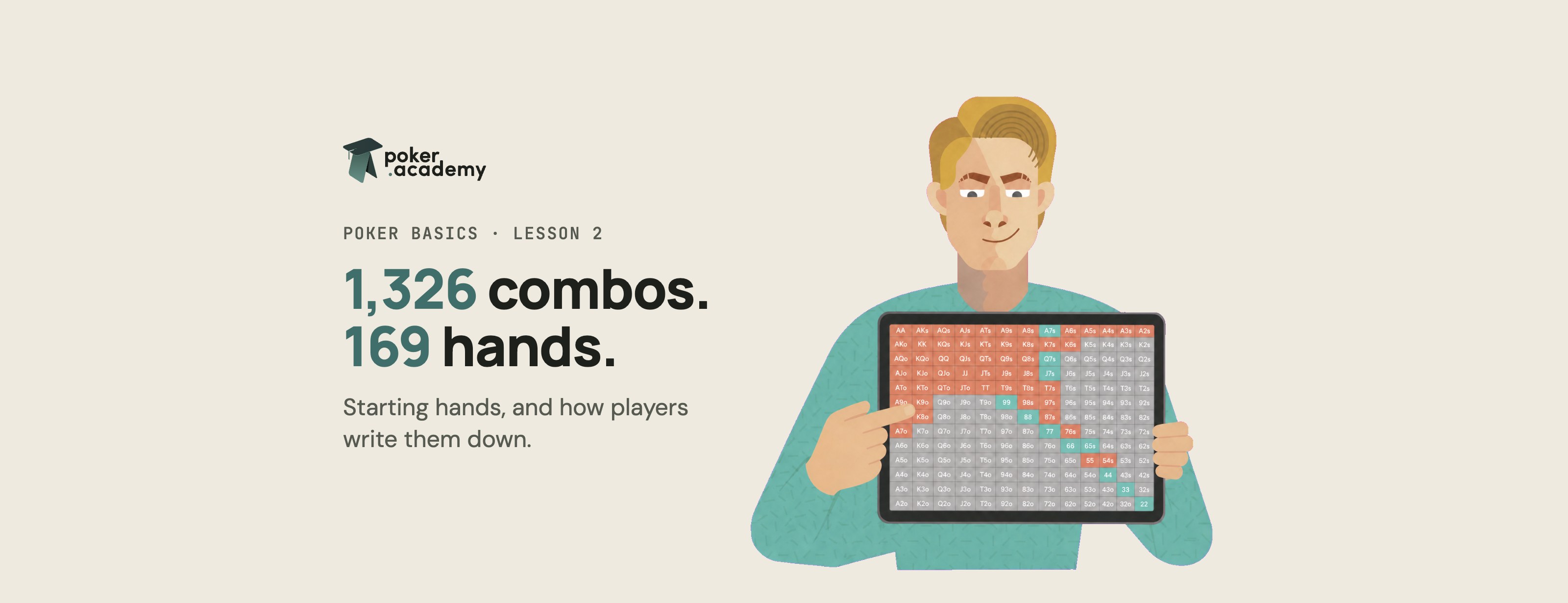
Before you can read a preflop chart, study a solver or talk about a hand with a friend, you need two things. You need to know how many different hands you can be dealt. And you need to be able to write any of them down in a few characters.
This is lesson 2 of our poker basics series. The video below covers it in three minutes. The article goes a step further: it shows the math behind every number and adds a few things we use every day in the app.
YouTubenot loaded yet
This video is on YouTube
Playing it lets YouTube set cookies on your device. Nothing is requested from YouTube until you allow it.
1,326 ways to be dealt two cards
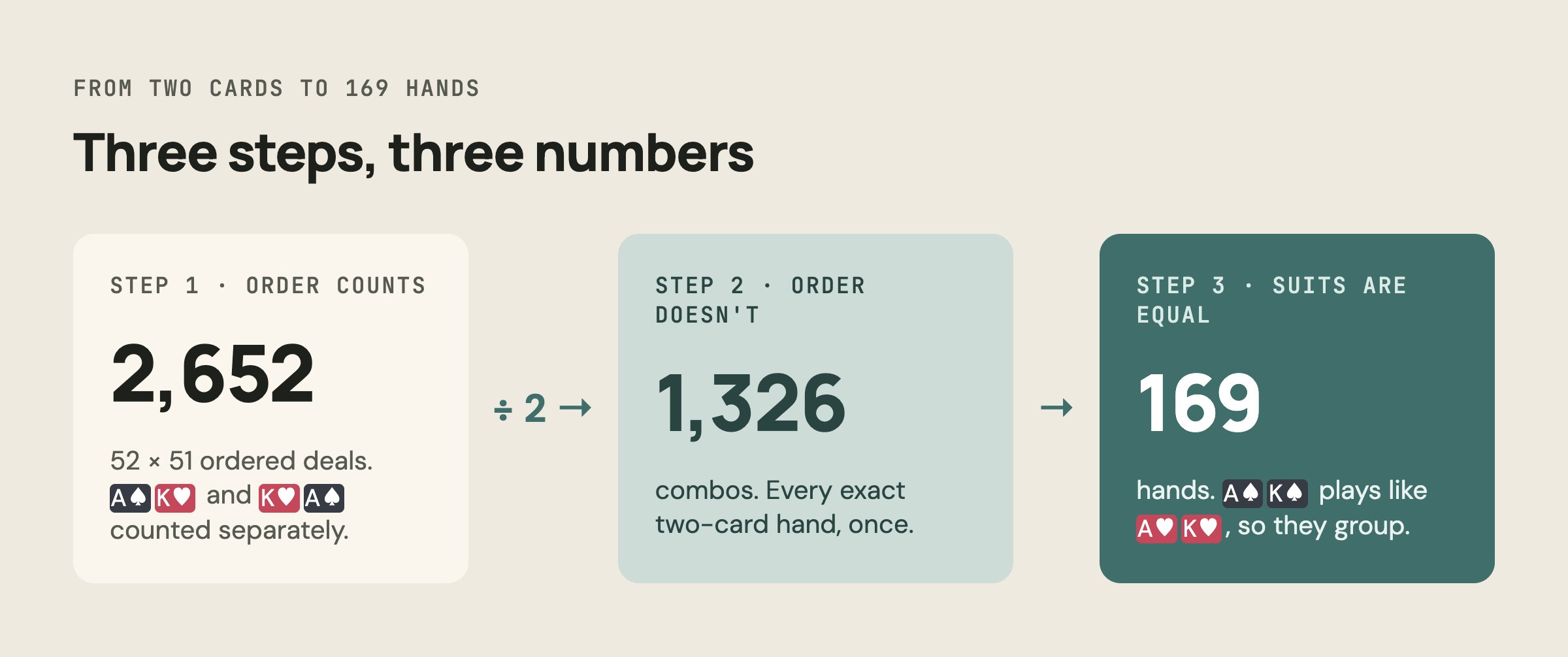
A deck has 52 cards. Your first card can be any of 52, your second any of the remaining 51. That gives 52 × 51 = 2,652 ordered pairs.
Order doesn’t matter in poker, though. A♠︎K♥︎ and K♥︎A♠︎ are the same hand, and each hand was counted twice. So we divide by two: 2,652 ÷ 2 = 1,326. That’s every distinct two-card starting hand, and it’s the number every range in poker adds up to.
1,326 is too many to think about one by one. Luckily, poker makes it easier: no suit is worth more than another. A♠︎K♠︎ and A♥︎K♥︎ play exactly the same before the flop. That lets us group combos into far fewer hands.
Unpaired hands: suited and offsuit
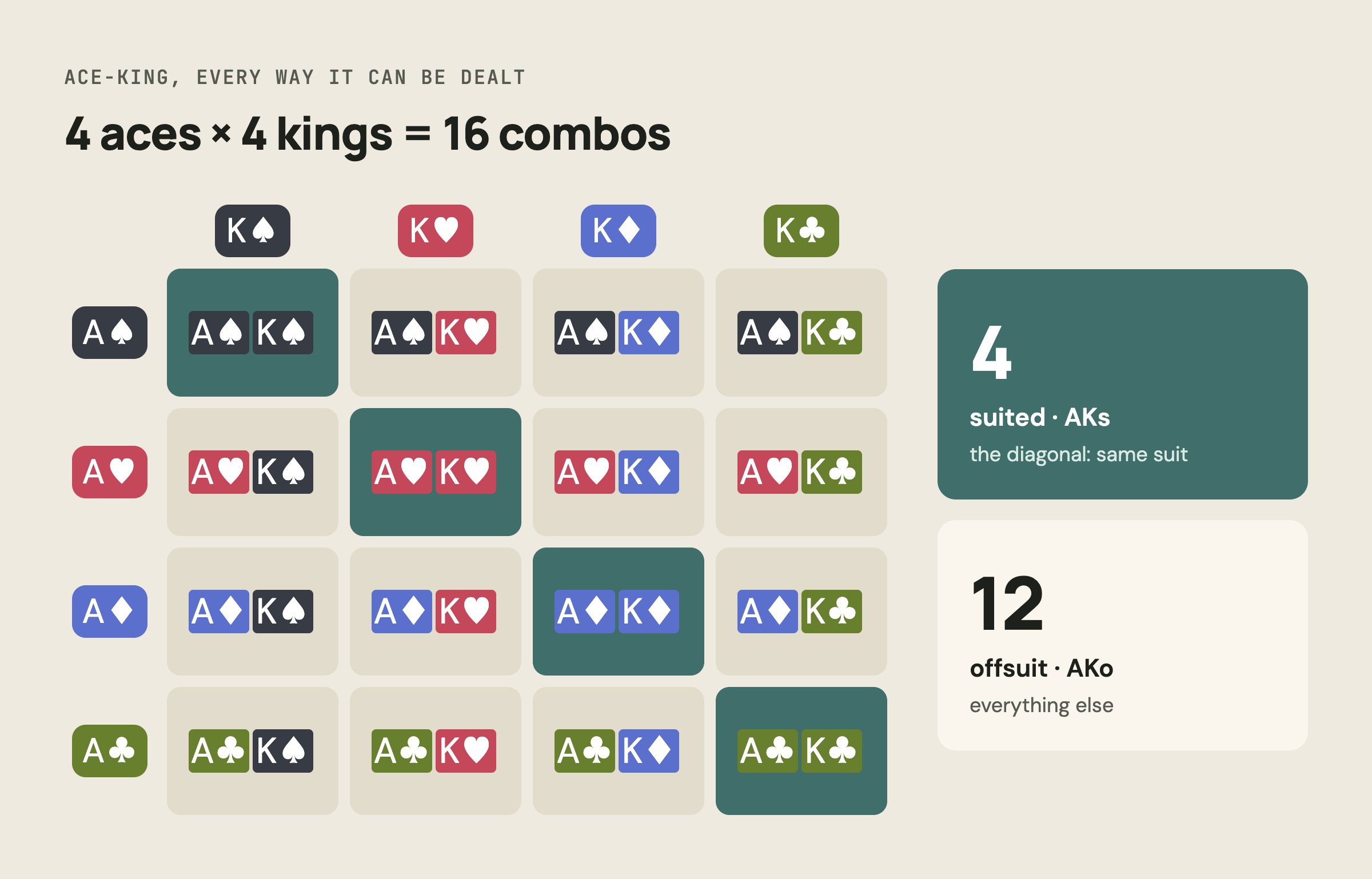
Take ace-king. There are four aces and four kings, so there are 4 × 4 = 16 ways to be dealt AK. They split into two groups that play differently:
- Suited – both cards share a suit (A♠︎K♠︎, A♥︎K♥︎, A♦︎K♦︎, A♣︎K♣︎): 4 combos.
- Offsuit – different suits (A♠︎K♥︎, A♠︎K♦︎ and so on): 16 − 4 = 12 combos.
Suited hands are stronger because they make flushes more often. How much more often? Here’s the count for all five board cards:
- Suited: 11 cards of your suit are left among the 50 unseen cards. You need at least 3 of them on the board: C(11,3)·C(39,2) + C(11,4)·39 + C(11,5) = 122,265 + 12,870 + 462 = 135,597 boards out of C(50,5) = 2,118,760. That’s 6.40%.
- Offsuit: each of your two suits has 12 cards left, and you need 4 of them on the board: 2 × (C(12,4)·38 + C(12,5)) = 2 × 19,602 = 39,204 boards. That’s 1.85%.
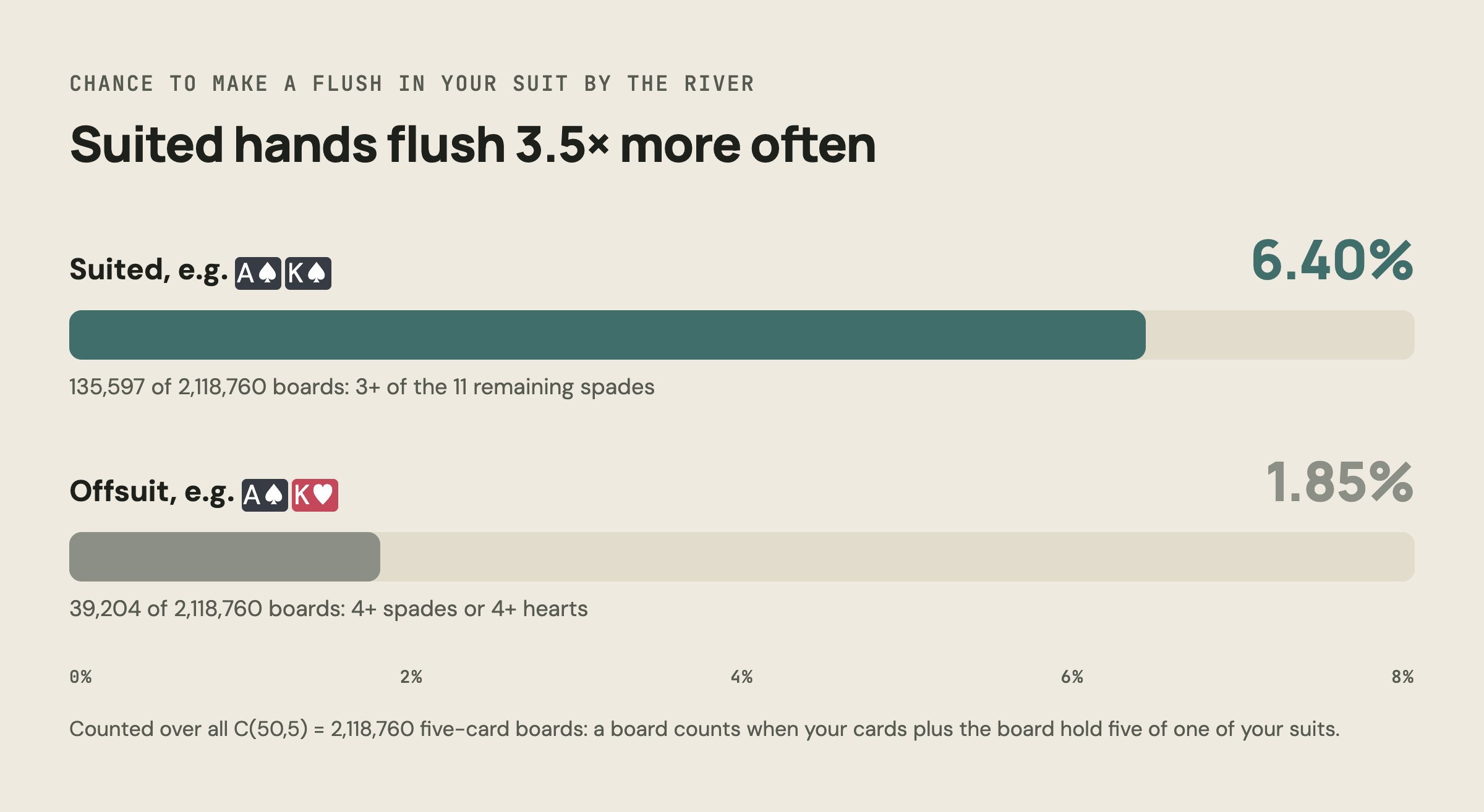
The same 4 + 12 split works for every unpaired hand, from AK down to 32.
Pairs: 6 combos
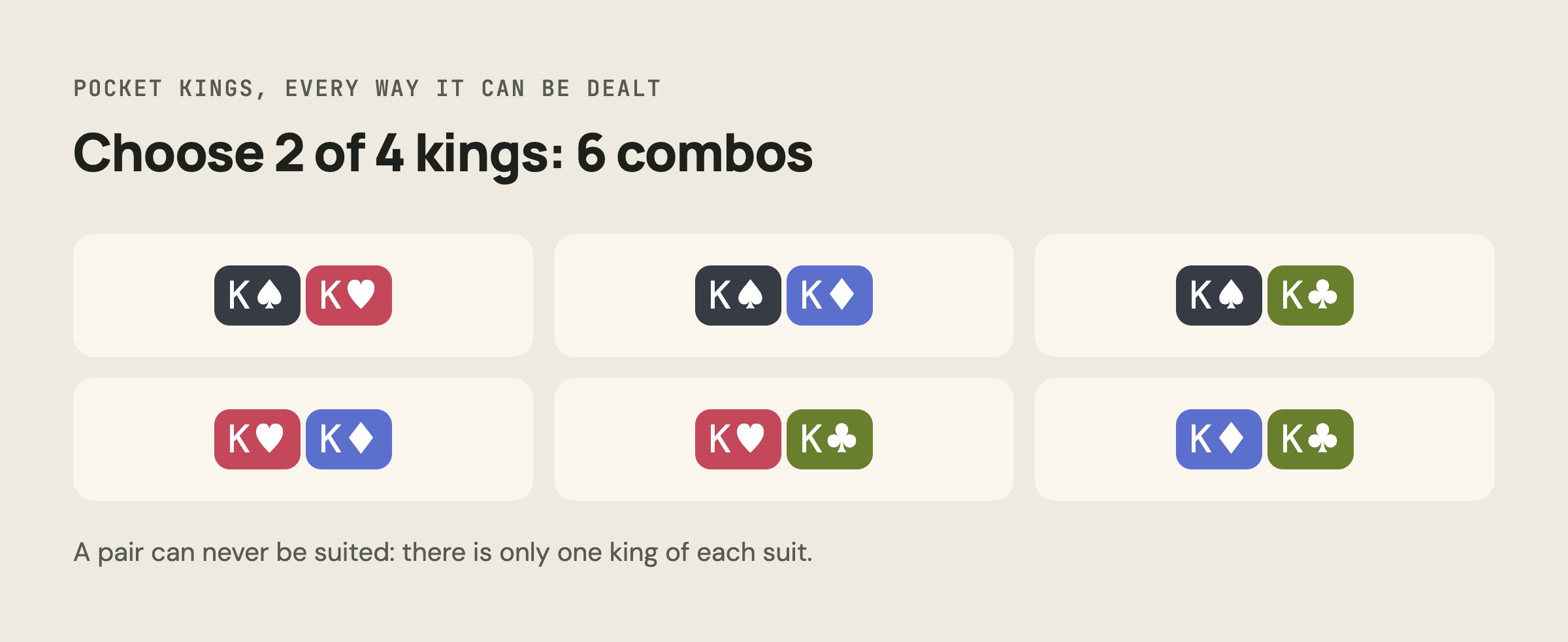
A pair needs two cards of the same rank, so it can never be suited. There are four kings, and you choose two of them: C(4,2) = 6 combos (K♠︎K♥︎, K♠︎K♦︎, K♠︎K♣︎, K♥︎K♦︎, K♥︎K♣︎, K♦︎K♣︎).
Play this spot instead of reading about it
Start Free TrialThe trainer deals the situations this article describes and grades every decision you make. Try it free for 3 days.
169 starting hands
Put it together and 1,326 combos collapse into 169 hands:
| Type | Hands | Combos each | Combos total |
|---|---|---|---|
| Pairs | 13 | 6 | 78 |
| Suited | 78 | 4 | 312 |
| Offsuit | 78 | 12 | 936 |
| Total | 169 | 1,326 |
Why 78? There are 13 ranks, and an unpaired hand is any two different ranks: C(13,2) = 78. Each of those 78 exists once as suited and once as offsuit.
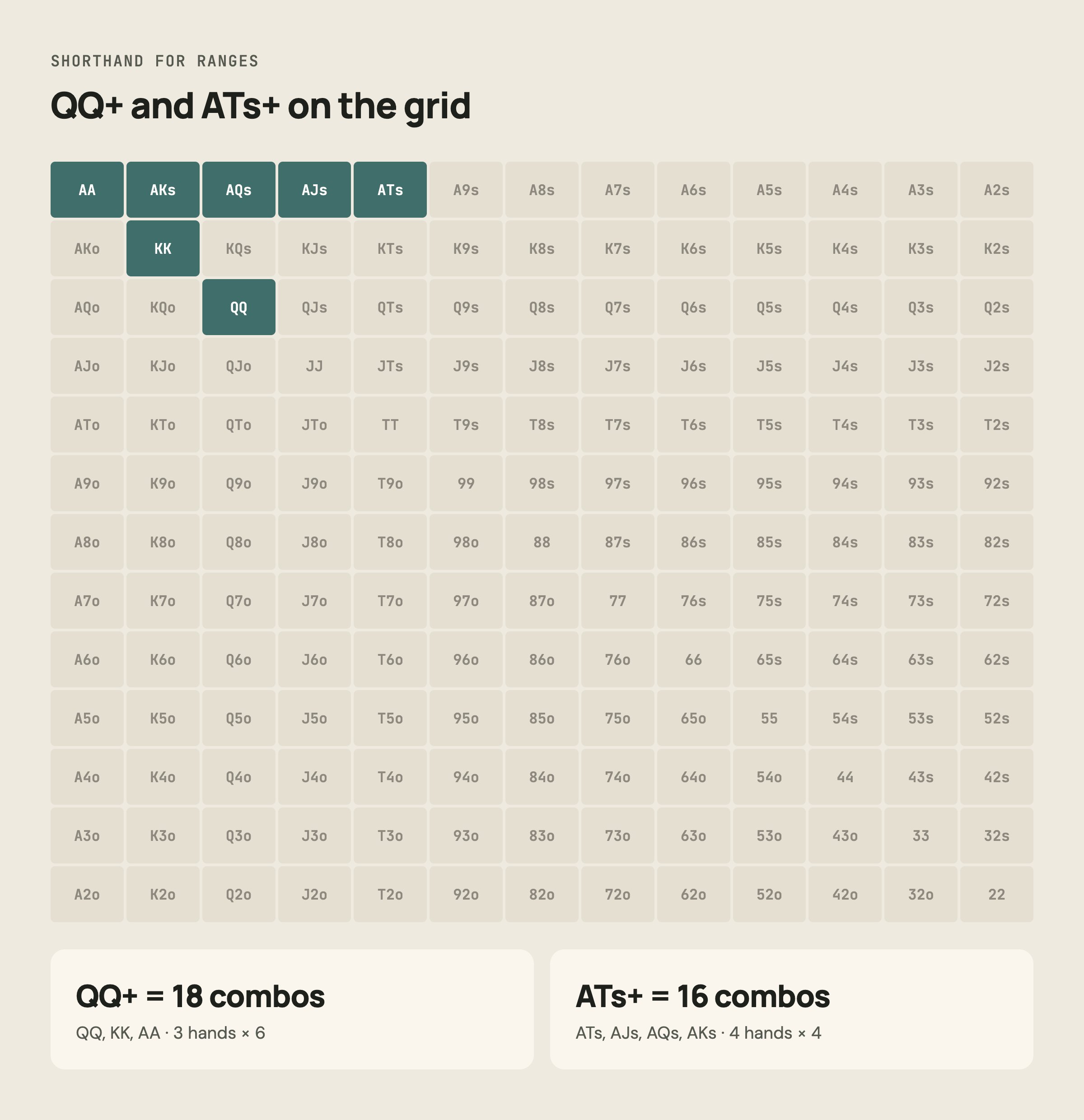
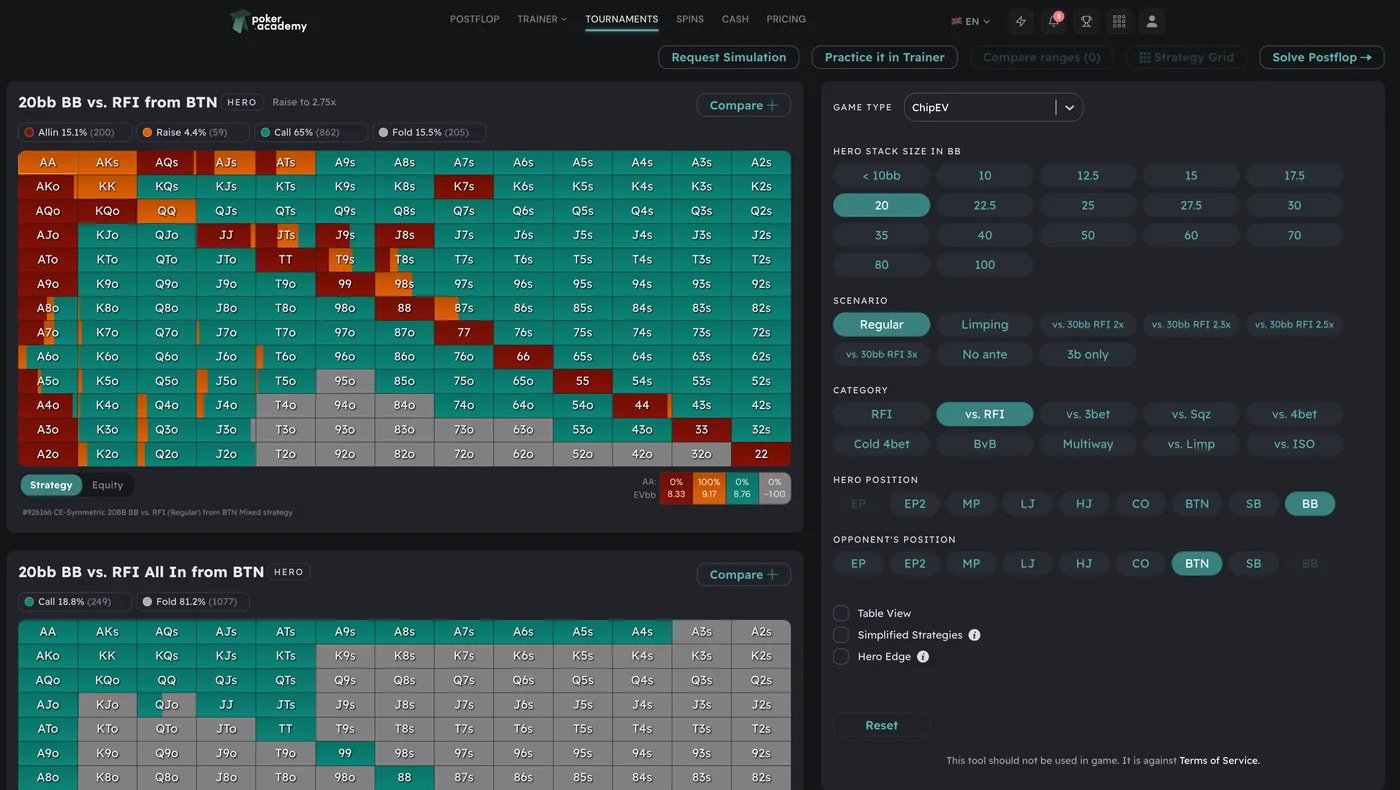
This is the 13×13 grid you see in every preflop chart, including ours. Pairs run down the diagonal, suited hands sit above it, offsuit hands below:
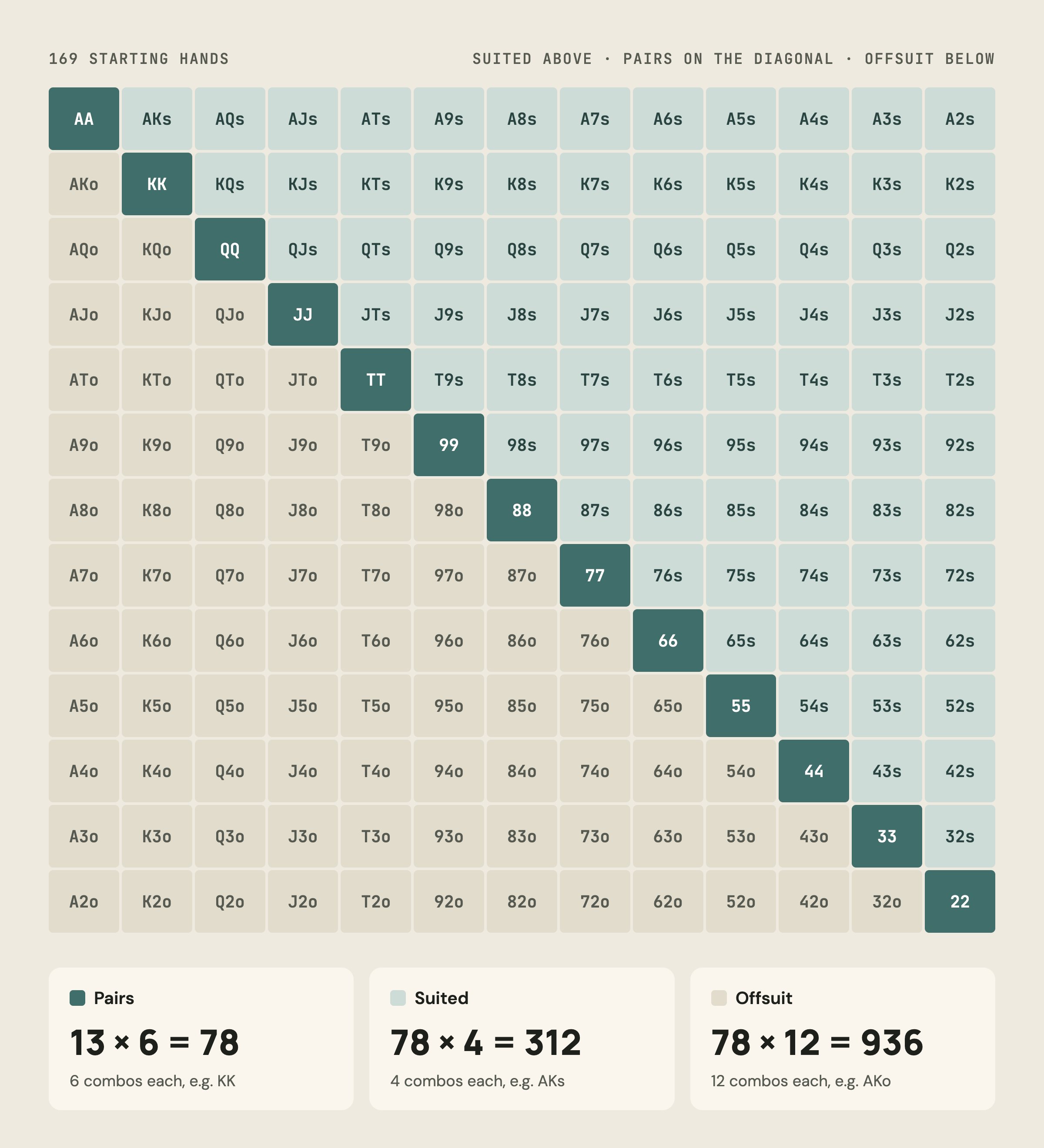
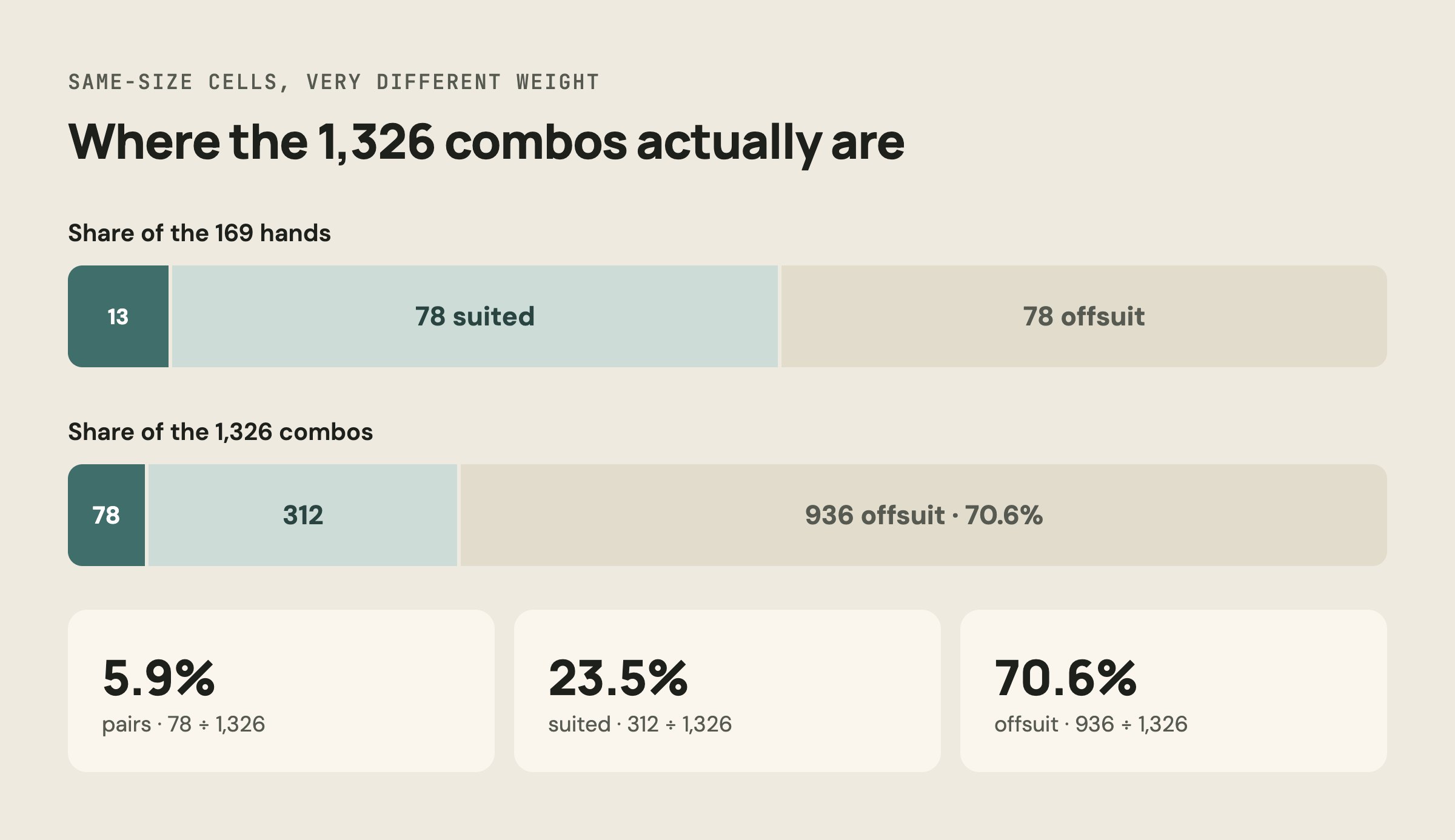
One thing to keep in mind when you read a chart: every cell looks the same size, but they don’t hold the same number of combos. AKo is 12 combos, AKs is 4. A chart that’s “half suited hands” is a lot less than half of all combos.
How to write hands down
Ranks
Ace, king, queen and jack are written with their first letter. Ten is T, so every card is exactly one character. The rest use their number.
| Card | Written as |
|---|---|
| Ace | A |
| King | K |
| Queen | Q |
| Jack | J |
| Ten | T |
| Nine to two | 9 … 2 |
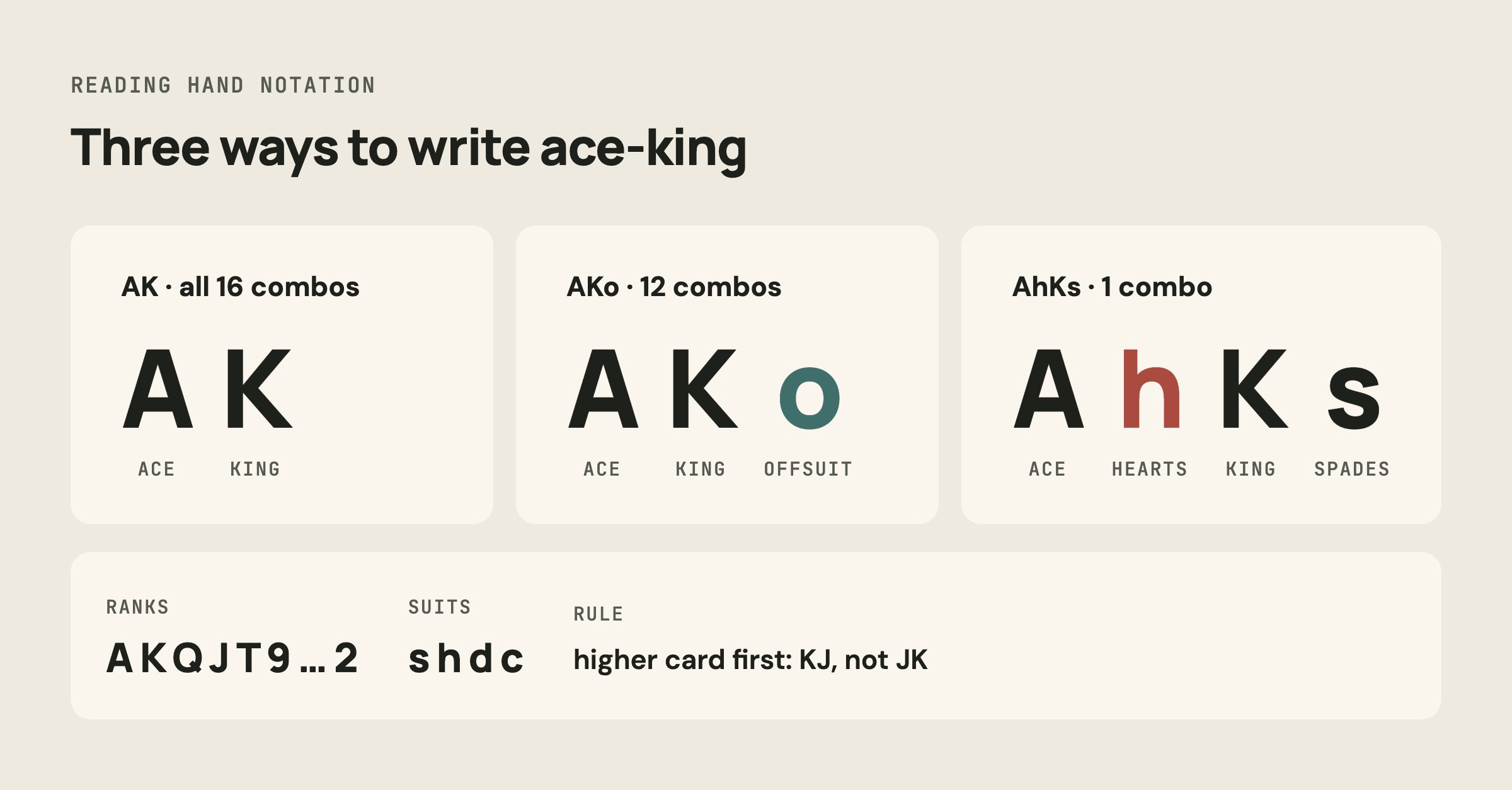
Always write the higher card first: KJ, not JK. 96, not 69.
Suits
To name exact cards, add a lowercase suit letter after each rank: s spades, h hearts, d diamonds, c clubs. Ace of hearts and king of spades is AhKs. Nine of clubs and six of diamonds is 9c6d.
Suited or offsuit
When the exact suits don’t matter, add s or o at the end of the hand. Don’t confuse this s with spades: it comes after both cards, not after one card.
| You write | It means | Combos |
|---|---|---|
| AK | All ace-king | 16 |
| AKs | Ace-king suited | 4 |
| AKo | Ace-king offsuit | 12 |
| AcKc | Ace of clubs, king of clubs | 1 |
| KK | Pocket kings | 6 |
Two things to use right away
Ranges in shorthand
A plus sign means “this hand and everything stronger of the same kind”:
- QQ+ = QQ, KK, AA → 3 × 6 = 18 combos
- ATs+ = ATs, AJs, AQs, AKs → 4 × 4 = 16 combos
- 22–66 = every pair from twos to sixes → 5 × 6 = 30 combos
Your cards change the count
Combo counts assume you don’t know any cards. As soon as you look at your hand, some combos are gone. Say you hold A♠︎Q♦︎:
- Your opponent can have AA only 3 ways instead of 6 – three aces are left, and C(3,2) = 3.
- AK drops from 16 to 12 combos (3 aces × 4 kings).
- If you held A♠︎K♦︎ instead, their AK would drop to 9 combos (3 × 3).
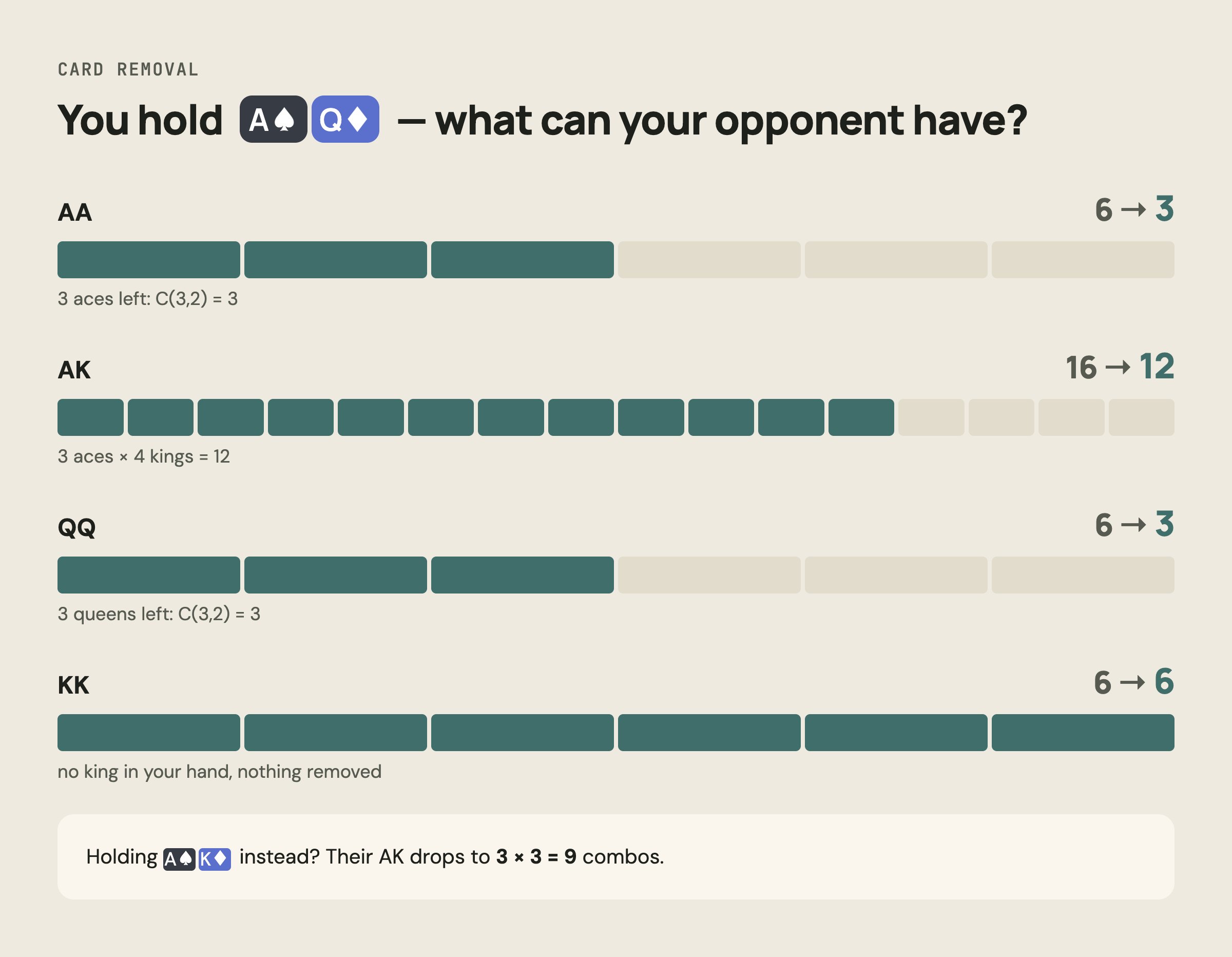
This is called card removal, or blockers, and it’s the reason solvers talk about combos rather than hands. We’ll come back to it later in the series.
Quick recap
- 52 × 51 ÷ 2 = 1,326 starting combos.
- Unpaired hands: 4 suited + 12 offsuit = 16 combos. Pairs: 6.
- 13 pairs + 78 suited + 78 offsuit = 169 hands in the 13×13 grid.
- Ranks: A K Q J T 9…2, higher card first. Suits: s h d c. Suited/offsuit: s or o at the end.
Next up in the series: how those 169 hands get turned into a strategy. If you want to see the grid in action now, open any spot in our preflop charts – each cell shows what the solver does with that hand. For the math side, see Introduction to Basic Poker Math.
Keep reading
All posts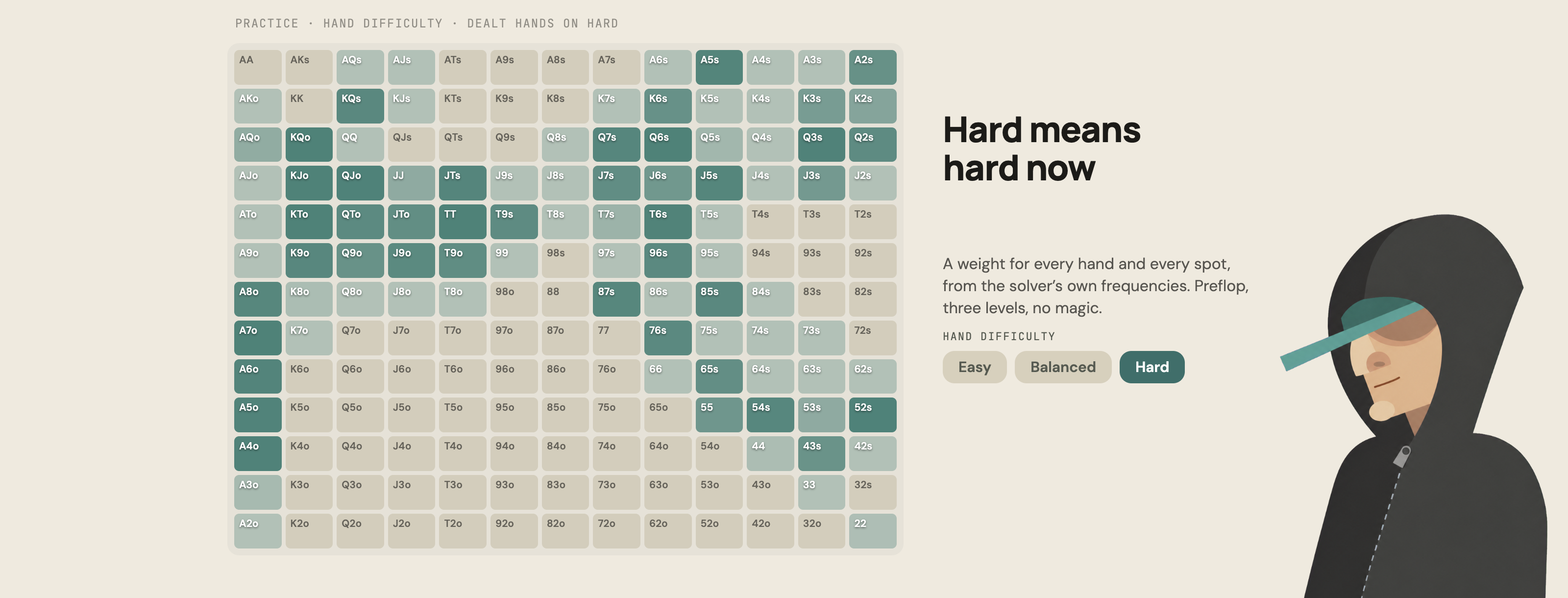
Poker Academy
Stop guessing preflop.
1,500,000+ GTO preflop solutions. Try them free for 3 days.
Start Free TrialCancel anytime.