
A poker study routine that survives tilt: review your own hands, repeat the spots, set a stopping rule
 Jan Przysucha
Founder of Poker Academy. Writes the product guides and updates on this blog.
Updated· first published ~10 min read
Your results tell you almost nothing for months at a time. I put numbers on that in the article on variance in tournament poker: in that model one winner in five is still losing after 1,000 tournaments. So if you want feedback this week instead of next year, it has to come from your decisions rather than your graph.
This is the routine I would run, and the parts of it the app does for you. It is short on purpose: a study plan you keep for six months beats a better one you drop in a fortnight.
First, find out what actually costs you money
The trainer grades every decision against the solver’s strategy for your exact hand in that exact node. The grade is just the frequency the solver plays the action you picked: 40% or more is Perfect, from 6 to 40% is Good, anything above zero is a Mistake, and exactly zero is a Blunder. A blunder is an action the solver never takes with that hand there, which is a different thing from a hand that lost.
This is every preflop decision my test account has had graded, split by that grade. 13,605 decisions, 5,116 big blinds of EV given away.
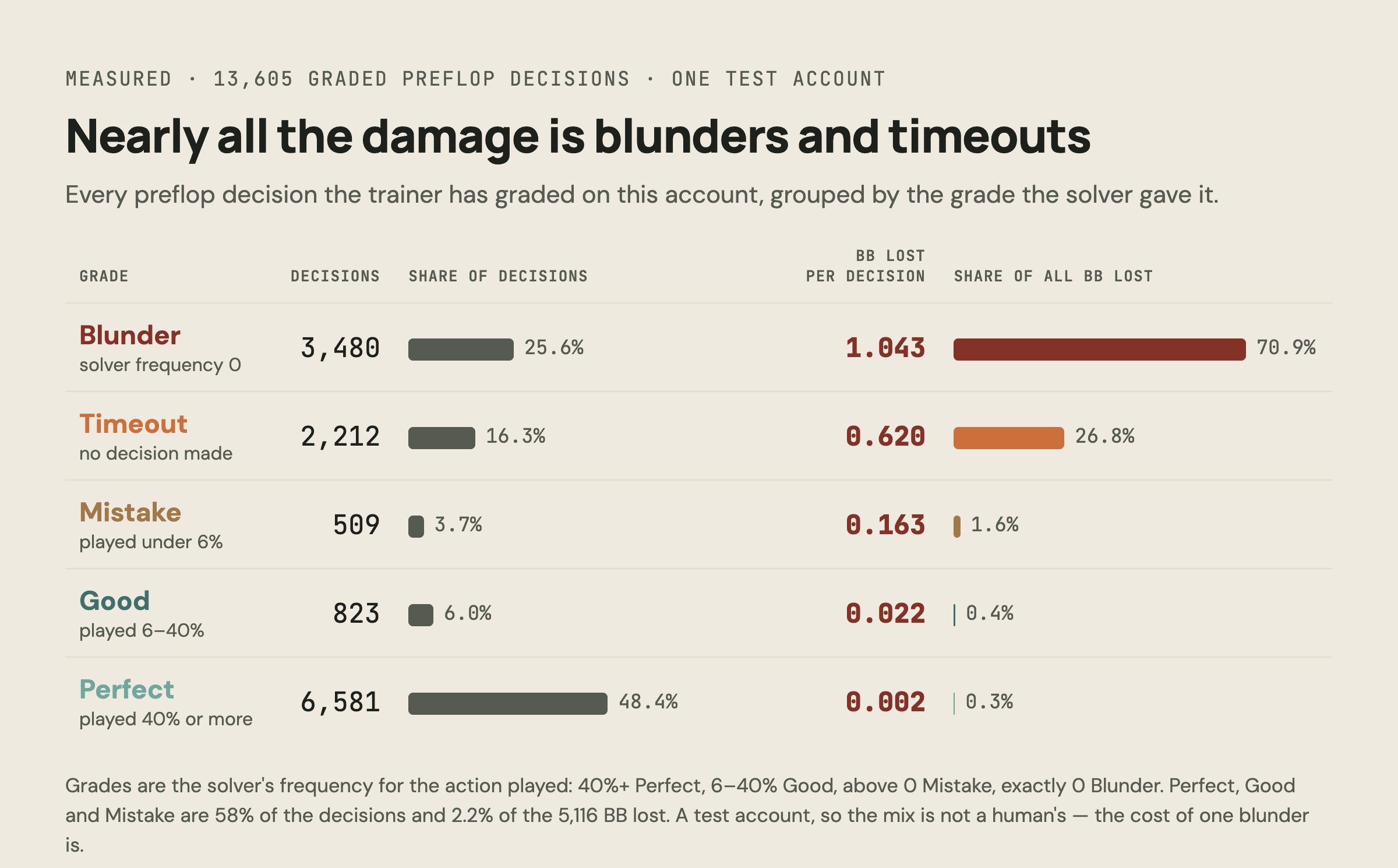
Blunders are 25.6% of the decisions and 70.9% of the damage, at 1.04 bb each. Timeouts, where the decision clock ran out and nobody acted, are another 26.8% at 0.62 bb a time. Everything else, Perfect and Good and Mistake together, is 58.2% of the decisions and 2.2% of the loss. A mistake averages 0.163 bb and a blunder 1.043, about 6 times more.
That ratio is the whole argument for how to study. Trimming mistakes is polishing; removing blunders and timeouts is the money. So the routine below is built to find those two things and nothing else. One caveat on the table itself: this is a test account, driven partly by automated testing, so the share of blunders is far higher than a real player’s. The per-decision cost is the part that transfers, because it measures the solver rather than me.
Mark the hand while you are still in it
The worst moment to decide which hands deserve review is after the session, when you remember the pots you lost and not the spots you guessed. So mark while you play. In Practice that is one key, M, and everything you mark lands in one list.
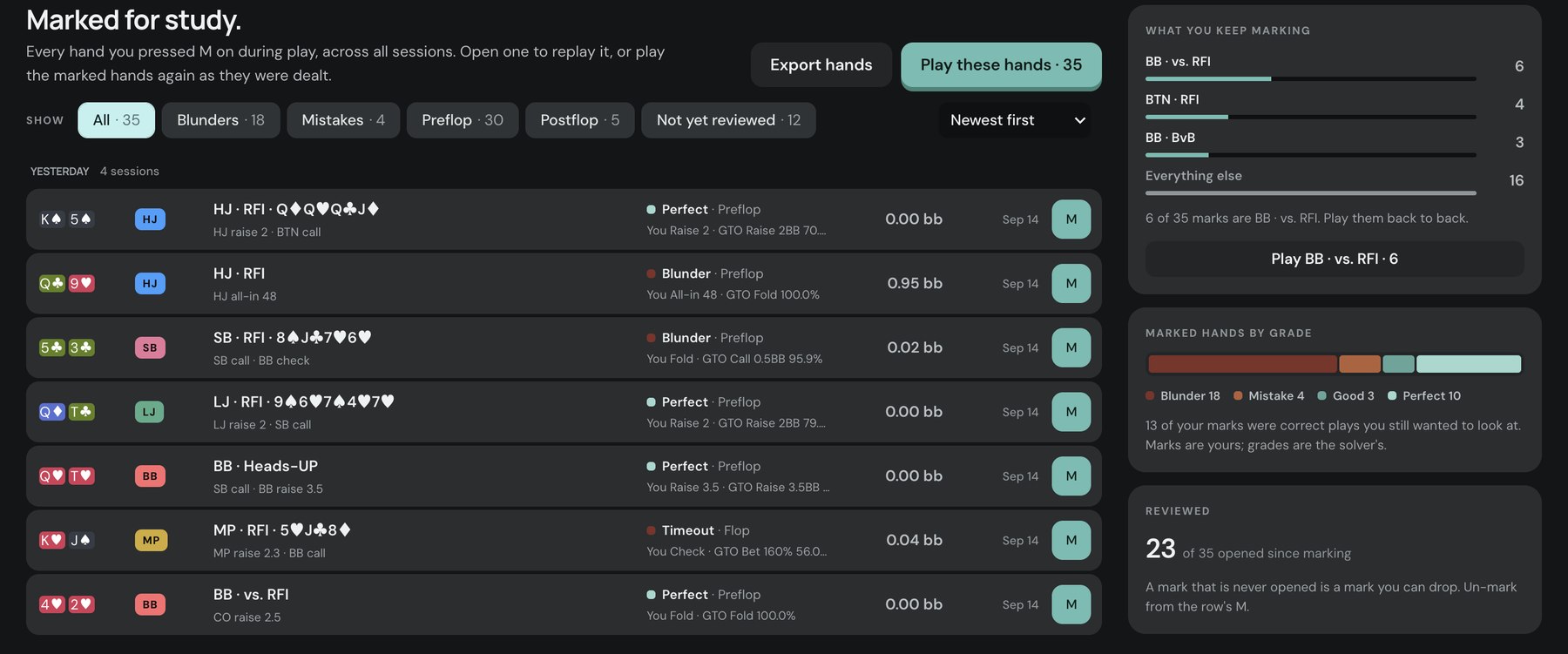
Two things on that screen matter more than the list itself.
- The grade and the mark are different facts. 13 of those 35 marks were plays the solver agreed with. I marked them because I was not sure, which is exactly the right reason to mark a hand. Marks are yours, grades are the solver’s, and a hand can be both correct and worth a second look.
- The repeats are the leak. 6 of the 35 are one spot, BB against a raise. That is one problem rather than six, and the panel offers to deal those six back to back.
Filter by “Not yet reviewed” before you start. A mark you never open is not study, it is a to-do list you are lying to yourself about.
Review the session, not the graph
After the session, the debrief already knows where the money went.
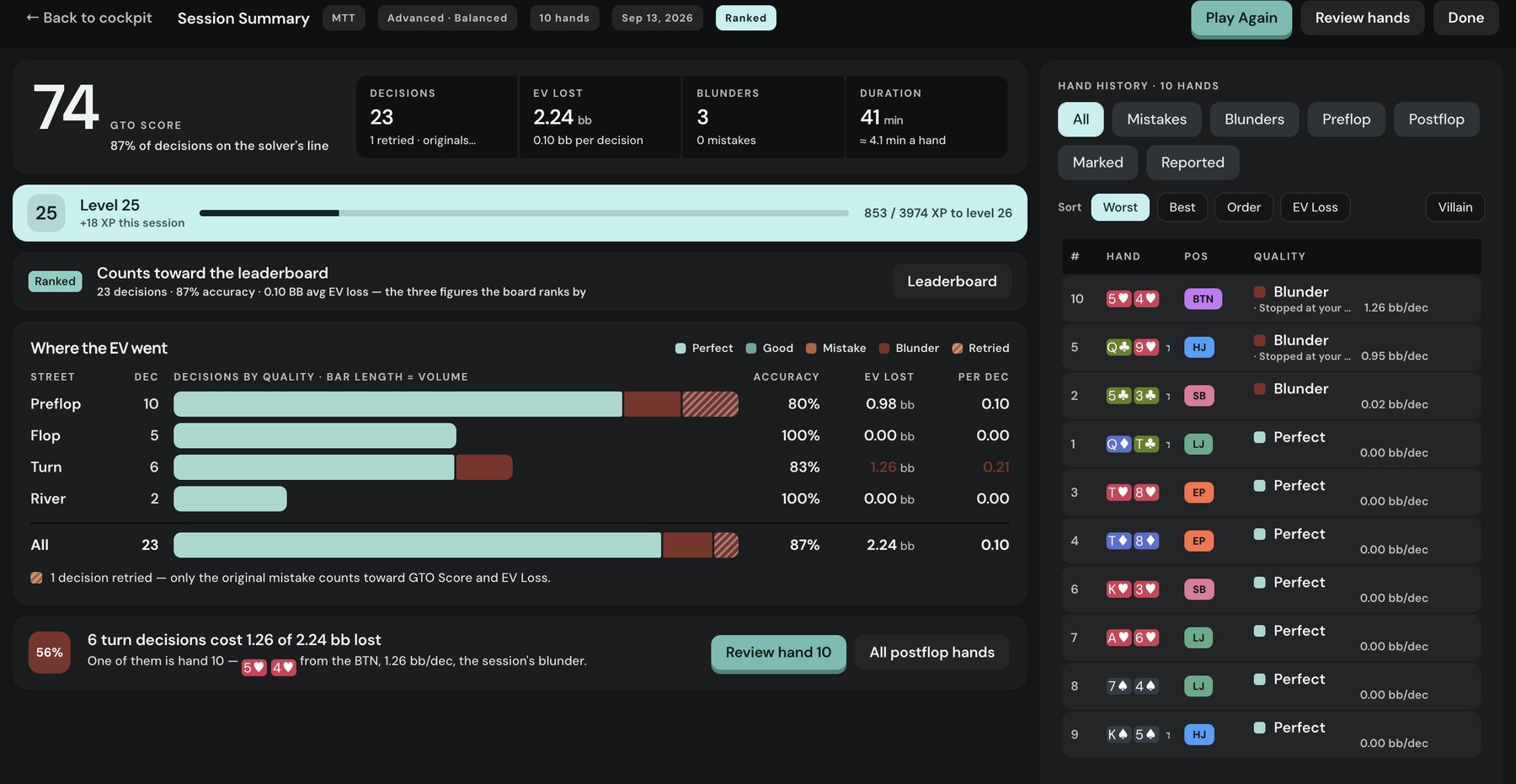
That session also shows why accuracy alone is a bad target. 87% of 23 decisions were on the solver’s line, which sounds fine, and it still gave away 2.24 bb. The screen says where: 6 turn decisions cost 1.26 of the 2.24, 56.2% of the damage on 6 of 23 decisions.
So the review has one question, not ten: which street and which hand carried the loss? Sort the hand list by worst, open the top two, done. Reviewing ten hands because you played ten hands is how study becomes a chore you quietly stop doing.
In the hand, judge the size of the error
Open one and the replayer stops at the decision the solver disagreed with, with that node’s full strategy next to it.
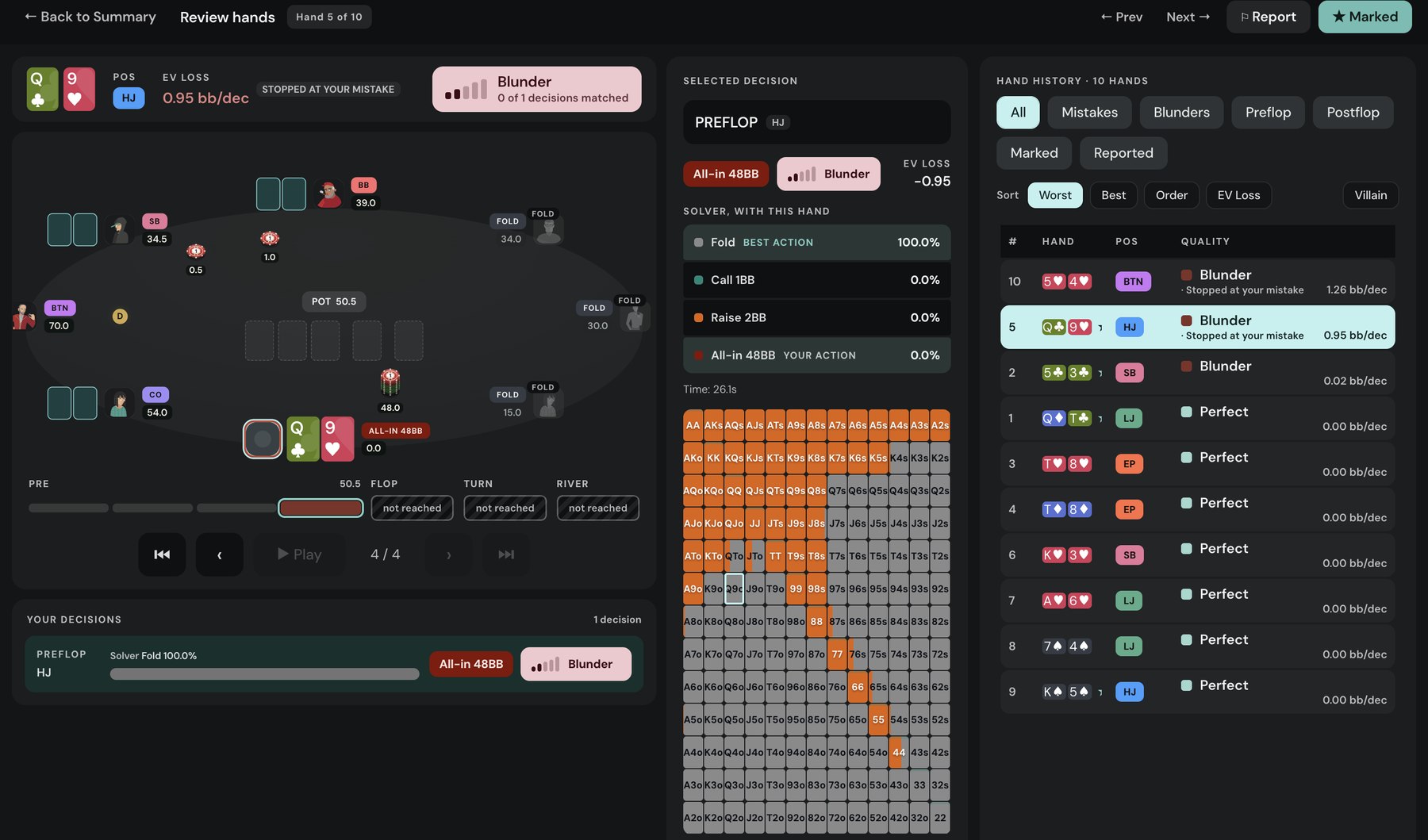
Here is that hand stated in full, because a frequency without its context is worth nothing. It comes from a PKO Final Table simulation, so bounties and pay jumps are already priced into those ranges. It is 8-handed, with a 0.96 bb table ante. Three players folded, so the hijack is first in, and the effective stack is 48 bb. In that node the solver opens 22.9% of its combos, 304 of 1,326, for 2 bb. It does not jam at all: the largest all-in frequency anywhere in the node is 0.01%, on AA. At 48 bb deep that is what you would expect.
I moved all in for 48 bb with Q♣︎9♥︎. The useful part is by how much that was wrong:
What the two wrong options cost, HJ first in, 48 bb effective
Folding is worth 0, so the cost of each alternative is just its EV with the sign flipped. Opening this hand would have been wrong by 0.016 bb, a rounding error, the kind of borderline hand it is pointless to argue about. Jamming was wrong by 0.95 bb, about 60 times more. Same hand, same seat, same street, and only one of the two errors is worth a minute of your time.
This is the habit worth building: read the EV loss, not the verdict. “I was wrong” is not information. “I was wrong by 0.95 bb because I picked a sizing the solver never uses here” is a leak with a name.
Then find the leak, which is a spot and not a feeling
One session is too small to name a leak. The Performance tab pools all of them and cuts the same accuracy by street and by seat.
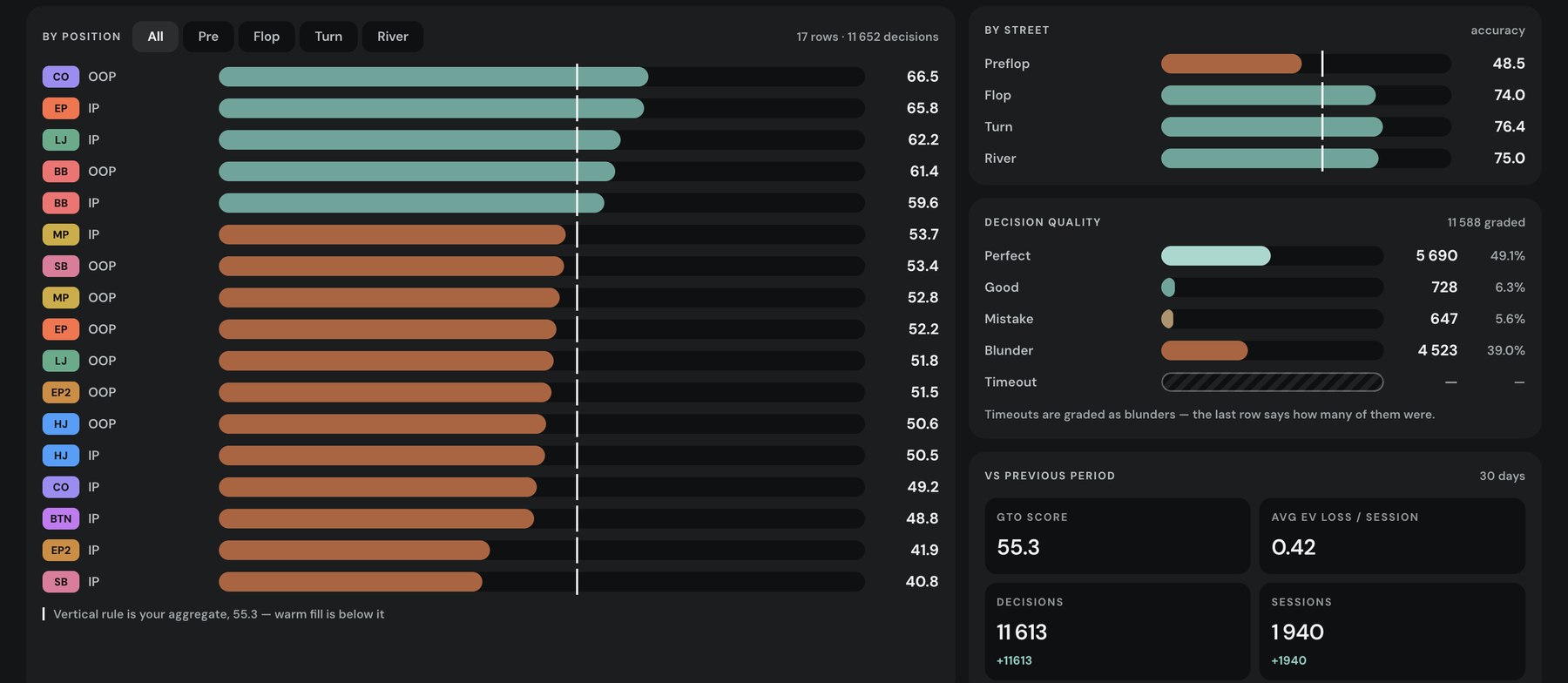
On this account the split is blunt. Preflop accuracy is 48.5 against 74.0 on the flop, 76.4 on the turn and 75.0 on the river. By seat it runs from 66.5 in the cutoff out of position down to 40.8 in the small blind in position, nearly 26 points between the best and the worst chair at the same table.
That is what a leak looks like when it is written down properly: a street, a seat, a stack depth and a spot type. “I play badly out of position” is not something you can drill. “In the small blind in position I am 14.5 points under my own average” is a session you can start this evening. If the spot is short-stacked, the ranges behind it are in short stack poker strategy; if the word “solver” in all this is still doing heavy lifting, what GTO actually means is the piece to read first.
Repeat the spot instead of rereading it
Reading a chart once does not survive the week. Repetition does, and it only works if something else keeps the calendar. The app tracks each spot separately, a spot being one seat, street, spot type and stack bracket. There are 768 of them on this account, 500 with at least five decisions behind them, and it schedules them with SM-2, the spaced-repetition algorithm out of flashcard software. Your accuracy on a spot sets how long until it comes back.
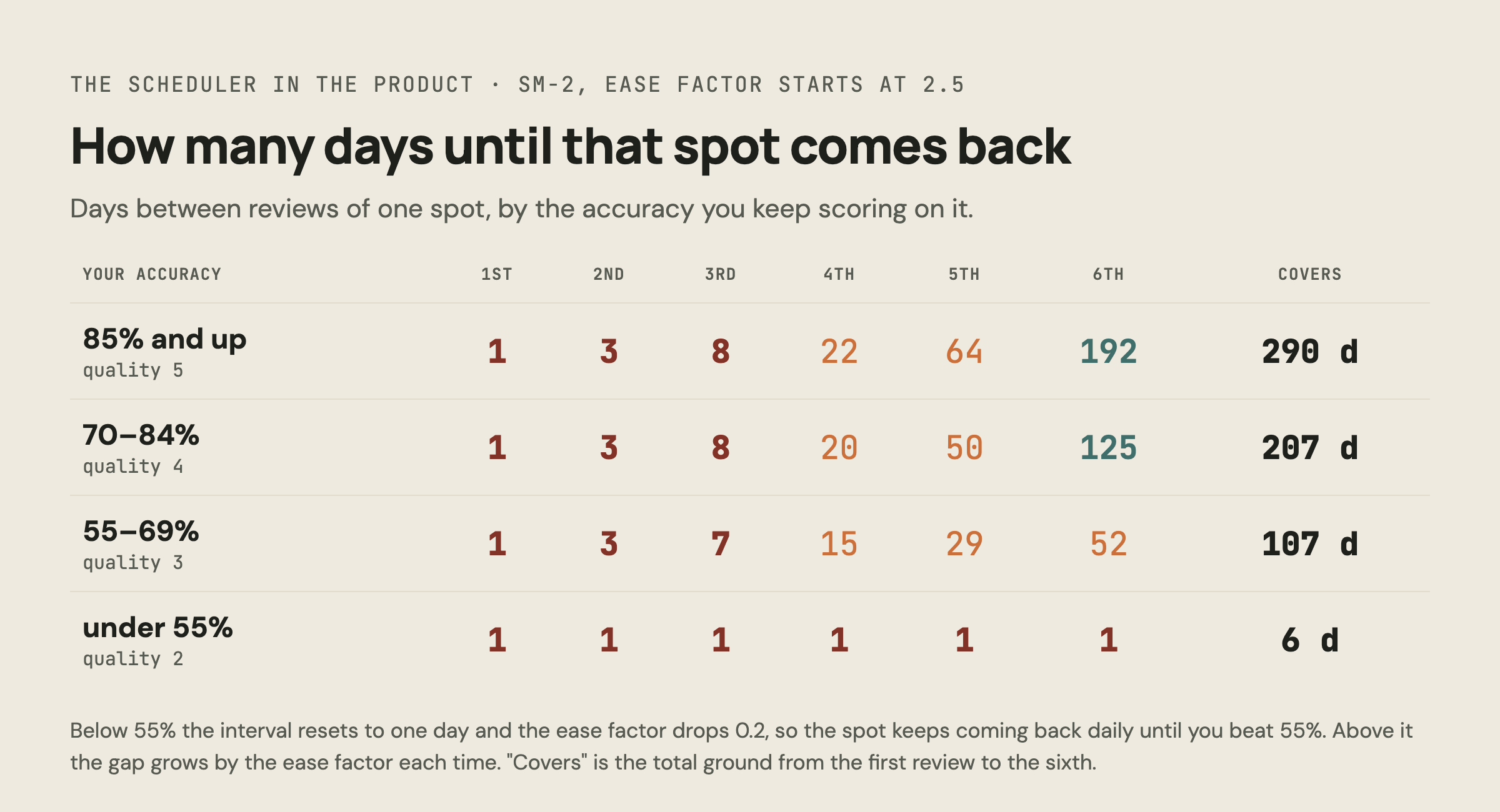
The two ends of that table are the whole idea. Score 85% or better and the gaps run 1, 3, 8, 22, 64, 192 days: six sessions cover most of a year. Score under 55% and the interval resets to one day every time, so the spot comes back tomorrow, and the day after, until you beat it. You do not get to decide that a spot is finished. Your accuracy on it decides.
The same counters set the label on each spot: practised needs 30 decisions at 60% accuracy, mastered needs 50 at 72%. On this account 64 of 768 spots have cleared that second bar. That is a useful reminder of how much ground there is, and of why choosing tonight’s spot yourself wastes the one decision you make before training.
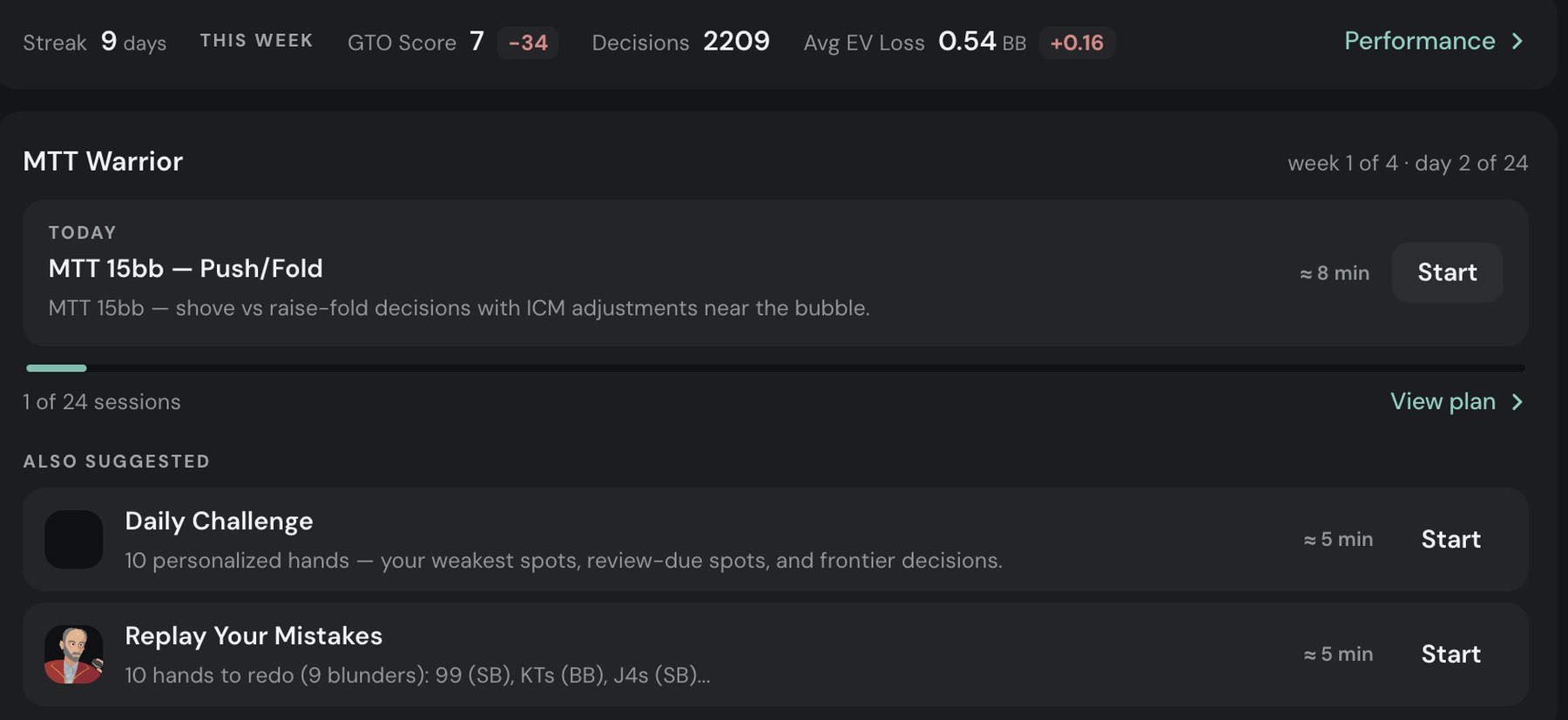
That is what the suggested drills are for. “Replay Your Mistakes” deals back hands you have already got wrong, and the daily challenge mixes weak spots with review-due ones. Twenty minutes of that beats an hour of scrolling charts, because the selection is made from your own record.
Tilt is decision quality dropping, and you can see it
Tilt gets talked about as a mood. Treat it as a measurement instead, because you have one: tilt is your EV loss per decision going up while nothing about the games changed. Three signals, all on screens you already have:
- EV loss per decision, the single number on the Performance tab. If your bankroll is falling and this is flat, you are running bad. If it is climbing, you are playing worse, and that half is yours.
- Timeouts. 2,212 of them on this account at 0.62 bb each. A timeout is the absence of a decision rather than a bad one, which makes it the cleanest evidence that attention has left the building.
- Decision time, stored per decision: 26.1 seconds on that Q♣︎9♥︎ jam. Very fast decisions in spots that deserve thought, and very slow ones in spots that do not, are both worth noticing.
None of that needs a mood journal. It needs you to read one number at the end of a session and compare it with the same number last week.
Set the stopping rule before you sit down
A stopping rule made at the table is not a rule, it is a negotiation, and you will lose it. Write it down while you are calm and make it about things you can check without arguing:
- A time or a hand count, fixed in advance. “Two hours” beats “until I feel like stopping”, because you can read a clock while tilted. If the end condition is “back to even”, the length of your session is being set by variance rather than by you.
- A loss limit in buy-ins. Protecting the bankroll is what bankroll management is for; this one is here because the session after a big loss is the one that produces blunders.
- A blunder count. Three in quick succession in spots you normally get right is a better stop signal than any feeling, and at roughly a big blind each it is a cost you can say out loud.
- One timeout is a warning. If the clock ran out on a decision you had an opinion about, the session is over. That rule is cheap to obey and expensive to ignore.
And keep the strategy fixed while the stakes or the volume move. Tightening up because you are running badly is a results-based change: it lowers your edge and does nothing to the swings. Fewer tables, shorter sessions or a level down does the opposite.
Results and decisions are two different questions
The last piece is a habit rather than a technique: refusing to mix up two questions that feel like one. “Did I win?” is answered by the graph, and over any period you can stand to look at, the answer is mostly noise. “Did I decide well?” is answered per decision, in a second, and it does not move with the cards. You need both, but only one of them gives you feedback fast enough to learn from, and only one is worth reacting to on a Tuesday night. How wide the other one really is, with the model behind it, is in the variance article.
So: mark while you play, read the debrief for where the EV went, open the two worst hands, let the scheduler pick tomorrow’s spots, stop on a rule you wrote when you were calm. That is the whole routine. It fits in twenty minutes, and it is the only feedback loop in poker faster than the variance.
Cheers! 🙂
Related posts
More in Theory
Keep reading
All posts
Poker Academy
Stop guessing preflop.
1,500,000+ GTO preflop solutions. Try them free for 3 days.
Start Free TrialCancel anytime.