
Bet sizing and SPR: why the size belongs to the spot
 Jan Przysucha
Founder of Poker Academy. Writes the product guides and updates on this blog.
Updated· first published ~9 min read
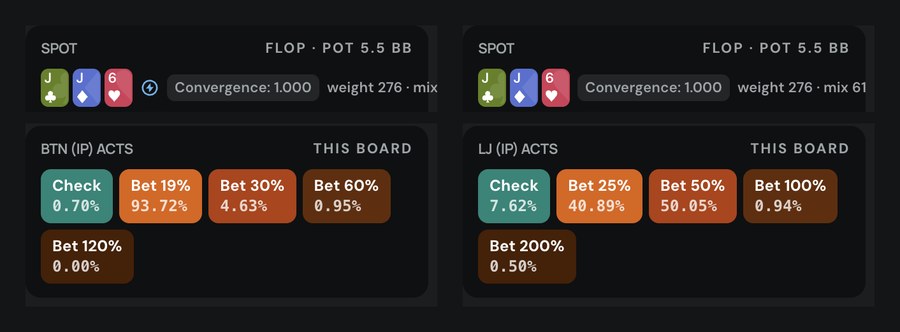
Two solved reports in front of me, on the same flop, J♣︎J♦︎6♥︎, with the same 5.5bb pot and the same job: I raised preflop, my opponent called, the big blind checked, and it is my turn in position.
In the first one I bet 19% of the pot with 93.7% of my range. In the second one I split: 40.9% of the range bets 25%, 50.1% bets 50%, and 7.6% checks. Same cards, same pot, and opposite answers.
The only thing that changed is how many chips are left behind. That ratio has a name, and it decides more about bet size than the two cards in your hand do.
SPR: the number that describes the spot
SPR is the stack-to-pot ratio: the effective stack divided by the pot at the start of the street.
Stack-to-pot ratio
Effective stack means the smaller of the two remaining stacks, because chips your opponent does not have cannot be won. You get SPR out of the preflop action, before the flop is dealt.
- MTT, 20bb, 9-max, 1bb big-blind ante. BTN opens to 2bb, BB calls. Pot = 2 + 2 + 0.5 (dead small blind) + 1 (ante) = 5.5bb. Behind: 20 − 2 = 18bb. SPR 18 / 5.5 = 3.3.
- Cash, NL200 6-max, 100bb, no ante. LJ opens to 2.5bb, BB calls. Pot = 2.5 + 2.5 + 0.5 = 5.5bb. Behind: 100 − 2.5 = 97.5bb. SPR 97.5 / 5.5 = 17.7.
- MTT, 50bb, 9-max, 1bb ante. SB raises to 4bb, BB calls. Pot = 4 + 4 + 1 = 9bb. Behind 46bb. SPR 5.1.
- MTT, heads-up, 30bb, 0.25bb ante. SB limps 1bb, BB checks. Pot = 1 + 1 + the 0.25bb ante, which the solve rounds to whole chips: 2.3bb. Behind 29bb. SPR 29 / 2.3 = 12.6.
Identical pots in big blinds, wildly different SPRs. The pot on its own tells you nothing.
Why SPR decides the size: count the bets to all-in
Betting a fraction f of the pot and getting called multiplies the pot by (1 + 2f). Do that n times and the pot is multiplied by (1 + 2f)n. All the chips are in when that equals 1 + 2 × SPR, so the size that gets stacks in over n even bets is:
Even sizing to get all in over n streets
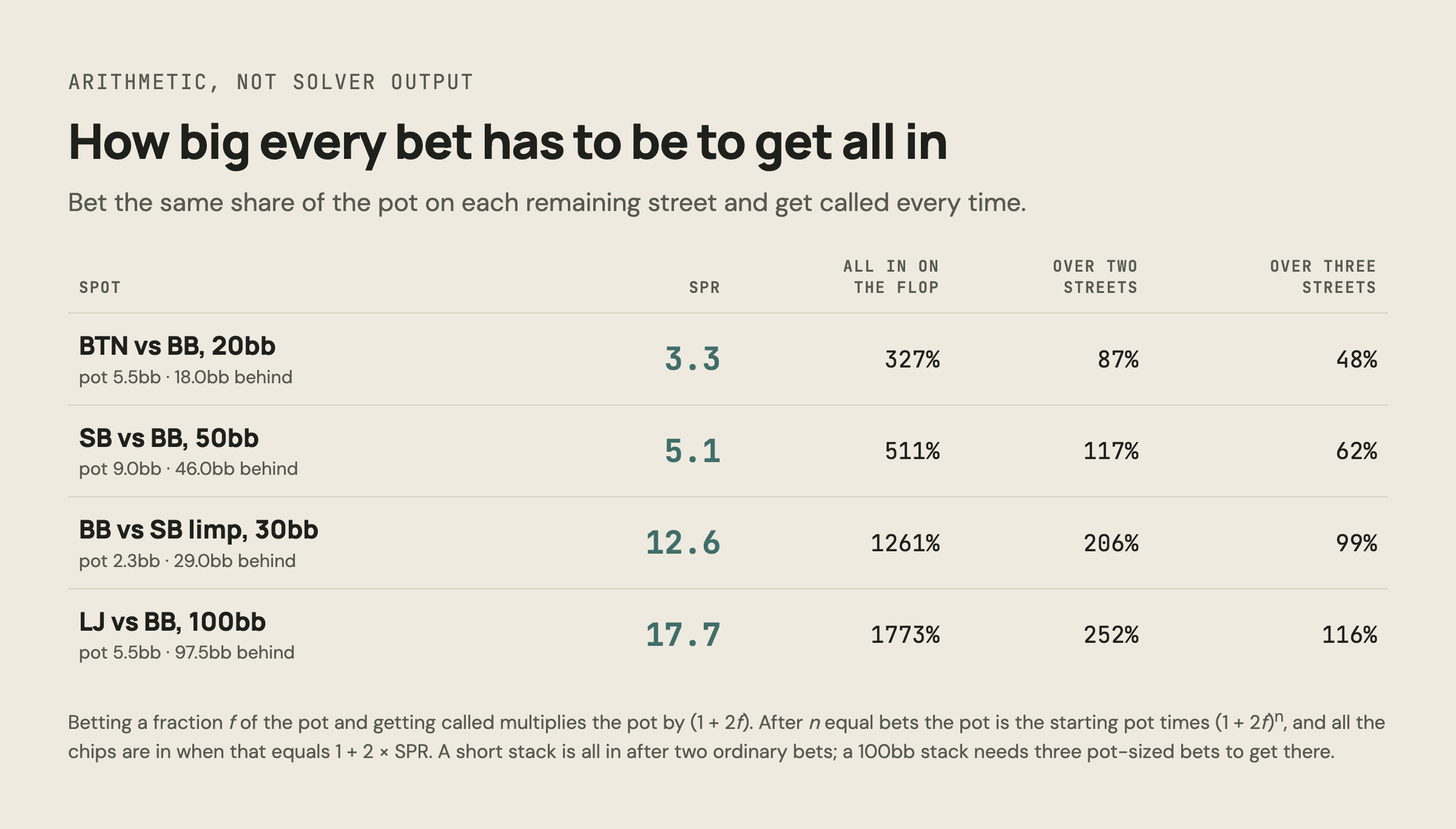
At SPR 3.3 two ordinary bets of 87% of the pot put the stacks in, and three bets of 48% do the same. At SPR 17.7 you need three bets bigger than the pot. So ordinary sizes already commit a short stack, while no single bet commits a deep one. The short stack can bet small and still get all the chips in by the river. The deep stack cannot, and does not have to.
The same 25 flops, two stack depths
The two reports I opened at the top were solved on exactly the same 25 flops, with the same 5.5bb pot and the same structure: preflop raiser in position, big blind checks. Only the stack differs, 18bb behind against 97.5bb behind.

- SPR 3.3: bets 89.5% of the time, and 86.1% of the whole range takes one of the two smallest sizes on the menu. The average bet, when it bets, is 25% of the pot, 1.38bb, which is 7.7% of the 18bb behind.
- SPR 17.7: checks 36.5% and splits the rest between 25% (21.9%) and 50% (35.6%), with 6.0% going to 100% or 200%. Average bet 47% of the pot, 2.60bb, which is 2.7% of the 97.5bb behind.
Flop by flop, the deep spot uses the bigger average size on 24 of the 25 flops, and the short spot bets more often on 24 of the 25. The short stack bets small in percent of the pot and big in percent of its own stack. The deep stack does it the other way round.
One board shows it on its own. Here is J♣︎J♦︎6♥︎ in both reports.
Careful: stack depth changes the ranges too
SPR alone did not produce that difference, and neither report claims it did. Stack depth moves the ranges at the same time, and the preflop charts of the same two simulations show it. Against a 2bb button open at 20bb the big blind calls with no pocket pair at all, because every one of the 78 pair combos 3-bets or jams, so on an unpaired flop its range holds no sets and no overpairs. Against a 2.5bb lowjack open at 100bb, 63 of those 78 combos call. Over these 25 flops the button at 20bb has 59.7% equity against the lowjack’s 53.5% at 100bb. Geometry and ranges push the same way here, which is why you cannot read causation out of two spots.
Play this spot instead of reading about it
Start Free TrialThe trainer deals the situations this article describes and grades every decision you make. Try it free for 3 days.
The arithmetic is the part that travels. You can work out SPR before the flop comes down; the ranges you have to learn spot by spot.
What each size actually buys
A bet does four things, and each of them has a price you can compute. Bet b into a pot of P:
Break-even fold equity for a pure bluff
Price the caller is getting (pot odds)
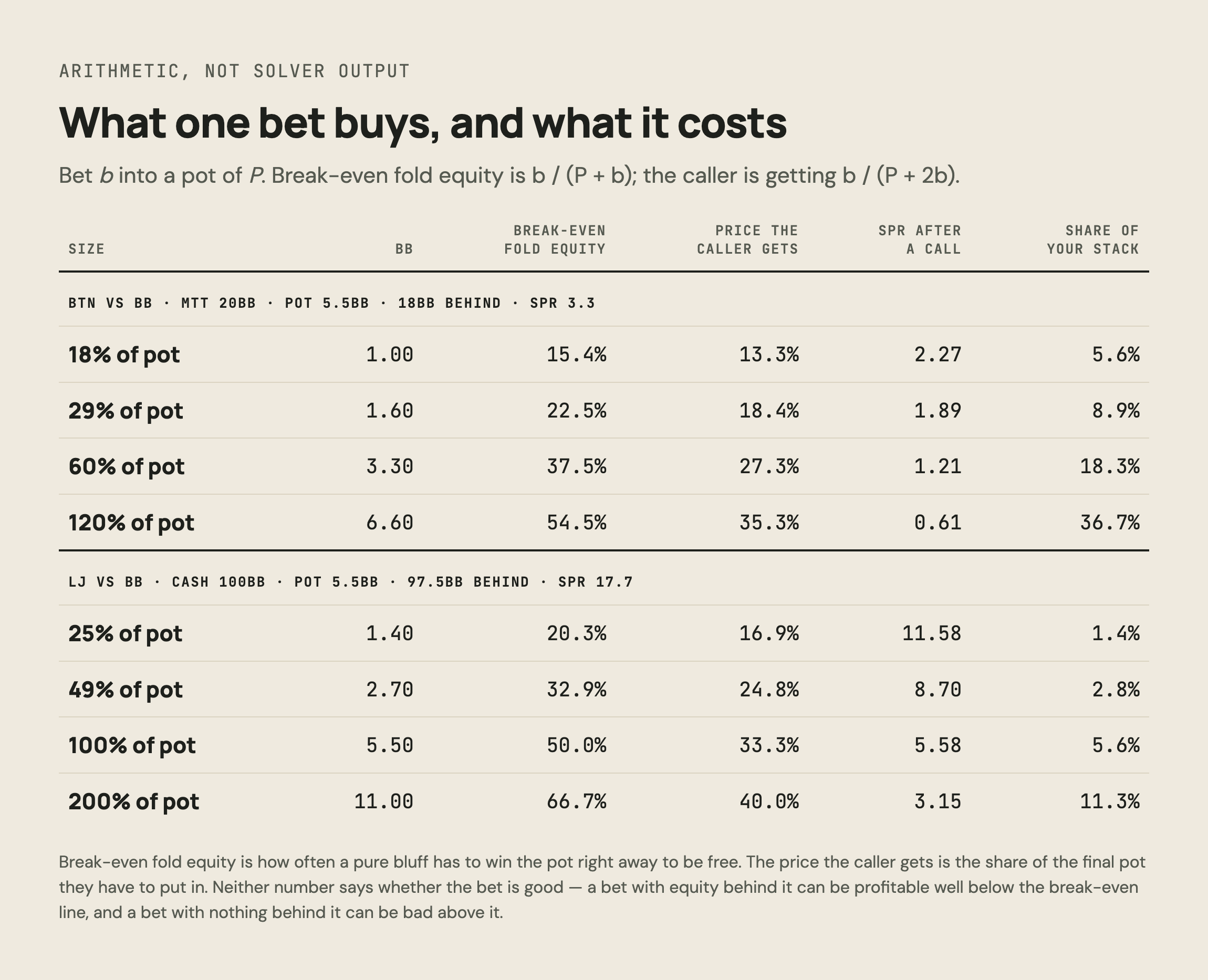
- Fold equity. A 19% bet needs to win the pot outright 15.4% of the time to break even as a pure bluff; a 120% overbet needs 54.5%. Bigger bets buy folds and pay for them.
- Denying equity. The caller’s price rises with the size: 13.3% at 19% pot, 35.3% at 120%. A big bet makes cheap draws pay, a small bet lets everything continue.
- Protection. That is the same fact from the other side. Charging a draw only matters when there are streets left to charge on, which brings SPR back in.
- Polarisation. A big size is only credible if your range holds hands that want the whole stack in. The SPR-after-a-call column shows why: a 60% bet at SPR 3.3 leaves SPR 1.21, so the turn is a shove. If you would not shove the turn, do not bet 60% on the flop.
None of those four numbers says whether the bet is good. They say what the bet needs to be good. A bluff with a flush draw behind it can be profitable well below its break-even line, because it still wins when it is called.
The middle of the ladder, and one spot that just checks
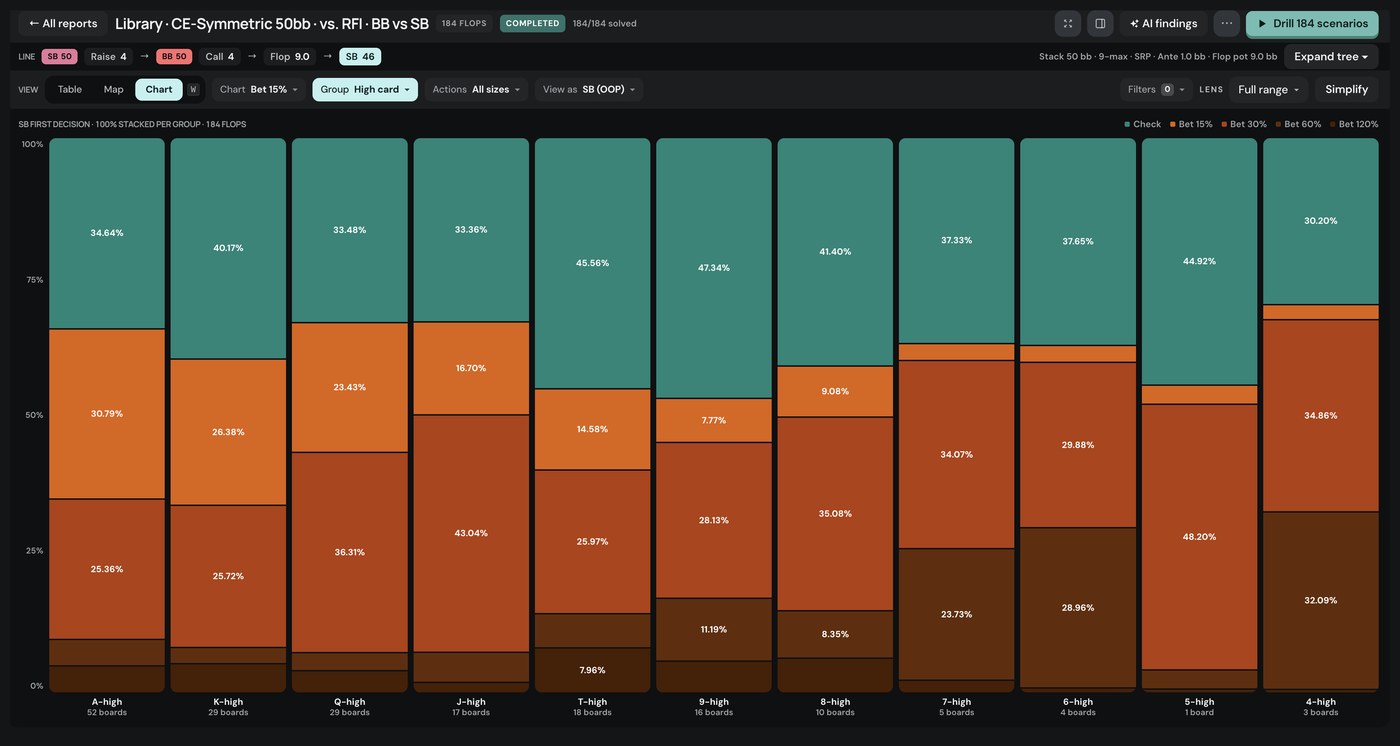
Two library-scale reports fill in the ladder between those extremes. Each is one preflop spot solved on 184 flops.
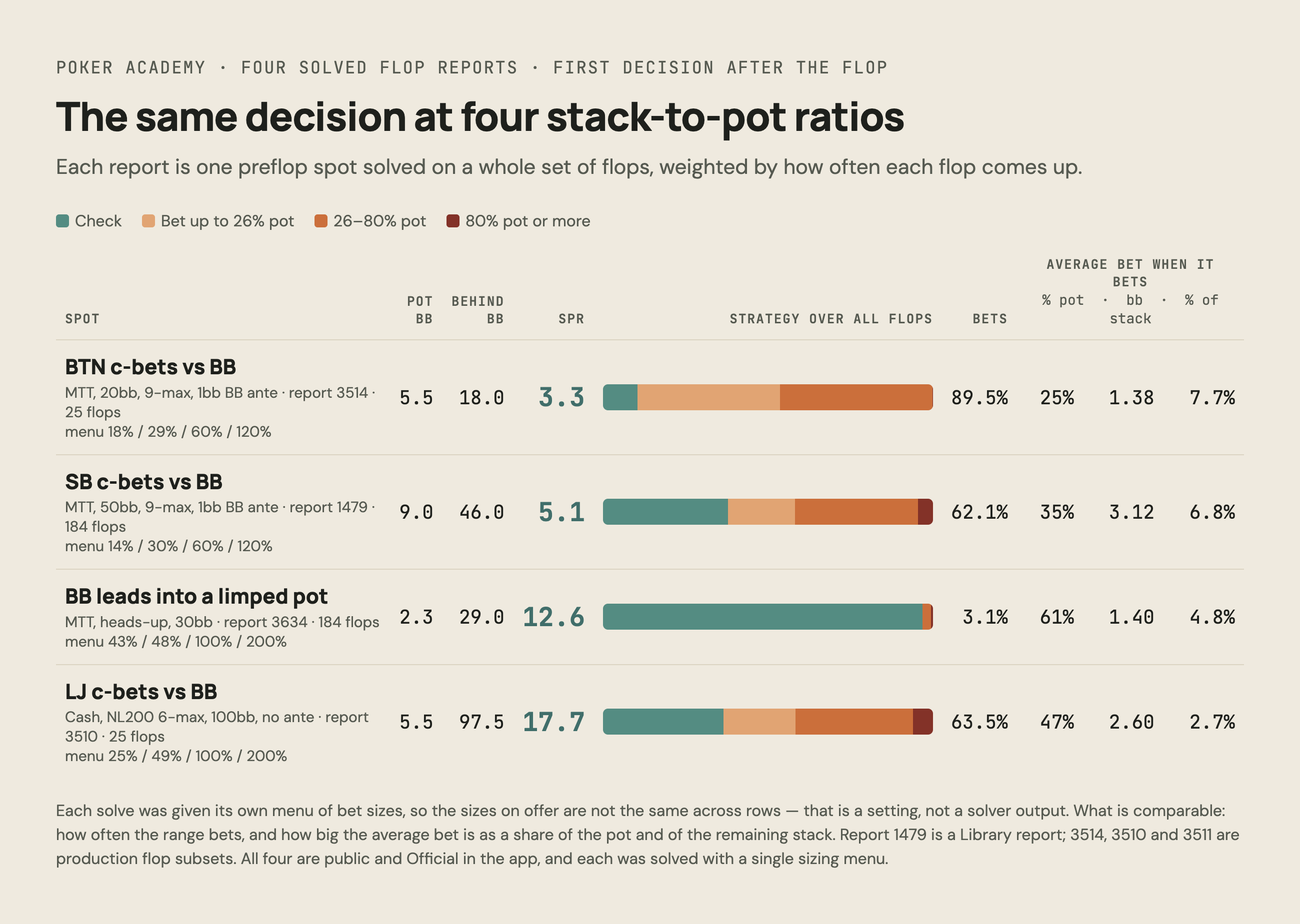
- SPR 5.1: SB c-bets vs BB, MTT 50bb. Pot 9bb, 46bb behind, 184 flops. Bets 62.1%: 15% pot with 20.2% of the range, 30% with 30.8%, 60% with 6.6%, 120% with 4.5%. In chips: 1.3, 2.7, 5.4 and 10.8bb.
- SPR 12.6: BB into a limped pot, heads-up MTT 30bb. Pot 2.3bb, 29bb behind, 184 flops. It checks 96.9% of the time.
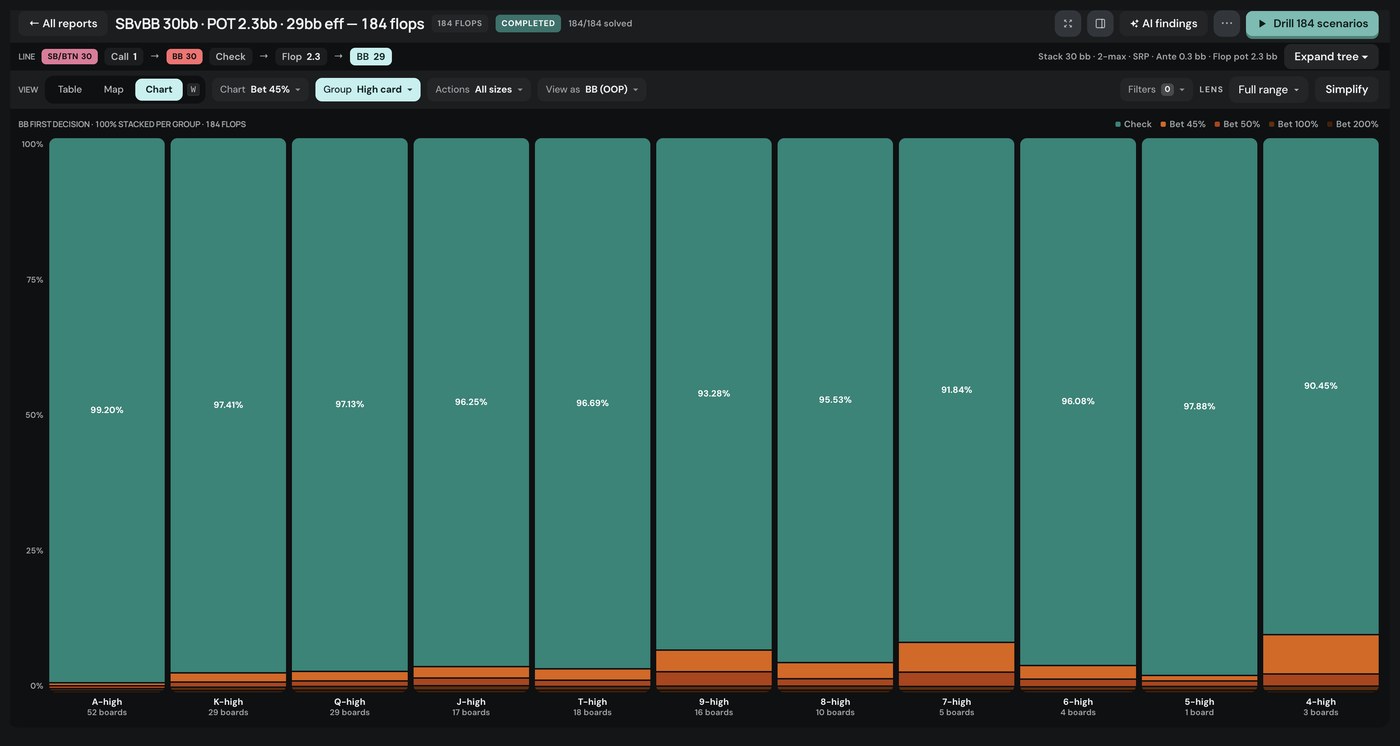
Look at that last one for a moment. The big blind has 29bb behind and a 2.3bb pot, and it almost never bets. There is nothing here worth risking a stack that is 12.6 pots deep, the limping range is wide enough that nobody has a real edge at the top, and a bet that gets raised turns a 2.3bb pot into a decision for 29bb. When SPR is enormous and nobody has a range advantage, a check is the cheapest way to see the next card.
A small sizing menu is enough
Look at what these solves actually use. At SPR 3.3 the button puts 86.1% of its range into the two small sizes and 0.2% into the 120% overbet, so the largest option on the menu is close to dead weight. At SPR 17.7 the lowjack puts 57.5% into two sizes and 6.0% into everything bigger. On J♣︎J♦︎6♥︎, 90.9% of the deep range is covered by 25% and 50%.
What cutting a mix down actually costs is a separate measurement, and I made it in is simplifying poker strategy the road to success: forcing the solver’s whole range onto one action in these same reports costs a fraction of a big blind per hand. The size menu is not where your money is.
So: one small size, one big size, and an overbet you use only when you know why. The pot and the stack decide which one you pick, not the strength of the two cards you happen to hold.
At the table
- Work out SPR before the flop is dealt. Effective stack over pot. It is one division and it frames every decision on three streets.
- Low SPR means ordinary bets are commitment. At SPR 3.3 two bets of 87% get the stacks in. Bet small and often, and save the big size for when you actually want the stack in.
- High SPR means no ordinary flop bet commits anybody. At SPR 17.7 even a pot-sized bet leaves SPR 5.6. You have three streets, so you can check the spots that do not want a pot and use the big size where you have the nutted hands.
- Ask what the size needs to work. Break-even fold equity, the price you are laying, and the SPR left after a call are all arithmetic you can do in your seat.
- Check the ranges as well as the geometry. The big blind’s calling range at 20bb and at 100bb are different animals, and that moves the answer as much as the SPR does.
Frequencies and sizes above come from these four spots only: two MTT stack depths, one heads-up limped pot, one 100bb cash spot. Different positions, different antes or a different format, and the numbers move. The reports are in the app; open the one that matches your game before you copy anything from this page.
If you want the frequency side of the same decision, how often the preflop raiser bets at all by board texture, I wrote that up in continuation bets: how often and how big.
Cheers! 🙂
Keep reading
All posts
Poker Academy
Stop guessing preflop.
1,500,000+ GTO preflop solutions. Try them free for 3 days.
Start Free TrialCancel anytime.