

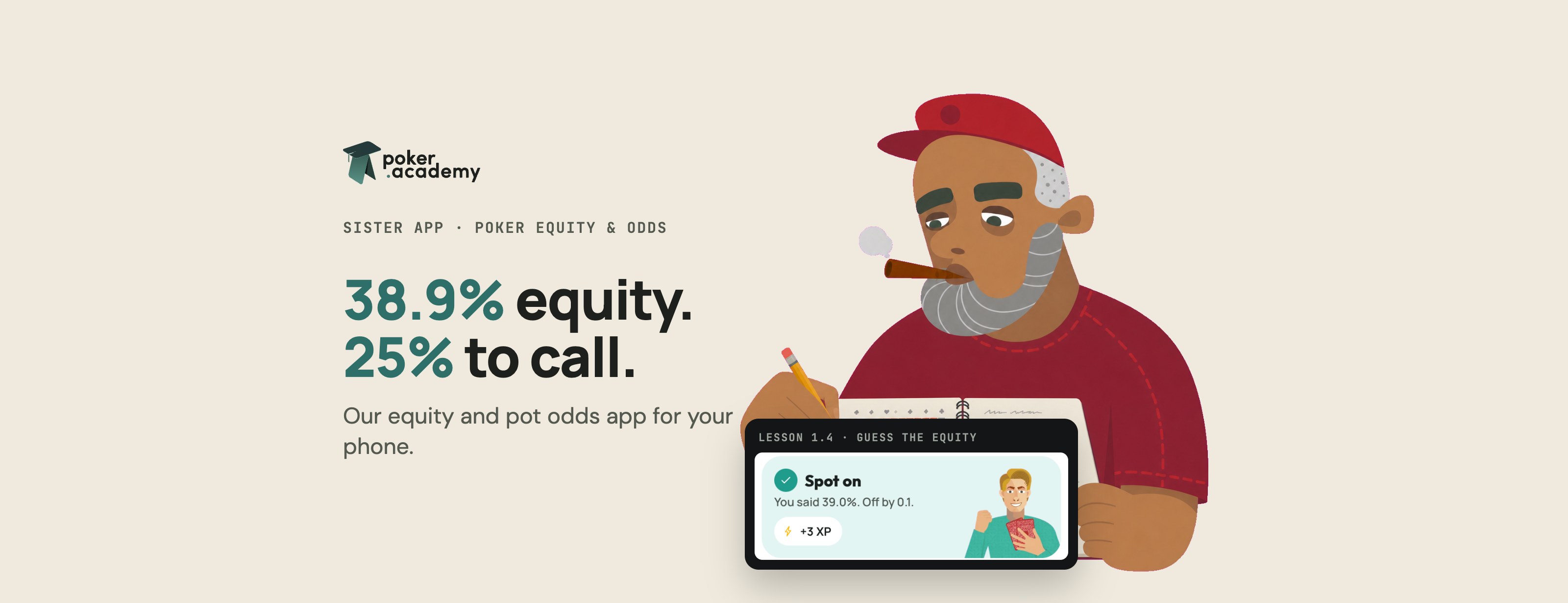
Quick test before you read on. You hold 9♠︎8♠︎ on K♠︎6♠︎2♦︎. You’re all in and they show K♦︎Q♣︎. How often do you win?
Pick a number first. The answer is 38.9%, counted over all 990 possible turn and river runouts.
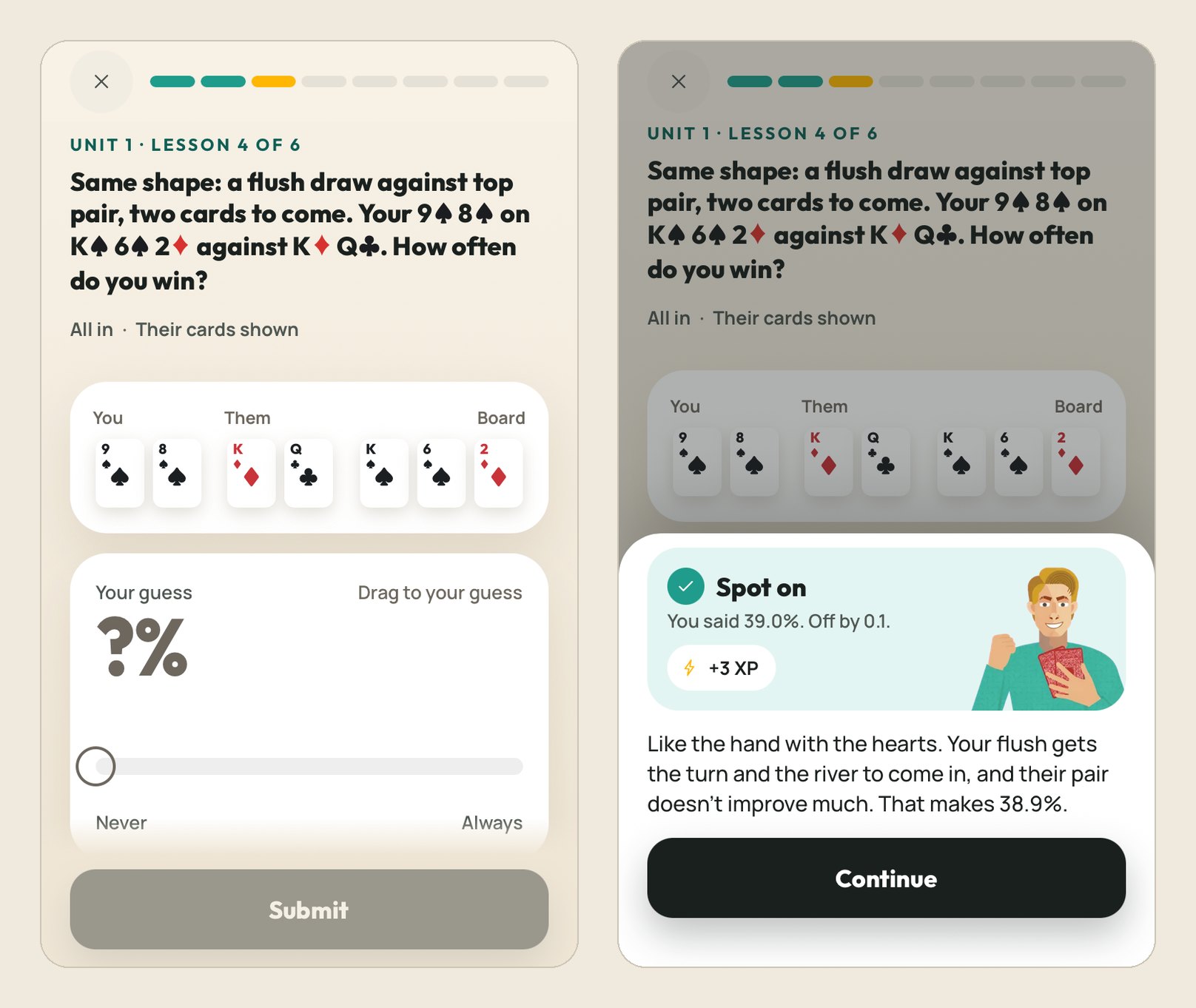
If you said half, the flush draw felt stronger than it is. If you said 20%, you’re folding hands that are clear calls, and that’s the mistake this post is about.
Why that number decides the call
Equity is the share of the pot you’d win on average if the rest of the cards were dealt with no more betting. Pot odds tell you what share a call needs. When your equity is bigger than what the call needs, you call.
The app teaches this spot in pairs. Here’s its twin with a bet in front of it: 5♥︎4♥︎ on K♥︎9♥︎2♣︎ against K♦︎Q♣︎. Same 9 outs, same 38.9%. That’s a bit more than the 35% you hit the flush by the river, because some runouts give you two pair, trips or a backdoor straight. The pot is 100 and they bet 50. You pay 50 to win a pot that will hold 200 after your call:
What a half-pot call needs
You have 38.9% and need 25%. You lose this hand more often than you win it, and calling is still right. Over many hands the call is worth 27.8 chips each time:
Average result of the call
One catch. That 38.9% counts both the turn and the river, and it assumes no more chips go in. If they bet again on the turn, you’re paying for one card, and 9 outs hit on the turn only 19.1% of the time. With stacks behind, the extra chips you win when the flush comes in are what keep the call good.
Now swap the flush draw for a gutshot. 9♣︎8♦︎ on J♥︎7♠︎2♣︎ against K♠︎J♦︎ has 4 outs and 20.3%. Same bet, same 25% needed.
Average result of the call
To break even, the pot you win would need another 46.3 chips from later bets. That’s implied odds. With deep stacks and an opponent who pays off when the ten comes, that’s doable. With little behind, it’s a fold.
Three more to guess
Three more spots from the app’s engine. Guess each one before you read the answer.
- AK or 22, all in before the flop. Who’s ahead? 22, by a hair: 52% to 48%. Even suited AK only has 49.9%. The smallest pair is a slight favourite over the best unpaired hands.
- 15 outs on the flop. The rule of 4 says 60%. Is it? 9♥︎8♥︎ on T♥︎7♥︎2♣︎ is a flush draw plus an open-ender. Counted, you get there by the river 54.1% of the time. The shortcut overshoots big draws.
- A♠︎Q♥︎ facing a shove of 100 into 150. Call? You need 28.6%. Against QQ+ and AK you have 24.4%, so fold. Against a range that adds TT, JJ, AQ, AJs and KQs you have 38.6%, so call. Same hand, opposite answer. The range decides.
You can’t count 990 runouts in your head while someone waits for you to act. You can learn roughly where the numbers sit, though, and then your gut gets them right at the table. That’s why Maciek from our team built this app.
Play this spot instead of reading about it
Start Free TrialThe trainer deals the situations this article describes and grades every decision you make. Try it free for 3 days.
What the app is
Poker Equity & Odds Calculator is our sister app for iPhone and Android. It’s built for beginners and intermediate players who want these numbers without a spreadsheet. The engine runs on your phone, so it works offline. When it can count every runout, it marks the result EXACT. When it has to sample, it puts ≈ and the margin of error next to the number. Every equity number in this post came out of that engine.
Decide: call or fold, with the reason
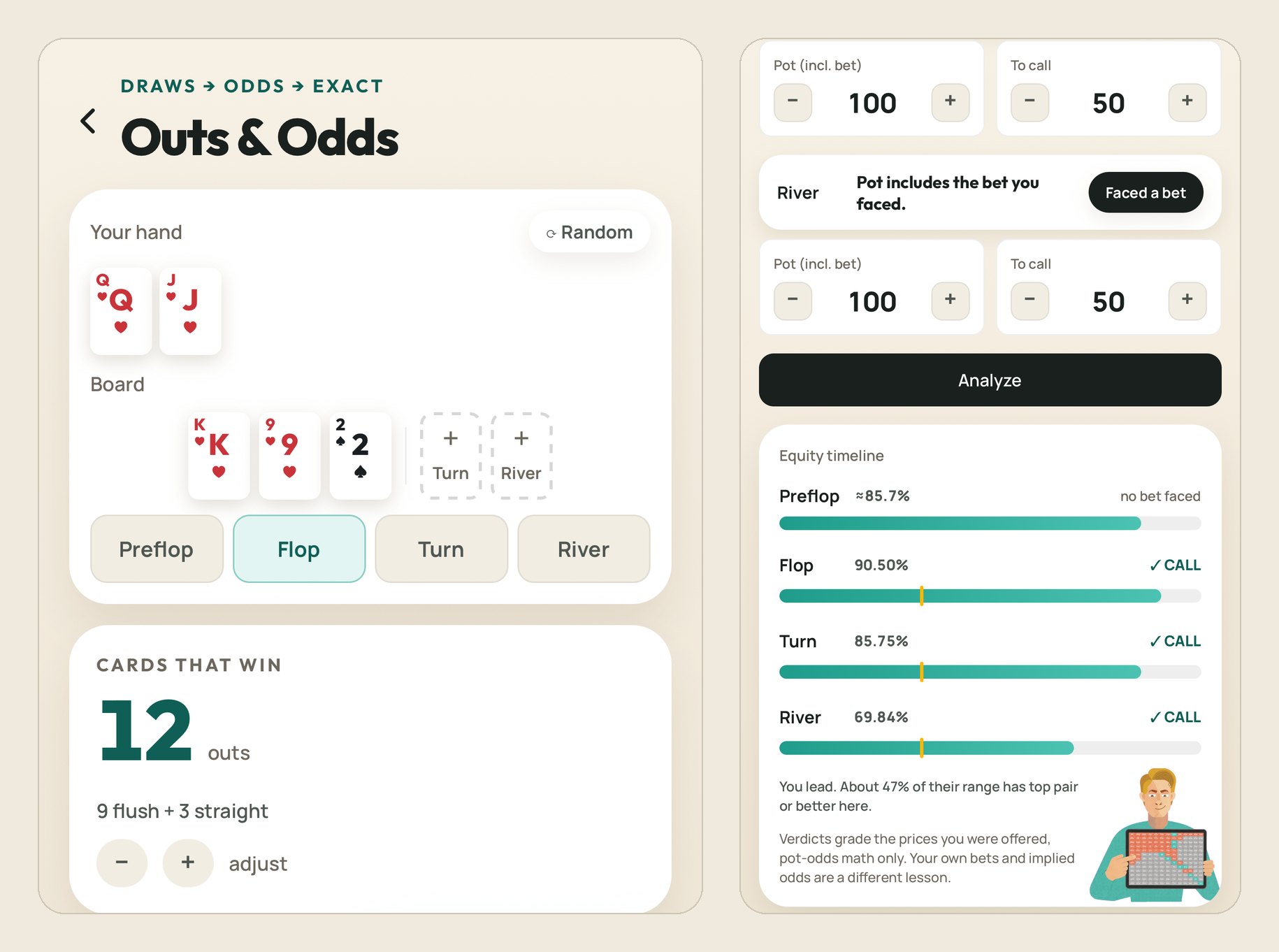
Enter your hand, the board, the pot and the bet you face. You get CALL or FOLD, your equity, the equity the call needs and the gap between them. Add the effective stack and it counts implied odds too. One thing to know: the pot you enter already includes their bet, so the flush draw spot above is Pot 150, To call 50.
Outs & Odds is one tap away on Home: tap in the board and it shows how many outs you have and which cards they are. And when a hand is over, log it in a few seconds. Hand Review replays it street by street with an equity line and a call or fold verdict at every bet you faced.
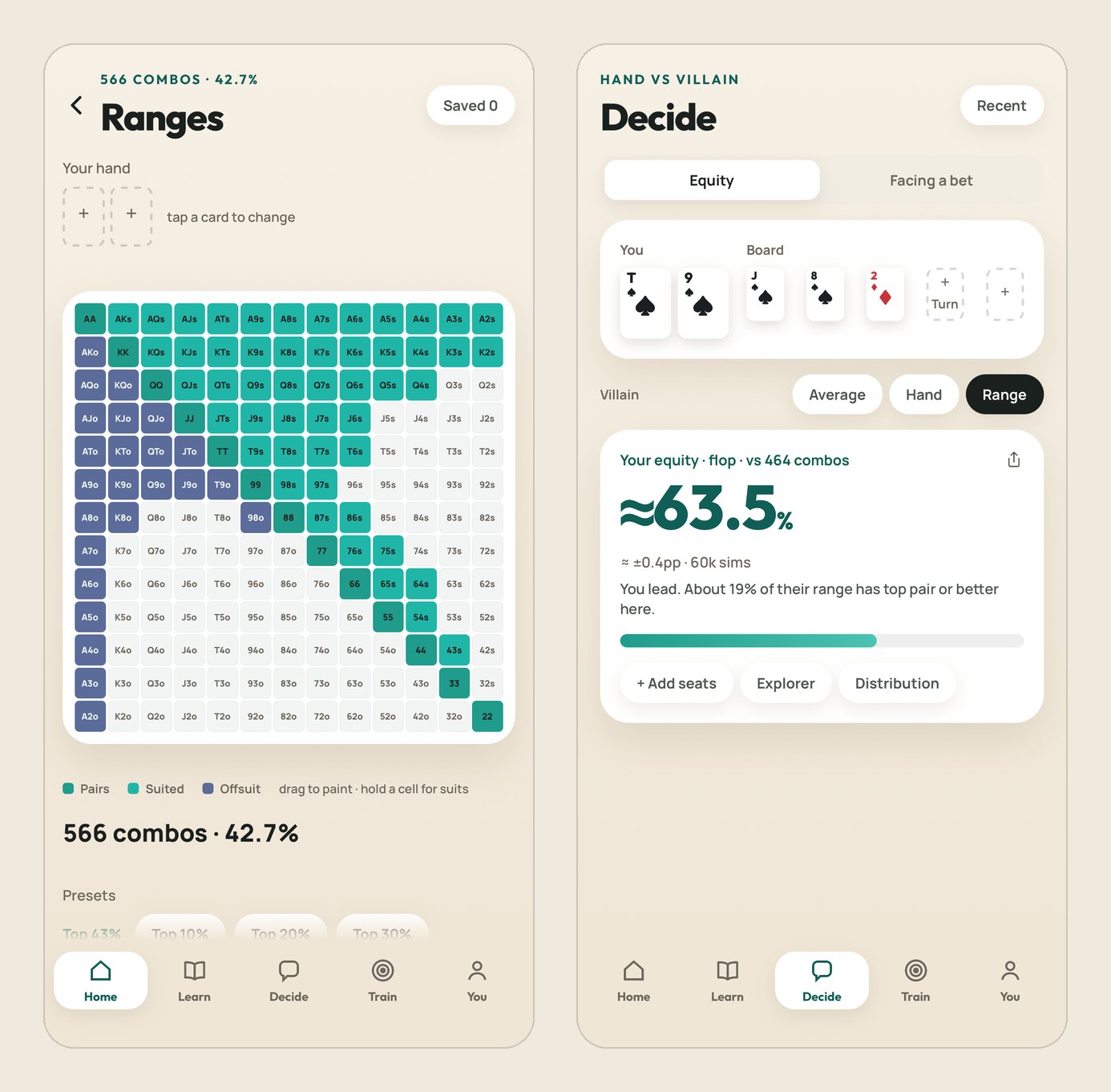
Ranges: a 13×13 grid you paint with a finger
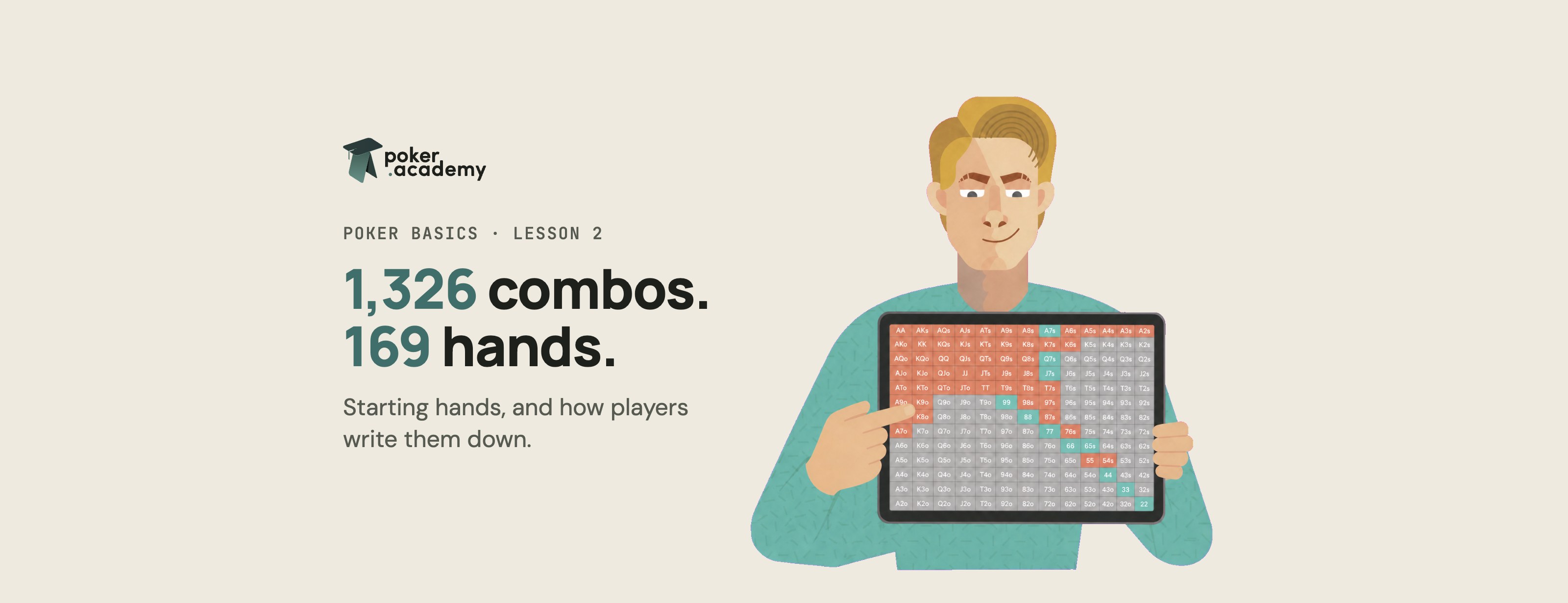
At the table nobody shows you two cards. You play against a range, so the app lets you draw one: drag across the grid, start from a preset, or build the villain’s range from position, action and player type. Then run your hand against it or run range vs range. With Premium you can also see how a whole range hits the flop: made hands, draws and combo counts. Ranges you save are there next time.
Train: guess first, then see the number
The trainer works like the quiz at the top of this post. You guess the equity, then you see how close you were and why. The Train path has five levels (coin flips, draws, pot odds, outs, mixed spots), each with three rounds of ten spots. There are timed flash drills too, for when you’ve got two minutes.
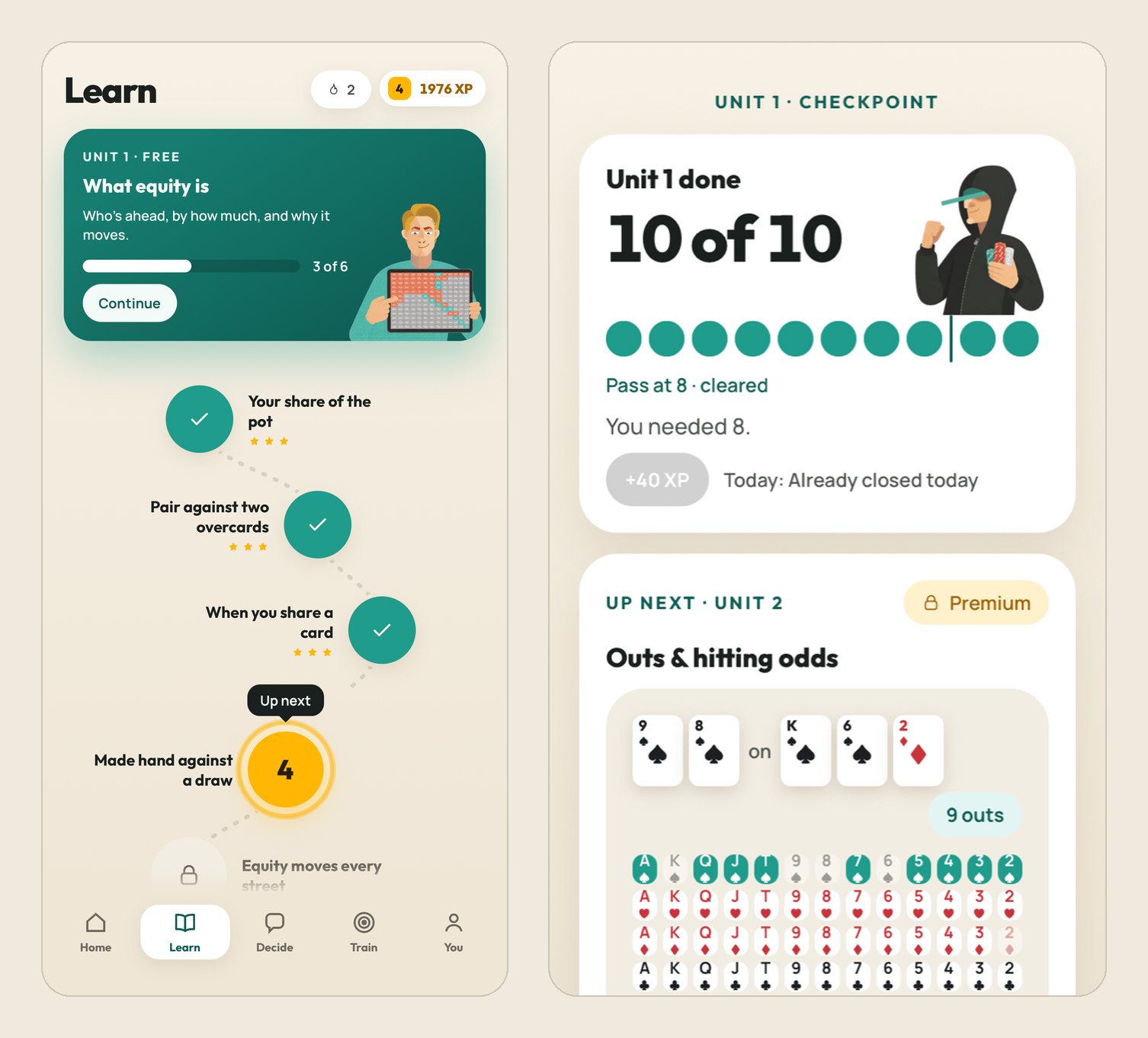
Learn: 28 short lessons, Unit 1 free
The newest part is a short course: five units, 28 lessons and a checkpoint after each unit. The units are what equity is, outs and hitting odds, pot odds, equity against a range, and putting it together. Every number in a lesson comes from the same engine as the calculator, and questions you miss come back later in review.
What’s free, what’s Premium
The range grid with presets, Decide, Outs & Odds, the daily trainer drills and Unit 1 of Learn with its checkpoint are free, and there are no ads. Premium opens the rest of the course, Units 2 to 5. It also removes the daily limits on equity checks, drills, range vs range and hand reviews, and adds the range vs board breakdown and unlimited saved ranges. Your hands and ranges stay on your device.
Try it on the next hand that bugs you
If the 38.9% surprised you, take the hand from your last session you keep thinking about, put it into Decide and see what it says.
Get it on the App Store or Google Play. There’s more about it, plus guides on draws and pot odds, at pokerequityodds.com.
Cheers! 🙂
Keep reading
All posts
Poker Academy
Stop guessing preflop.
1,500,000+ GTO preflop solutions. Try them free for 3 days.
Start Free TrialCancel anytime.