
Board texture and range advantage: how to read a flop
 Jan Przysucha
Founder of Poker Academy. Writes the product guides and updates on this blog.
Updated· first published ~11 min read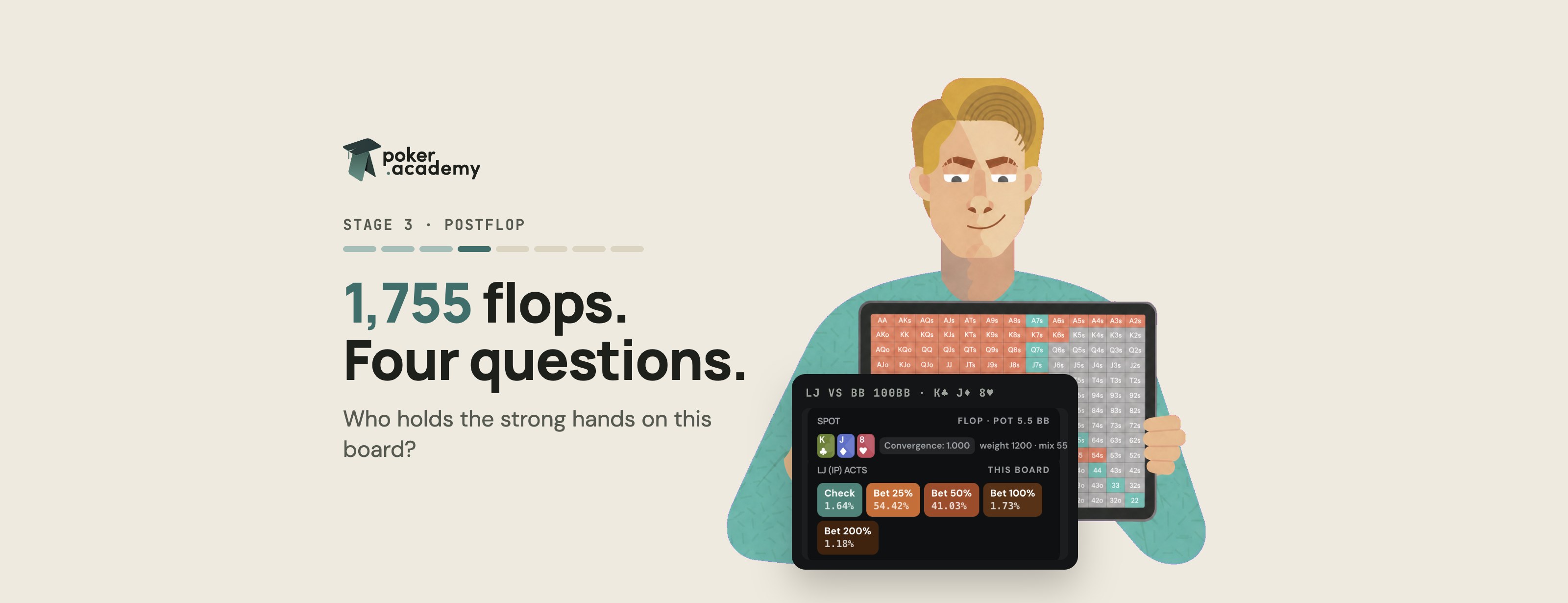
There are 22,100 ways to deal three cards off a 52-card deck. Strip out the flops that are the same board in different suits and 1,755 are left. Nobody memorises 1,755 strategies. What you can do is answer four questions about the board, then one question about the two ranges sitting on it.
This is the first article of the postflop stage, and it is about reading the flop before you decide anything. The frequencies come from solved flop reports in Poker Academy; the combo counts come from the preflop charts of the same simulation.
The spot
- Cash, 6-max, NL200 fast-fold, 100bb, no ante. The lojack opens to 2.5bb, everybody folds, the big blind calls. Pot: 2.5 + 2.5 + 0.5 = 5.5bb, 97.5bb behind, so SPR is 97.5 / 5.5 = 17.7.
- Report 3510: 25 flops, all solved with one bet menu of 1.4bb, 2.7bb, 5.5bb and 11bb, which is 25%, 50%, 100% and 200% of the pot. Each flop carries a weight and the weights add up to 22,100, so each board stands for a cluster of boards.
Before trusting any weighted average, check what the weights are. Here they reproduce the real counts of rainbow, two-tone, monotone, paired and unpaired flops exactly. But king- and queen-high boards carry 73% of the weight against 34% of the real flop space, and ace-high 1% against 22%. So I compare groups against each other and never read a total as a census. The heads-up report at the end is representative on every axis, and I say so where I use it.
Four questions about the flop
- 1. What is the high card? K♣︎J♦︎8♥︎ is king-high; 7♣︎4♦︎2♥︎ is seven-high.
- 2. Is it paired? 6♣︎6♦︎4♣︎ is paired, 8♣︎8♦︎8♥︎ is trips, K♣︎J♦︎8♥︎ is unpaired.
- 3. Is it connected? 9♣︎7♦︎5♥︎ makes straights and draws for a lot of hands. Q♣︎8♦︎3♥︎ makes almost none.
- 4. What are the suits? Rainbow (Q♣︎8♦︎5♥︎), two-tone (Q♣︎8♣︎5♦︎), monotone (Q♣︎8♣︎5♣︎).
The last one has a fixed answer, and it is worth knowing because people overrate how often a flush is on the way:
Flops by suit pattern, out of 22,100
That is 39.8% rainbow, 55.1% two-tone, 5.2% monotone. Paired flops are 3,744 of 22,100 (16.9%) and trips another 52, so five flops in six are unpaired.
Range advantage: whose flop is it?
Range advantage means your whole range has more equity than the other player’s range on this board. It is a property of two ranges and one flop, not of your hand.
It starts preflop. The lojack opens 244.9 combos, 18.5% of all 1,326 starting hands. The big blind calls 217.3 combos, 16.4%. Almost the same size, and not the same shape:
- The big blind 3-bets AA, KK and AKs 100% of the time and QQ 31% of the time, so those hands are not in its calling range at all. The lojack keeps everything it opened.
- The big blind defends hands the lojack never opens: 98s, 97s, 75s, 86s and 64s are all calls for the blind and 0% opens for the lojack.
One range is the top 18.5% with its head still on; the other is wider and capped. Over the report’s 25 flops the lojack has 53.1% equity against 46.9%: real, but modest, and not spread evenly.
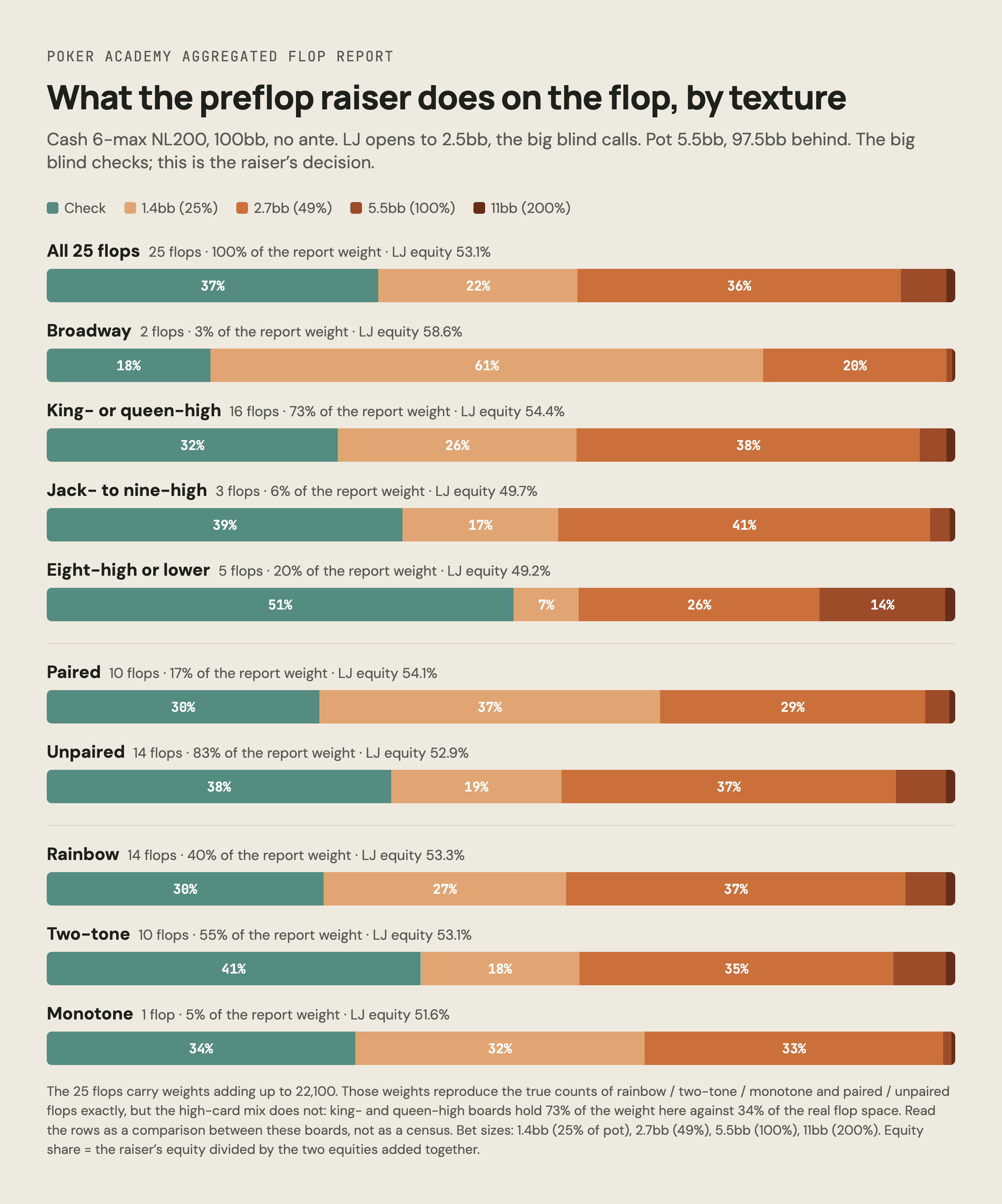
- Broadway (Q♣︎Q♦︎T♣︎ and Q♣︎Q♦︎J♥︎): 58.6% equity for the raiser against 41.4%.
- Eight-high or lower (five flops): 49.2% against 50.8%. The raiser is behind.
- Connected (two flops): 48.5% against 51.5%.
Those are the two full ranges as they arrive on the flop. The report’s board panel shows a slightly different figure, because by then the big blind has checked and checking is itself a filter. The two equities do not add up to exactly 100% (off by up to 2.8 points on one flop of the 25), so I give each side as a share of the two added together.
Nut advantage: count the combos
Nut advantage is a different claim: you hold more of the hands at the very top. Equity is an average and an average hides the top, so you can have more equity and still be the one who cannot stack off.
It is countable, and counting it is the most useful postflop habit I know. Take the two preflop ranges, delete the three flop cards from the deck, sort what is left by what it makes. Suited hands are 4 combos, offsuit 12, pairs 6, before card removal.
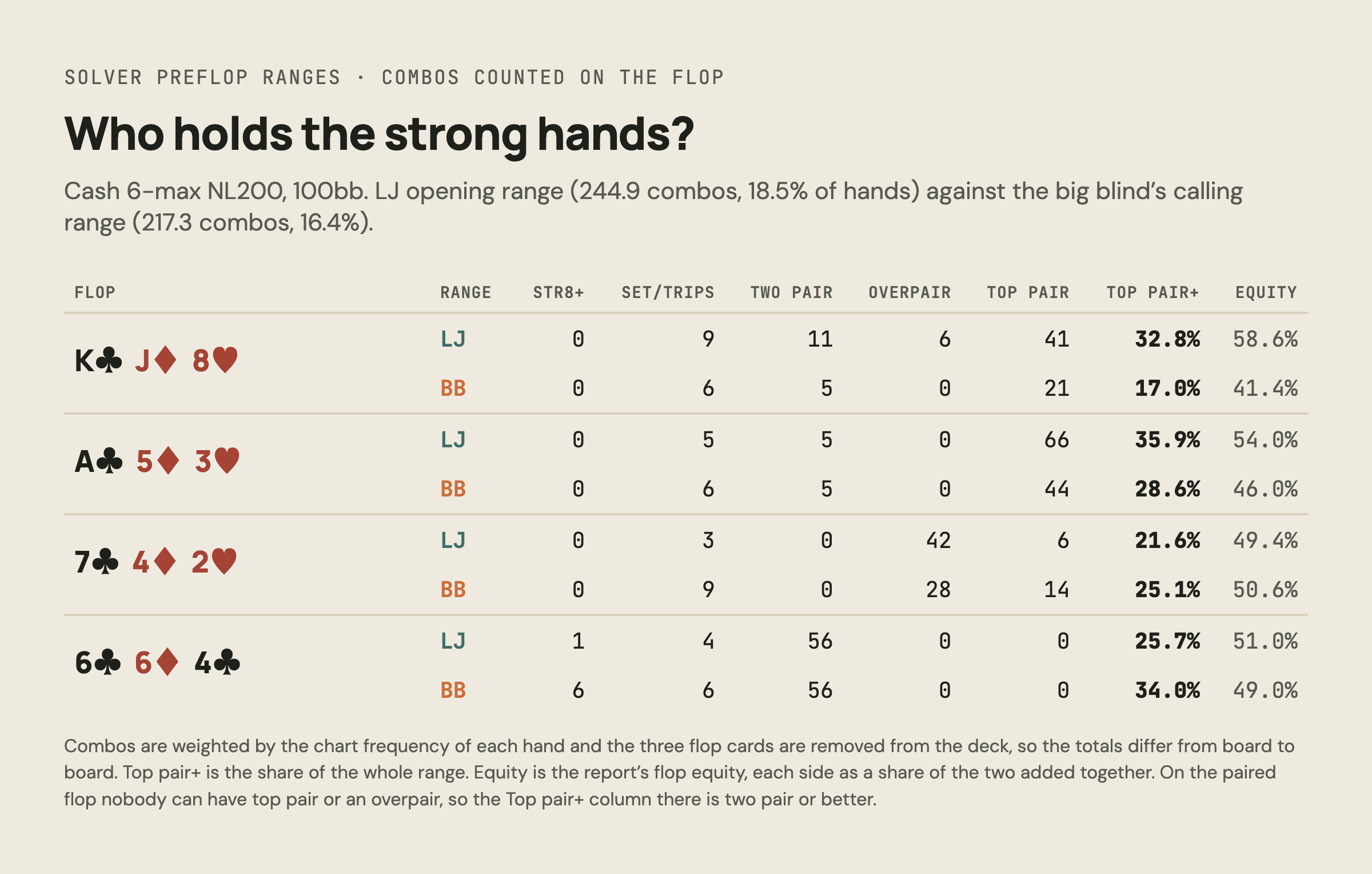
- K♣︎J♦︎8♥︎. The lojack has 6 overpair combos, the big blind zero, because AA and KK are always 3-bets. Sets 9.0 against 6.0, and the difference is exactly the missing KK. Top pair 40.9 against 20.7. Top pair or better: 32.8% of the raiser’s range, 17.0% of the caller’s.
- 7♣︎4♦︎2♥︎. Now it flips. The big blind has 8.9 set combos to 3.3: it calls 22, 33 and 44 almost always while the lojack opens 22 never, 33 1% and 44 9% of the time. Two pair or better: 4.4% against 1.4%. The raiser does hold 42.0 overpair combos to 28.1, but overpairs are not the top of this board.
- 6♣︎6♦︎4♣︎. Nobody can hold top pair or an overpair, because the board pair is the top pair. What is left is two pair or better, and the big blind has 34.0% of its range there against 25.7%.
That last board is worth staring at. A paired flop takes the hand class everybody is used to off the table and the ranking starts again lower down. It is where “my top pair is good” stops being true.
Play this spot instead of reading about it
Start Free TrialThe trainer deals the situations this article describes and grades every decision you make. Try it free for 3 days.
What the solver does with it
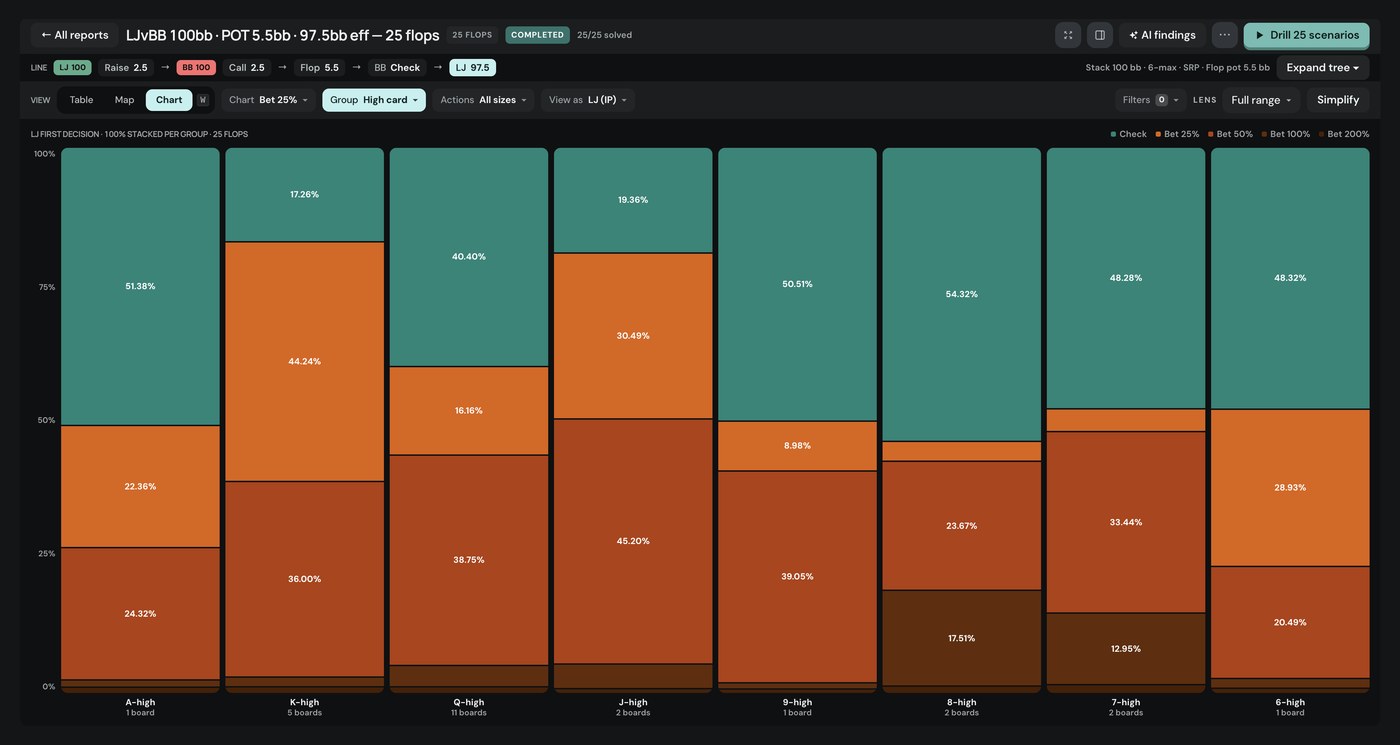
Across the 25 flops the raiser bets 63.5% and checks 36.5%. The sizes are the four above.
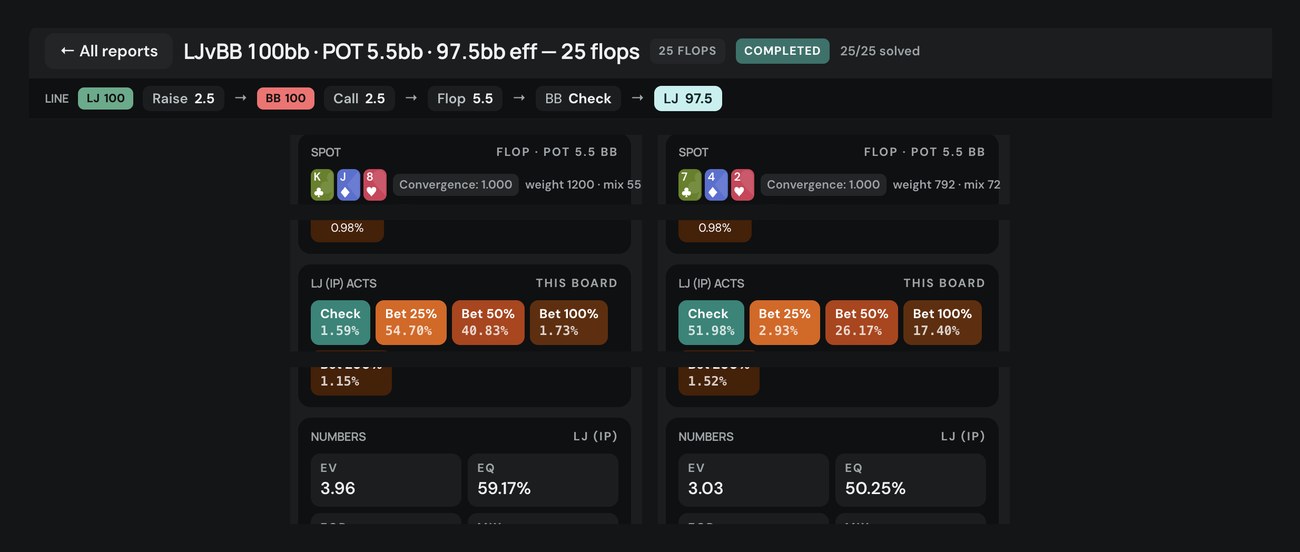
- K♣︎J♦︎8♥︎: the raiser bets 98.4%. 54.7% takes 1.4bb, 40.8% takes 2.7bb, and the full pot gets 1.7%.
- 7♣︎4♦︎2♥︎: the raiser checks 52.0%, and 17.4% of the whole range picks the full-pot size, ten times the share it gets on the king-high board.
- Broadway (the two queen-queen flops): 81.9% bet, 60.9% of the range in the 1.4bb size.
- Eight-high or lower: 48.5% bet, full pot 13.8% against 2.9% on king- and queen-high flops.
That shape is the rule of thumb everybody repeats, now with numbers under it. It is a heuristic, not something the solver announces: range advantage lets you bet often; nut advantage lets you bet big. On the king-high board the raiser’s edge is mostly top pairs, so it bets almost always and small. On the low board it has no edge in the top classes, so it bets rarely, and the part that does bet is the part that wants a big pot.
Frequencies for the same decision at other stacks and positions: continuation bets, how often and how big. If 4 / 12 / 6 was new above: starting hands, combos and notation.
The suits, on one set of ranks
The report carries the same three ranks in all three suit patterns, so the suits are the only thing that changes.
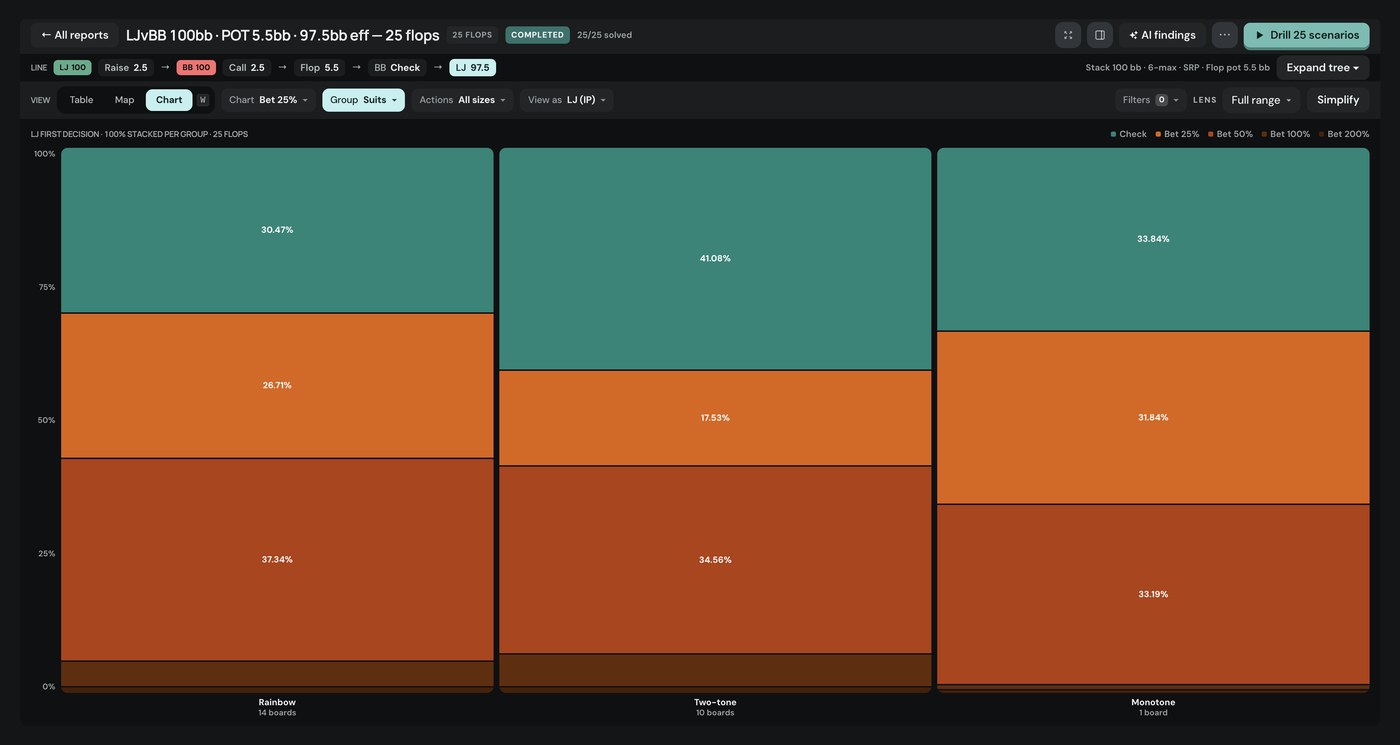
- Q♣︎8♦︎5♥︎ (rainbow): check 42.4%, full pot 8.1%.
- Q♣︎8♣︎5♦︎ (two-tone): check 45.3%, full pot 6.0%.
- Q♣︎8♣︎5♣︎ (monotone): check 33.8%. It bets more often, not less, and the 1.4bb size jumps from 3.6% of the range to 31.8% while the full pot collapses to 0.7%.
So “monotone, slow down” is half right, and the wrong half is the one people remember. Here the raiser bets more hands on the monotone board and takes it down cheaply; what disappears is the big bet. A flush is already possible, so nobody is building a big pot.
One caveat: at the 50bb spot in the c-bet article the out-of-position raiser checks monotone flops 53.9% of the time. Different position, stack and bet menu, different answer. Textures do not carry a fixed instruction across spots.
The other side: when the caller leads
The big blind acts first, so it can bet before the raiser does. Across the 25 flops it checks 85.6% of its range, and 95.7% on king- and queen-high boards. Then the board changes and so does it.
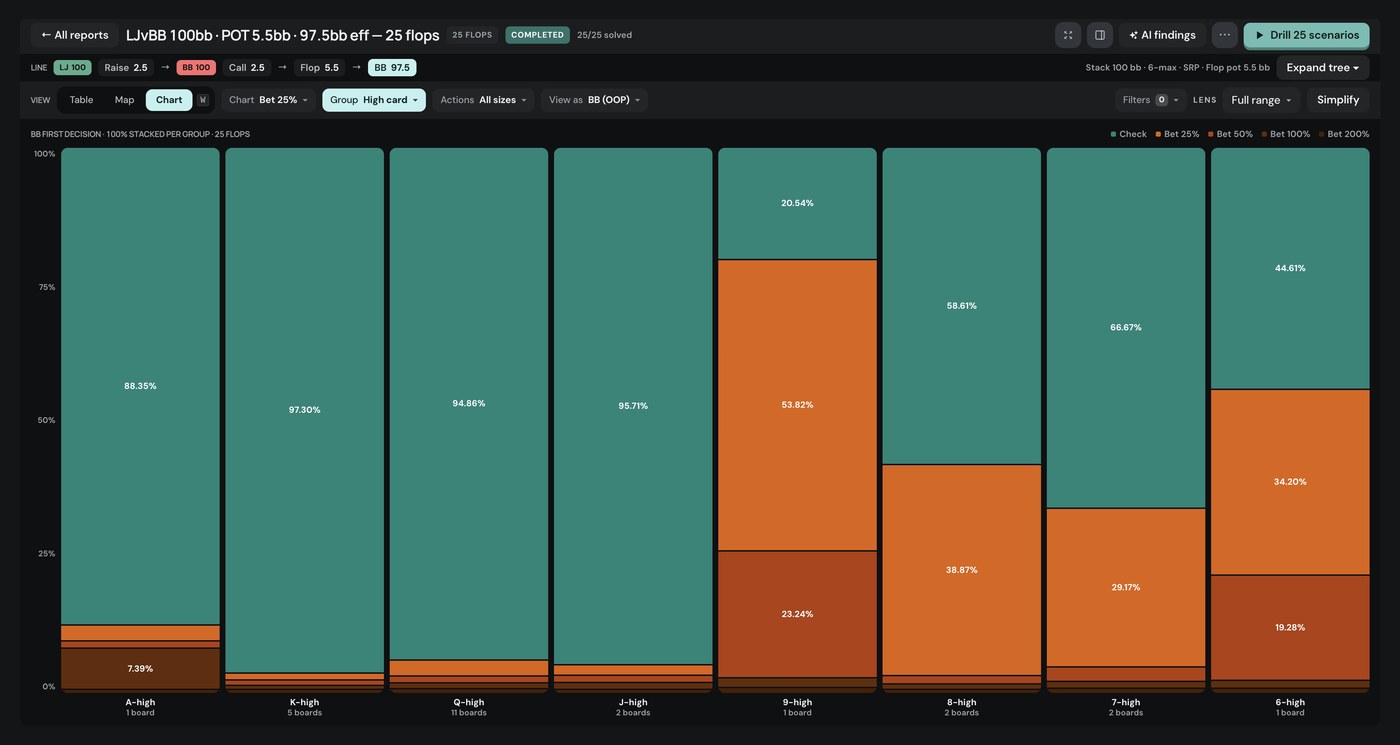
- 9♣︎7♦︎5♥︎: it bets 79.5% of its range, 53.8% at 1.4bb and 23.2% at 2.7bb. Its equity share there is 53.0% against 47.0%.
- 7♣︎4♦︎2♥︎: it bets 48.2%, almost all at 1.4bb.
- K♣︎J♦︎8♥︎: it bets 2.2%.
The 9♣︎7♦︎5♥︎ number looks wild until you check the charts. The lojack opens 98s, 97s, 75s, 86s and 95s exactly 0% of the time; the big blind calls 98s always, 97s 98% and 75s 99%. Count the combos and the lojack has zero straights and zero two pair there, against 3.5 and 3.9 for the big blind. It does hold more overpairs, 30.0 to 16.1: strong hands that do not want a big pot against a range holding every straight on the board.
A caution, because this is easy to misuse: those are one solver’s frequencies in one spot with this bet menu. Leading is not a licence to donk every low board.
The control case: a limped pot
If range advantage comes from the preflop raise, what happens when nobody raises? Heads-up MTT, 30bb. The small blind limps 1bb (781.7 combos, 59% of hands), the big blind checks (845.5 combos, 63.8%; it raises 24.4% and jams 11.9%). Pot 2.3bb, 29bb behind.
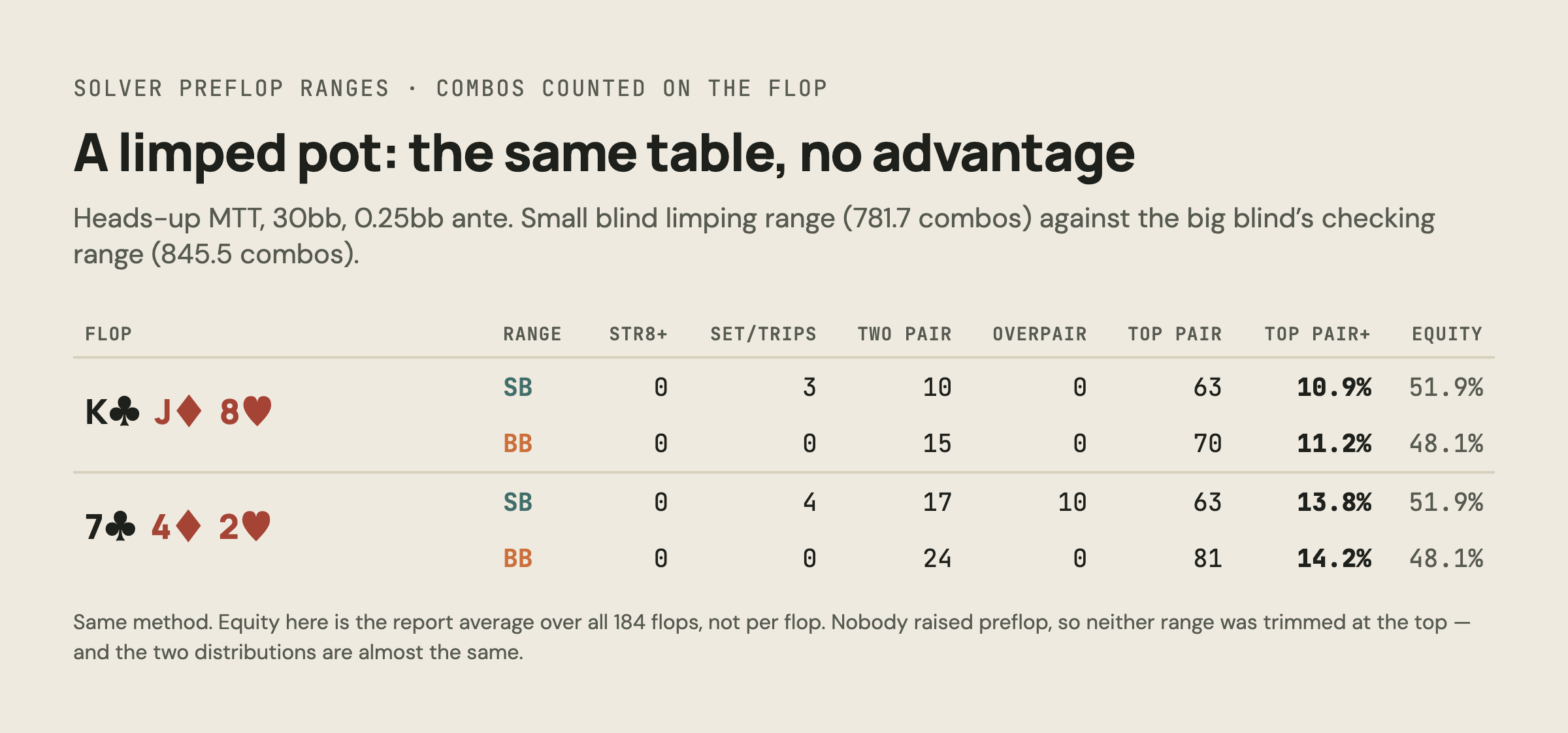
On K♣︎J♦︎8♥︎ the limper has top pair or better 10.9% of the time and the big blind 11.2%. Two pair or better: 1.9% each. On 7♣︎4♦︎2♥︎, 13.8% against 14.2%. Two wide, uncapped, nearly identical ranges. Equity over all 184 flops of report 3634: 51.8% against 48.2%, and that edge is position, not cards. This is the representative report: 22.2% of its weight sits on ace-high flops against 21.7% in the real flop space, so its totals can be read as totals.
One asymmetry survives, at the top: the big blind has no sets at all on either board, because it raises or jams every pocket pair against a limp. The limper keeps a few. The player with slightly less equity holds the only sets.
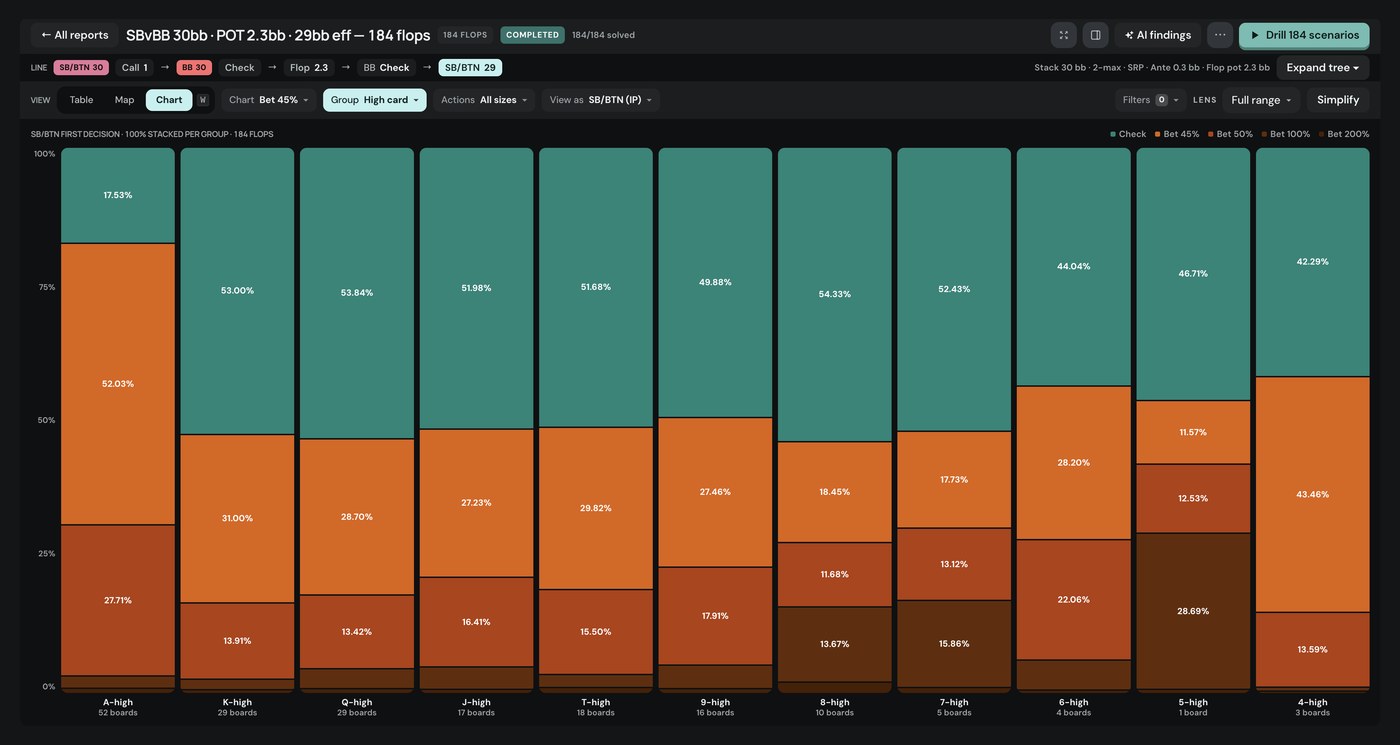
The strategy follows from that. The big blind leads 3.1% of the time over all 184 flops: where neither range is ahead, the first player checks. The limper then bets 55.6%, and 82.5% on ace-high flops, which is position plus the fact that the big blind raised its aces.
Four mistakes this fixes
- “Wet board, slow down.” Wet for whom? The raiser bets 98.4% on K♣︎J♦︎8♥︎ and checks 52.0% on 7♣︎4♦︎2♥︎. Both rainbow, both unpaired, both with an open-ender available. The ranks belong to different ranges, and that is the whole difference.
- Reading the high card and stopping. The smallest bet went from 3.5% of the range to 31.9% between the rainbow and the monotone version of the same three ranks.
- Assuming the caller is always capped. It is capped because it 3-bet its best hands. In a limped pot nobody 3-bet anything and nobody is capped.
- Treating top pair as the top of the range. On a paired board there is no top pair. On a low board the sets belong to the caller.
The habit is short. Look at the flop, answer the four questions, then ask which hands each range can have that beat one pair. If you cannot answer that, the size you pick is a guess.
Cheers! 🙂
Keep reading
All posts
Poker Academy
Stop guessing preflop.
1,500,000+ GTO preflop solutions. Try them free for 3 days.
Start Free TrialCancel anytime.