
Practice: Know what your mistakes actually cost
 Jan Przysucha
Founder of Poker Academy. Writes the product guides and updates on this blog.
~7 min read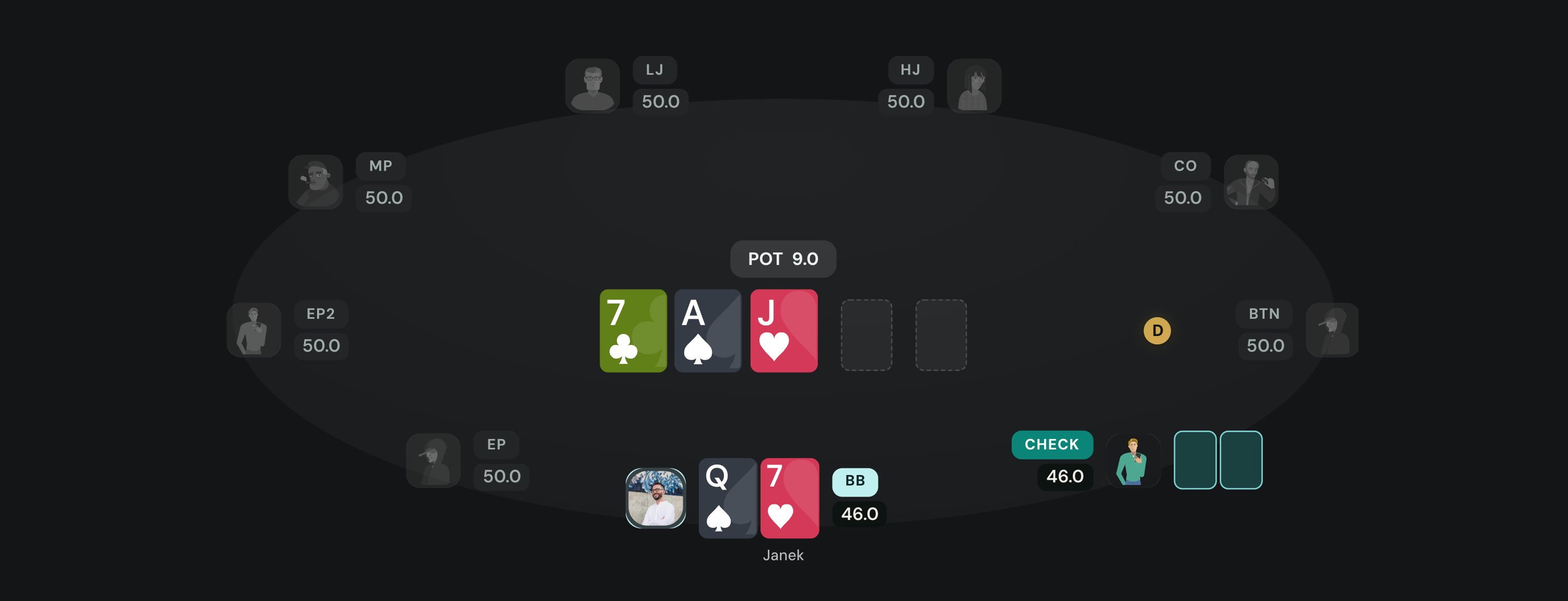
Every player I know can tell you their worst hand of the year.
Nobody can tell you what it cost them.
Not “I got coolered” – an actual number. How many big blinds that call gave away. That is the thing I wanted for years and never had, and it is why Practice exists in the shape it does.
You play the whole hand. Not a quiz question.
Most trainers stop exactly where poker gets hard. Preflop spot, pick an action, tick or cross, next.
That is not poker. That is flashcards.
In Practice you get dealt into a seat with a stack, blinds and antes. Players in front of you act. You make your preflop decision – and if the hand goes on, you see a flop, a turn, a river. The pot, the stacks and both ranges carry forward from what actually happened, and the opponent answers from solver strategy at every node.
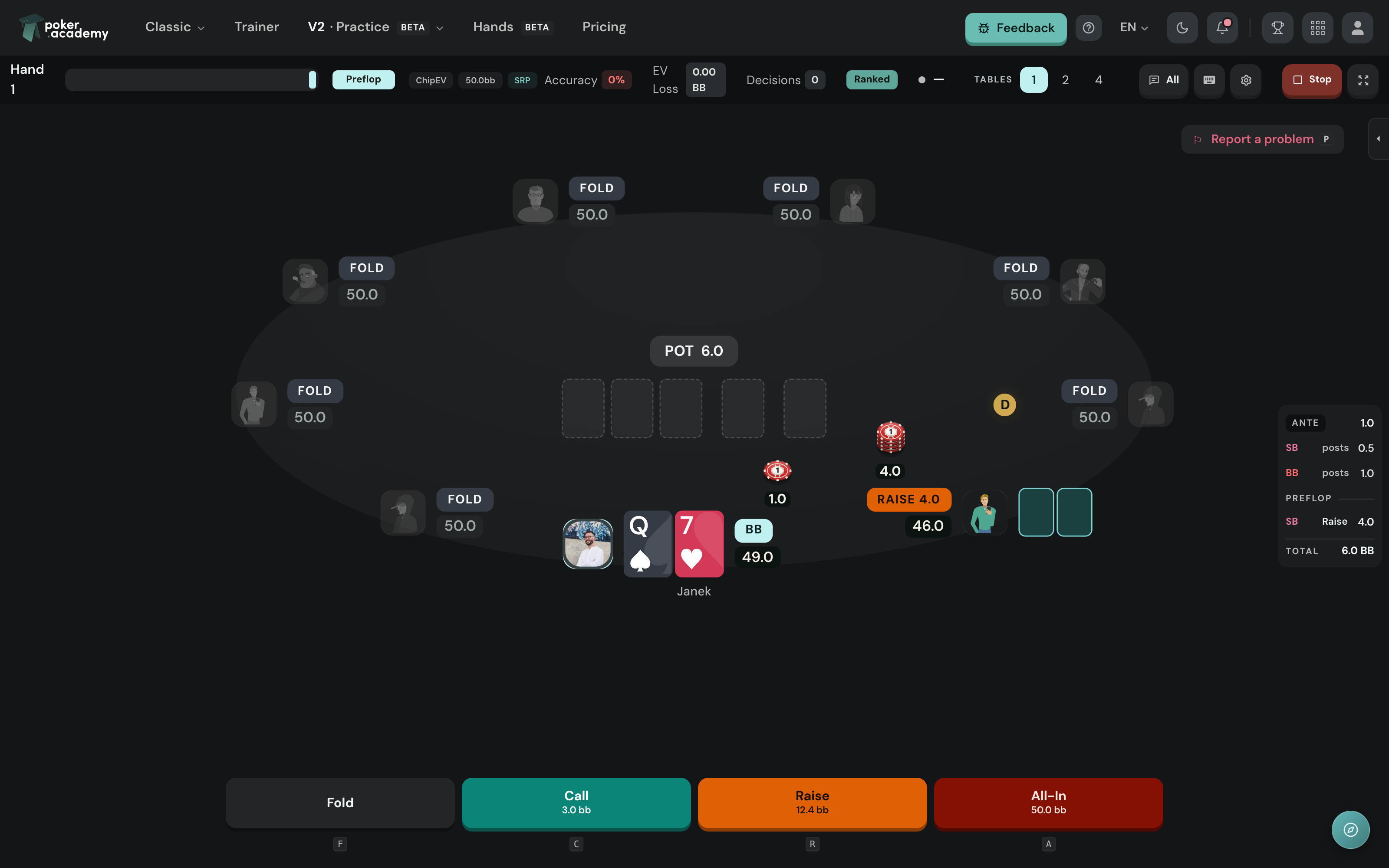
Every number on that felt checks out. Ante 1 bb, blinds 0.5 and 1 – that is 2.5 in the middle. Small blind raises to 4, so the pot is 6. You owe 3 more.
Pot odds: 3 / (6 + 3) = 33.3%. Exactly what the panel says. Do that arithmetic yourself – I want you to.
Postflop, every bet size is named as a percentage of the pot with the big blinds worked out for you, so you always know what a size actually costs before you press it.

Then it tells you the price
This is the part I care about most.
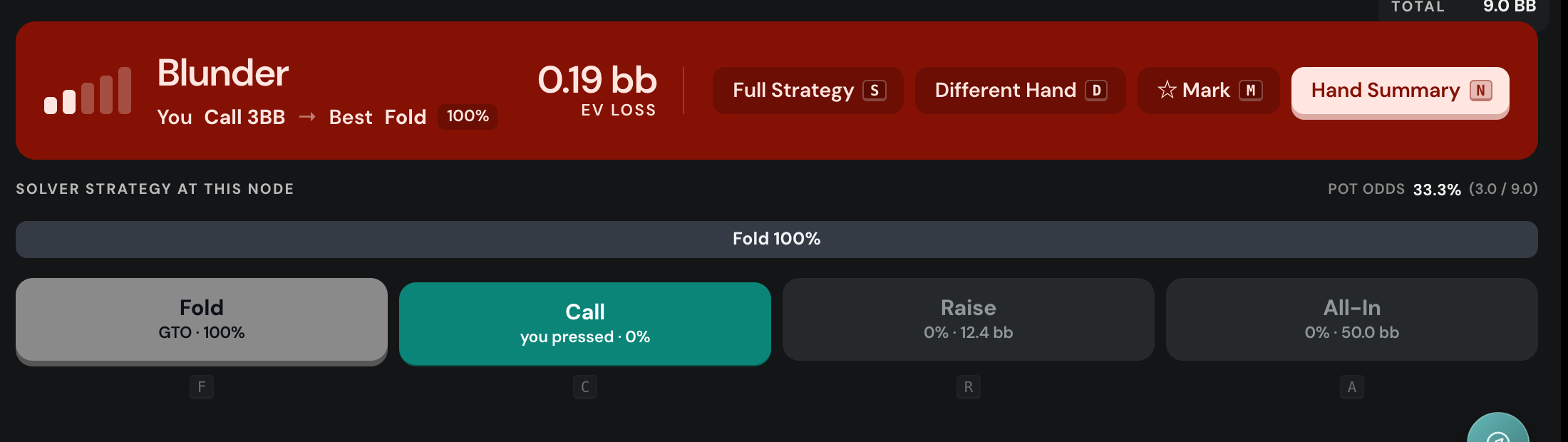
You are not told you were wrong. You are told what it cost you: 0.19 bb.
Best, correct, inaccuracy, mistake, blunder – and the grade comes from how much EV you gave up against the pot, not from a list of approved buttons. A call that costs a hundredth of a big blind and one that torches half the pot are not the same error, and any trainer that paints both red is teaching you nothing.
Your range calls. Your hand folds. Both are true.
If you take one thing from this post, take this one. I have got it wrong myself more times than I want to write down.
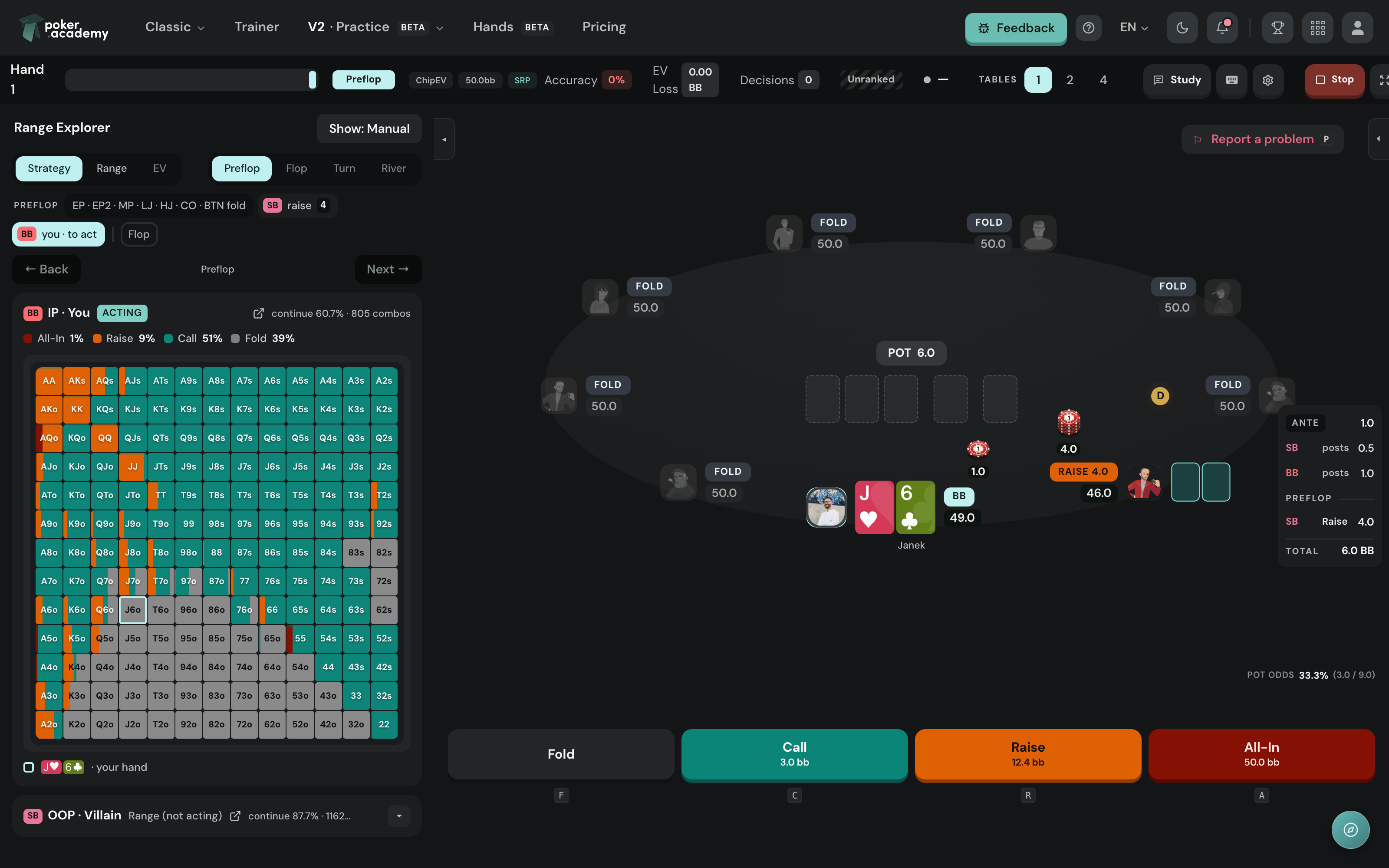
Facing that raise, the big blind range continues 60.7% of the time across 805 combos. Calling looks fine. But the hand was J♥6♣, and for that combo, at that node, the solver folds 100% of the time.
Both are correct – they answer different questions, and swapping one for the other is how you talk yourself into calls a chart seems to bless. So we put them side by side in plain words: Solver, with this hand and Solver, across the whole range.
You decide what gets dealt
Random hands are a waste of your evening. So you tell it what to deal before you sit down.
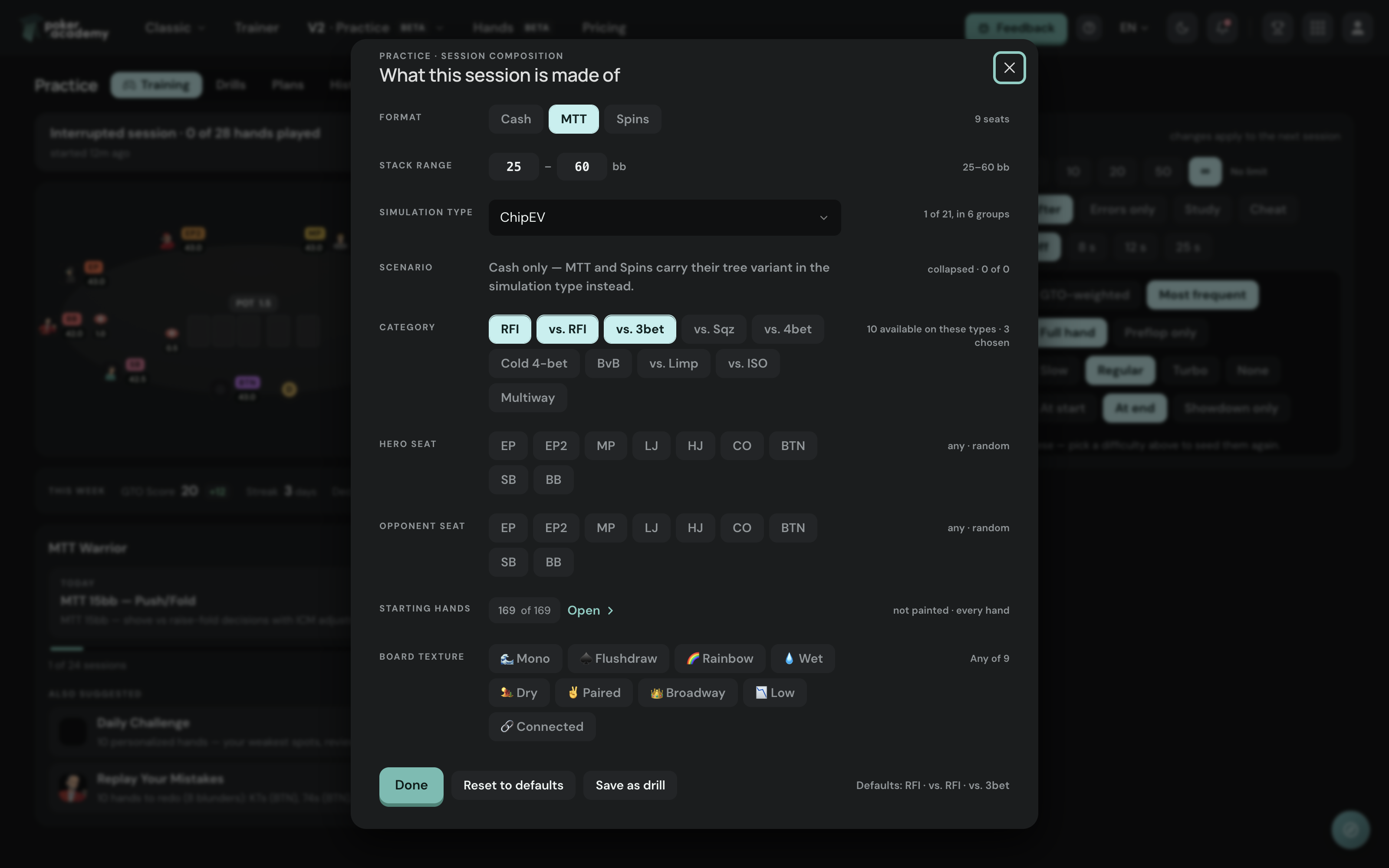
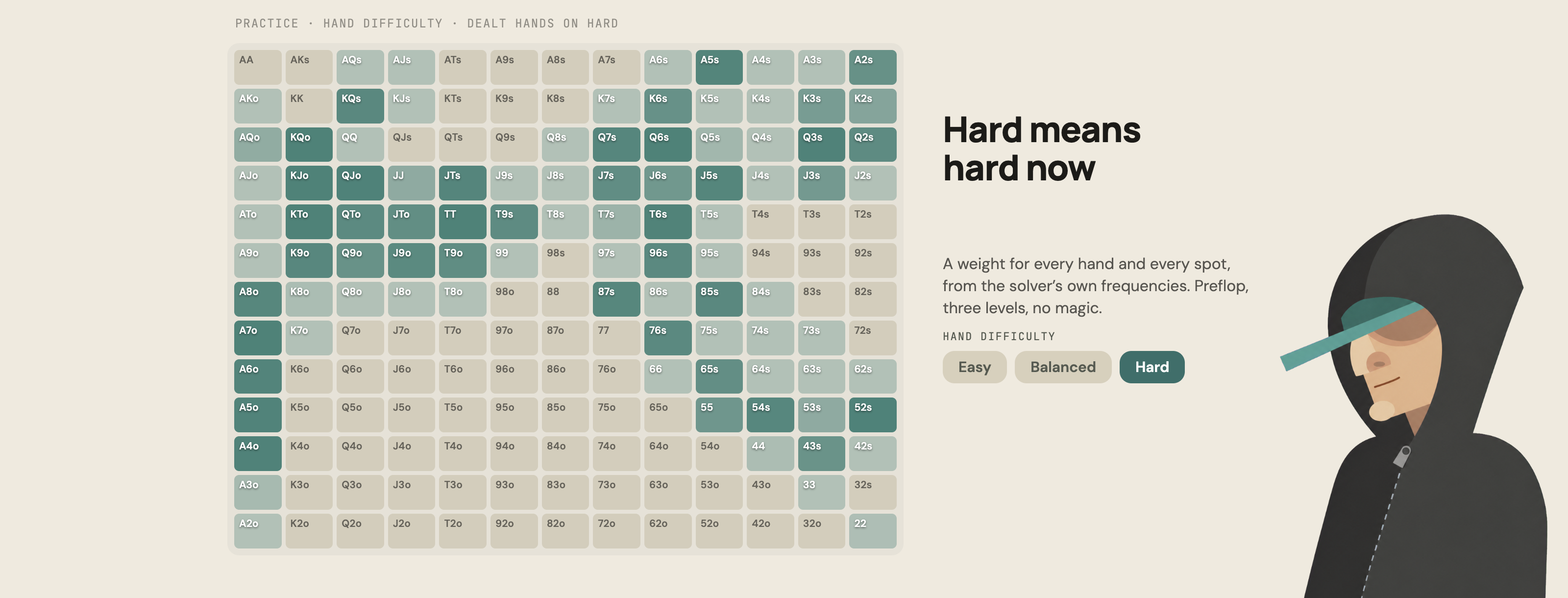
Cash, MTT or Spin & Go. Any stack range. Ten preflop categories – opens, facing a raise, three-bets, squeezes, blind versus blind, limped pots. Pin your seat, your opponent’s, or neither. Narrow to board textures, or to specific starting hands if a class of holding keeps butchering you. Mine is offsuit broadways out of position.
Play this spot instead of reading about it
Start Free TrialThe trainer deals the situations this article describes and grades every decision you make. Try it free for 3 days.
The other half of the cockpit is how it behaves.
| How it plays | Your options |
|---|---|
| Hands | 5 · 10 · 20 · 50 · no limit |
| Feedback | Study · After · Errors only · Cheat |
| Clock | Off · 8s · 12s · 25s |
| Opponent | Samples solver frequencies · always most frequent |
| Villain cards | At start · at end · showdown only |
| Tables at once | 1 · 2 · 4 |
That last row is the one people miss. Practice can deal four tables at once, each running its own hand.
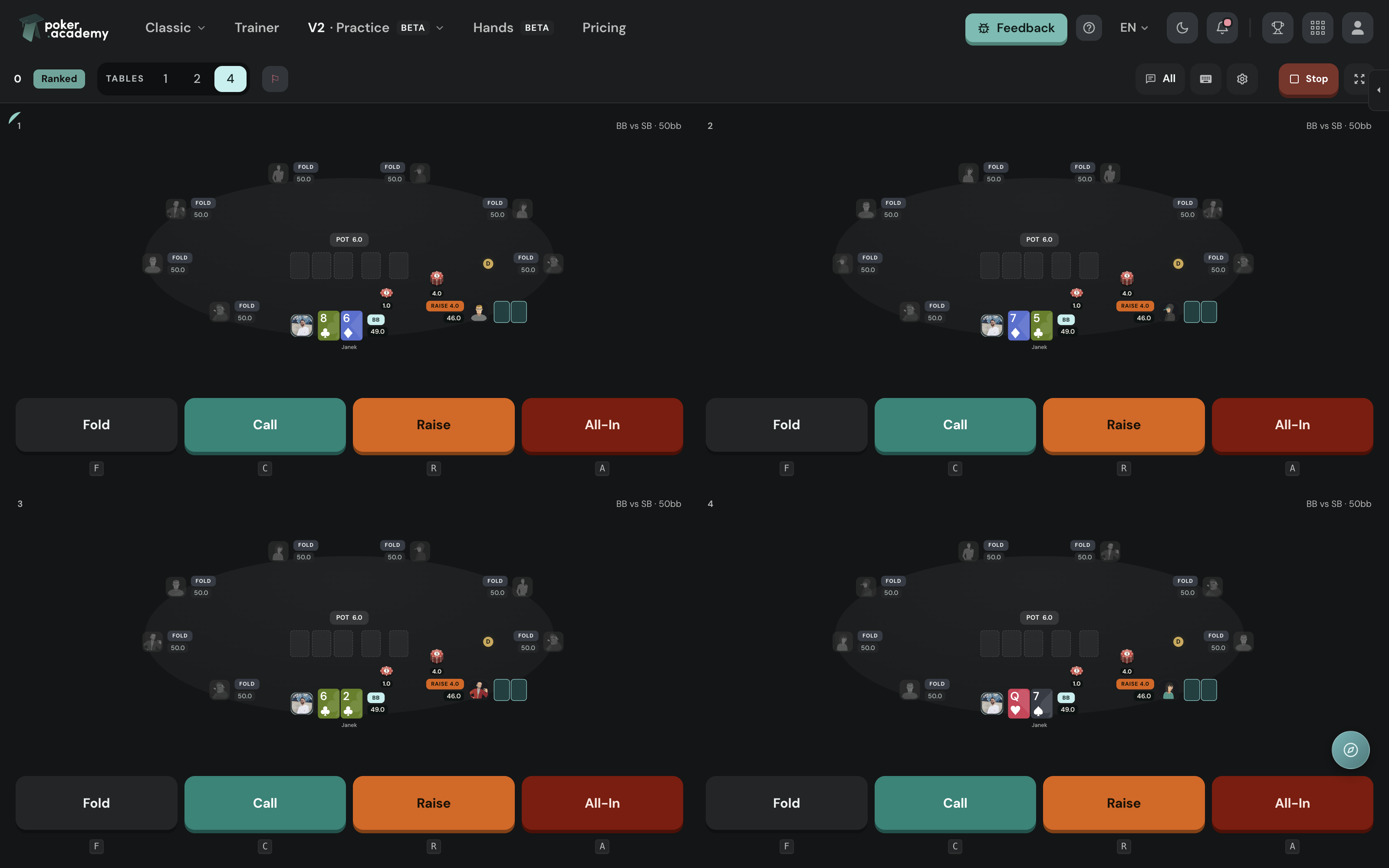
Not a gimmick – the closest thing to the pressure of a real session. Multi-tabling costs you the same EV here as it does online, except here somebody counts it.
Four ways to be told you are wrong
Only After and Errors only count towards your ranked stats. A decision made while staring at the answer measures nothing, and I am not going to let the app flatter you.
Turn your leak into a machine
Anything you can configure, you can save as a drill and start with one click. Blind versus blind at 20 bb. Facing a three-bet in position, 100 bb deep, paired boards.
Every drill keeps its own record – runs, dates, accuracy – so the list stops being a menu and becomes a scoreboard. Mine says blind-versus-blind went 33% → 44% → 62%, and that the cold four-bet drill I built a month ago is still on 0% because I have been avoiding it. Uncomfortable in a useful way.
There is a catalogue of ready-made drills next to your own, so you do not have to build them all yourself. Plans go further: multi-week structures, six sessions a week, each day with its own setup waiting. If you have ever opened the app thinking “no idea what to work on today” – that is what this is for.
Mark the hands that bug you
One key during a session flags a hand for later. They pile up in Marked – every hand you pressed M on, across every session you have played.
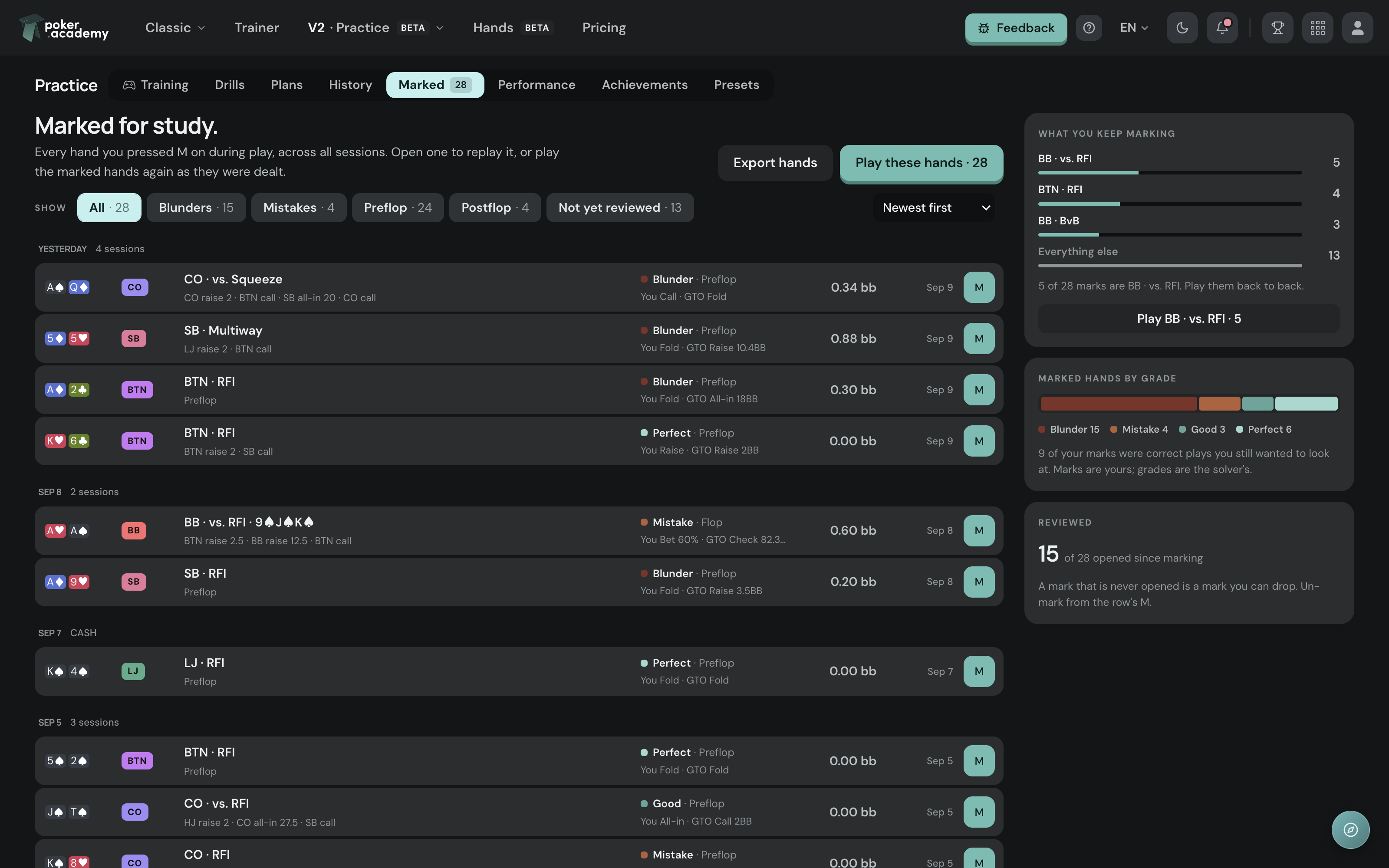
Two things there are smarter than I expected when we built them.
It looks for a pattern in what you flag. If five of your marks are big blind facing an open, it says so – and offers to deal those five back to back. Your instinct about which hands were interesting turns into a drill without you noticing the theme yourself.
And it splits them by grade. Plenty of marked hands are not errors: nine of my twenty-eight were correct plays I still wanted to see again. The screen says it plainly – marks are yours, grades are the solver’s. It also counts how many you actually went back to. Mine says 15 of 28.
Opening one gives you the replayer: the hand street by street, your decision at every node, the verdict, and the solver strategy beside it – for your exact combo and for the whole range.
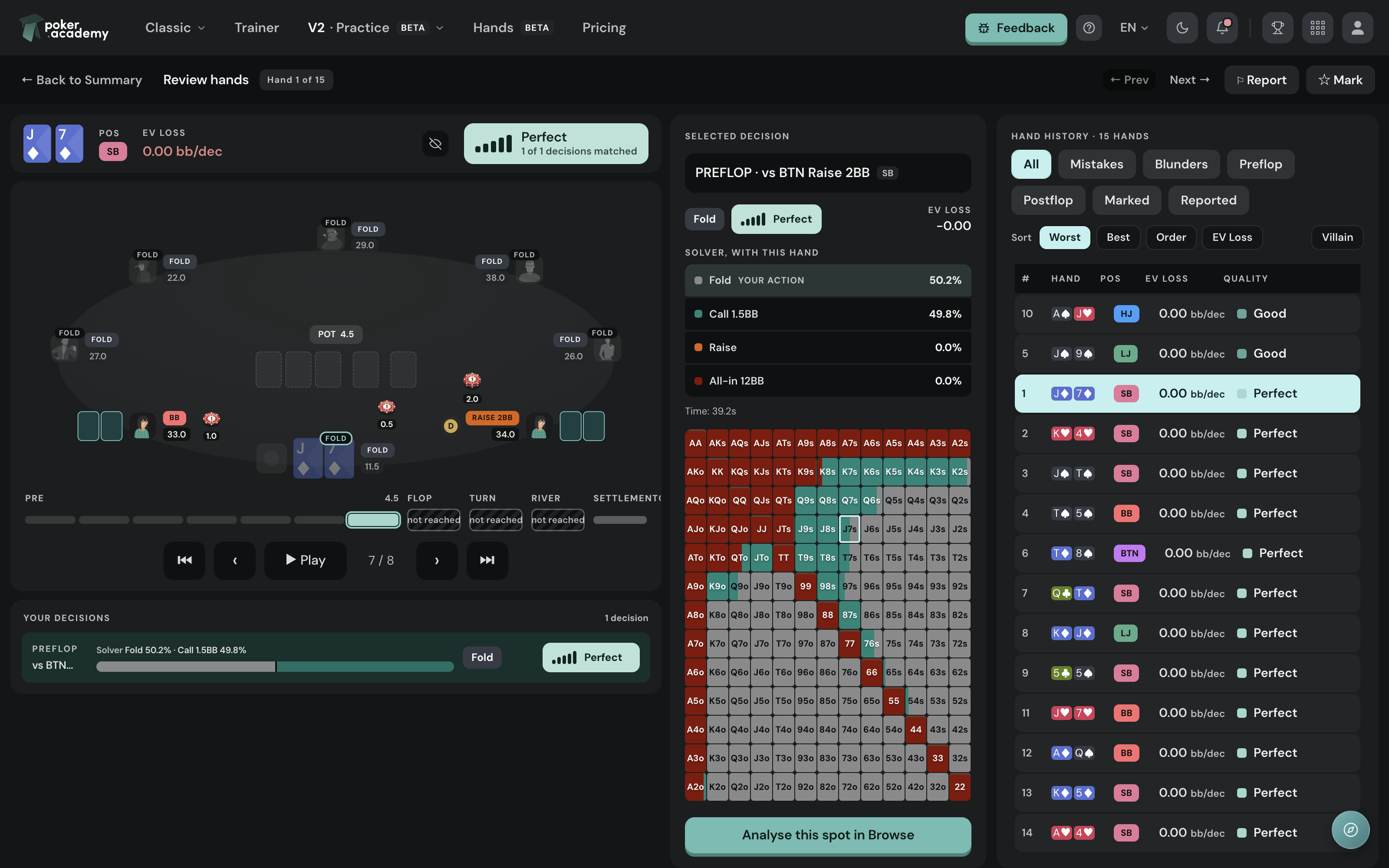
Playing 400 hands teaches you almost nothing by itself.
Playing 400 hands, flagging the 11 that confused you, and then actually sitting with those 11 – that is a study session. The first is just clicking.
And then the part that hurts
Every graded decision goes into your record. Seven days, thirty, ninety.
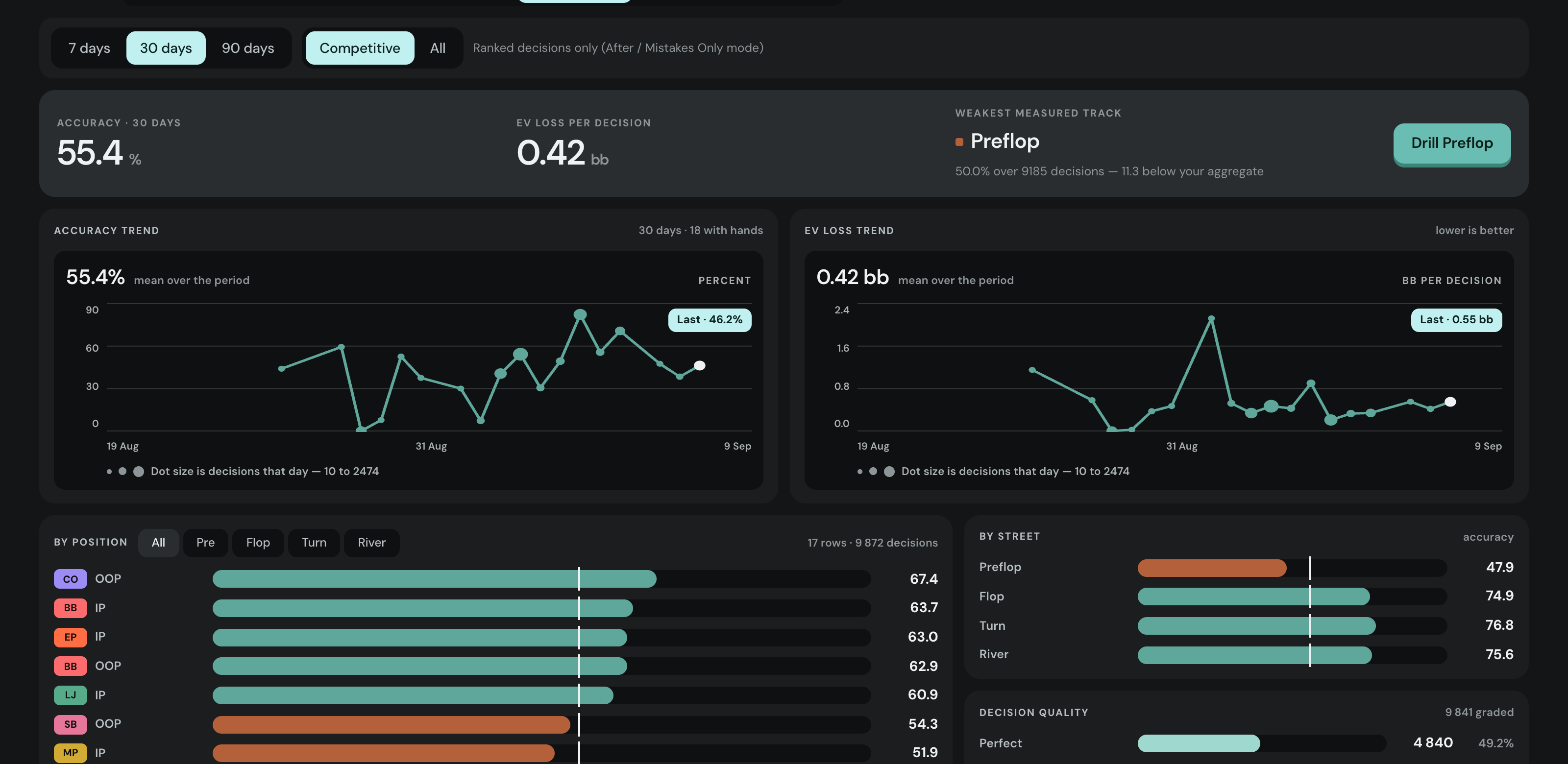
Two headline numbers: accuracy, and average EV loss per decision. Then the breakdowns that actually find the leak – by position and by street. That is how you learn your flop play is fine and your preflop is quietly bleeding.
It also names your weakest measured track, tells you how far below your own average it sits, and puts a button right there that drills exactly that. When it stops being your weakest, the app tells you that too.
One promise about the numbers
Every frequency, every EV figure, every verdict comes from solved solutions, read at the node you are standing on. No lookup table of “typical” frequencies. No heuristic wearing a solver costume. And when there is no solved data for a spot, the app says so instead of inventing a number.
A trainer that always has an answer is a trainer that is sometimes making it up – and you would never know which times.
Start here
Open Practice. Leave the defaults. Set feedback to After. Play 20 hands. Ten minutes.
You will finish with a verdict on every decision and a number for what the session cost you. Then read the review, mark what surprised you, and turn the recurring one into a drill.
Play, review, narrow, repeat. That loop is the entire product.
Go find out what your calls actually cost. Cheers! 🙂
Related posts
More in Update
Poker Academy
Stop guessing preflop.
1,500,000+ GTO preflop solutions. Try them free for 3 days.
Start Free TrialCancel anytime.