
Poker hand rankings explained: every hand, how rare it is and why
 Filip PedzichUpdated· first published ~10 min read
Before ranges, pot odds or solvers, you need to know which hand wins. This guide covers the ten hand rankings used in Texas Hold’em and Omaha, with an example of each in real cards and a count of how rare each one is.
I also fixed a few things the older version of this post got wrong: the name of a full house, the odds of flopping a set, and whether A♠︎K♠︎ really beats a pair of tens.
The basics: best five cards win
Hold’em uses a standard 52-card deck. You get two private cards, the hole cards. Five community cards go on the board. At showdown every player makes the best five-card hand out of those seven cards, and the best hand wins the pot.
You can use both hole cards, one, or none. If the board is better than anything you can make with your cards, you “play the board”.
Omaha uses the same rankings with one rule change: you get four hole cards and must use exactly two of them plus exactly three board cards. Four hearts on the board and one heart in your hand is not a flush in Omaha.
Poker hand rankings, best to worst
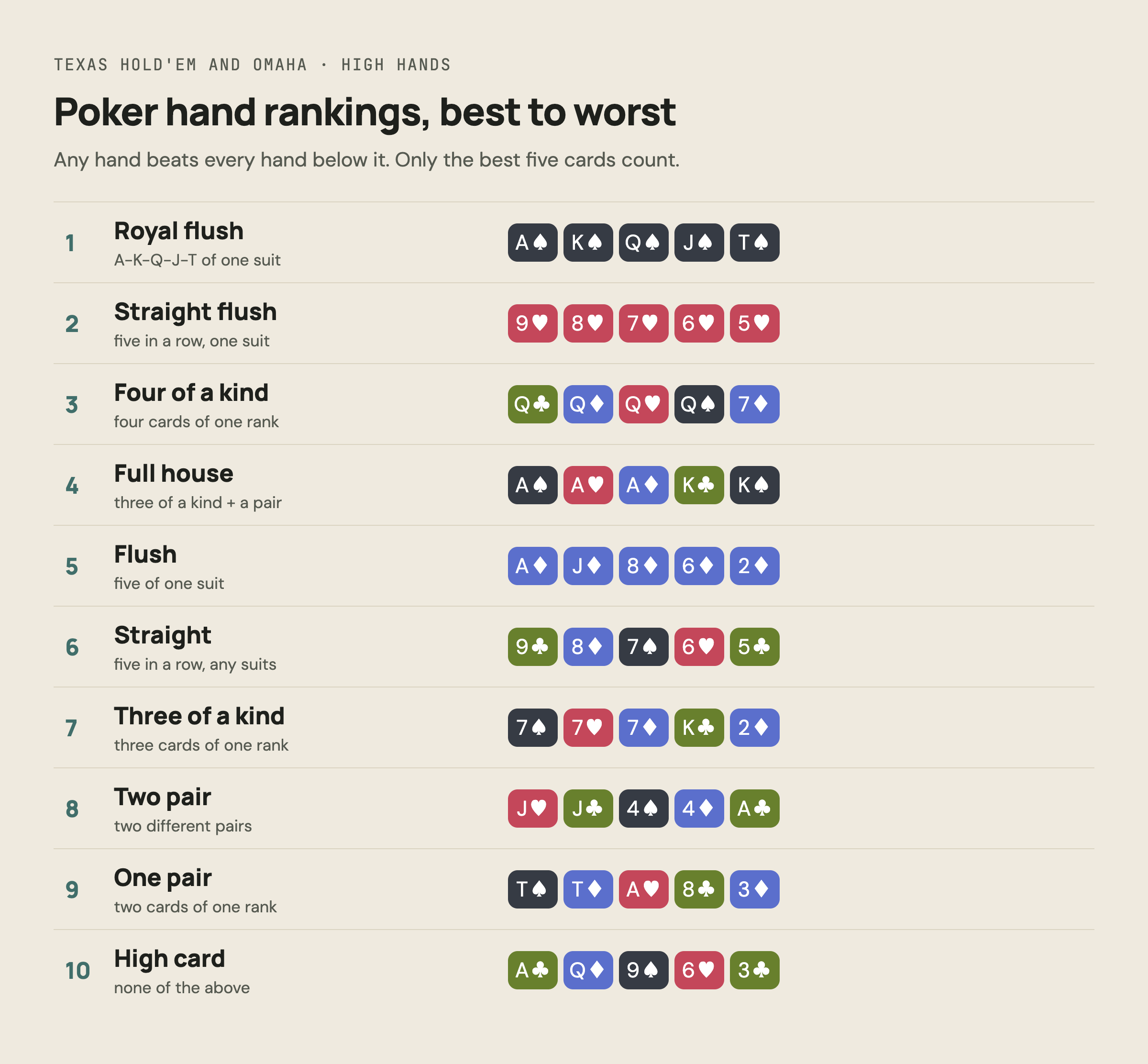
- Royal flush: A♠︎ K♠︎ Q♠︎ J♠︎ T♠︎. The ace-high straight flush. There are only four, one per suit.
- Straight flush: five cards in a row of one suit, like 9♥︎ 8♥︎ 7♥︎ 6♥︎ 5♥︎. Between two straight flushes, the higher top card wins.
- Four of a kind (quads): Q♣︎ Q♦︎ Q♥︎ Q♠︎ 7♦︎. Higher quads win; if both players share quads on the board, the fifth card decides.
- Full house: three of a kind plus a pair. A♠︎ A♥︎ A♦︎ K♣︎ K♠︎ is aces full of kings: the three cards name the hand, the pair comes after “full of”.
- Flush: five cards of one suit, like A♦︎ J♦︎ 8♦︎ 6♦︎ 2♦︎.
- Straight: five cards in a row, any suits, like 9♣︎ 8♦︎ 7♠︎ 6♥︎ 5♣︎.
- Three of a kind: 7♠︎ 7♥︎ 7♦︎ K♣︎ 2♦︎. With a pocket pair plus one card on the board it’s called a set; with one card in your hand and two on the board, trips.
- Two pair: J♥︎ J♣︎ 4♠︎ 4♦︎ A♣︎. Compare the higher pair first, then the lower pair, then the fifth card.
- One pair: T♠︎ T♦︎ A♥︎ 8♣︎ 3♦︎. Higher pair wins; with the same pair, the kickers decide.
- High card: A♣︎ Q♦︎ 9♠︎ 6♥︎ 3♣︎. No pair, no straight, no flush. Compare the highest card, then the next, down to the fifth.
Why this order? Rarer hands rank higher
Deal five cards from a shuffled deck and count every possible hand: there are C(52,5) = 2,598,960 of them. The fewer ways a hand can be made, the higher it ranks.
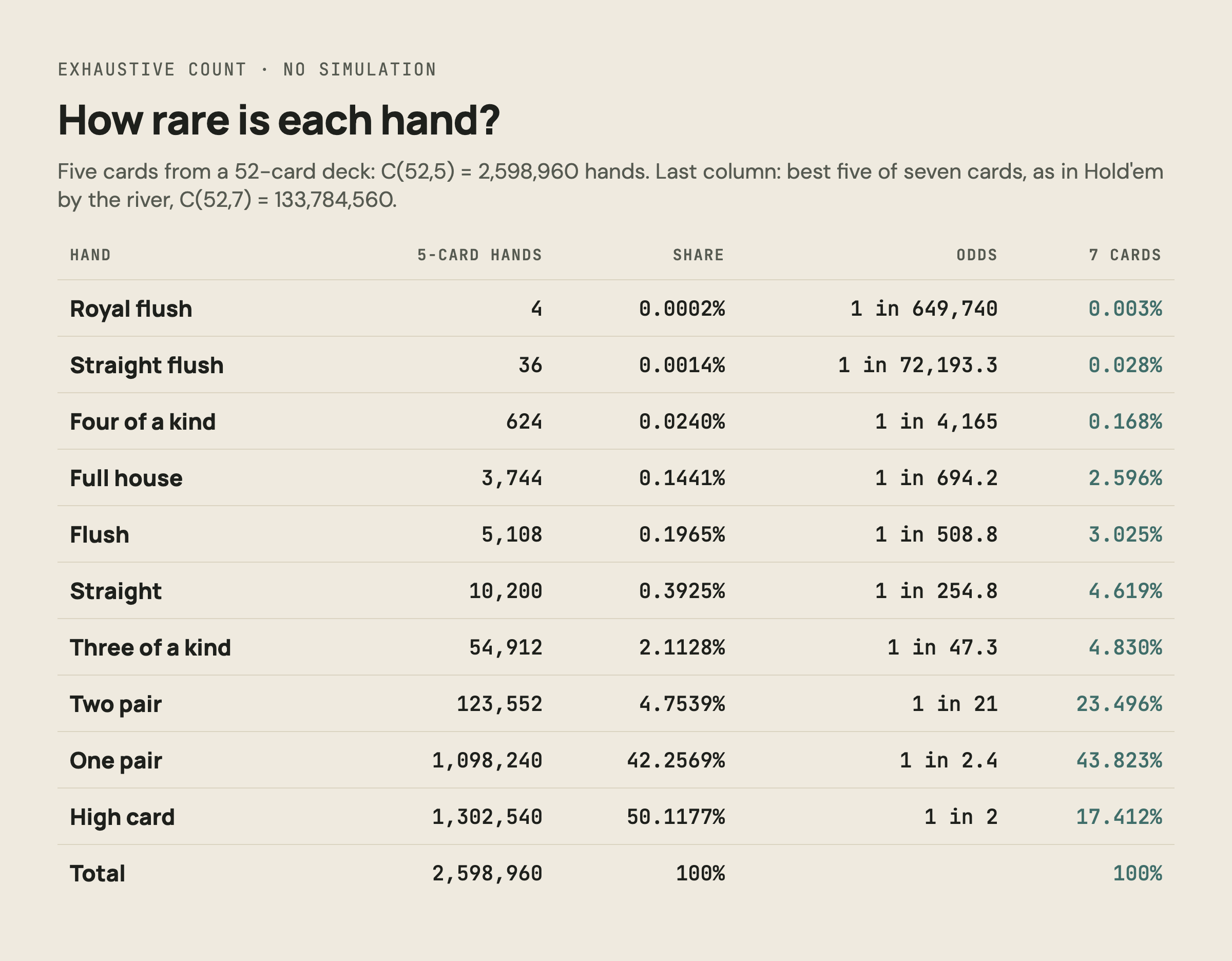
Two rows are worth checking by hand, because they explain the most common beginner question: why does a full house beat a flush?
Full houses: rank of the three × suits × rank of the pair × suits
Flushes: 5 ranks of one suit, minus the 40 straight flushes
There are fewer full houses (3,744, or 1 in 694) than flushes (5,108, or 1 in 509), so the full house ranks higher.
The last column breaks that pattern. When you choose the best five of seven cards, high card (17.4%) is rarer than two pair (23.5%). The ranking stays the same anyway, because it is defined on five-card hands.
Ties, kickers and split pots
When two players have the same kind of hand, the cards inside it decide. These are the cases that cause most of the arguments at the table.
Full house against full house. Compare the three of a kind first. On a board of K♠︎ K♦︎ A♣︎ 7♥︎ 2♠︎, a player with A♥︎ A♦︎ has aces full of kings (A-A-A-K-K). A player with K♥︎ A♠︎ has kings full of aces (K-K-K-A-A). Aces full wins, even though the other player holds the case king.
Kickers. On K♣︎ 8♦︎ 5♥︎ 3♠︎ 2♣︎, K♥︎ Q♦︎ and K♠︎ J♥︎ both have a pair of kings. The next card decides: queen beats jack, so K♥︎ Q♦︎ wins. Only the best five cards play, so a sixth or seventh card never breaks a tie.
Play this spot instead of reading about it
Start Free TrialThe trainer deals the situations this article describes and grades every decision you make. Try it free for 3 days.
Flush against flush. Compare the five flush cards from the top, one by one. On A♥︎ 9♥︎ 6♥︎ 2♣︎ J♦︎, K♥︎ 3♥︎ makes A-K-9-6-3 and Q♥︎ T♥︎ makes A-Q-T-9-6. The ace is shared, the king beats the queen, and that settles it. The lower cards only matter when the higher ones match.
Split pots. If the best five-card hands are exactly equal, the pot is split. That is true in every standard variant. In Hold’em it usually happens when the board plays: on 5♥︎ 6♦︎ 7♣︎ 8♠︎ 9♥︎, both A♣︎ A♦︎ and K♠︎ 2♦︎ play the nine-high straight on the board and chop. A player with T♦︎ 3♣︎ would win alone with a ten-high straight.
Two players can only split a royal flush if all five cards are on the board, like A♠︎ K♠︎ Q♠︎ J♠︎ T♠︎. Nobody’s hole cards can improve that hand, so every player still in the hand shares the pot.
Suits never break a tie. A spade flush is not better than a heart flush.
The ace plays high and low
In Hold’em and Omaha the ace is both the highest and the lowest card in a straight. A-2-3-4-5 (the wheel) is the lowest straight, five-high. T-J-Q-K-A is the highest. On A♣︎ 2♦︎ 3♥︎ K♠︎ 9♣︎, 4♠︎ 5♦︎ makes the wheel.
A straight can’t wrap around the ace. Q-K-A-2-3 is not a straight; on Q♣︎ K♦︎ A♥︎ 2♠︎ 3♣︎, 9♥︎ 8♥︎ has only ace-high.
Other variants rank hands differently
These rankings are the same in Texas Hold’em and Omaha, which is what most people play. They are not the same everywhere:
- Lowball games such as Razz and 2-7 Triple Draw reward the worst hand. In 2-7 straights and flushes count against you; in Razz they don’t count at all.
- Short Deck (six-plus Hold’em) removes the 2s to 5s. With fewer cards a flush is harder to make, so a flush beats a full house there.
- Hi-lo games like Omaha Hi-Lo split the pot between the best high hand and the best qualifying low hand.
If you sit down in anything other than Hold’em or Omaha, check the house rules first.
How often do you flop a set?
A pocket pair flops a set or better about 11.8% of the time, roughly 1 in 8.5 flops. The old version of this article said 10%. You hold 7♠︎ 7♥︎, so 50 cards are left and two of them are sevens. Count the flops without a seven:
Flop a set or better with a pocket pair
That includes the rare flops with both remaining sevens: 48 of 19,600, or 0.24%, where you flop quads. The set alone (including sets that are already a full house) is 2,256 flops, 11.5%.
Starting hands: what the ranking means before the flop
Hand rankings tell you who wins at showdown. Before the flop you only have two cards, so starting hands are ranked by how much money they make, and that depends on the spot. Take a real one: a 6-max cash game, 100bb deep, no ante, action folds to the lojack (LJ), the first player to act.
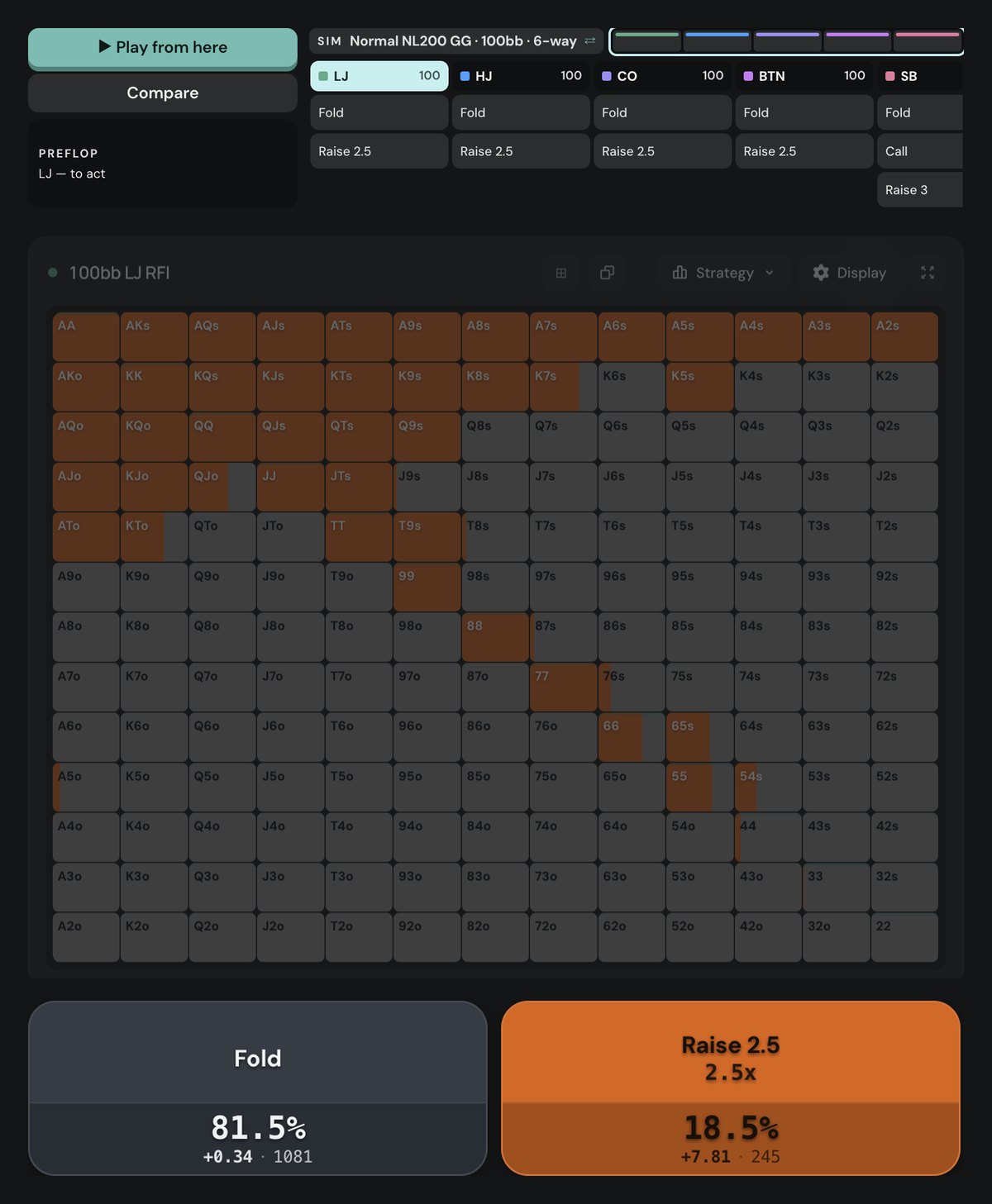
Each square of the 13×13 grid is one starting hand: pairs on the diagonal, suited hands above it, offsuit hands below. The solver opens 18.5% of hands from the lojack. The same chart shows how much each open is worth, so the ranking below comes from data instead of memory.
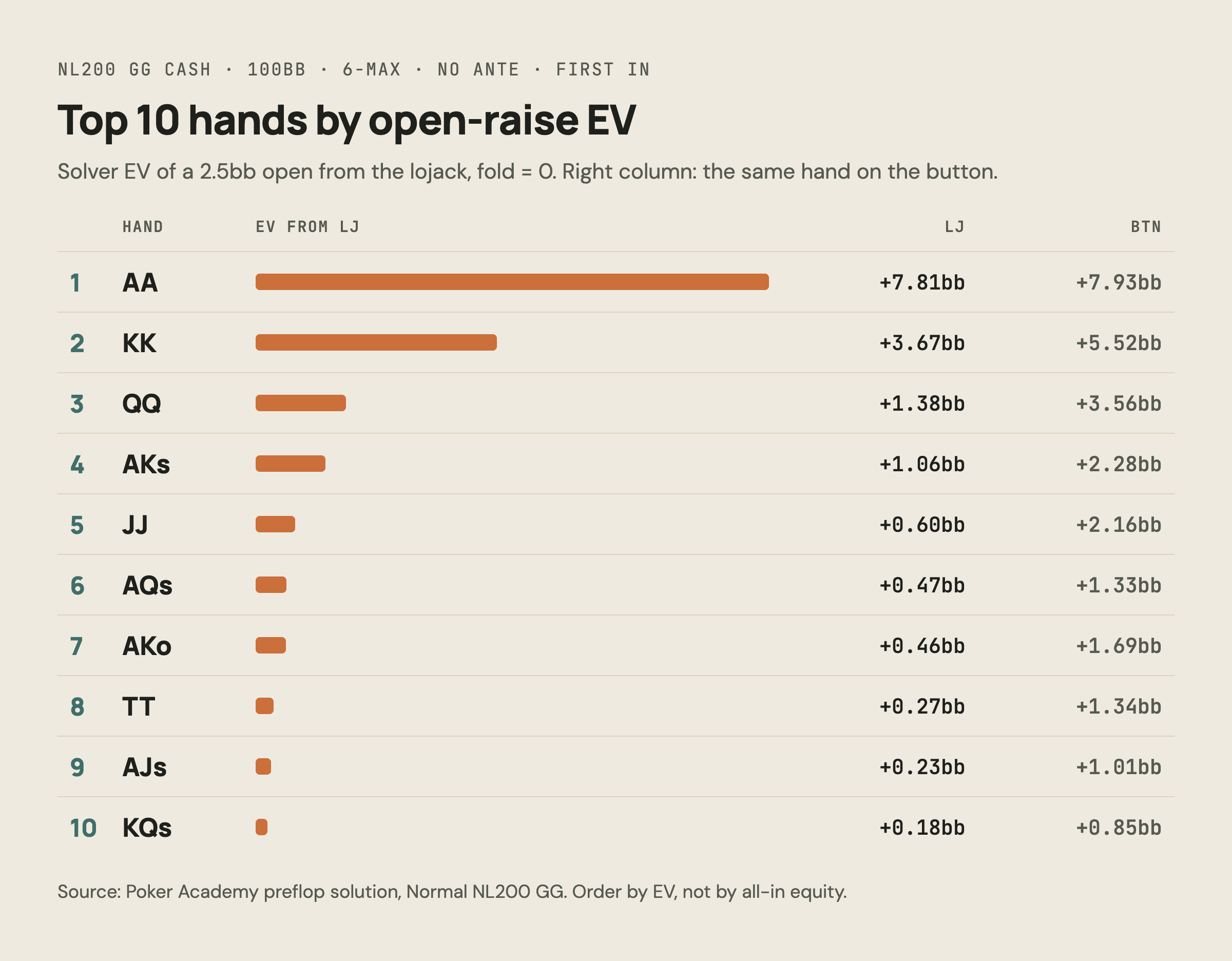
AA is the best starting hand by a mile: +7.81bb for an open from the lojack. After KK and QQ comes AKs at +1.06bb, ahead of JJ (+0.60bb) and TT (+0.27bb). On the button AKs (+2.28bb) is still ahead of JJ (+2.16bb) and TT (+1.34bb).
That does not mean A♠︎K♠︎ beats T♥︎T♦︎ when the money goes in. All-in preflop, the tens are a small favourite. I counted all 1,712,304 boards:
Tens vs ace-king suited (hearts-diamonds vs spades), all-in preflop
So why does AKs rank higher by EV? EV measures everything that follows the open, not one all-in against one hand. The rest of this paragraph is my reading rather than solver output: AKs makes top pair with the best kicker and nut flushes, and it blocks AA and KK. TT is often unsure what to do on flops with an overcard.
The worst hand depends on how you measure it too. In both spots above, 72o (for example 7♣︎ 2♦︎) has the lowest open-raise EV of all 169 hands: −0.21bb from the lojack and −0.20bb on the button. Both numbers are below zero, so the solver folds it.
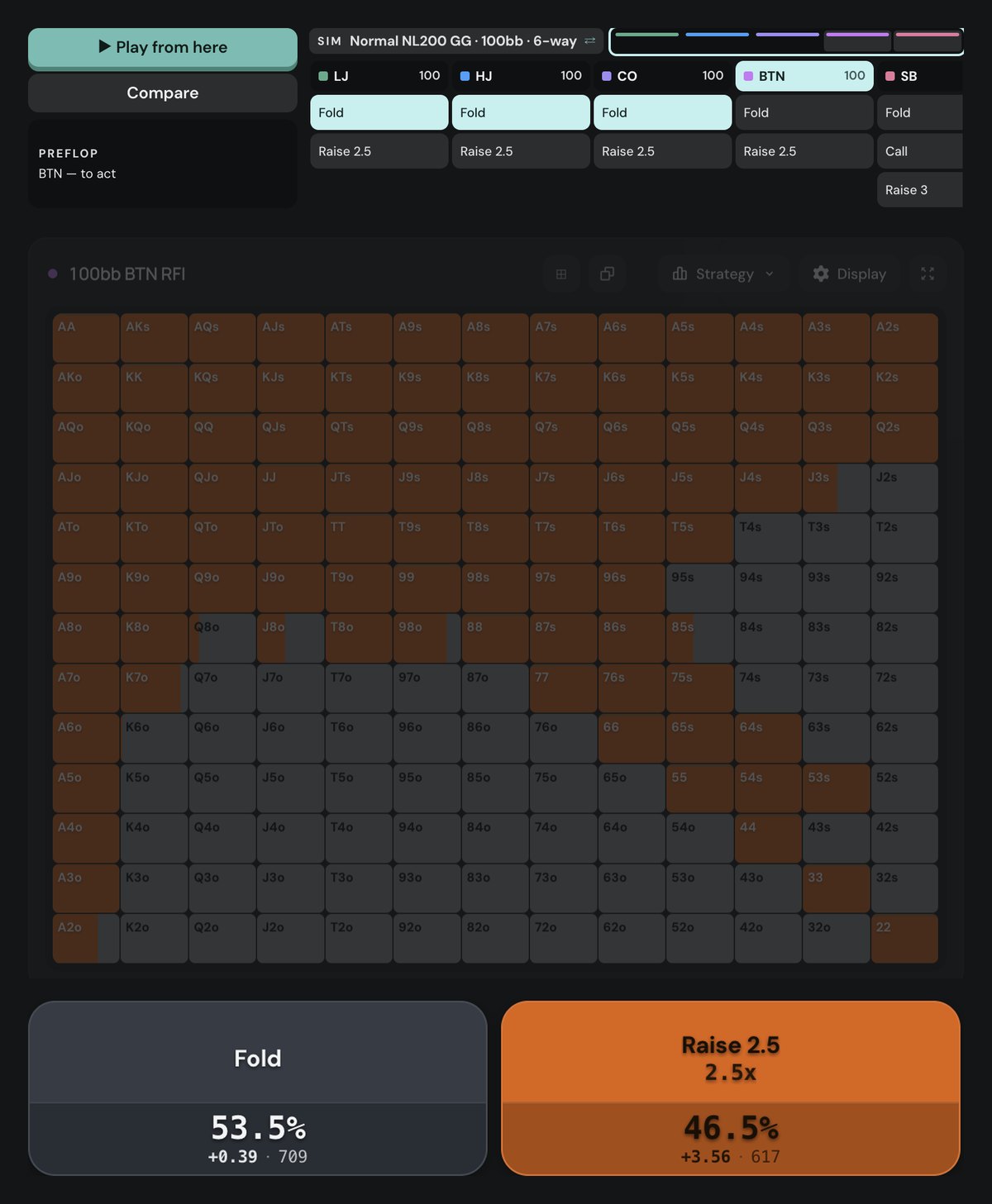
Compare the two charts. From the lojack 18.5% of hands open; from the button, 46.5%. A starting hand has no fixed rank: it depends on your position, stack depth and the game you play, which is why a top ten list is only a starting point.
Quick recap
- The best five cards win. In Omaha you must use exactly two hole cards.
- Order: royal flush, straight flush, quads, full house, flush, straight, three of a kind, two pair, one pair, high card.
- Rarer hands rank higher: 3,744 full houses against 5,108 flushes out of 2,598,960 five-card hands.
- A-A-A-K-K is aces full of kings. The three of a kind names the hand and decides between full houses.
- Ties go to the kickers, then the pot is split. Suits never break ties.
- The ace plays high or low in a straight, but a straight never wraps around.
- A pocket pair flops a set or better 11.8% of the time.
- Starting hands rank by EV in a given spot. TT is a 53.9% favourite against AKs all-in, but AKs opens for more EV.
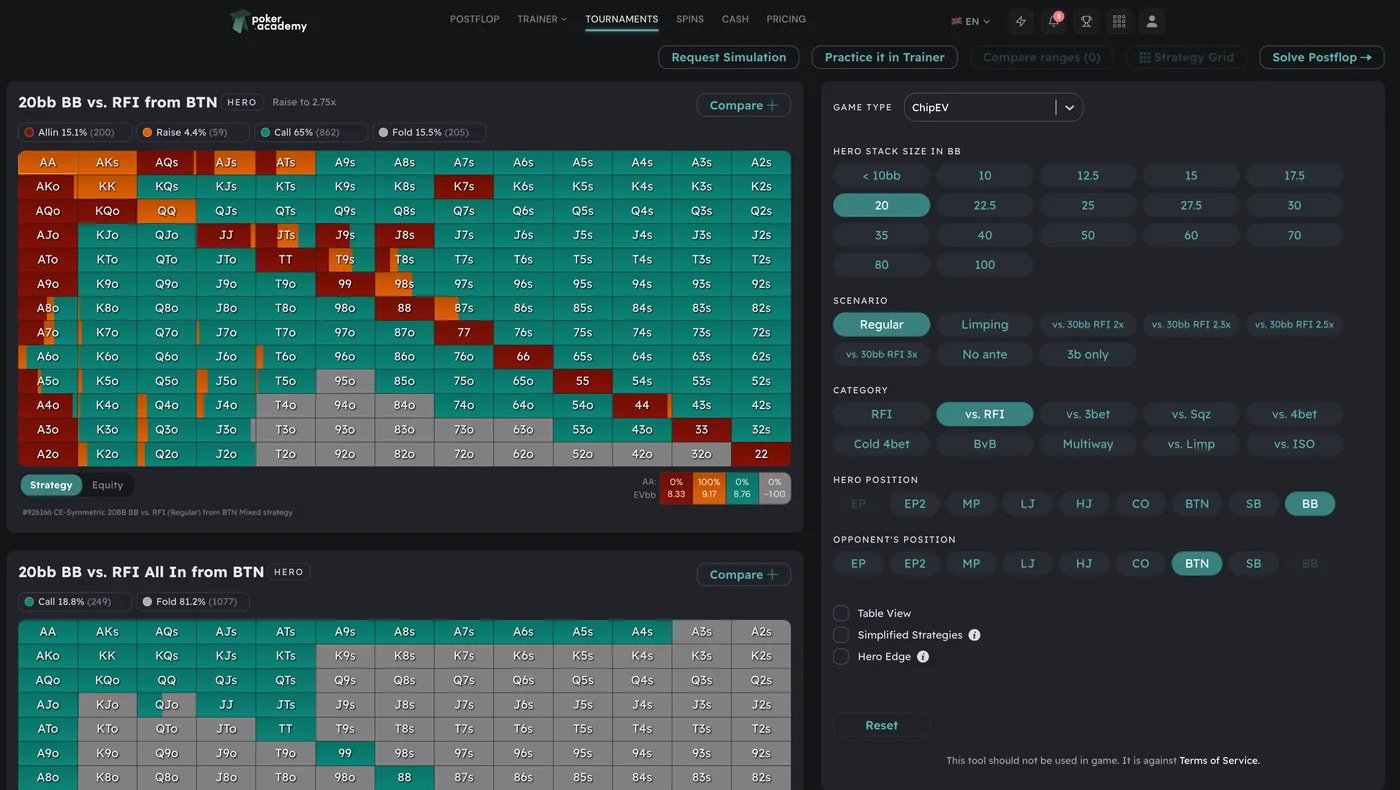
When you’re comfortable with the rankings, open the preflop charts and click through a few positions. It’s the fastest way to see how your two cards turn into a range.
Cheers! 🙂
Keep reading
All posts
Poker Academy
Stop guessing preflop.
1,500,000+ GTO preflop solutions. Try them free for 3 days.
Start Free TrialCancel anytime.