
What keeps you stuck at low stakes in poker: five leaks, measured in the app
 Filip PedzichUpdated· first published ~9 min read
If you have played NL25 or NL50 for a year and your graph looks the same as when you started, the cause is usually a handful of small mistakes in the spots you play every orbit. Each one costs a little, and together they cost the win rate you need to move up.
I won’t give you a win rate you should have. I don’t have honest data for that, and neither does anyone who quotes one without a sample. I can show you where the common leaks sit, what the solver does in those spots, and which screen in the app checks your own game against it.
Every chart below is 6-max cash, 100bb deep, no ante, solved with rake. The main sim is Normal NL50 GG: 5% rake with an 8bb cap. Tournaments are a different game, with antes and short stacks. For those, start with the short-stack guide.
Leak 1: opening the wrong number of hands
You make more decisions before the flop than anywhere else, so a small leak there adds up fastest. Players go wrong in both directions. Some open too many hands from early position because the hand “looks nice”. Others open the button like it is early position and hand over the blinds.
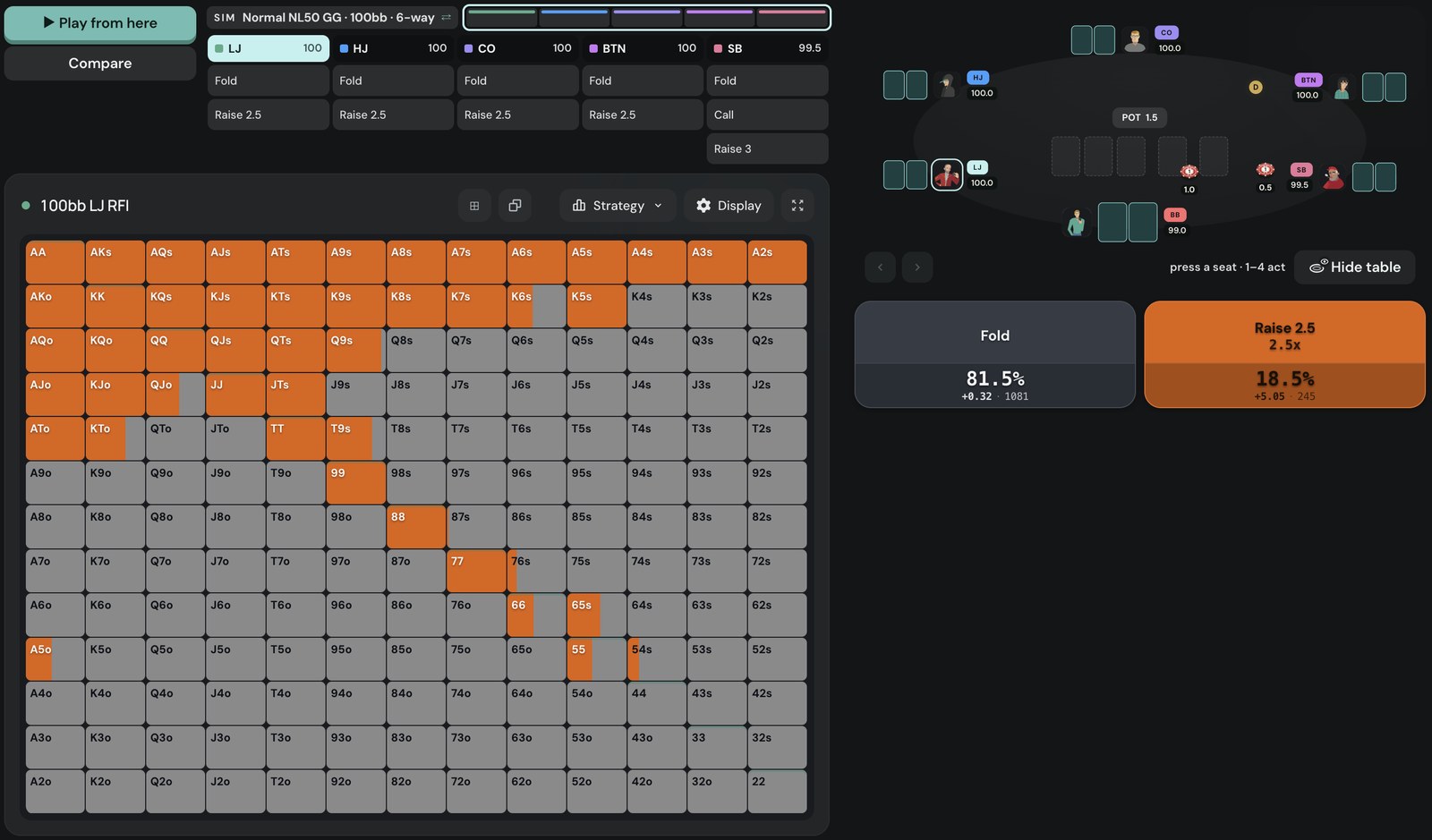
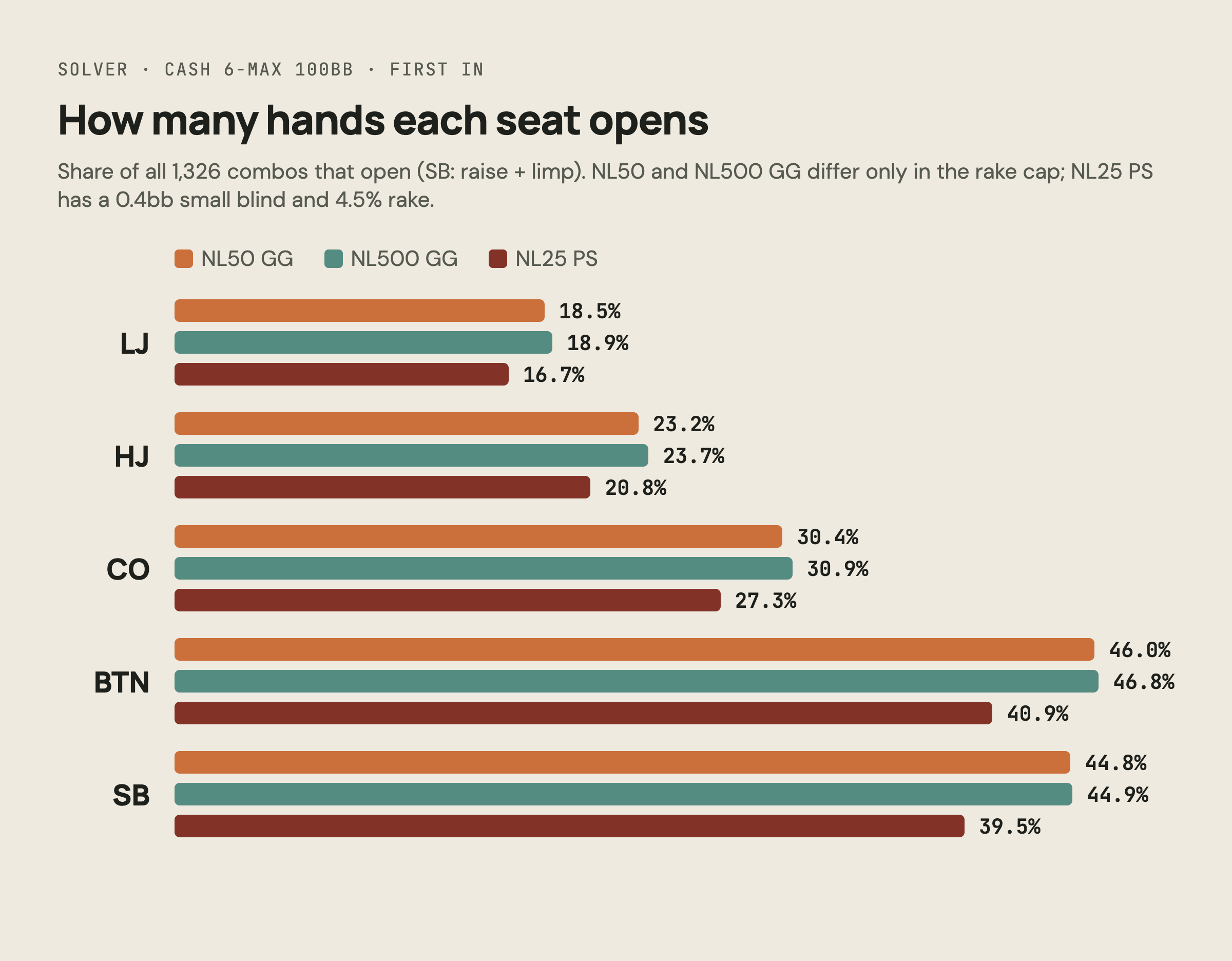
From the lojack, the first seat in 6-max, the solver opens 18.5% of hands to 2.5bb at NL50 GG. That is every pair from 77 up, every suited ace, most suited kings, QTs, Q9s, JTs, AQo, AJo, ATo, KQo, KJo, and KTo most of the time. 66 and 55 are raised only part of the time, and 44, 33, 22, A9o and 98s fold.
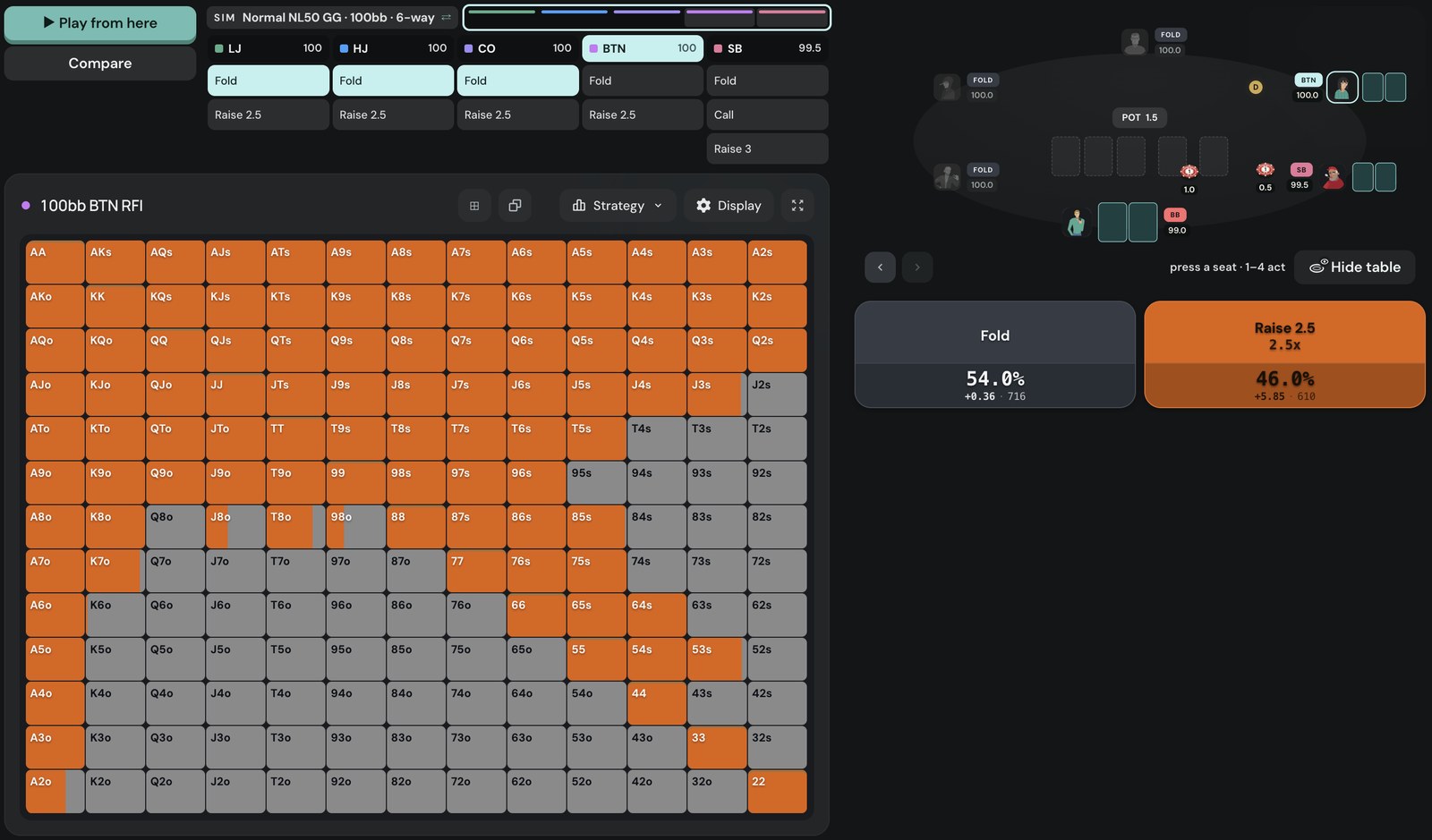
On the button the same chart opens 46.0%. K8o, Q9o, 96s and every suited ace raise. Q8o and T4s fold. The spread between the lojack and the button runs from 18.5% to 46.0% of hands, so a player who opens 25% everywhere is too loose in one seat and much too tight in the other.
The chart also depends on the rake and the blinds. Here are the same opens in three sims. NL50 GG and NL500 GG differ only in the rake cap, and the charts are almost the same. NL25 PS has a 0.4bb small blind instead of 0.5bb and a different rake rule, and it opens tighter in every seat: 40.9% on the button. I can’t tell you which of the two changes does most of that, because both change at once. So study the sim that matches your site and your stake.
Leak 2: the big blind, and the maths behind “open any two”
The big blind loses money for everyone. The question is how to lose the least. Against a 2.5bb button open with the small blind folding, the app shows the price right under the table:
BB vs a 2.5bb button open: pot odds
27.3% is the equity you need to call if you won every pot you have equity in. You don’t: you are out of position and the rake takes a slice of the pots you play. So the solver defends much less than the pot odds suggest. At NL50 GG it folds 59.2%, calls 30.2% and 3-bets to 11bb with 10.6%, which is 40.8% defended. K9o, T9o, A5o and every suited ace, king and queen continue. K8o, Q8o, A2o and 87o fold.
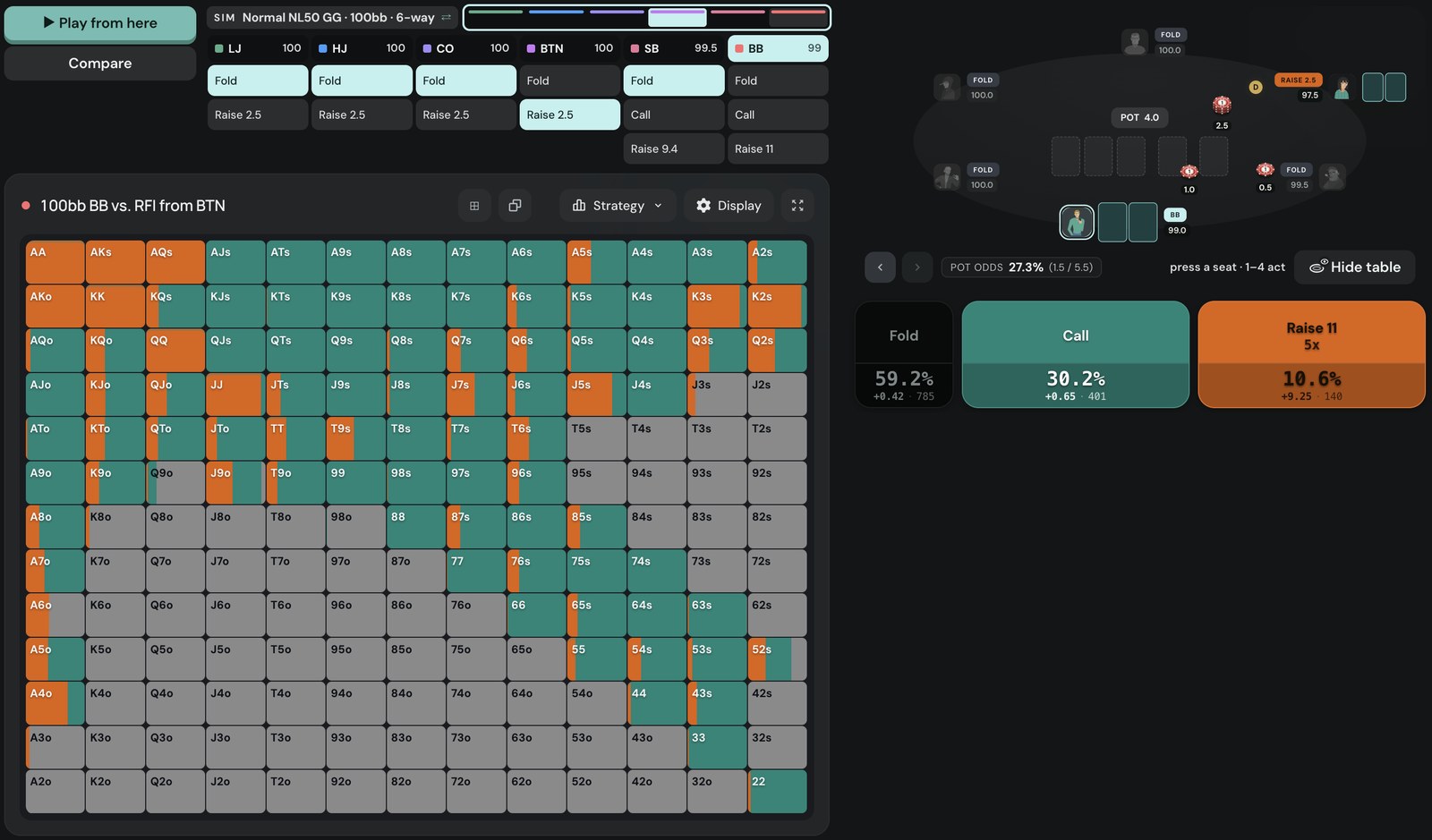
So the number to compare yourself with is 40.8%, in this format. If you learned from tournament charts, where the big blind with an ante defends far wider, you may be calling too much here. If you fold everything that isn’t a pair or an ace, you are folding too much.
An earlier version of this article said that if the big blind defends only 50%, you can open 100% of hands from the button. That was wrong. A button open that never wins after a call has to win the blinds often enough to pay for itself:
A 2.5bb open as a pure bluff: folds needed
Both blinds have to fold for that to happen. The small blind folds 83.8% against the open, and the big blind folds 59.2% of the time after that:
How often both blinds fold (solver)
EV of a 0-equity open at that fold rate
49.6% is well short of 62.5%. The button’s 46% range works because those hands have equity and position after a call; the fold rate alone never pays for it. Even against a big blind who over-folds, the small blind still has to fold as well. With the small blind at 83.8%, the big blind would need to fold this much for a pure bluff to break even:
BB fold rate that makes a 0-equity open break even
That is a simplification: it ignores rake and every hand that gets played postflop. The exploit it supports is modest. Against a big blind who folds more than the chart, add hands at the edge of your button range. Don’t jump to any two cards.
Leak 3: bluffing players who don’t fold
At low stakes you will meet players who call too much. The mistake is to keep bluffing them the way you would bluff a regular. The breakeven is the same formula as before: your bet divided by the pot plus your bet.
River bet of 75% pot as a pure bluff: folds needed
Now say you have a read that a player folds only 25% on the river against this size. That 25% is an assumption for the example, not a stat I measured:
EV of the bluff if they fold 25% (pot 100, bet 75)
Each bluff loses almost a third of the pot. The fix runs the other way: bluff less, and bet more of your medium-strength hands for value, because this player calls with worse. I go through that with a solver lock in the calling-stations article, and the opposite player type in the one on nits.
If you use a HUD, a rule of thumb many players use is that a low went-to-showdown (below about 26%) together with a high won-at-showdown (above about 53%) points to someone who only goes to showdown with strong hands. Those thresholds are heuristics; no solver produced them, and they mean little on a small sample.
Leak 4: not knowing what the rake costs
At micro stakes the rake matters more than most players think, because the cap almost never comes into play. At NL50 GG the sim uses 5% of the pot with an 8bb cap. At NL500 GG it is 5% with a 1.6bb cap. The percentage is the same in both, and only the cap changes.
Single-raised pot on the flop: BTN opens 2.5bb, BB calls
100bb all-in, BTN vs BB (pot 200.5bb), before the cap
After the cap
In a small pot both stakes pay the same 0.275bb. The cap only starts to help above 160bb at NL50, and above 32bb at NL500. So at NL50 you pay the full 5% in almost every pot, including most 3-bet pots: a 3-bet to 11bb that gets called makes 22.5bb, and 5% of that is 1.125bb. At NL500 the same pot pays 1.125bb as well, but a called 4-bet pot of 50bb hits the 1.6bb cap there and pays the full 2.5bb at NL50.
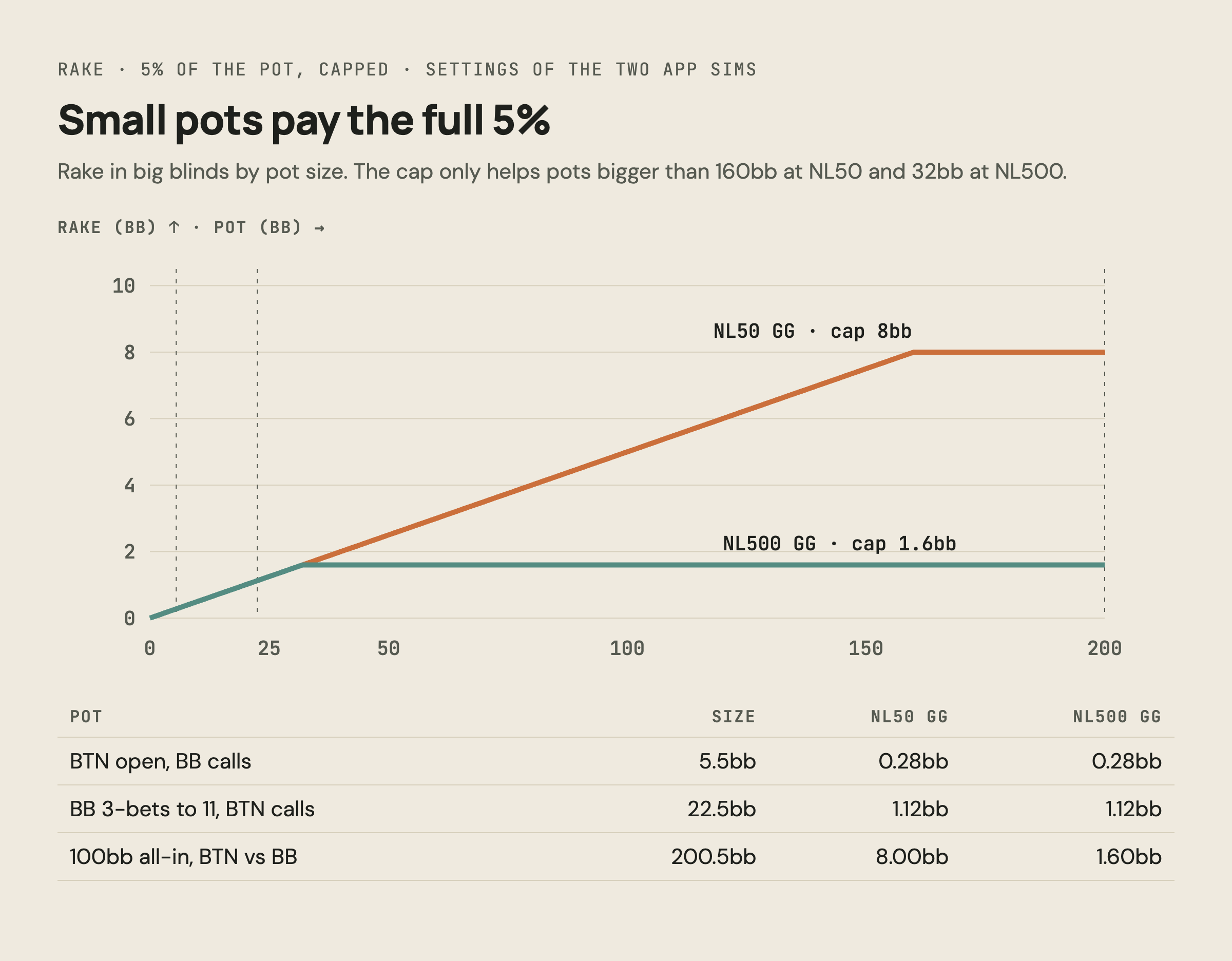
In dollars the cap is still bigger at NL500: 1.6bb of $5 is $8, and 8bb of $0.50 is $4. But in big blinds, the unit your win rate is measured in, the micro-stakes player pays more. It is also one reason the big blind folds so much in these charts: every flop you see pays its slice.
Two practical things. Check what your site actually charges, because rake rules change and differ between cash, fast-fold and different regions. And count rakeback as part of your result when you compare stakes, because at low stakes it can be the difference between a small winner and a small loser.
Leak 5: tilt, volume and bankroll
None of the leaks above matter if you play your worst poker for the last hour of every session. At low stakes the pots are small, so it is easy to think a bad call “only cost 20bb”. Five of those is a buy-in.
You can’t measure tilt from results, because results are mostly variance. You can measure decisions. Practice in the app grades every decision against the solver, and the Performance screen shows where you lose the most: accuracy and EV loss per decision, the weakest track, and accuracy by position and street.
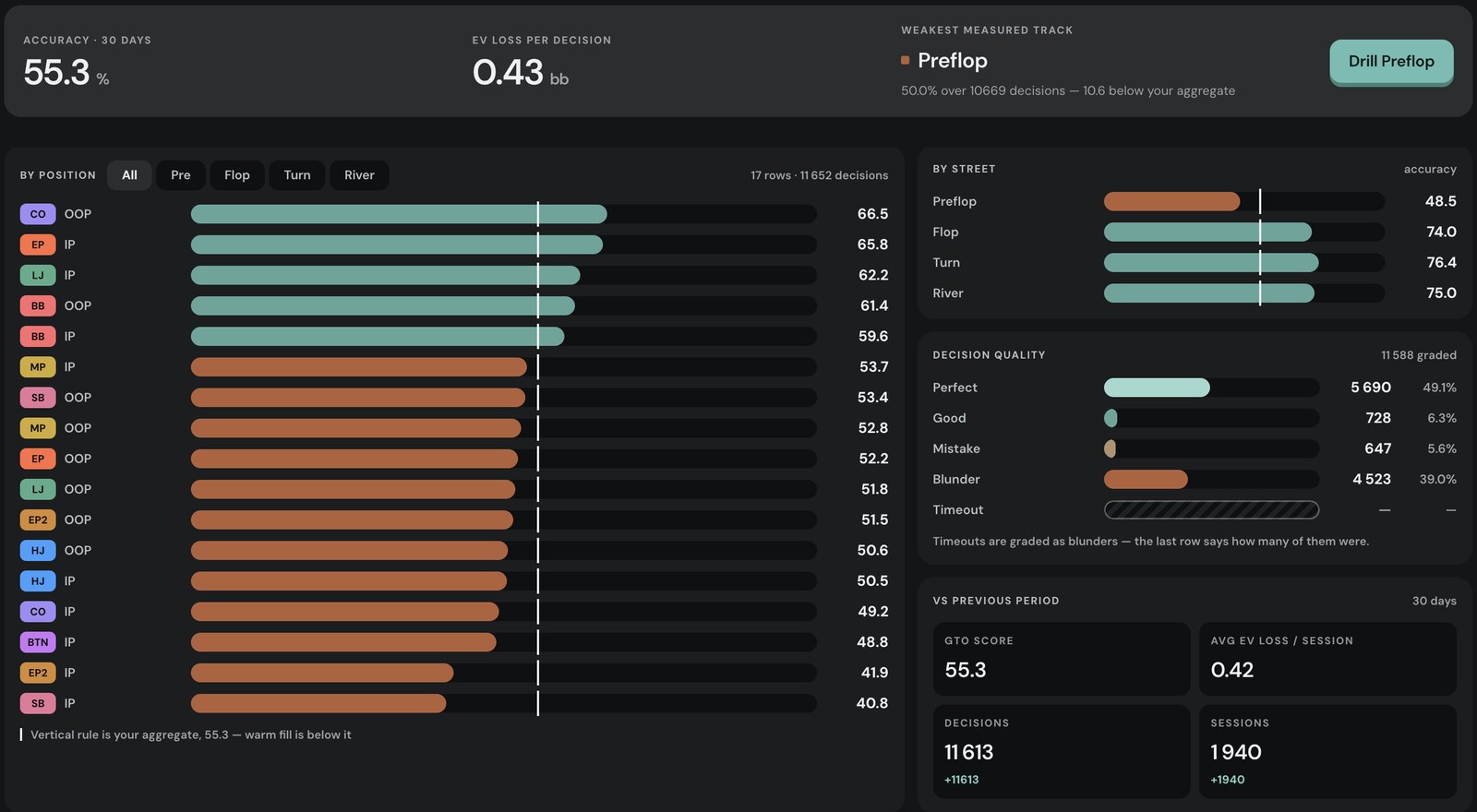
This is a test account, so ignore its numbers. Look at the layout. The warm bars are the seats where it plays below its own average, and the “weakest measured track” card tells you what to drill next. If your own profile shows the big blind or the small blind in warm colours, you know which chart to study before your next session. That beats watching another hour of content about rare river spots.
Volume and bankroll come last because they don’t fix leaks, they only let you survive them. Keep enough buy-ins that a normal downswing doesn’t force you to drop down or play scared. You will hear rules of thumb for cash of a few dozen buy-ins. Treat them as heuristics: the real number depends on your win rate and the standard deviation of your game, and a small sample tells you little about either. If you also play tournaments, the variance article works through the maths for MTTs.
A plan that moves you up
- Opens: compare your open range with the chart for your site, seat by seat. Start with the lojack and the button.
- Big blind: against a 2.5bb button open at 100bb with rake, the solver defends 40.8%. Know which hands are in and which are out.
- Exploits: widen the button a little against blinds who over-fold. Stop bluffing players who don’t fold, and value bet them thinner.
- Rake: count it in big blinds. At NL50 almost every pot pays the full 5%.
- Your leaks: play graded sessions in Practice and let Performance pick the next spot to study.
Pick one of these for a month, not all five. Once your big blind defence matches the chart, move on to the next one.
Cheers! 🙂
Poker Academy
Stop guessing preflop.
1,500,000+ GTO preflop solutions. Try them free for 3 days.
Start Free TrialCancel anytime.