
How to play against poker maniacs: bluff-catching, 3-bet defense and a solver lock
 Filip PedzichUpdated· first published ~11 min read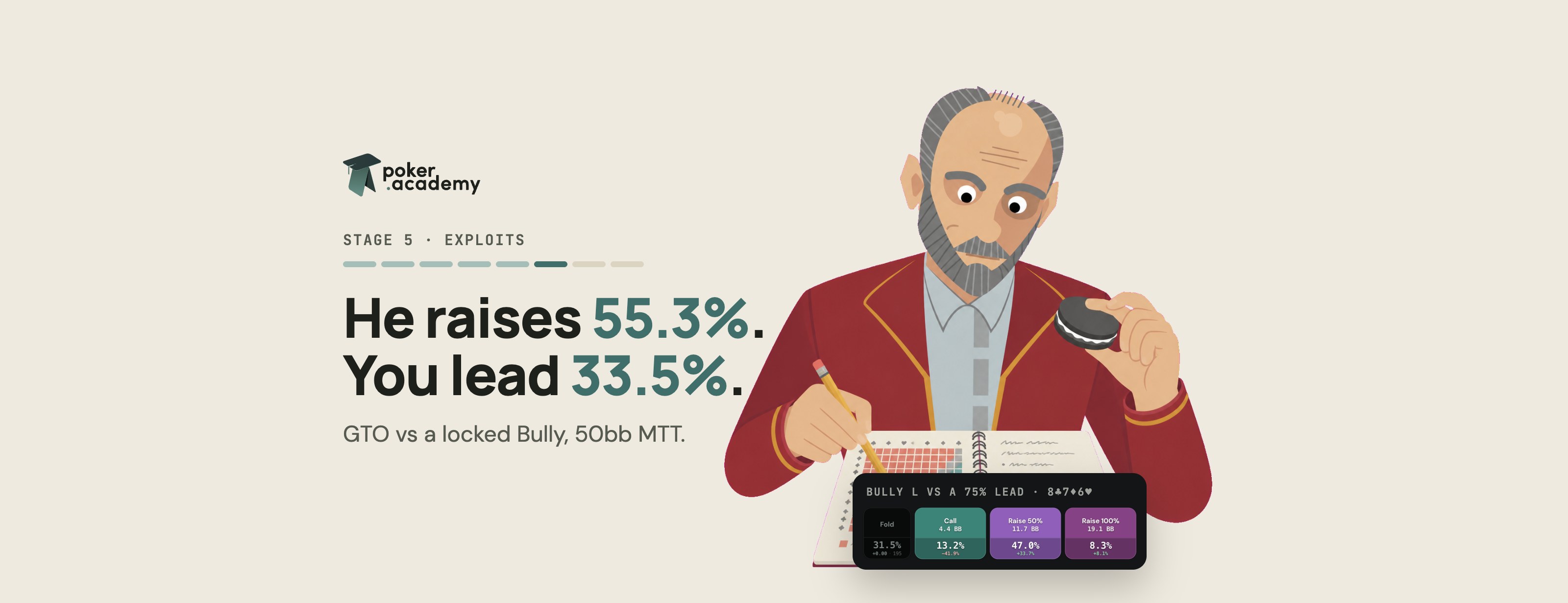
Every table has one. He raises your open, bets every time you check, and shows seven-high the one time you call him down. Most players fold to him until they get angry, then call everything. Both halves of that lose money.
Here I look at a maniac through the Poker Academy solver. The preflop part uses real chart data. The postflop part uses a flop I solved earlier and then re-solved against a locked “Bully” opponent, and the answer surprised me: calling more turns out to be the small half of it.
Everything below is a tournament spot: 50bb, 9-handed, 1bb big-blind ante, chipEV. The button opens to 2.2bb and the big blind plays against him.
What a maniac is (and isn’t)
A maniac bets and raises far more often than the equilibrium does, and folds less when you play back. That is a statement about frequencies, and it is my working definition; the solver has no such term.
A maniac is not the same as a good loose-aggressive player. A strong LAG plays many hands but picks his spots. A maniac adds aggression where it loses EV. The difference matters, because the right counter depends on which hands the extra aggression comes with. If he bluffs too much, you call more. If he bets thin value too much, you don’t. Most of this article is about telling those apart.
The maths of bluff-catching
Start with the numbers that don’t depend on anybody’s strategy. On the flop below the pot is 5.9bb and the maniac bets 4.4bb, which is 74.6% of the pot. You call 4.4bb to win 5.9 + 4.4:
Pot odds against a 4.4bb bet into 5.9bb
A hand that only beats bluffs breaks even when bluffs make up exactly that share of his betting range:
How many bluffs make a bluff-catcher break even
So if more than 29.9% of the hands that bet 4.4bb here are bluffs, a pure bluff-catcher profits by calling. If fewer, it loses. MDF is the range version of the same number: how much of your range has to continue so that his bluffs with no equity can’t profit automatically.
Minimum defense frequency, same bet
Maniacs love overbets. An overbet makes each call more expensive, but it also means he needs you to fold less often. Against a 150% bet (8.8bb into 5.9bb):
Pot odds and MDF against an 8.8bb overbet
None of this tells you what he actually bets with, and that is the problem. “He’s a maniac, so call” assumes his extra bets are bluffs. Keep that assumption in mind for the solver section.
Preflop: defending against wide 3-bets
Before the flop, a maniac shows up as a player who 3-bets and 4-bets too often. Here is the baseline you deviate from. The button opens 2.2bb, the big blind 3-bets to 8.8bb, and the button has to decide.
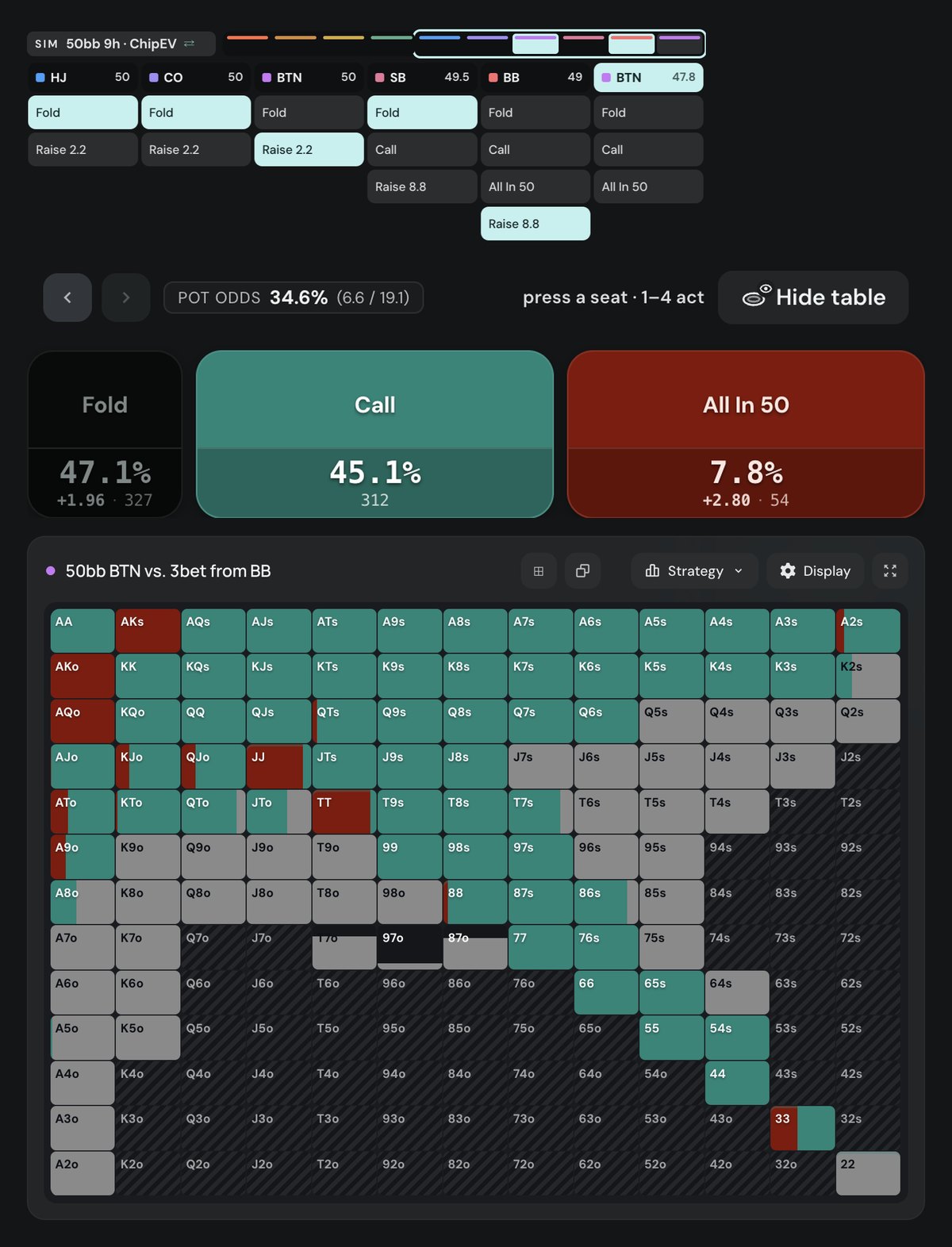
The solver folds 47.1% of the opening range, calls 45.1% and jams 7.8%. The jams are AKs, AKo, AQo, JJ and TT, plus some KJo, QJo, ATo, A9o and 33. AA, KK and QQ just call. The call price:
Button calling the 3-bet
Now look at it from the 3-bettor’s side. A pure bluff 3-bet risks 7.8bb more to win the 4.7bb already in the pot:
Folds a zero-equity 3-bet bluff needs
The button folds 47.1%, well under 62.4%. So even at equilibrium, a 3-bet with no equity doesn’t print money. It relies on the hands that get called having some equity and playability.
The exploit is a heuristic. If a player 3-bets much wider than the big blind’s 13.7% raise range in this spot, his 3-bets are weaker and the 34.6% price is easier to beat. Continue with the edge of the chart: the hands the solver mixes between call and fold, like A8o, JTo, T7s and 86s, become calls. And move your value up. A 50bb jam with JJ, TT, AQo and AK gets called by more worse hands when his range is wide. I don’t have a solver run against a locked wide 3-bettor, so I can’t give you the new percentages.
The same logic works when the maniac is the one jamming. The big blind 3-bet to 8.8bb, the button shoves 50bb, and the big blind calls 41.2bb more:
Play this spot instead of reading about it
Start Free TrialThe trainer deals the situations this article describes and grades every decision you make. Try it free for 3 days.
Big blind calling a 50bb 4-bet jam
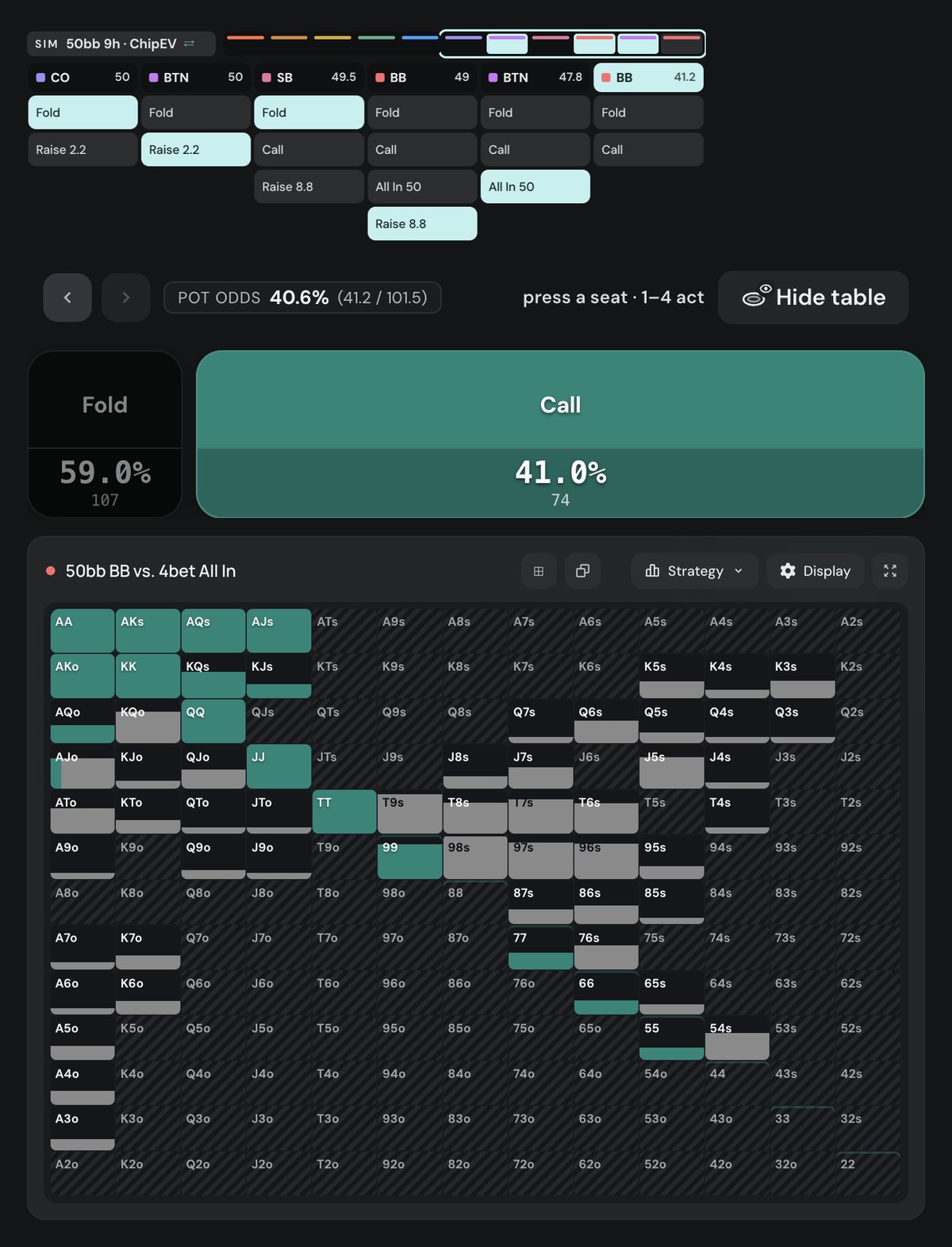
The solver calls 41.0% of its 3-bet range: AA, KK, QQ, JJ, TT, 99, AK, AQs, AJs, KQs, KJs, AQo and the part of 77, 66 and 55 that 3-bets. Everything else folds, including AJo, KQo and the suited-connector 3-bets. (88 isn’t in this range at all: the solver jams it instead of 3-betting small.) You need 40.6% equity against his jamming range. Against a player who jams more hands than the solver does, the same 40.6% is easier to reach, so hands like AJo and KQo move closer to a call. That direction is maths. Where exactly the line lands depends on his real range.
A real flop against a locked Bully
Now postflop. Same simulation: the button opens 2.2bb, the big blind calls. The pot is 2.2 + 2.2 + 0.5 + 1 = 5.9bb, both players have 47.8bb behind, so the stack-to-pot ratio is 47.8 / 5.9 = 8.1.
The flop is 8♣︎7♦︎6♥︎. At equilibrium the big blind checks 98.5% of its range. When the big blind checks, the button bets 75% of the pot with 52.1% of its range and checks back 42.9%.
Poker Academy’s postflop solver has node locking with ready opponent profiles: Nit, Bully and Calling Station, each in S, M or L strength. The Bully turns checks that were close in EV into bets. When he faces a bet, the L version turns calls into raises. I used an existing lock of the button as Bully L, the extreme version, and let the solver re-solve the big blind’s side.
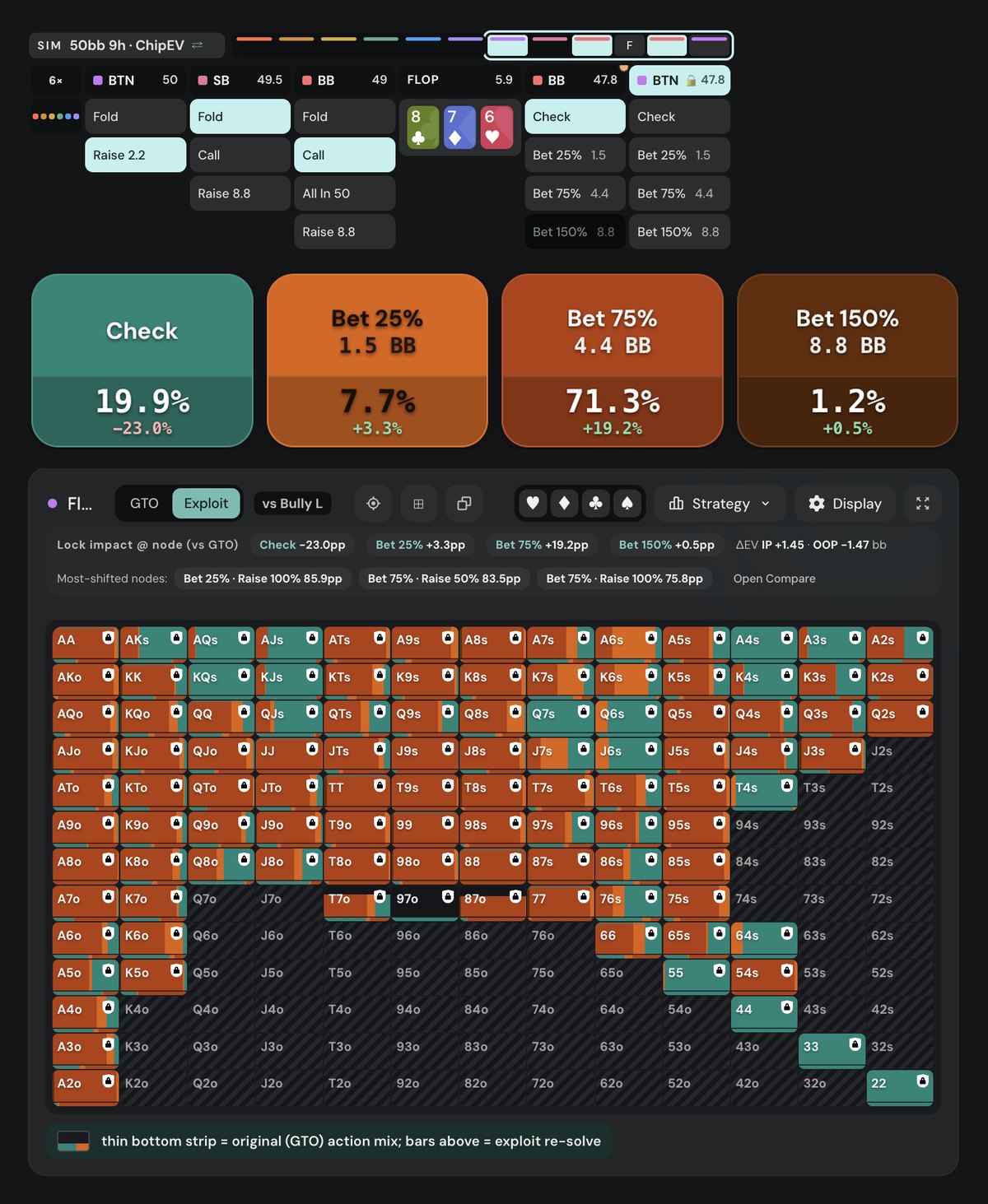
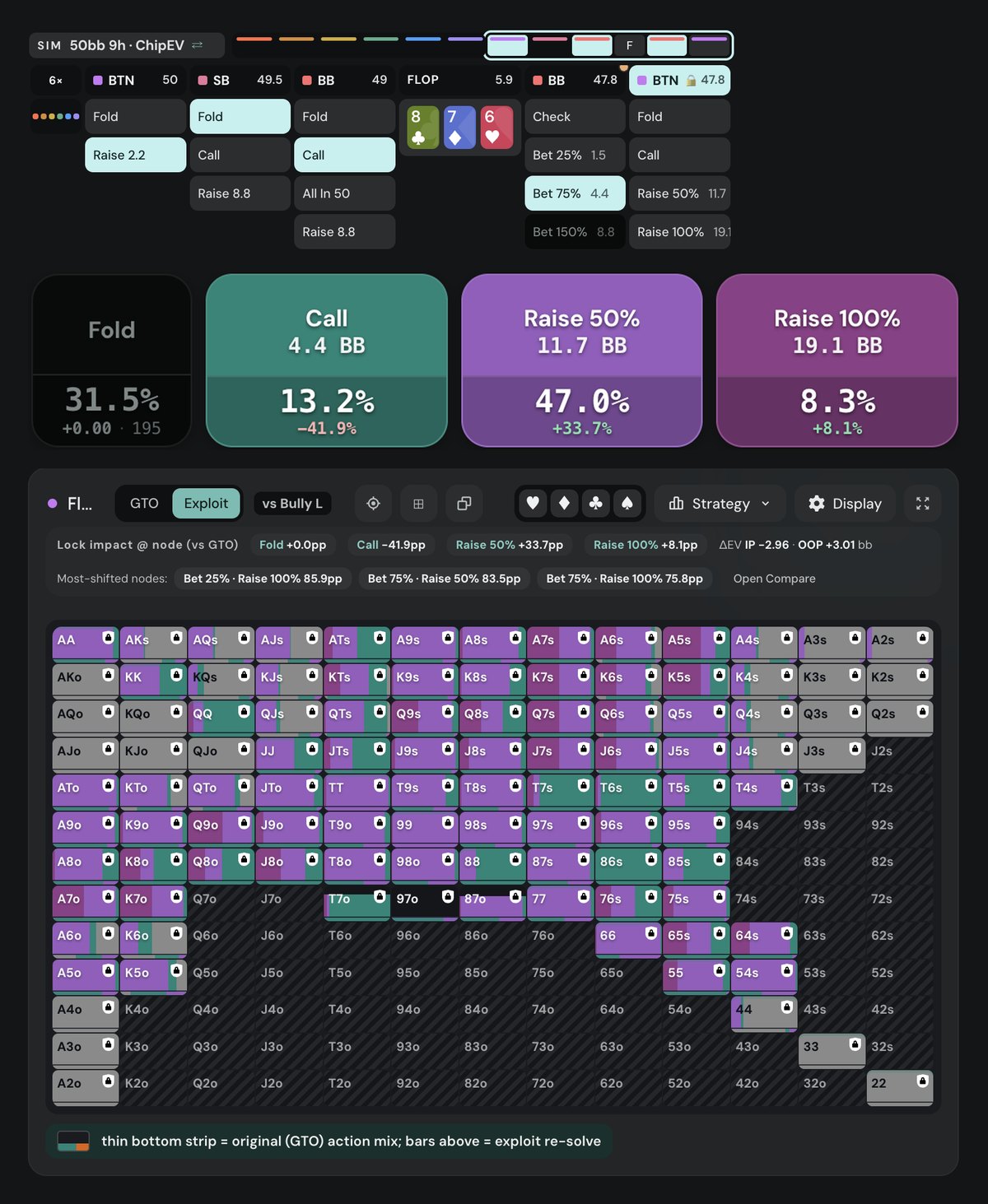
So this Bully does two things: he bets 19.2 percentage points more when checked to, and he raises a lead 55.3% of the time instead of 13.5%. His fold rate against a lead stays where GTO put it; the calls are what turn into raises.
What the solver does against him
Here is the part that surprised me. Instead of checking and calling more often, the big blind starts leading.
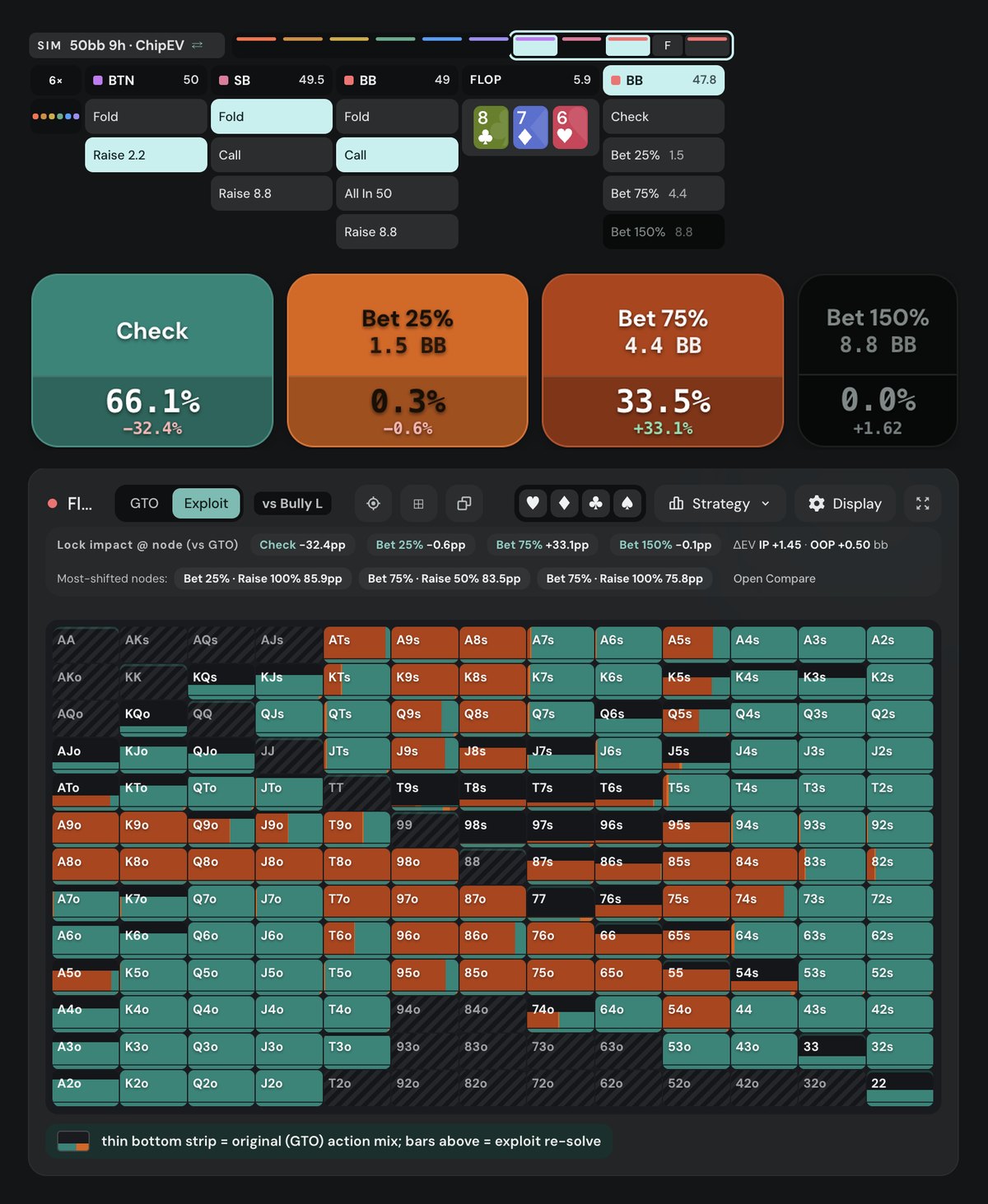
The leads are mostly two pair, straights and pairs with straight draws: 8♣︎7♦︎6♥︎ gives 87, 86 and 76 two pair, T9 and 54 make a straight, and 98, 97 and 65 have a pair plus an open-ended draw. The app’s lock-impact line at the lead node shows the big blind +3.01bb and the button −2.96bb against GTO at that node.
My reading, which is a heuristic: a player who raises too often is best trapped by giving him something to raise. At equilibrium the big blind keeps these hands in its checking range. Against a player who turns calls into raises, a 4.4bb lead with a strong hand gets raised to 11.7bb or 19.1bb by hands that would otherwise just call. That is the trap against a maniac here: you bet the hands that want to be raised, instead of checking and hoping.
Then the checking range. What’s left after the leads is weaker, and the solver defends it less:
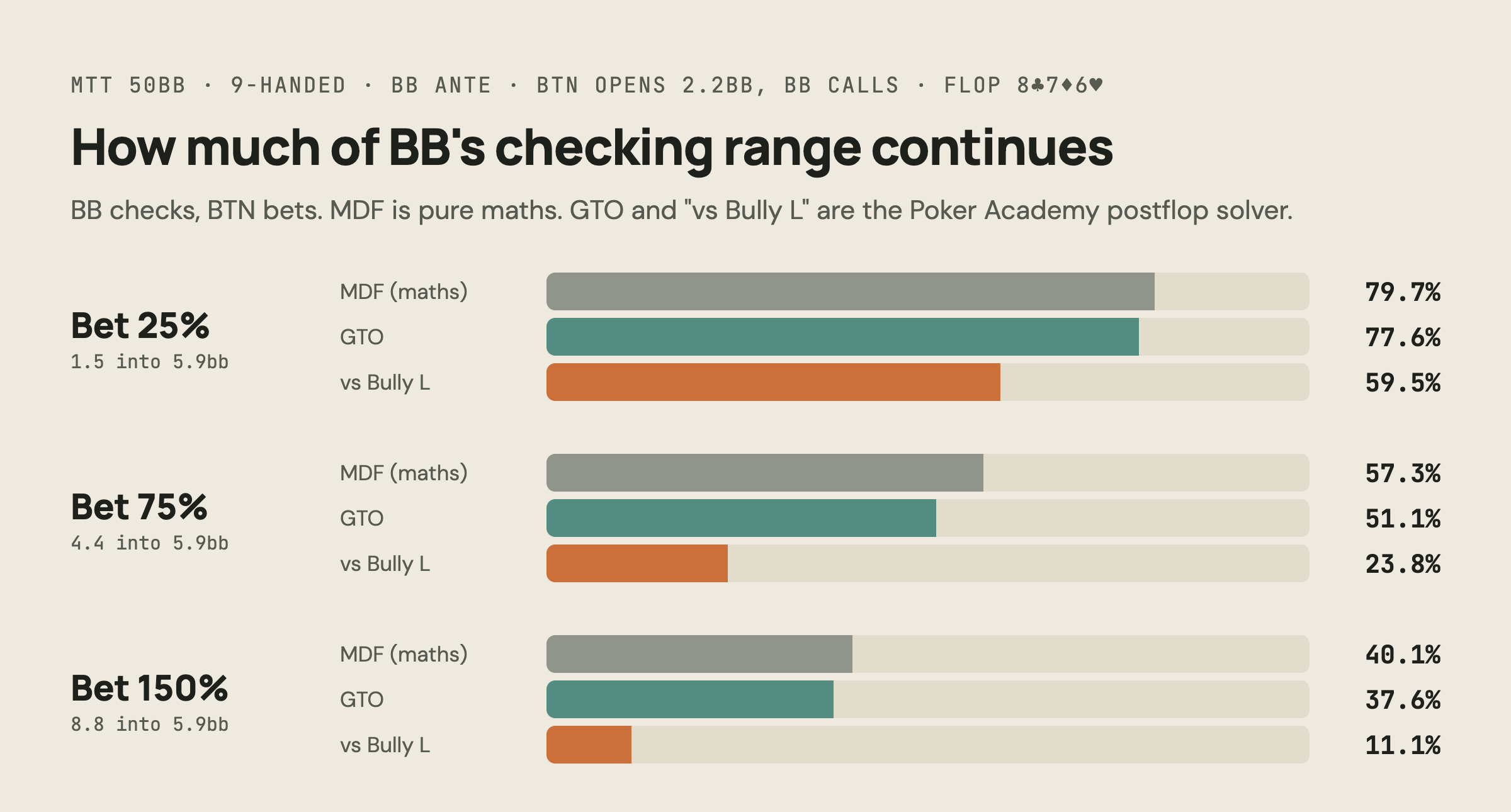
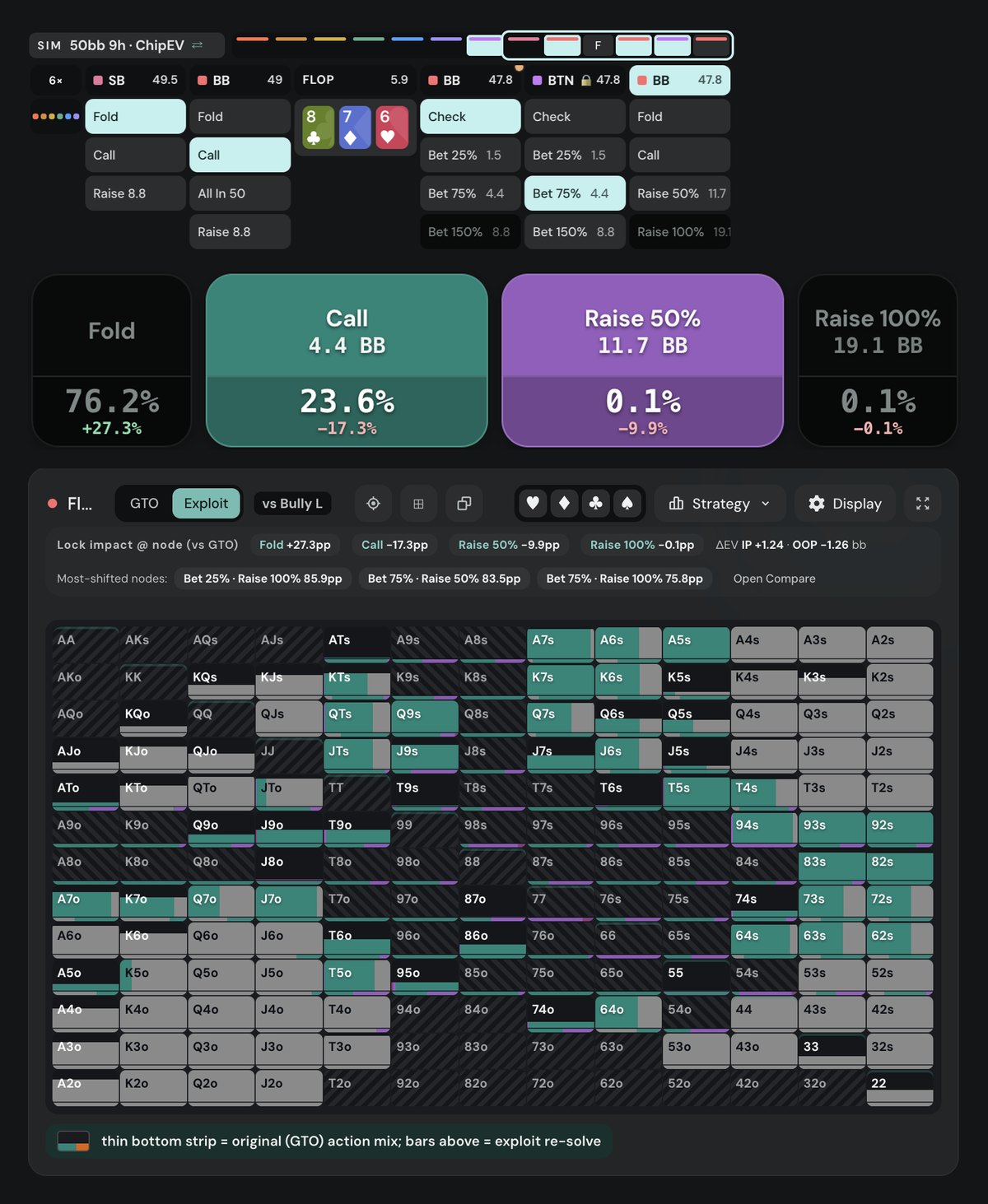
Against the 4.4bb bet, the exploit folds 76.2% of its checking range while MDF says 57.3%. Two things explain it. The strong hands already left as leads, so the checks are mostly overcards, gutshots and air. And this Bully’s extra bets are hands that were close between checking and betting, which is a long way from air. So “he bets a lot, call him down” is wrong against this model.
Two warnings. First, the percentages at a node are shares of different ranges, so 76.2% and 48.9% don’t describe the same hands. Second, L is the extreme profile. The solver answers an extreme model with an extreme strategy. Don’t copy 33.5% leads into your game. Copy the direction: bet your strong hands into the player who raises too much, and don’t assume his bets are bluffs.
When calling more is right
Widening your calls can still be right, and it depends on his bluff share. If you have hands where he shows up with air, and he bets more than 29.9% bluffs into a 5.9bb pot with a 4.4bb bet, bluff-catchers make money. That’s a real exploit, and the Bully L lock just doesn’t model it, because it adds close hands, not air.
The practical test, a heuristic: look at what he shows down. If the extra aggression turns up as missed draws and random high cards, call more with bluff-catchers. If it turns up as second pair and weak top pair, raise your value and fold your weakest bluff-catchers. If you don’t know yet, stay close to the baseline.
Stop bluffing him thin
The easiest money you lose against a maniac is your own bluffs. A pure bluff of 4.4bb into 5.9bb needs this many folds:
Folds a 4.4bb bluff needs
A player who folds less than that turns every zero-equity bluff into a loss. Keep the bluffs that have equity when called, like strong draws, and give up the ones that don’t. Bet your value bigger instead. He is the one who calls and raises, so let him.
The cost: variance
Playing back at a maniac means bigger pots. The 3-bet pot above is already 12.5bb before the call, and a jam puts 101.5bb in the middle. Standard deviation grows with the money at risk: if every amount in a hand doubles, the swing doubles and the variance quadruples.
In a cash game that’s a bankroll question. In a tournament it’s more than that. My data is chipEV, and chips aren’t money near the bubble or at a final table. There, ICM makes calling off 41.2bb with a marginal hand more expensive, so you should tighten the calls above, even against a maniac.
Checklist against a maniac
- Start from the chart. At 50bb the button folds 47.1% to a 3-bet to 8.8bb, and the big blind calls a jam with 41.0% of its 3-bet range.
- Widen by the price, not by how annoyed you are. 34.6% equity to call the 3-bet, 40.6% to call the jam. A wider 3-bettor or jammer makes those easier to reach.
- Find out what his aggression is made of. Air: bluff-catch more. Thin value: bet your strong hands and fold more.
- Trap by betting into a raiser. Against the Bully L lock the solver leads 33.5% on 8♣7♦6♥ instead of checking 98.5%.
- Cut the thin bluffs. A 75% pot bluff needs 42.7% folds.
- Respect the variance and ICM. Bigger pots mean bigger swings, and tighter calls when chips aren’t money.
Cheers! 🙂
Poker Academy
Stop guessing preflop.
1,500,000+ GTO preflop solutions. Try them free for 3 days.
Start Free TrialCancel anytime.