

BB Ante Explained: Why Your Preflop Sims Are Costing You Money
 Paweł Brzeski
Poker Player. Creator. Builder. WSOPC ring winner. Creator of Poker Academy. I write about strategic thinking under uncertainty and the emotional side of this beautiful game for those who want to feel, think better, play better, and build something meaningful.
Updated· first published ~10 min read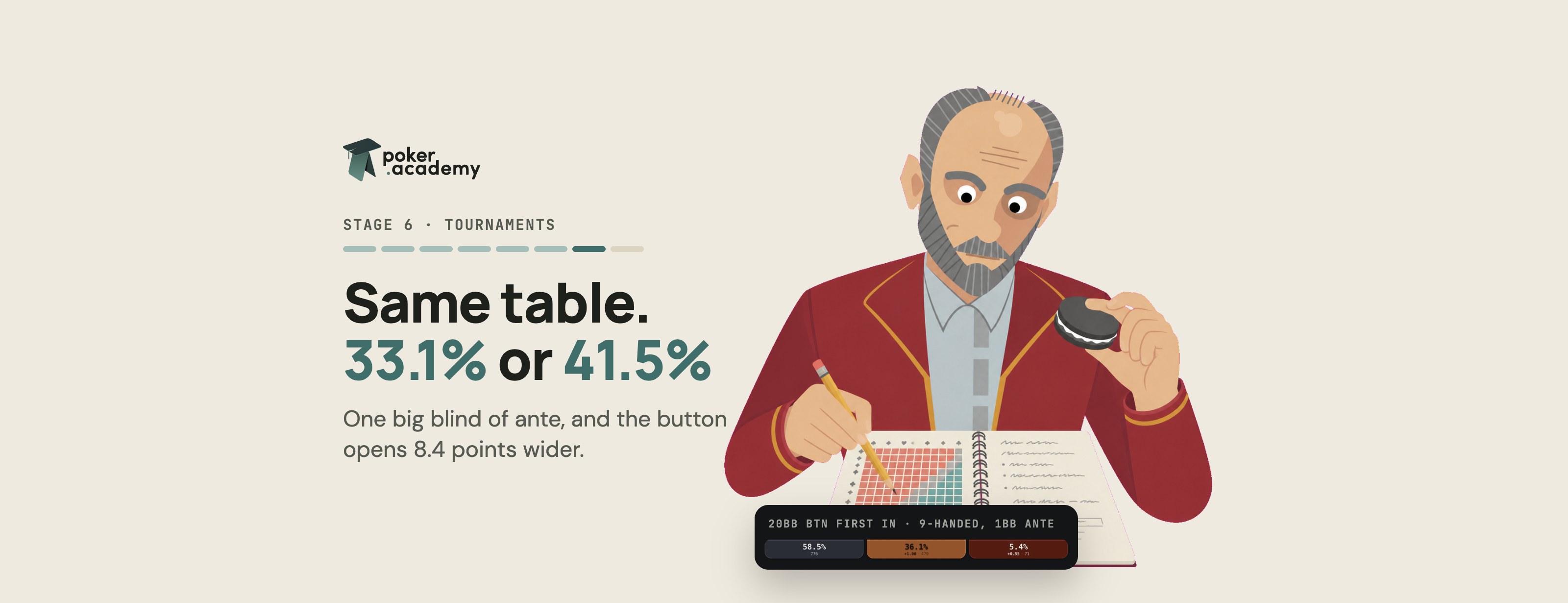
If you study ranges from a solver run with a classic ante and then sit down in a live tournament with a big blind ante, you are not looking at the same game. Most players know what the big blind ante is. Fewer have looked at what it does to the ranges, and the effect is not small.
So here it is, measured. Everything below comes from the Poker Academy preflop catalogue, and every number says which simulation it came from: table size, stacks, ante, and whether it is chipEV, ICM or FGS. Where the catalogue cannot answer a question cleanly, I say so instead of guessing.
What the big blind ante actually changes
In a classic ante format every player posts a fraction of a big blind. Our tournament simulations use 0.125bb a head, so the total in the middle scales with the table:
Classic ante, total in the pot
Eight-handed that is 1bb. Four-handed it is 0.5bb. Three-handed, 0.375bb. With the big blind ante the whole thing is posted by one player and the amount does not care how many seats are filled:
Big blind ante, total in the pot
Those are the numbers the catalogue actually stores, straight from the formats as they are dealt. Its three-handed final tables carry an ante of 0.375bb or 1bb, its four-handed ones 0.5bb or 1bb, its nine-handed rings 1.125bb or 1bb.
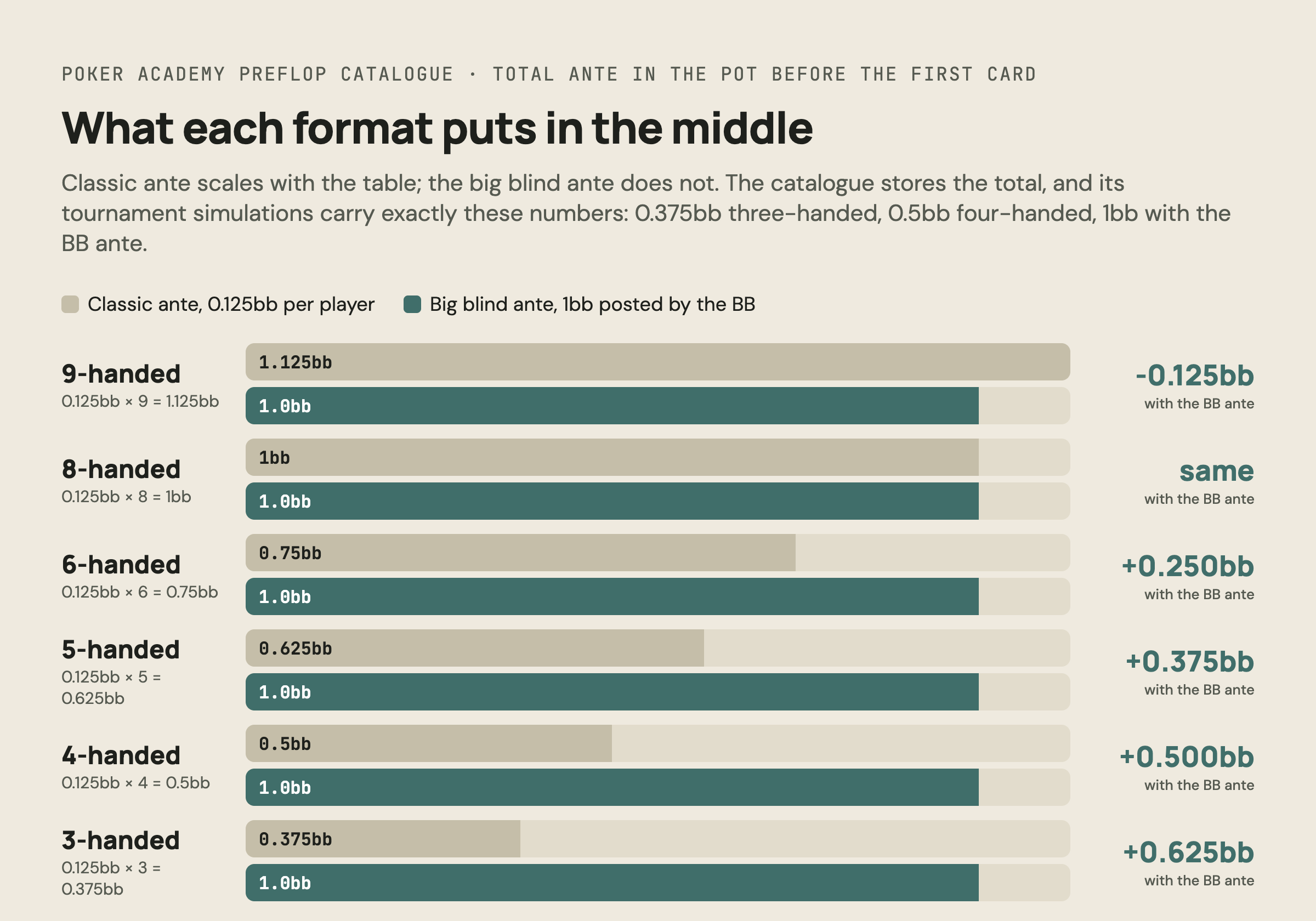
Read the right-hand column. Four-handed the big blind ante puts double the ante in the middle. Three-handed it is 2.7 times as much. Short-handed play is where tournaments get decided: the last two tables, the final table, heads-up, the spots with the steepest pay jumps behind them.
What that extra dead money does
The catalogue has no pair of tournament simulations that differ only in the ante format, so I will not pretend it does. It does have a clean experiment on the question underneath: does dead money in the middle widen ranges, and by how much.
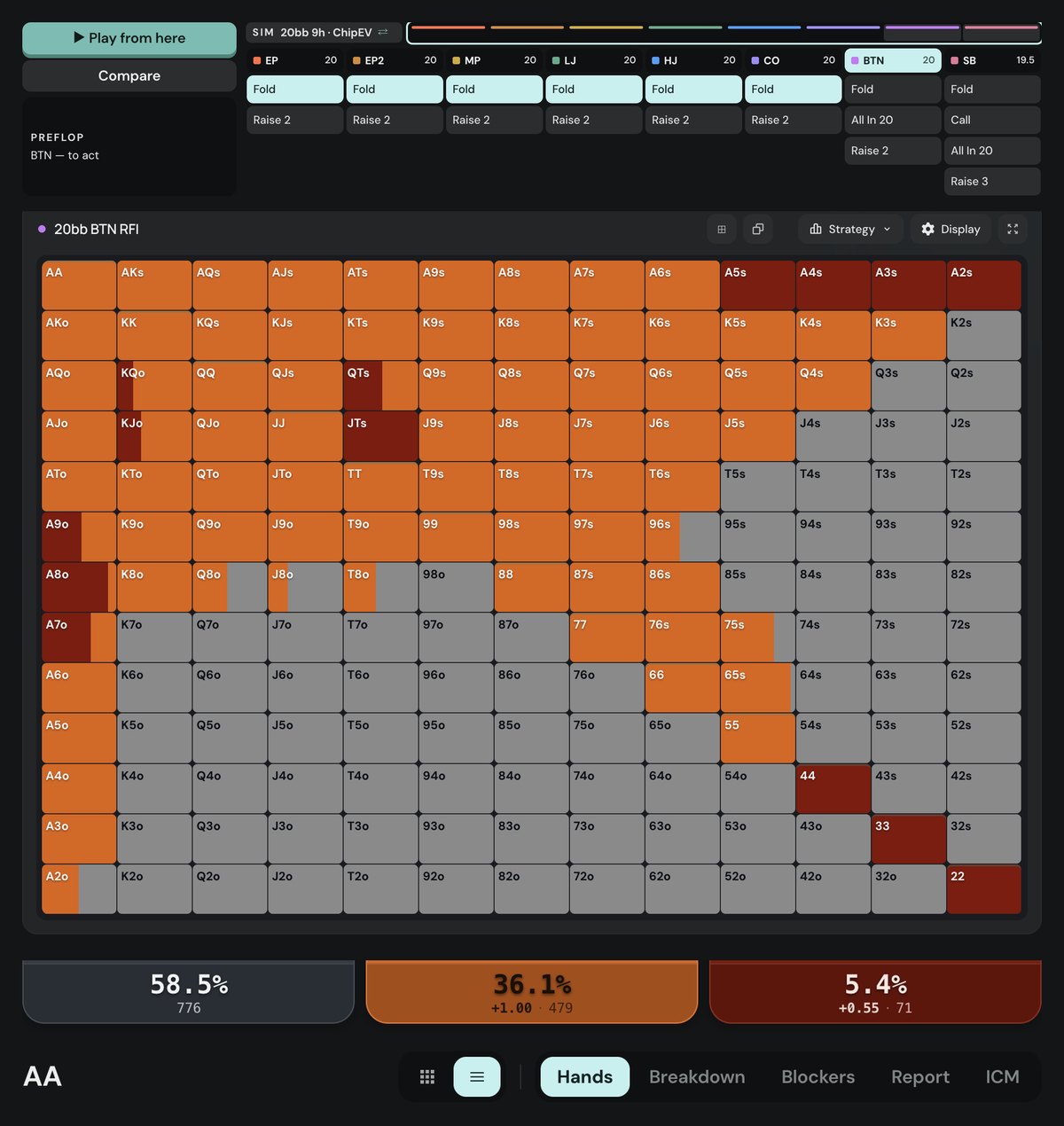
Two chipEV runs, nine-handed, 20bb for everyone, identical open sizes: “20bb 9h” with a 1bb ante and “20bb – no ante” with none. Same table, same stack, same payout model, and one big blind of difference in the middle. Every seat opens wider.
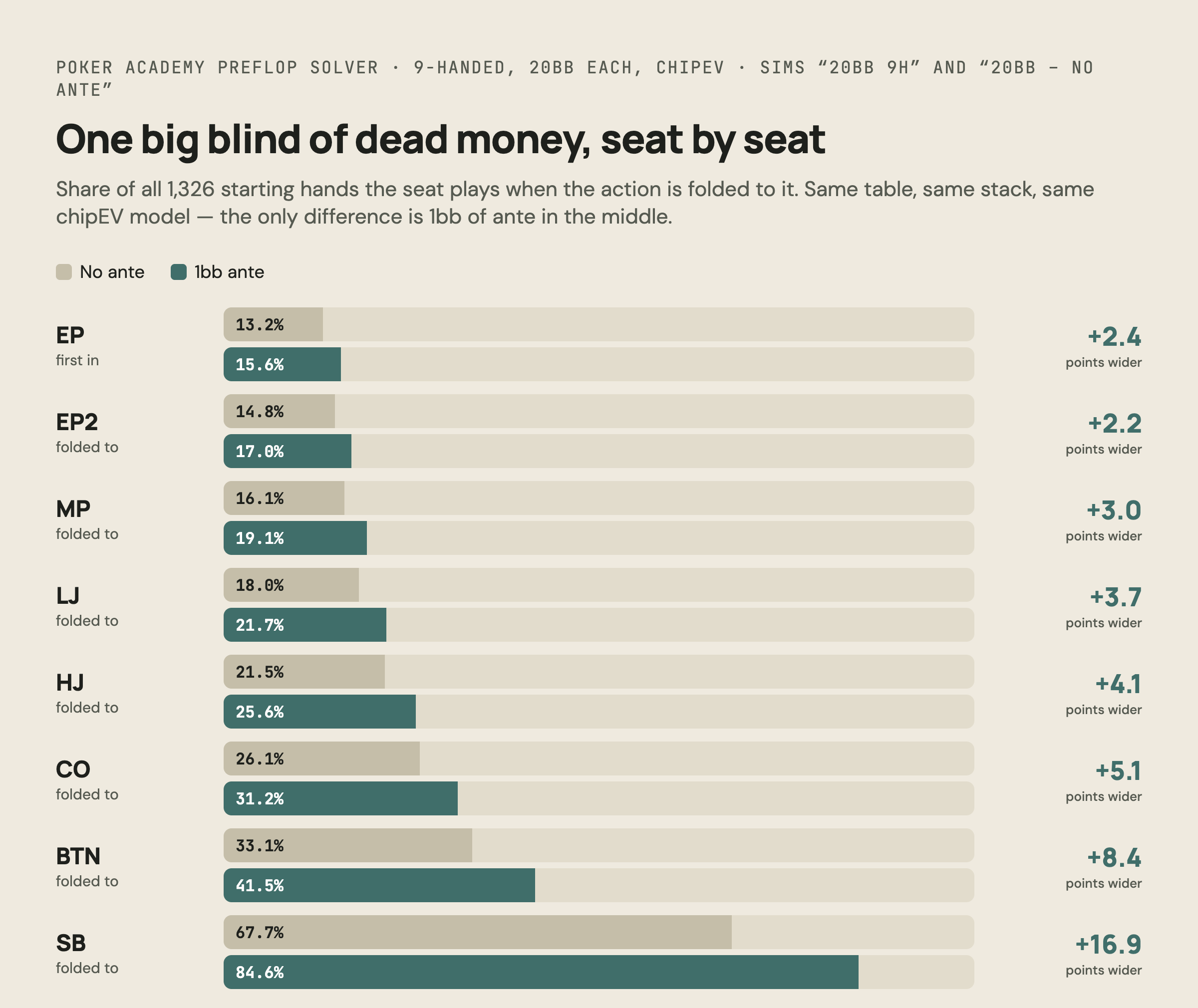
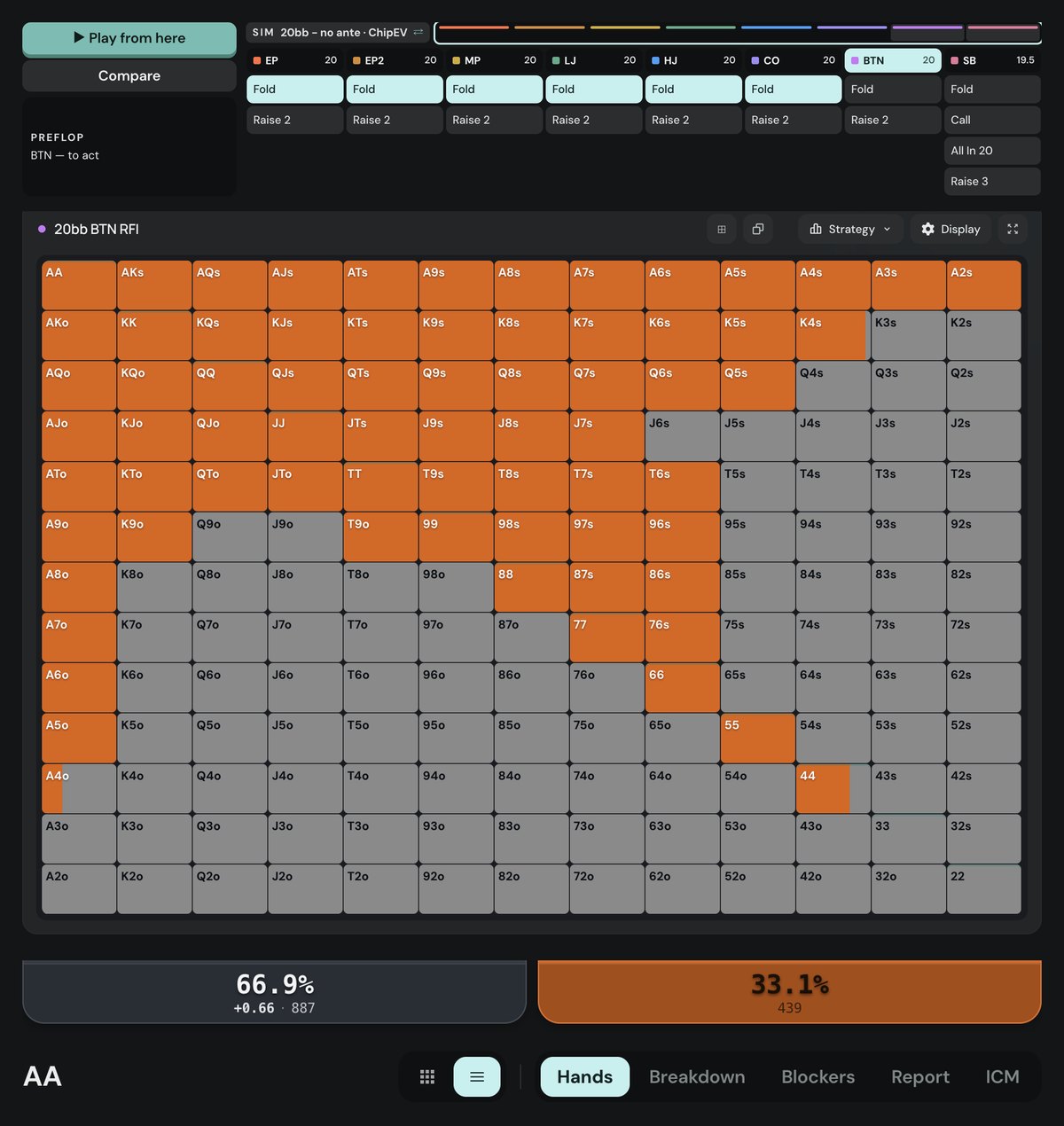
The button shows it most clearly. Without the ante it opens 33.1% of hands, 439 combos, and never jams. With 1bb in the middle it plays 41.5%: 479 combos raising to 2bb and 71 combos moving all-in for 20bb, a line the no-ante solution never uses.
The reason is arithmetic. The ante is money nobody has to win a showdown to claim, and it changes the price of everything downstream. Take the big blind facing that 2bb button open, small blind folded:
Price to defend, no ante
Price to defend, 1bb ante
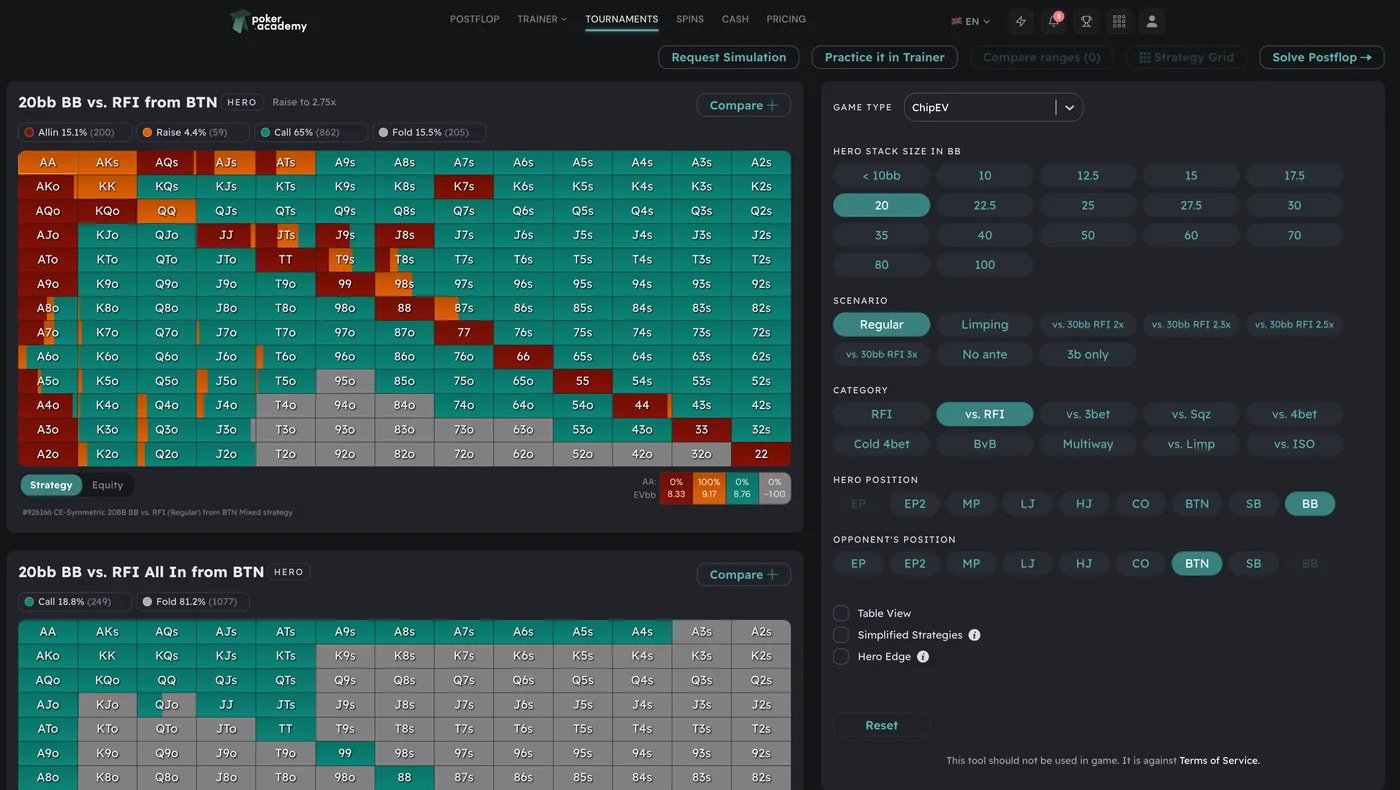
Four points cheaper, and the solver spends them. In the no-ante run the big blind folds 32.9% of its hands to that open. In the ante run it folds 15.5%. One caveat: the two trees are not identical at that node, because the ante run is offered a 2.8bb re-raise and the no-ante run is not. Read the fold number, which both trees can express, rather than the split above it.
Short-handed, where the gap is biggest
Put the two halves together. Three-handed, the big blind ante leaves 0.625bb more in the middle than a classic ante does, and from the chart above we know what extra dead money does to a range: it widens it, and it widens it most in the seats closest to the blinds. Three-handed, every seat is close to the blinds.
I want to be careful here, because this is where the old version of this article overreached. The catalogue’s three-handed final tables come in both formats, but they do not share a stack layout, so I cannot hand you a like-for-like pair and call the difference the ante. I can show you what the big blind ante final tables look like, and some of those spots do not exist in the classic-ante world at all.
Play this spot instead of reading about it
Start Free TrialThe trainer deals the situations this article describes and grades every decision you make. Try it free for 3 days.
The VPIP claim I got wrong
The previous version of this article said that a short stack’s total VPIP goes down under the big blind ante, because hands move out of the limping range and into the shoving range. That cannot be right, and here is why. VPIP is one minus the fold:
Voluntarily put money in the pot
A limp and a shove are both voluntary. Moving hands between them changes the shape of the range and leaves VPIP exactly where it was. The only way VPIP falls is if hands move into the fold.
And in the one pair of runs where I can isolate the ante, they do not. The small blind in the no-ante solution folds 32.3% of its hands; with a 1bb ante it folds 15.4%. Its all-in range grows from 2.0% to 10.2% at the same time, so the shove does get wider, but the folds shrink with it and VPIP goes up, from 67.7% to 84.6%. More dead money means more hands played.
The old claim about a 24bb small blind shoving 14% under one format and nothing under the other is gone, too. In the catalogue, how much a small blind jams is mostly a question of the effective stack it is playing against. Three-handed with the big blind ante, a 40bb small blind against a 40bb big blind never jams at all; the same 40bb against a 10bb big blind jams 68.4% of its hands. The classic-ante final tables behave the same way, so this is a stack question, not an ante question.
Where the big stack sits changes your range
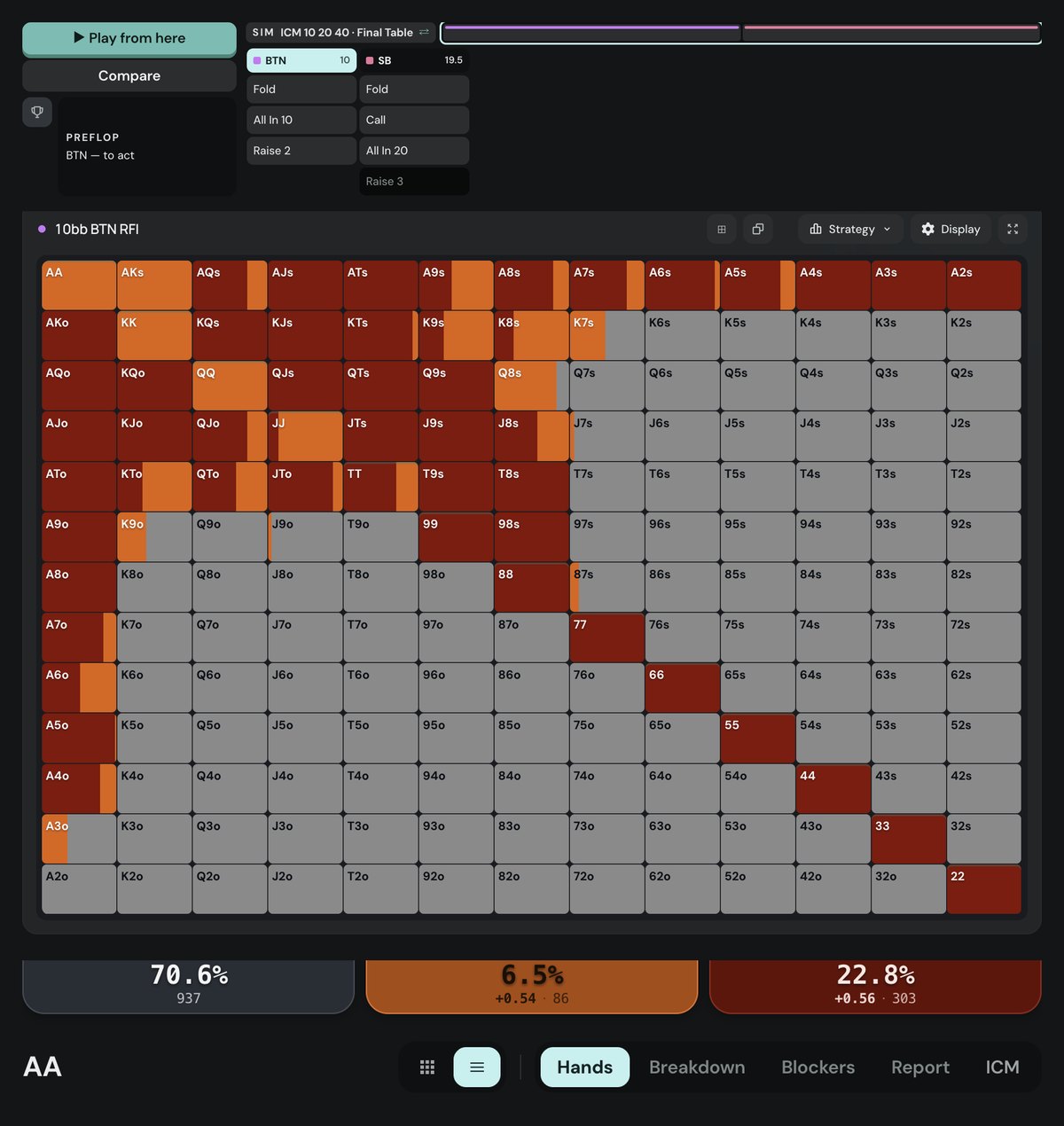
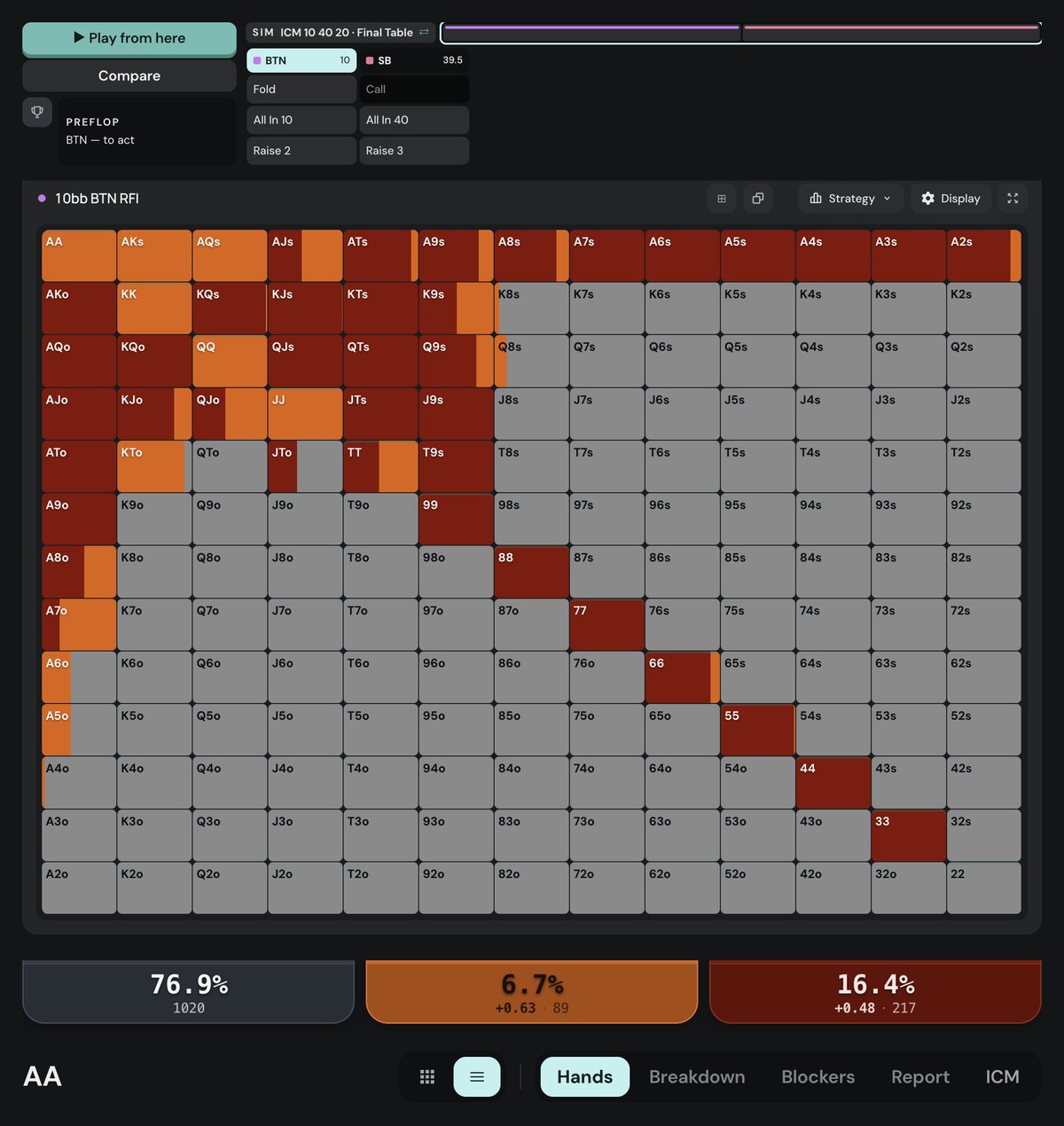
This part of the original article holds up, and the big blind ante final tables let me show it properly. The catalogue has all six seat orders of the same three stacks: 10bb, 20bb and 40bb, three-handed, ICM, 1bb big blind ante. The stacks never change, only who sits where.
Take the 10bb button both ways. With the 40bb stack in the big blind it plays 29.4% of hands, 303 combos of which are a jam. Move the big stack to the small blind, directly behind it, and the same 10bb button plays 23.1%, with the jam down to 217 combos.
Look at what that big stack does when the button folds. With 40bb in the small blind against a 20bb big blind it plays every single hand: 51.2% all-in, 48.7% raising, 0.0% folding. 72o and 32o are pure raises. That is as much pressure as a preflop node can carry, and the big blind is who it is aimed at.
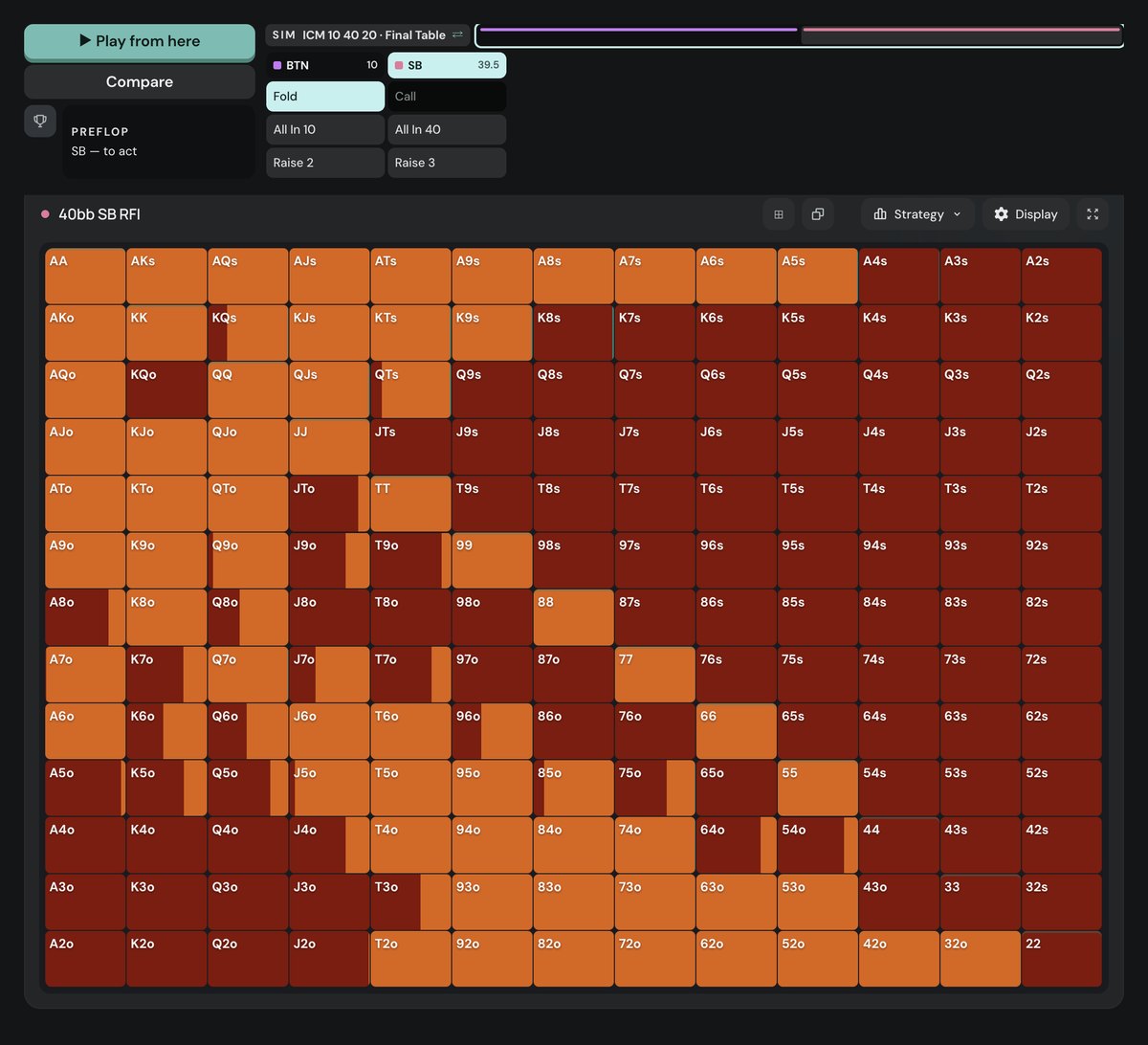
My reading, and I will flag it as reading rather than solver output: when the player behind you is going to force a stack-off with the third player most hands, the cheapest chips available to a short stack are the ones the other two pay each other. That is a heuristic about why the numbers look like this. The numbers themselves are the ranges above.
Eight-handed: the pot is the same, the pressure is not
Eight-handed, 0.125bb × 8 = 1bb, which is exactly what the big blind ante posts. The pot-size effect I spent the first half of this article on is gone.
What is still there is who pays. Under the big blind ante the big blind posts the blind and the ante:
What the big blind owes next hand
For anyone with 2bb, that is the whole stack, gone before a card is dealt. The catalogue models this with FGS, Future Game Simulation, which prices what the next hand is going to cost you instead of treating this hand as if it stood alone the way plain ICM does. There are five such simulations, eight-handed, big blind ante, identical apart from the two shortest stacks moving together from 2bb to 6bb.
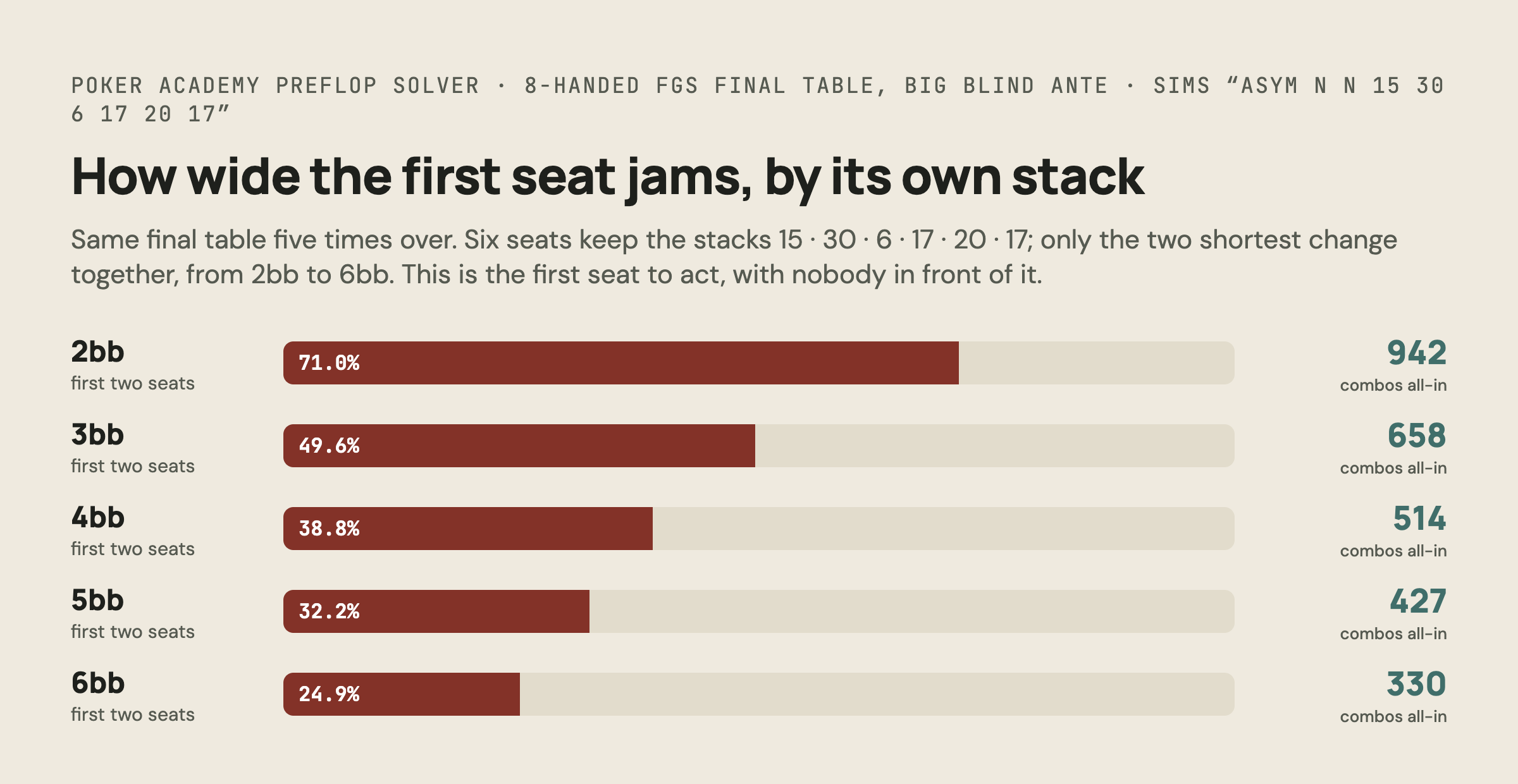
With 2bb in the first seat, 942 of the 1,326 combos are an all-in. That includes hands nobody shoves under the gun in a normal tournament: Q8o, K3o and A2o are all a pure jam, and the range only stops at hands like J4o and 72o.
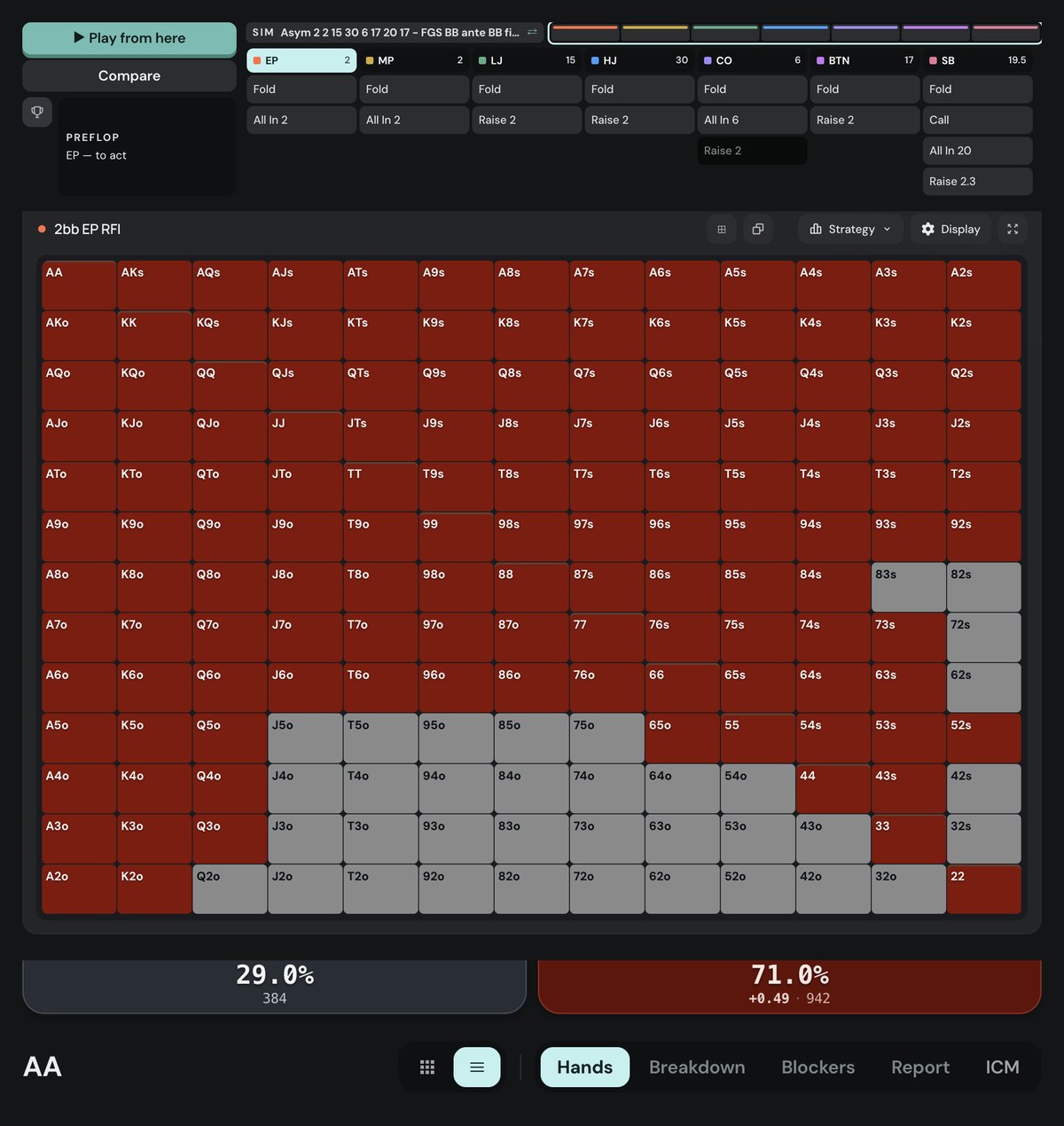
One limit: this is one family of simulations, and I have no classic-ante FGS twin to sit beside it. So read 71% as what FGS says about this big blind ante final table, not as a measured gap between the two formats. The mechanism is plain arithmetic: the big blind ante bills the short stack 2bb next orbit instead of 1.125bb.
What I would take to the table
- Check the ante before the chart. Eight-handed the two formats agree. Every seat shorter than that, the big blind ante leaves more behind: +0.25bb six-handed, +0.5bb four-handed, +0.625bb three-handed.
- Dead money is a licence to play. One extra big blind in the middle moved the button from 33.1% to 41.5% and the big blind’s fold from 32.9% to 15.5% in the one controlled pair I have.
- VPIP only falls when hands move into the fold. A wider shoving range on its own tightens nobody.
- Where the big stack sits matters as much as how big it is. The same 10bb button plays 29.4% with the big stack in the big blind and 23.1% with it in the small blind.
- With 2bb under the big blind ante, waiting is the expensive option. Next orbit costs 2bb, which is all of it.
None of this is worth memorising hand by hand. The ante format, the stacks and the payout model all move these numbers, so the habit that pays is to open the solution that matches the tournament you are actually in, and to look at the same seat twice: once with the ante the room is dealing, once with the one your charts were built on.
Cheers! 🙂
Related posts
More in Live Game

Poker Academy
Stop guessing preflop.
1,500,000+ GTO preflop solutions. Try them free for 3 days.
Start Free TrialCancel anytime.