
Risk / (risk + reward): the breakeven formula behind every bluff, call and raise
 Paweł Brzeski
Poker Player. Creator. Builder. WSOPC ring winner. Creator of Poker Academy. I write about strategic thinking under uncertainty and the emotional side of this beautiful game for those who want to feel, think better, play better, and build something meaningful.
Updated· first published ~10 min read
Most players at the table are guessing. They bluff because it feels right, fold because he probably has it, and call because they are curious.
One formula tells you how often a decision has to work to break even, whether that decision is a bluff, a call or a raise. It won’t tell you whether it will work; that part is still your estimate of your opponent. Once you know the threshold, though, you know exactly what you are estimating against.
If pot odds, alpha and equity are new to you, start with basic poker math. Here I take those formulas, show that they are one idea, and point at the places where the app prints the same numbers on screen.
The formula
Breakeven
- Risk is the chips you put in with this decision. Money already in the pot stopped being risk; it is part of the reward.
- Reward is what you win if it works, everything already in the middle included.
- Breakeven is how often it has to work to come out at zero. Above that the decision makes money, below it loses.
That covers all four buttons in the Breakeven Calculator. Here they are one at a time, all on the river with a pot of 100.
Bet as a bluff
You missed your draw. The pot is 100 and you bet 100. If you get called, you lose. Risk is your bet, reward is the pot.
Pot-size bluff: opponent must fold
Your opponent has to fold more than half the time. Whether they will is the read you still need. The formula only draws the line: fold 45% and the bluff loses, fold 55% and it wins.
This is the same number as alpha, bet ÷ (pot + bet). It assumes the bluff has 0% equity when called, which is only really true on the river. With a turn semi-bluff that wins some of the time when called, you need fewer folds. Say you bet 100 into 100 on the turn with 20% equity, and to keep it simple nobody bets on the river:
Turn semi-bluff with 20% equity (simplified)
28.6% folds instead of 50%. Equity when called pays part of the bill.
Call against a bet
Now flip it. The pot is 100 and your opponent bets 100. You risk 100 to win the pot plus their bet.
Call a pot-size bet: equity needed
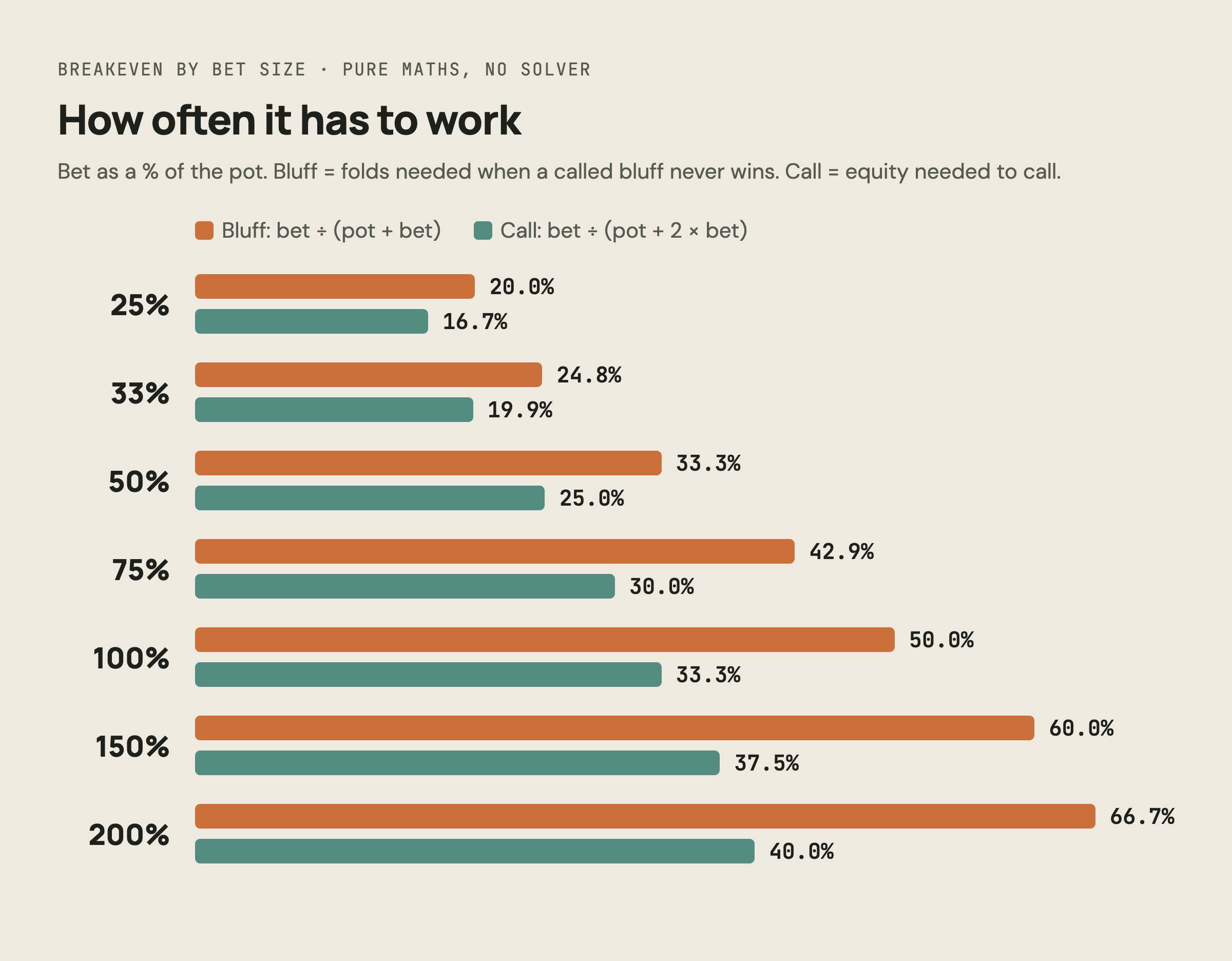
You need the best hand one time in three. This is pot odds, just written as risk and reward: 100 ÷ (100 + 100 + 100).
Why the caller’s number is lower
Same pot, same bet. The bluffer needs 50% folds, the caller needs 33.3% equity. Risk is 100 in both cases, but the reward is not. The bluffer wins the pot, 100. The caller wins the pot and the bet, 200, because the bet is already in the middle.
Watch what those two numbers measure, though. One is how often the opponent must fold, the other how often your hand must win. Different kinds of number, so “calling is cheaper than bluffing” is a fair comparison only at the same bet size and only for a bluff that never wins when called.
The caller’s number also tells you how often a player betting pot on the river should be bluffing. If your opponent’s bets are either the nuts or air, you break even calling when 1 bet in 3 is a bluff. So a bettor who wants to make your call indifferent bluffs 33.3% of the time and has value the other 66.7%. That is theory for a polarised river range, and it describes nobody in particular. Real players bluff more or less than that, which is where exploiting starts.
Raise as a bluff
Pot 100, your opponent bets 100, and you raise pot-size to 400. If they fold, you win the pot and their bet. If they call, you lose.
Pot-size bluff-raise: opponent must fold
Two folds in three, against 50% for a plain bet. The raise is more expensive because the first 100 of your 400 only matches their bet. That call part goes into your risk and adds nothing to your reward:
What the 400 is made of
Your risk went up 4 times, from 100 to 400. Your reward only doubled, from 100 to 200. So a pure bluff-raise needs a lot more folds than a pure bluff-bet of the same pot fraction.
Play this spot instead of reading about it
Start Free TrialThe trainer deals the situations this article describes and grades every decision you make. Try it free for 3 days.
Call against a raise
Now you are the one who bet. Pot 100, you bet 100, your opponent raises pot-size to 400. You call 300 more. Your 100 is already in the pot, so it is reward now, not risk.
Call a pot-size raise: equity needed
33.3% again, the same as calling a pot-size bet. A pot-size bet or raise always offers the caller 2 to 1, whatever happened before it.
The pattern
- Bet as a bluff: risk = your bet, reward = the pot.
- Call a bet: risk = your call, reward = the pot plus the bet.
- Raise as a bluff: risk = your whole raise, reward = the pot plus their bet.
- Call a raise: risk = what you add, reward = everything in the middle, your own earlier chips included.
The formula never changes. The only thing that moves is what counts as already being in the middle.
Where the app shows the price
When you study you don’t have to do this in your head. In Browse, every spot where the player to act faces a bet has a POT ODDS badge under the table, and that badge is this formula: the call against everything already in the middle.
Take a 6-max cash game, 100bb deep, no ante. The button opens to 2.5bb, the small blind folds, and the big blind has to decide. The pot is 0.5 + 1 + 2.5 = 4bb and the call is 1.5bb:
BB vs a 2.5bb button open, cash 100bb
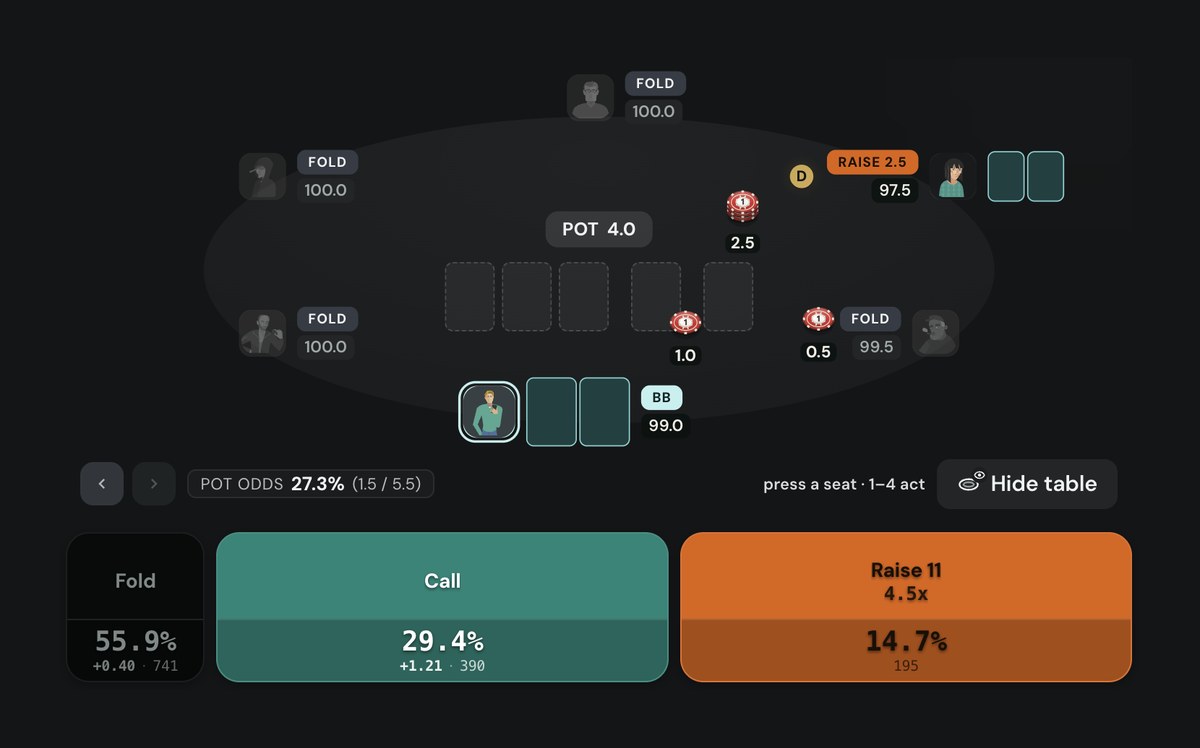
The badge shows the chip price. This simulation is solved with 5% rake capped at 0.6bb, so the real price of seeing a flop is a bit worse than 27.3%. The solver defends the big blind with 44.1% of hands here: it calls 29.4% and 3-bets 14.7%.
The number under each percentage is EV. Click a hand and the list shows it per combo, measured against folding. Take KTo. The solver says calling with it loses 0.47bb counted from the start of the hand. Folding loses 1bb, the big blind you already posted. So the call is worth it:
KTo: call compared with fold (solver EV)
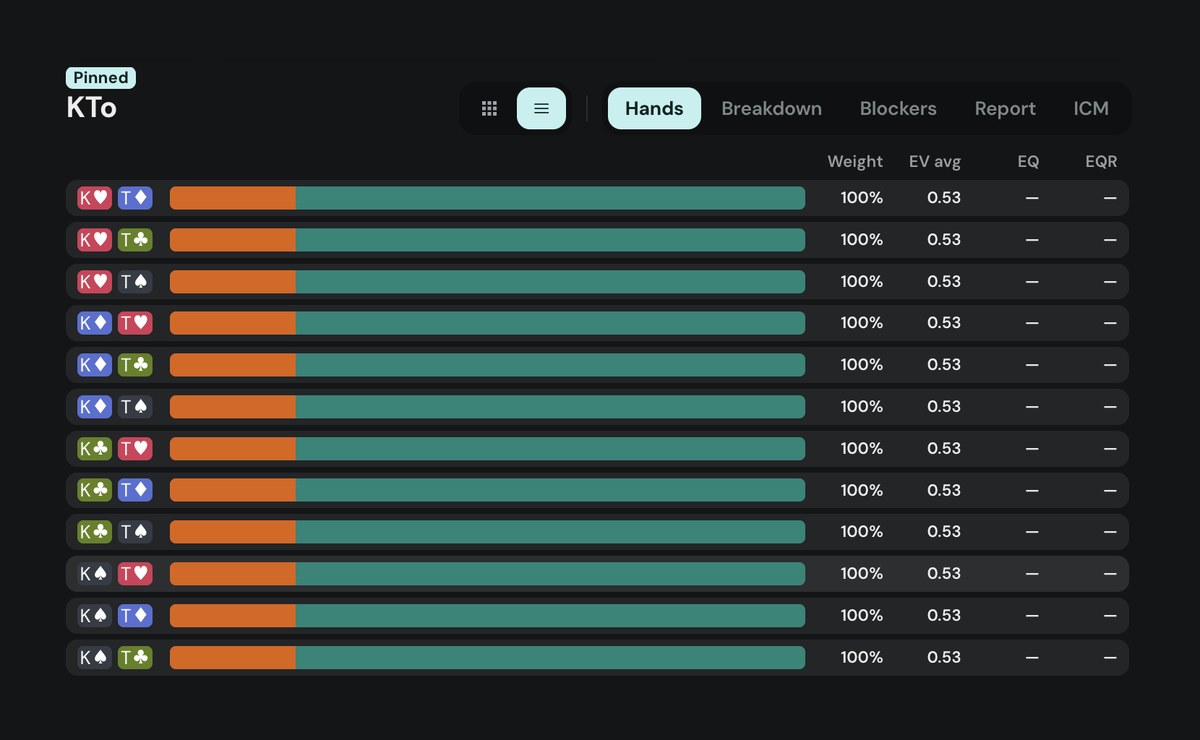
That is what risk and reward means in practice. The 1bb you posted stopped being risk, so a call that loses money on average can still be the best option, because folding loses more.
A 3-bet bluff costs more than a call
From the same big blind, a 3-bet goes to 11bb. As a pure bluff your risk is the 10bb you add, and the reward is the 4bb in the middle:
Pure 3-bet bluff to 11bb: button must fold
Now look at what the button does. After the 3-bet the app shows the button’s response with its whole opening range: it folds 54.4%, calls 34.4% and 4-bets 11.2%.
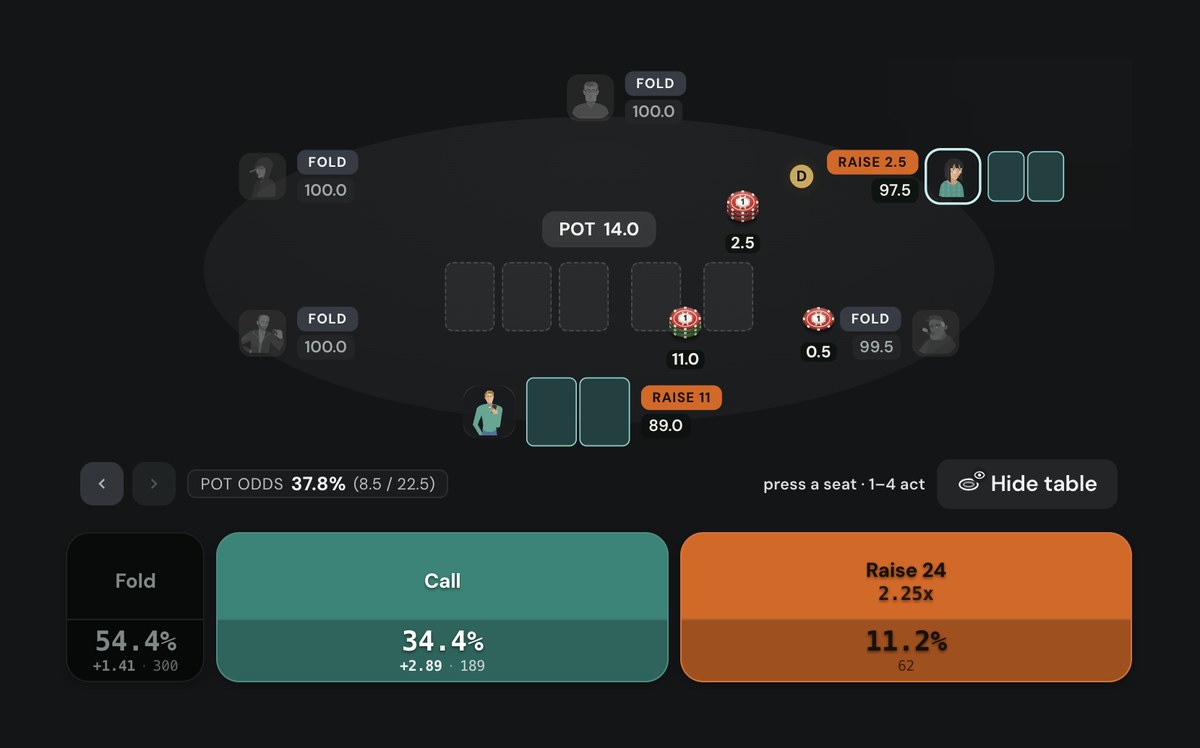
54.4% is well below 71.4%. If the 3-bet never won after a call or a 4-bet, it would lose:
Pure bluff 3-bet, never winning when the button continues
So the 3-bets in this chart all have something behind them. The range is value hands plus hands that keep equity and play well when called: AA to TT, AKo and AQo, most suited broadways, suited aces like A5s and A4s, suited connectors like 76s, 65s and 54s part of the time. The formula says a pure bluff is too expensive here, and equity when called pays for the rest of the range.
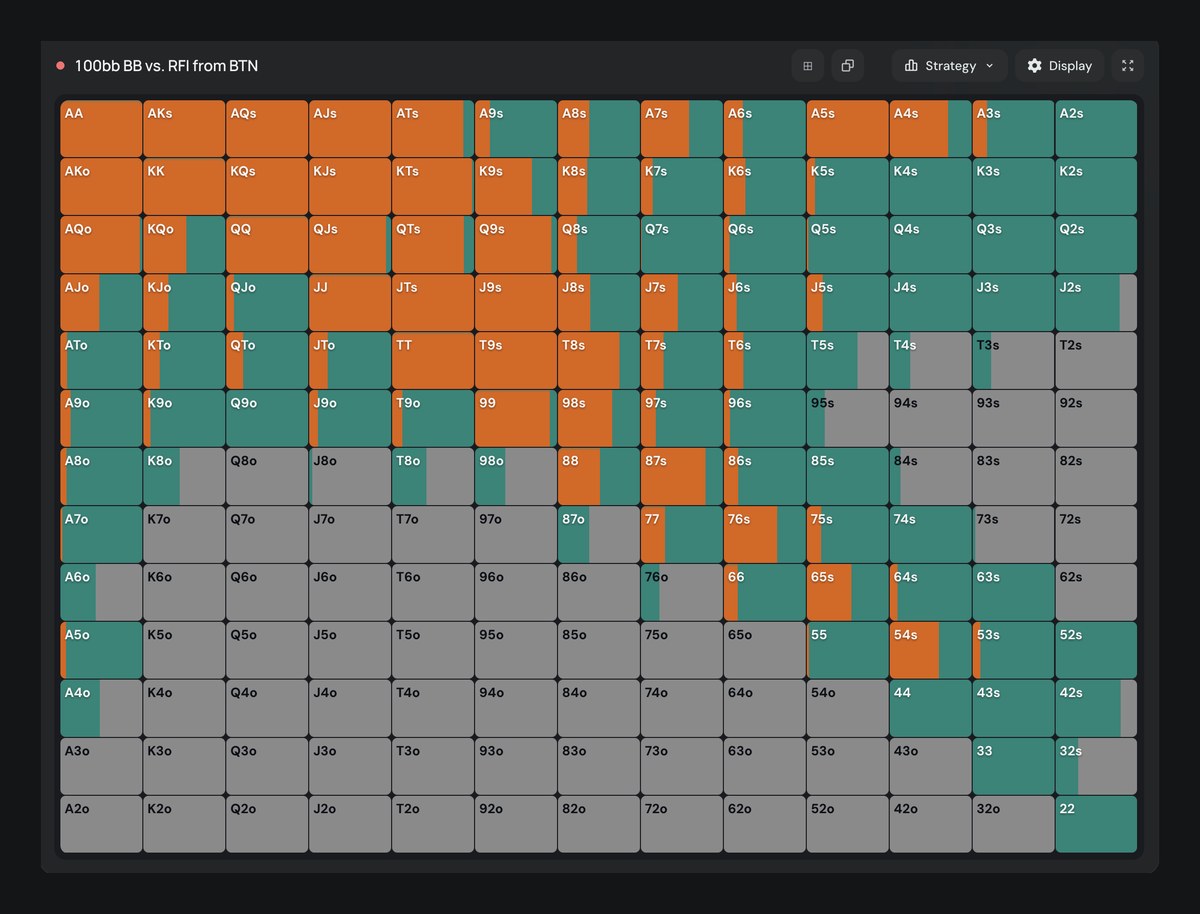
The button’s own call checks the formula from the other side: it adds 8.5bb to a 14bb pot, 8.5 ÷ 22.5 = 37.8%, which is the number on its badge.
BTN calls the 3-bet
Same seat, different price in a tournament
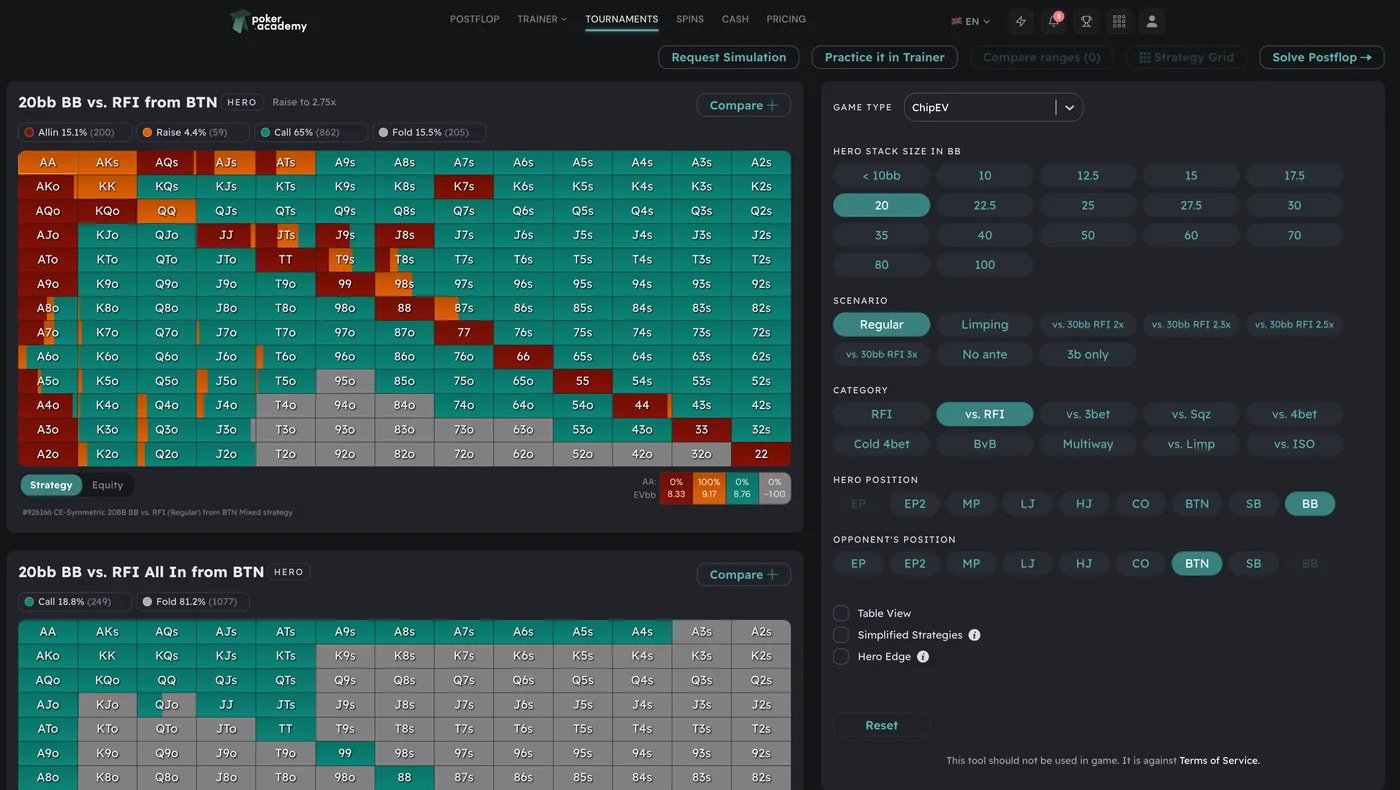
Change the format and the price changes with it. A 9-handed tournament, 20bb deep, chipEV, with a 1bb big-blind ante. The button opens to 2bb. Now the middle holds 0.5 + 1 + 1 + 2 = 4.5bb and the call is 1bb:
BB vs a 2bb button open, MTT 20bb with 1bb BB ante
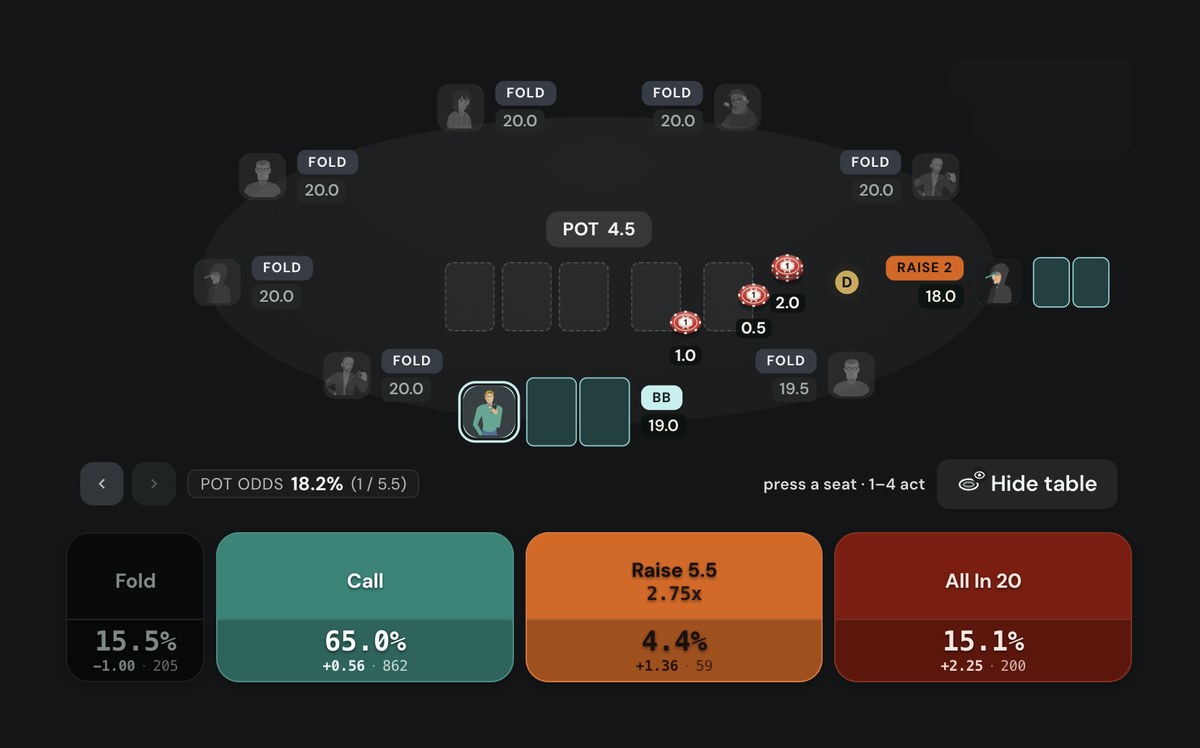
18.2% instead of 27.3%, and the solver folds only 15.5% of hands instead of 55.9%. The price is a big part of that, though 20bb and 100bb are different games in other ways too. The ante is dead money: it adds to the reward and costs the big blind nothing to call.
The tiles show EV against folding again. Fold is the baseline at −1.00bb, the posted blind. Calling is +0.56bb better on average for the hands that call, raising to 5.5bb +1.36bb, and the all-in +2.25bb.
Beyond the table
The same threshold works away from poker as long as risk and reward are in the same unit. If asking for a $50 monthly discount costs you nothing beyond an email, any chance above zero is worth it. Once the risk is time or pride and the reward is money, you have left this formula behind. You are estimating expected value with a guess about what your time is worth, which is fine, and it is a different calculation. The habit carries over either way: instead of “will this work?”, ask “how often does it need to work?”
Try it yourself
The Breakeven Calculator runs these four cases for any pot and bet in a few seconds. Then open Browse, find a spot where you face a bet, and check the POT ODDS badge against your own maths. Next time someone fires a river bet at you, count the pot, count the bet, and compare the price with how often you think you are ahead.
Cheers! 🙂
Keep reading
All posts
Poker Academy
Stop guessing preflop.
1,500,000+ GTO preflop solutions. Try them free for 3 days.
Start Free TrialCancel anytime.