
PKO strategy: how to turn bounties into chips and adjust your ranges
 Filip PedzichUpdated· first published ~9 min read
Progressive knockout tournaments put a price on every head. That changes who calls an all-in, how wide the blinds defend, and even how wide the first raiser opens. At a final table it changes much less than people expect.
An earlier version of this article quoted a bounty value without saying where it came from. Here the conversion is done step by step, and then a chipEV chart sits next to a PKO chart for the exact same eight stacks, so you can see what the bounty does to real ranges.
Where your buy-in goes
In a standard PKO your buy-in, after rake, is split in two. One part goes to the normal prize pool, paid out by finishing position. The other part becomes the bounty on your head.
I’ll use a constructed example for the maths: a $20 PKO, rake ignored, $10 to the prize pool and $10 as your starting bounty, 20,000-chip starting stack. When you knock someone out, you get half their bounty in cash ($5) and the other half is added to your own bounty ($10 becomes $15). That 50/50 split is a common setting, but not the only one. Check the lobby of your tournament before you use these numbers.
Turning a bounty into chips
To compare a bounty with a pot you need both in the same unit. Early in a tournament, far from the money, a simple assumption does the job: chips are worth the prize-pool money they stand for. Your 20,000 chips stand for the $10 you put into the prize pool, so $1 is worth 2,000 chips.
Cash half of a starting bounty, in chips
At 500/1,000 blinds
So in this example knocking out a player with a starting bounty is worth half a starting stack, or 10bb at 500/1,000. Three assumptions sit under that number, and you should know them:
- Chips are linear. This is chipEV thinking. Near the money and at the final table, ICM makes chips you win worth less than chips you lose, and the conversion breaks down.
- Only the cash half counts. The half added to your own bounty is usually paid when someone knocks you out later, or when you win the tournament. It is worth something, less than its face value. Leaving it out is a conservative heuristic rather than a solver result.
- The bounty is the starting one. A player who has already busted two people carries a bigger bounty. At $20 the cash half is $10, which is 20,000 chips or 20bb in this example.
A fixed rule like “a bounty is worth X% of a stack” therefore doesn’t work. The answer depends on the split, the size of that player’s bounty, how you value the half that goes on your head, and the blind level you convert to.
You only win a bounty you cover
A bounty is paid when you take all of a player’s chips. So you need at least as many chips as they have, and you have to win the pot. Chopping the pot doesn’t bust anyone.
- You cover them: their bounty is extra money on your side of the pot odds.
- They cover you: you can’t win their bounty. Your own bounty is what’s on the line, and it goes to them if you lose.
- A third player is still to act: the bounty goes to whoever wins the pot, and that may not be you. Be careful counting it before the action is closed.
Pot odds with the bounty in the pot
Same constructed example. Blinds 500/1,000 with a 1,000 big-blind ante, so in big blinds: 0.5 + 1 + 1. A player with a starting bounty moves all-in for 10bb, everyone folds to you in the big blind, and you cover. The pot before your call is 10 + 0.5 + 1 + 1 = 12.5bb, and calling costs 9bb more.
Required equity, chips only
Required equity, with the 10bb bounty
The bounty is paid only when you win, so it belongs on the winning side of the equation. You can check that with the EV of the call, where e is your equity:
Play this spot instead of reading about it
Start Free TrialThe trainer deals the situations this article describes and grades every decision you make. Try it free for 3 days.
Break-even equity
From 41.9% down to 28.6%. That is a big difference, and it gets bigger the shorter the all-in stack is, because the bounty stays the same while the chips at risk get smaller.
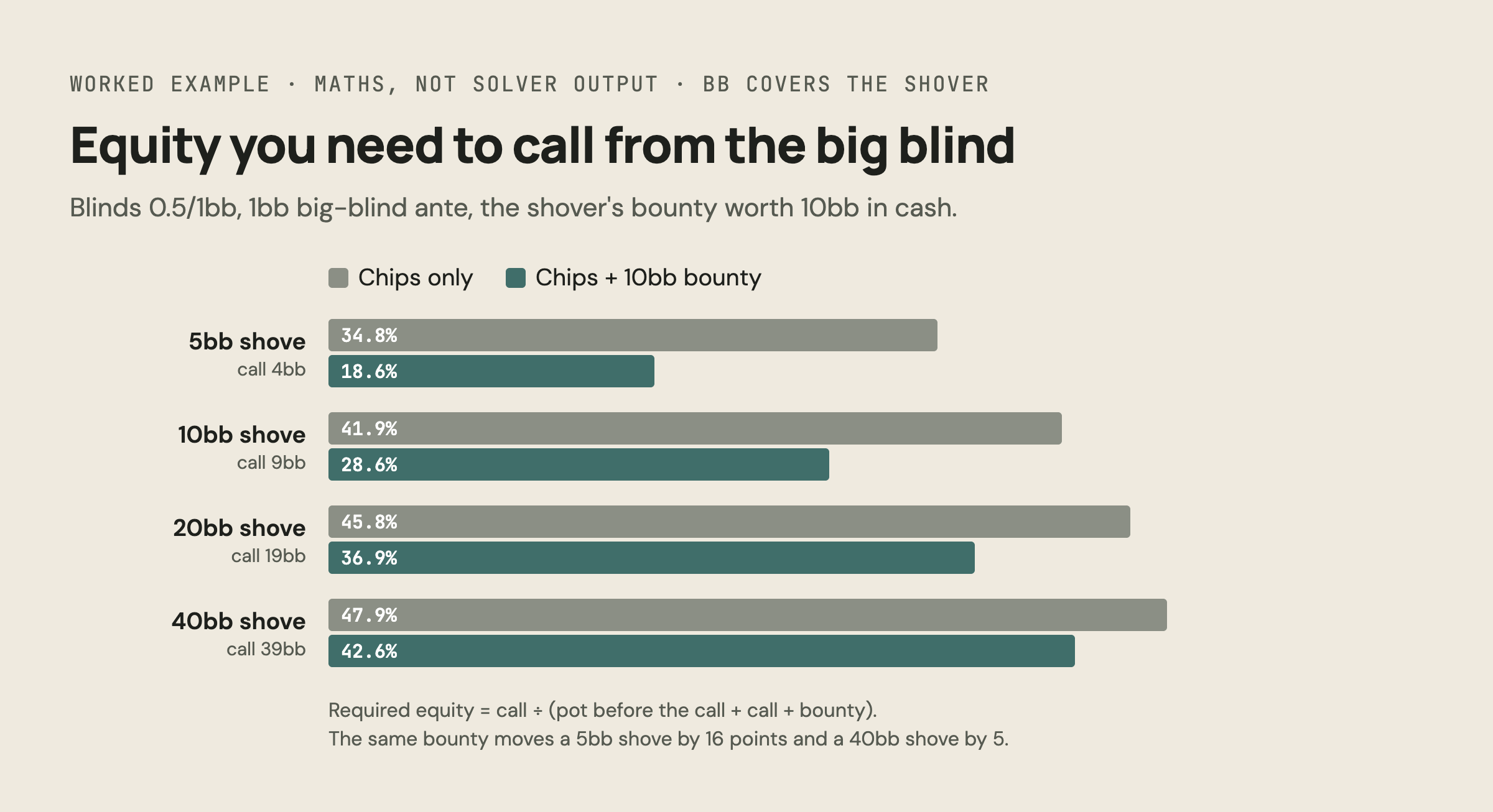
That is the honest version of “bounty power”: the bounty measured against the chips you have to put in. A 10bb bounty on a 10bb stack changes your call a lot. The same bounty on a 40bb stack moves it by about 5 points.
What the solver does with the same stacks
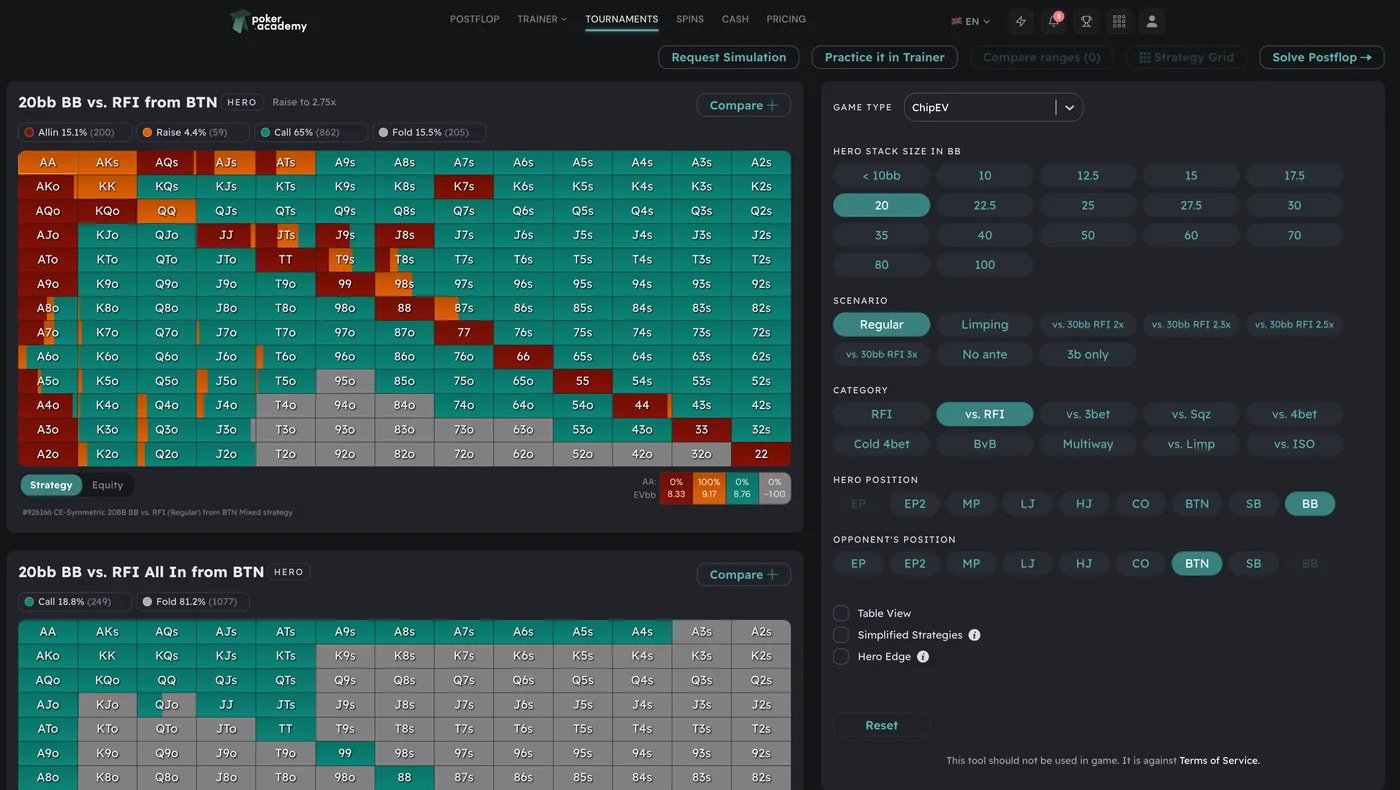
Pot odds tell you the price. They say nothing about how everybody else’s ranges change when they chase bounties too. For that I use two preflop simulations in Poker Academy with identical stacks: an 8-handed MTT table with 54, 12, 18, 42, 22, 32, 38 and 6bb (EP to BB), a 0.12bb ante per player, 0.96bb in total. One is chipEV. The other is a PKO model with a $500 bounty on every player, with the whole field still in the tournament.
One caveat. The PKO simulation also uses ICM, so the difference between the two comes from more than bounties. I can’t separate the two effects from this data, so read the gaps below as “PKO model vs chipEV” rather than as a pure bounty effect.
The spot: MP has 12bb and moves all-in. Everyone who acts after MP except the big blind covers that stack. Here is the small blind with 38bb in chipEV:
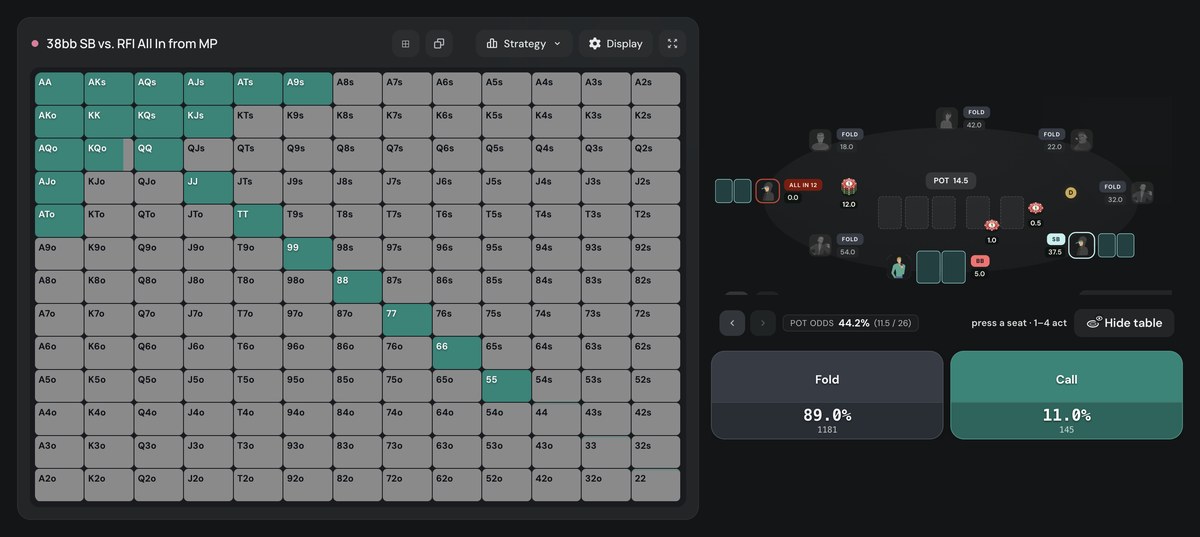
The small blind calls 11.0% of hands: 55 and better, A9s and better, KJs and KQs, ATo and better, and KQo 79% of the time. The price is on the table. You call 11.5bb into a pot of 14.46bb (12 + 0.5 + 1 + 0.96), and the chipEV screen rounds the pot to 26bb and shows 44.2%.
Pot odds for the small blind
Now the same spot in the PKO simulation:
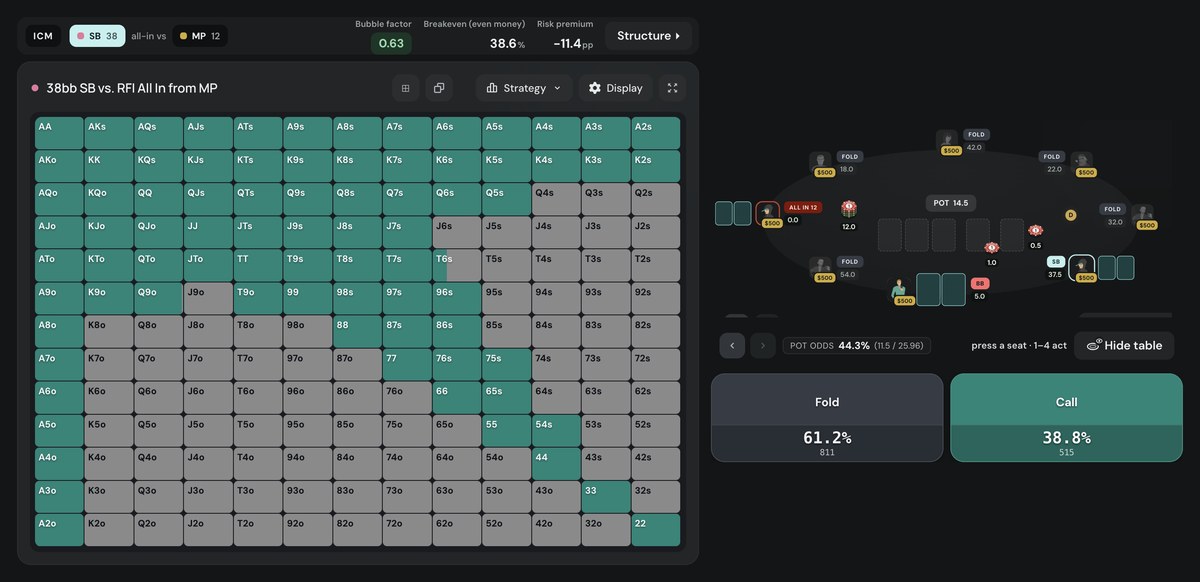
The call range is 38.8%: every pair, every suited ace and suited king, every offsuit ace, K9o and better, suited connectors down to 54s. The pot odds tile still says 44.3%, since it counts chips only. The bounty shows up in the ICM strip above the chart, which gives a bubble factor of 0.63 for this all-in. Below 1, that means losing chips costs you less than winning them earns you. For an even-money all-in that is the break-even:
Break-even for an even-money all-in
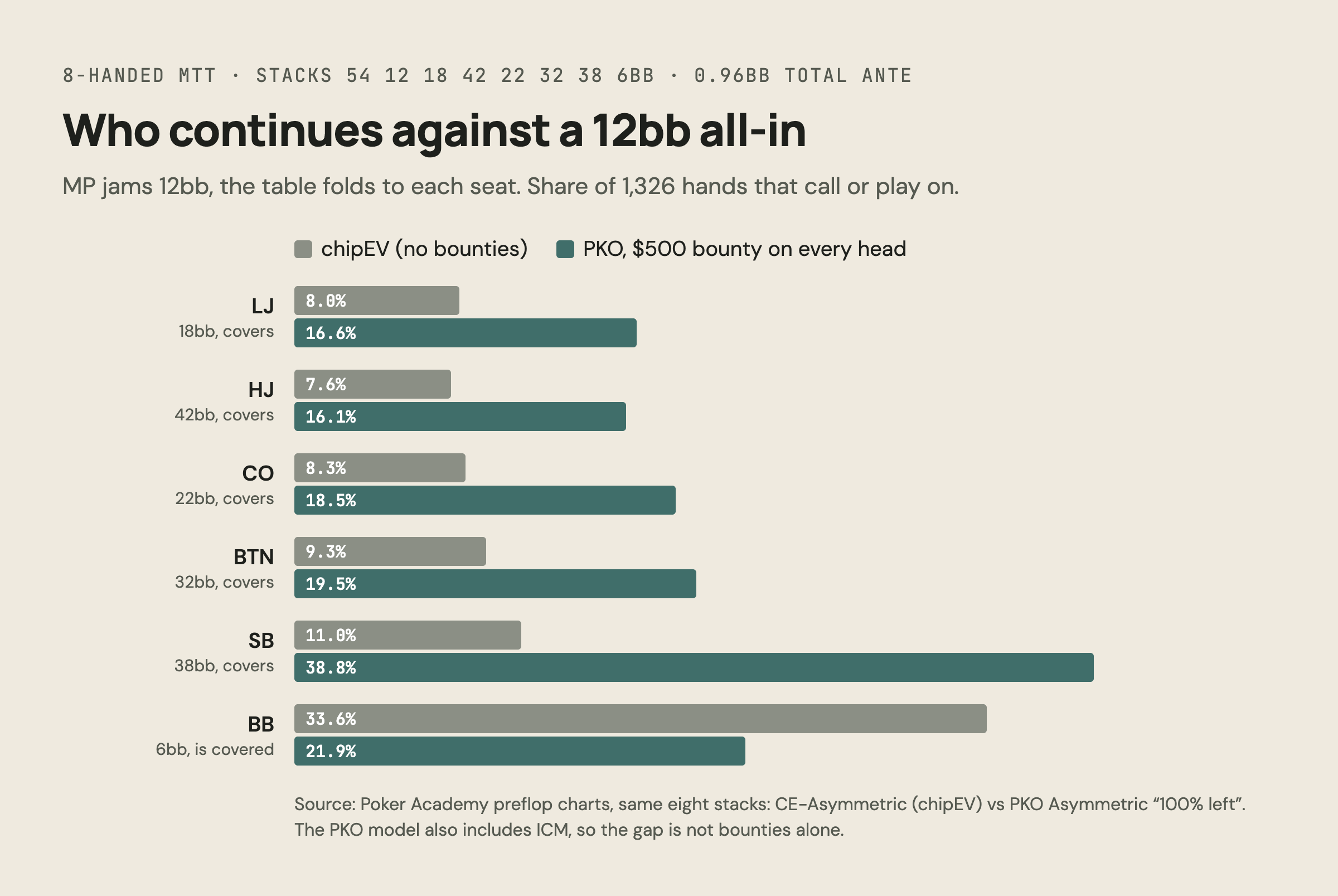
Look at the last row. The big blind has 6bb and can’t win MP’s bounty, because MP covers him. In chipEV he calls 33.6% of hands; in the PKO model he calls 21.9%. Covering decides whether the bounty is on your side at all.
Openers get wider too
Bounties change the opens as well. If players behind you call wider, you’d expect the first raiser to play tighter. The solver does the opposite from six of the seven seats that open. My reading, which the chart doesn’t prove: a covering stack collects bounties when those wider calls lose.
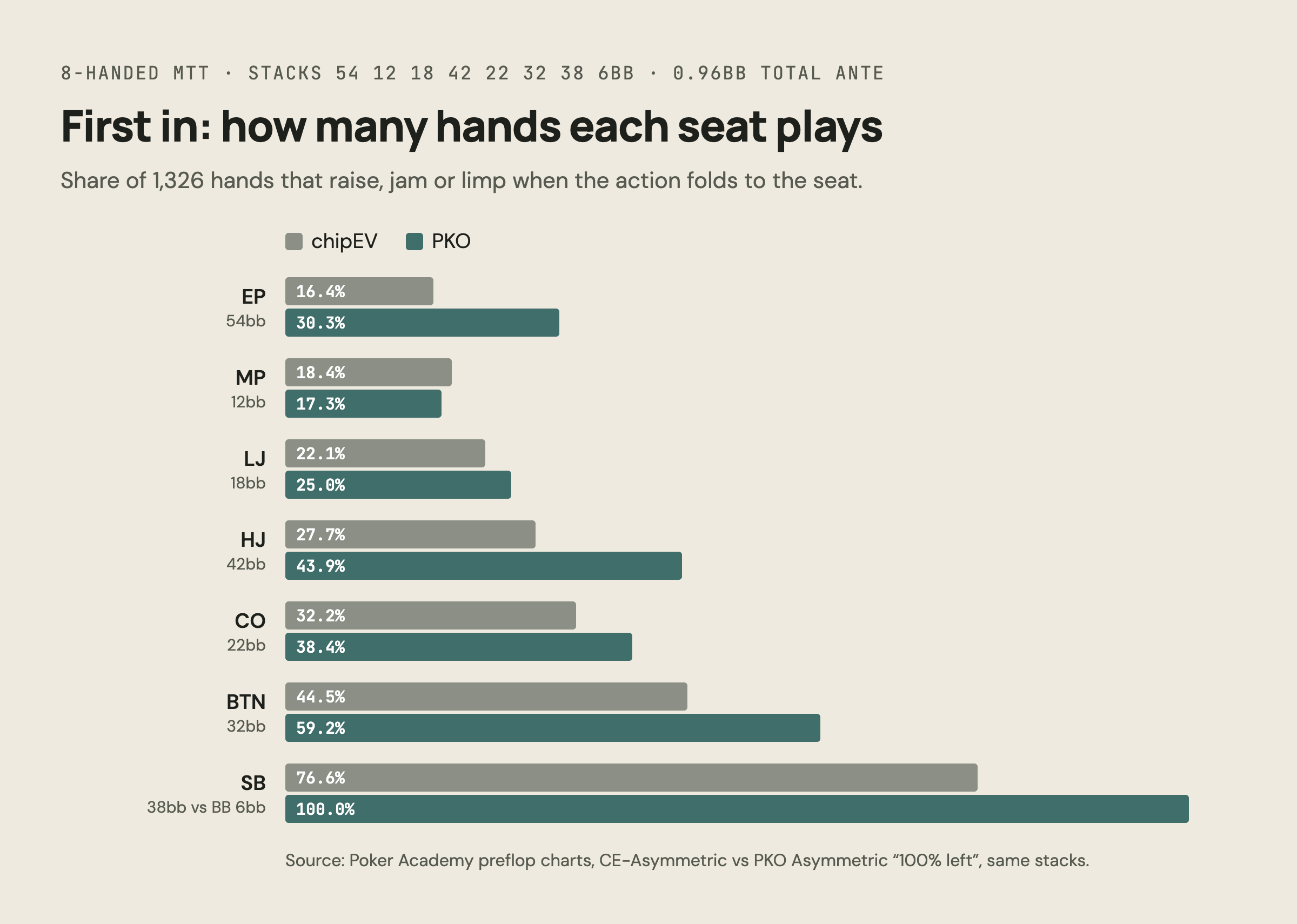
The clearest case is the small blind against a 6bb big blind. In chipEV the small blind jams 72.3% of hands and limps 4.3%:
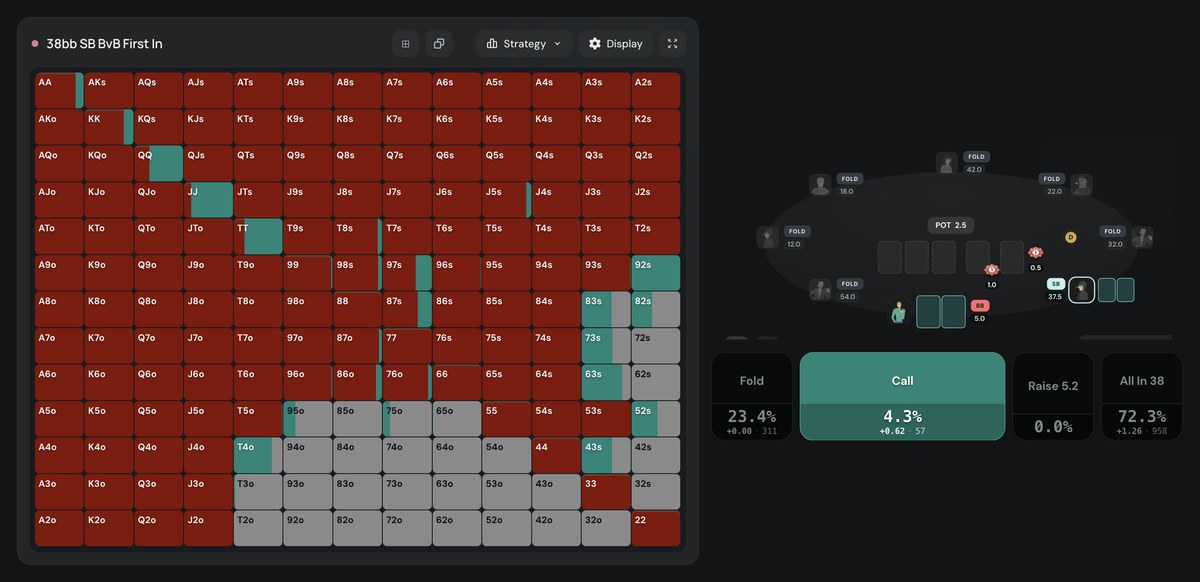
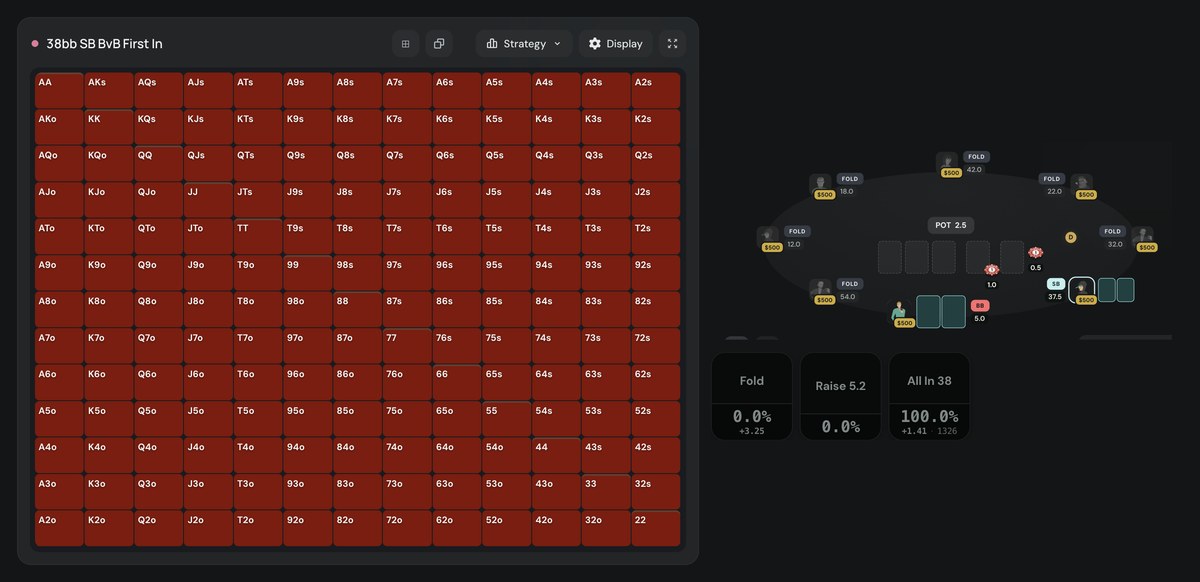
With a bounty on a 6bb stack, the small blind jams every hand. MP with 12bb, covered by almost everyone, doesn’t widen at all. It jams 17.3%, and that range includes 44 to 99. So the old tip “don’t jam small pairs as a short stack in a PKO” is too broad: in this spot the solver jams them (it folds 33 and 22).
At the final table, pay jumps weigh more
An earlier version of this article told you not to compare a bounty with the next pay jump. That was wrong. At a final table that comparison is the decision: how much is the bounty worth, and how much ICM does calling cost you?
Poker Academy has a PKO final-table simulation with the same eight stacks. The bounties there differ from player to player (MP has $3,750, the small blind $9,375) and the payouts are a final-table structure, so it isn’t a controlled test. The direction is clear enough anyway.
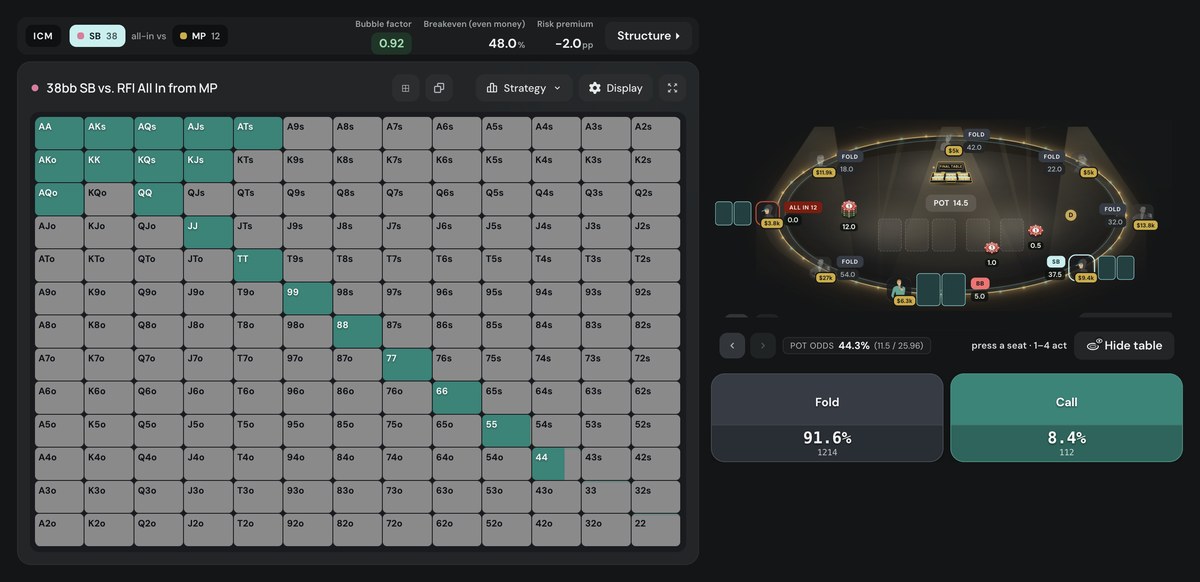
The small blind calls 8.4%, close to the ICM final table without bounties (5.3%) and far from the 38.8% early in the PKO. The bubble factor is 0.92, so the break-even for an even-money all-in is 48.0%. The bounty still helps, and the pay jumps matter more.
A short checklist
- Read the structure: how much of the buy-in is bounty, and how much of a won bounty is paid in cash.
- Convert the cash part of the bounty into chips, then into big blinds at the current level.
- Check who covers whom. No cover, no bounty.
- Add the bounty to the pot odds only when you cover and the action is closed.
- The shorter the all-in, the more the bounty matters. Against deep stacks it moves your call much less.
- Near the money and at the final table, compare the bounty with the ICM cost of the all-in. In the final-table spot above, the pay jumps won.
Then look at real PKO charts for stacks like yours, next to the chipEV version, and play the spots in the trainer until the wider calls stop feeling wrong.
Cheers! 🙂
Keep reading
All posts
Poker Academy
Stop guessing preflop.
1,500,000+ GTO preflop solutions. Try them free for 3 days.
Start Free TrialCancel anytime.