
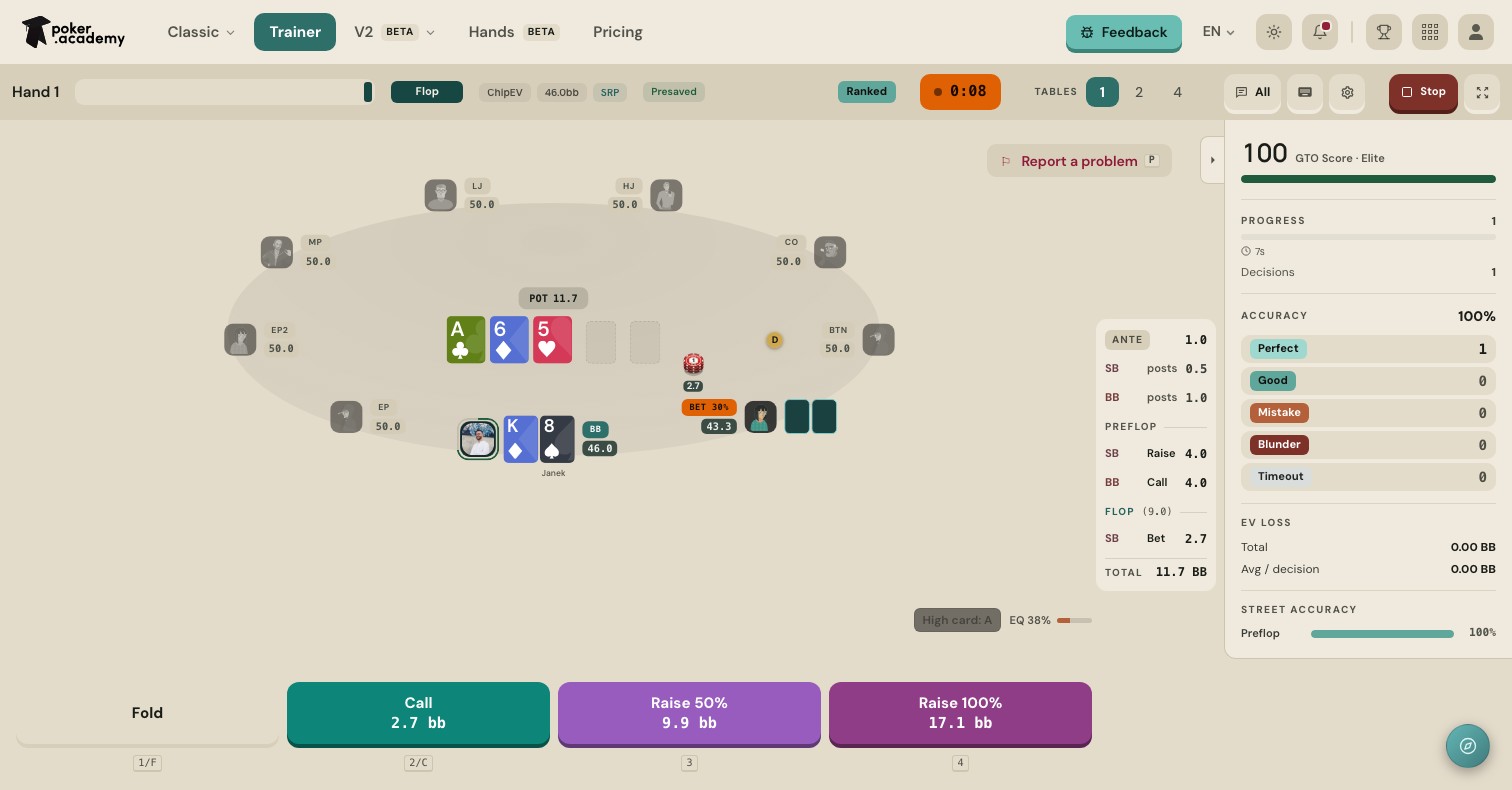
 The flop is dealt, the villain has bet, and the decision is hero’s
You played the strategy
Your action is what the solver does at that node, at that frequency.
Full Hand Trainer
The charts give you the answer. The trainer deals you the spot, puts you against an opponent who plays the solver’s strategy, and grades every decision you make until the hand is over.
The screens in the shot are film art, not live output. What the product actually shows is below, in screenshots.
You play the whole hand
The opponent acts from the solver’s strategy, so the hand develops the way real hands do. After your 3-bet you see a flop in a 3-bet pot, and you play it with the range you built preflop.
Every street is played out, which is the part a lookup cannot teach: the cost of a preflop call is usually paid three streets later, and you only feel that if you are still in the hand when it arrives.
Sessions can be pinned to preflop only when that is what you are working on.
You choose when villain’s cards show: at the start, at the end, or only at showdown. Each one turns the same spot into a different exercise.
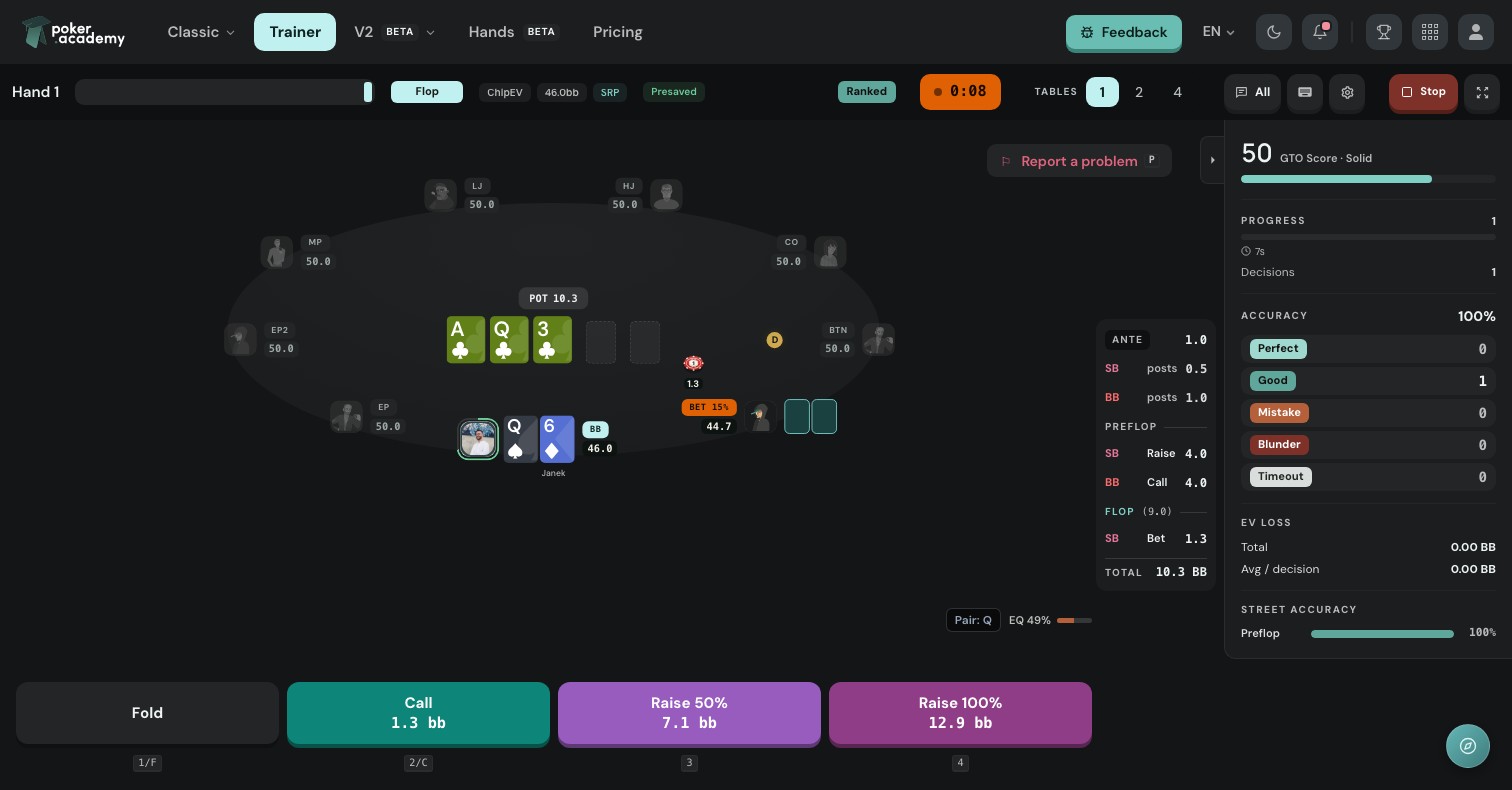 The flop is dealt, the villain has bet, and the decision is hero’s
This is the centre of it
Four grades. Watch the two in the middle: a decision that was good but not the best costs a little each time, and those small costs add up over a session.
Your action is what the solver does at that node, at that frequency.
Inside the mix, but not the branch carrying the most of it. Costs little and adds up.
Off-strategy, with the EV cost stated in bb rather than implied.
Separated from mistakes on purpose: one is a habit, the other is an accident.
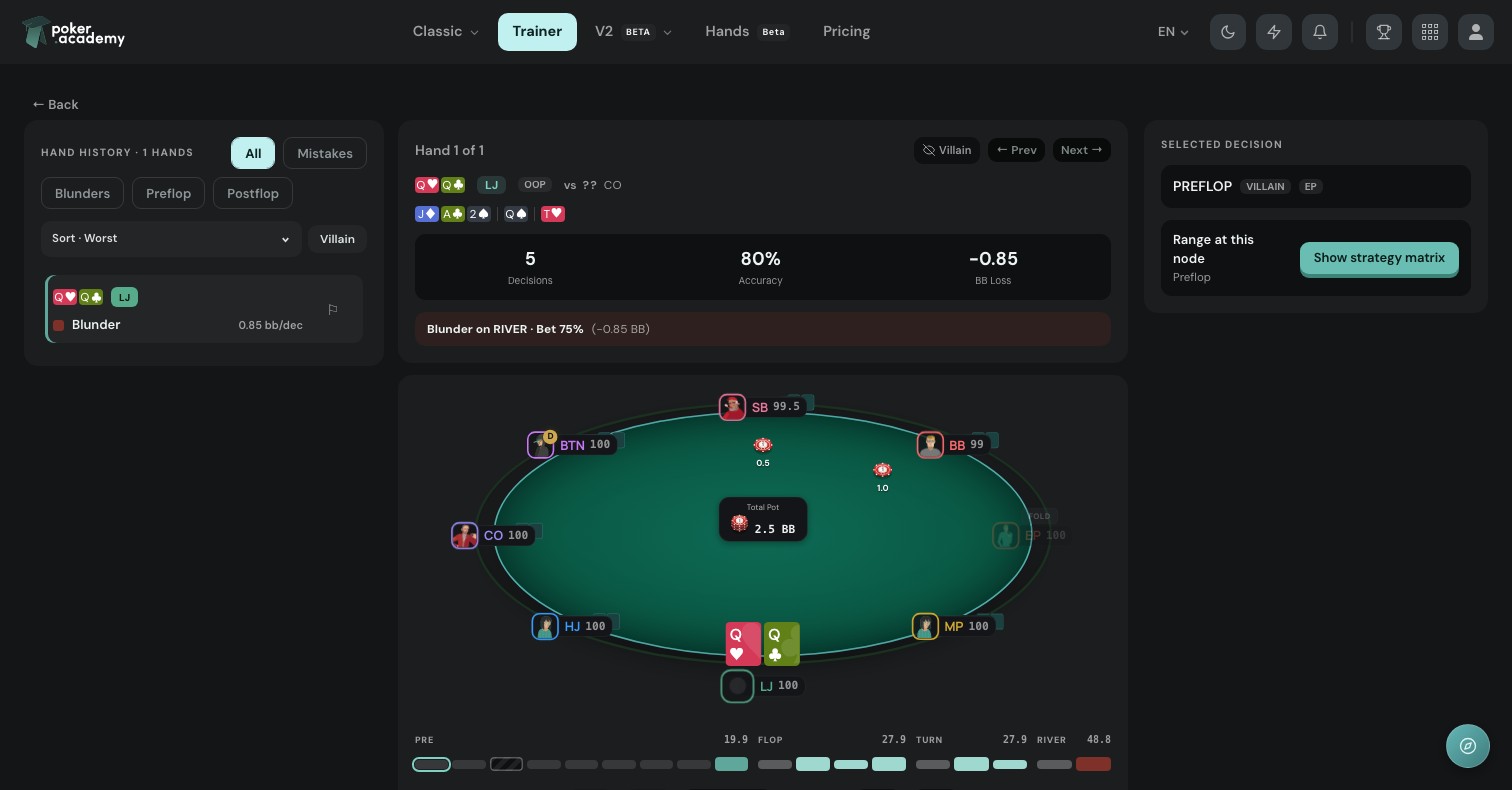 One hand, decision by decision: the solver’s frequencies, what you did and what it cost
You choose the spot
Everything about a session is set on one screen: the format and depth, who you are up against, and how much the trainer tells you and when. Three of those groups do most of the work, so the panel is built around them rather than around an alphabet of settings.
The preflop situation, your seat and villain’s seat, each chosen on its own. Leave one empty and it is random. A category the chosen scenario cannot deal is removed, not greyed out, and the counter above the group moves with it.
Category 3 of 11
Hero seat none = random
Opponent seat none = random
The list is not the same in every format: Cash carries no Heads-Up and no vs. ISO, and Spins reduces the seats to BTN, SB and BB because that is the game.
The one setting that changes what the session is. It opens on After on purpose. Study shows the answer before you decide, so starting there turns your first sessions into copying answers instead of training.
Feedback
Timer per decision
The timer switches off while Feedback is set to Study. Reading a range and playing against the clock are two different exercises, so the panel will not let you combine them.
Format first; everything under it narrows to what that format’s matrices actually cover.
Four ways to decide what to train
Any configuration becomes a named drill you can rerun. This is how most people end up with a list.
Eight kinds, all built from your own sessions, among them weakest spot, review due, close decisions, blunder buster, mistake replay and daily challenge.
A day-by-day curriculum. You decide what to study once, and the plan covers every evening after that.
A fixed set of spots, assigned to you or opened from a link, with a leaderboard. Because the hands are identical, this is the one place in the product where your results compare directly with other players’.
Accuracy, attempts, hands and age per row, so a drill you have not touched in a month says so. A drill never played shows dashes rather than a score, because nothing has happened yet.
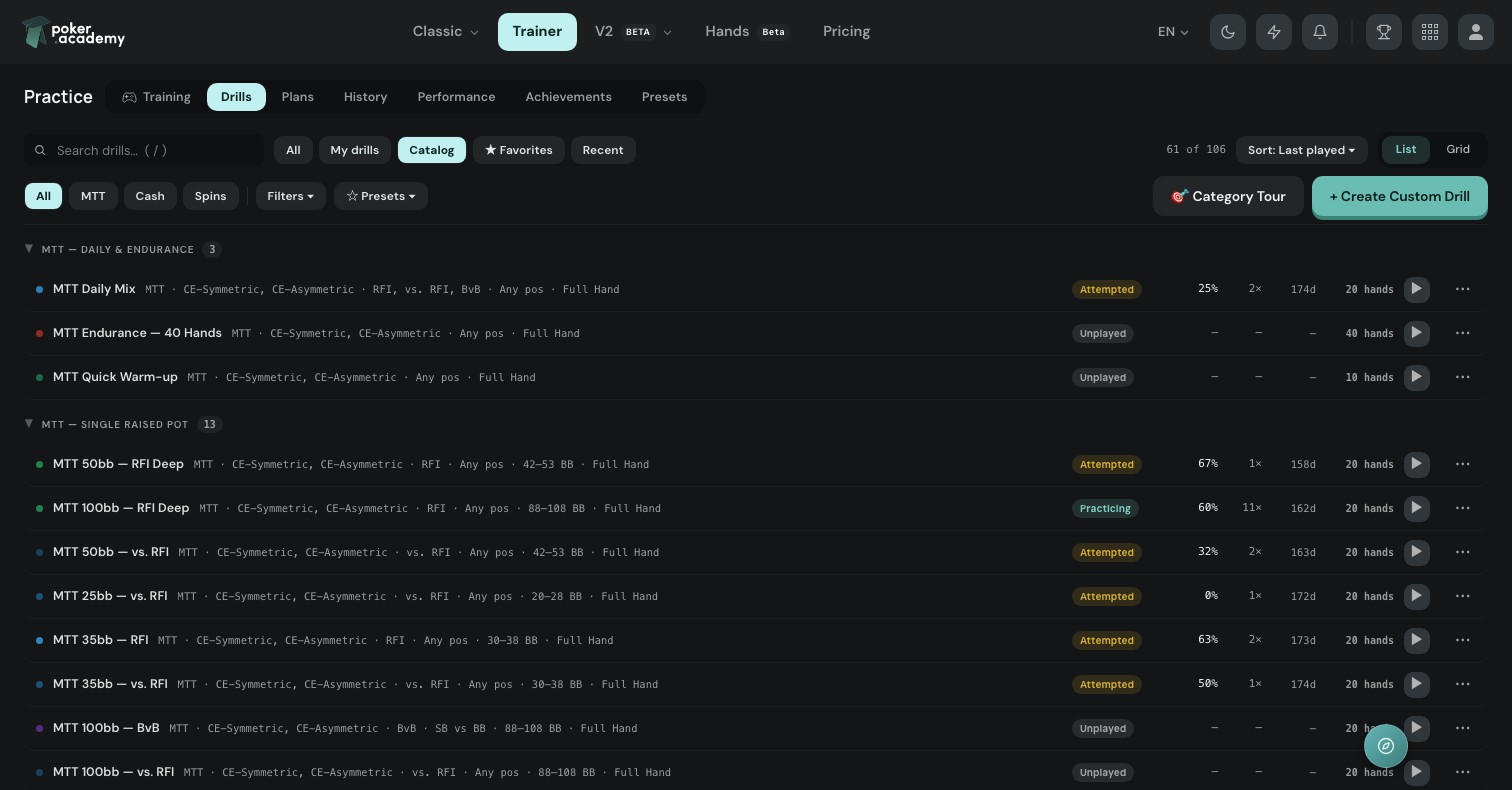 The catalog, grouped by spot, with your own drills one chip away
A plan is a sequence of drills with a target and a calendar. The one on this account is a four-week tournament course: six sessions a week, a rest day at the end of each.
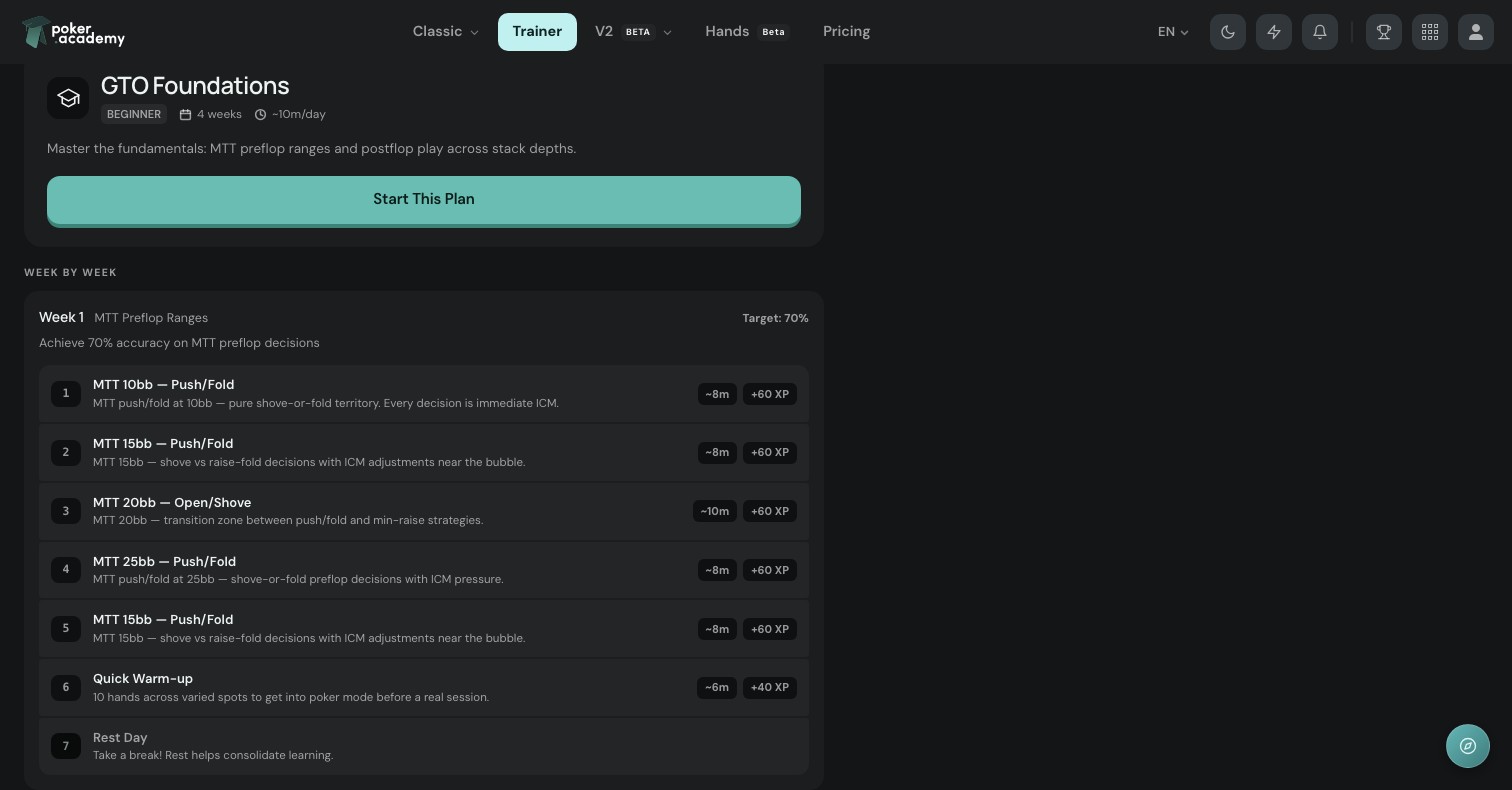 Week 1 of 4, the day strip, and this week session by session
It measures you
The summary lands the moment a session ends: the score, the decision-quality split, accuracy per street, and one written note about the session. Every line in it opens the hand it came from.
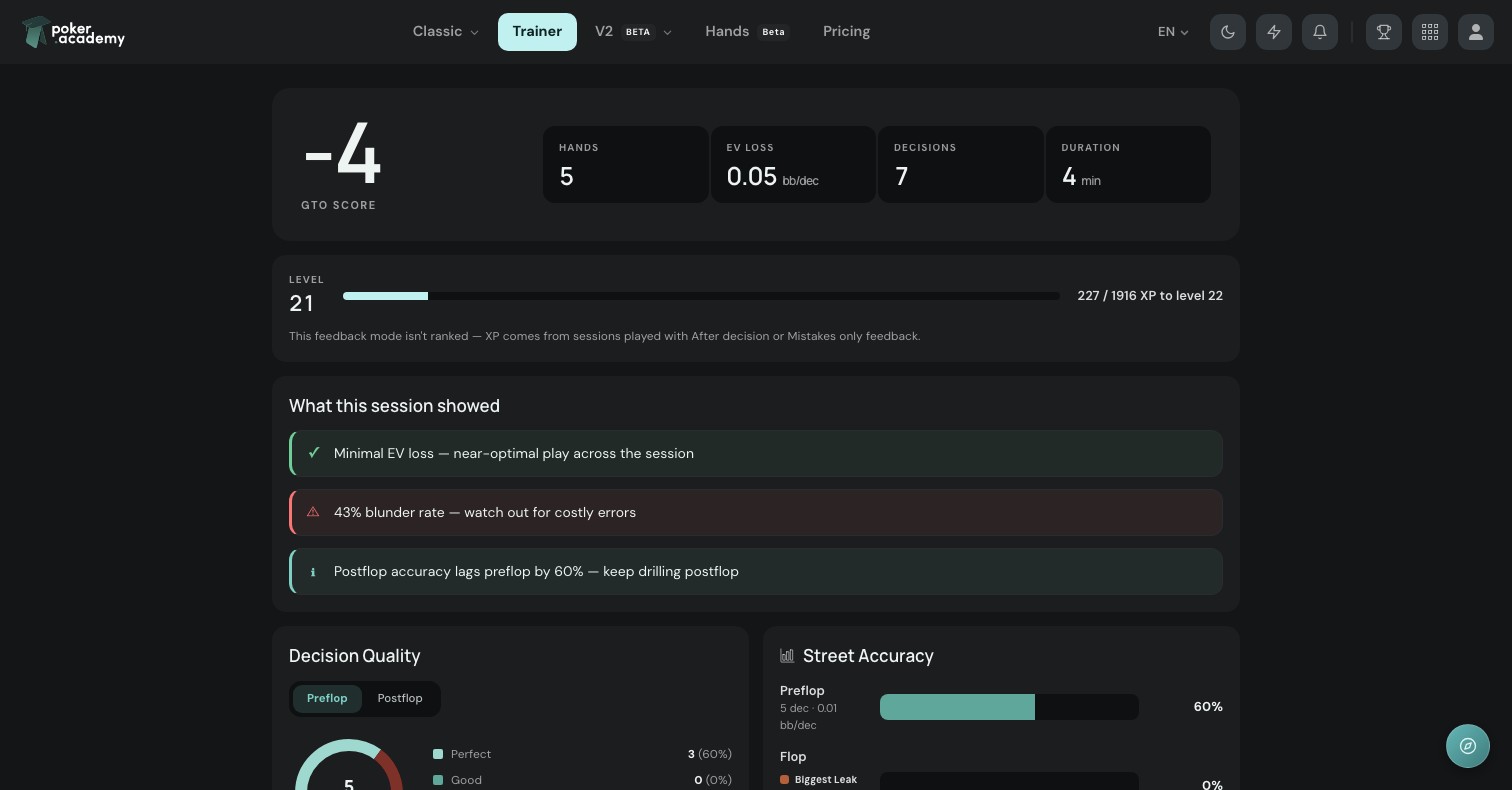 Score, hands, bb per decision, and the per-street split
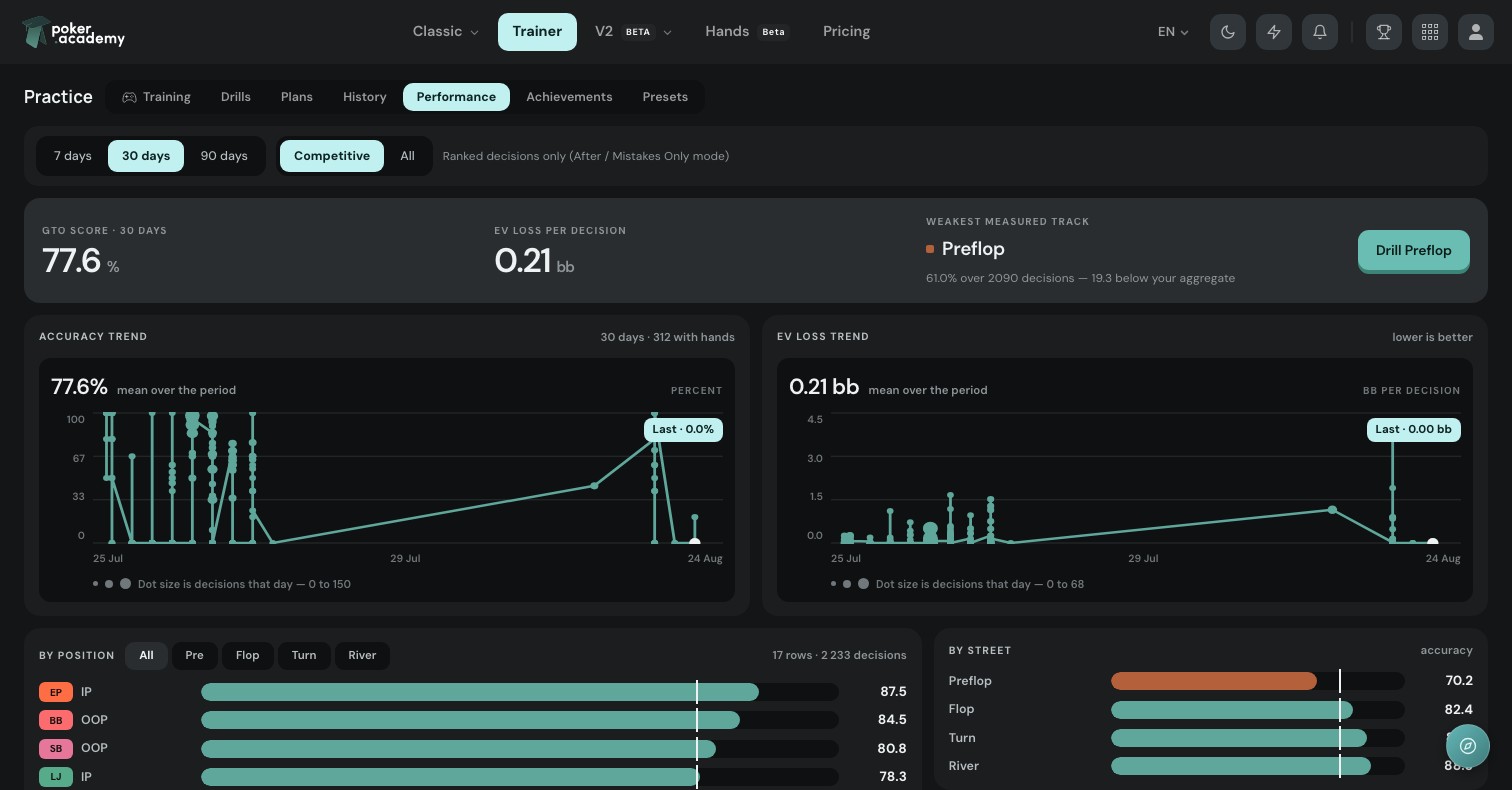 Trends, position breakdown, per-street accuracy
Accuracy and EV loss over time, then the same numbers cut by position, by street and by decision quality. This view tells you which drill to build next, and the generated drills read the same numbers to build themselves.
Every number here is counted from your own sessions. None of it is a projection or a rating.
Nothing is thrown away
Sessions do not expire and are not summarised away. Open any one of them, pick any decision, and the range at that node opens as the full grid. It is the same solver output the rest of the product reads.
Accuracy, bb per decision and duration per session, with a calendar strip showing the weeks you actually studied.
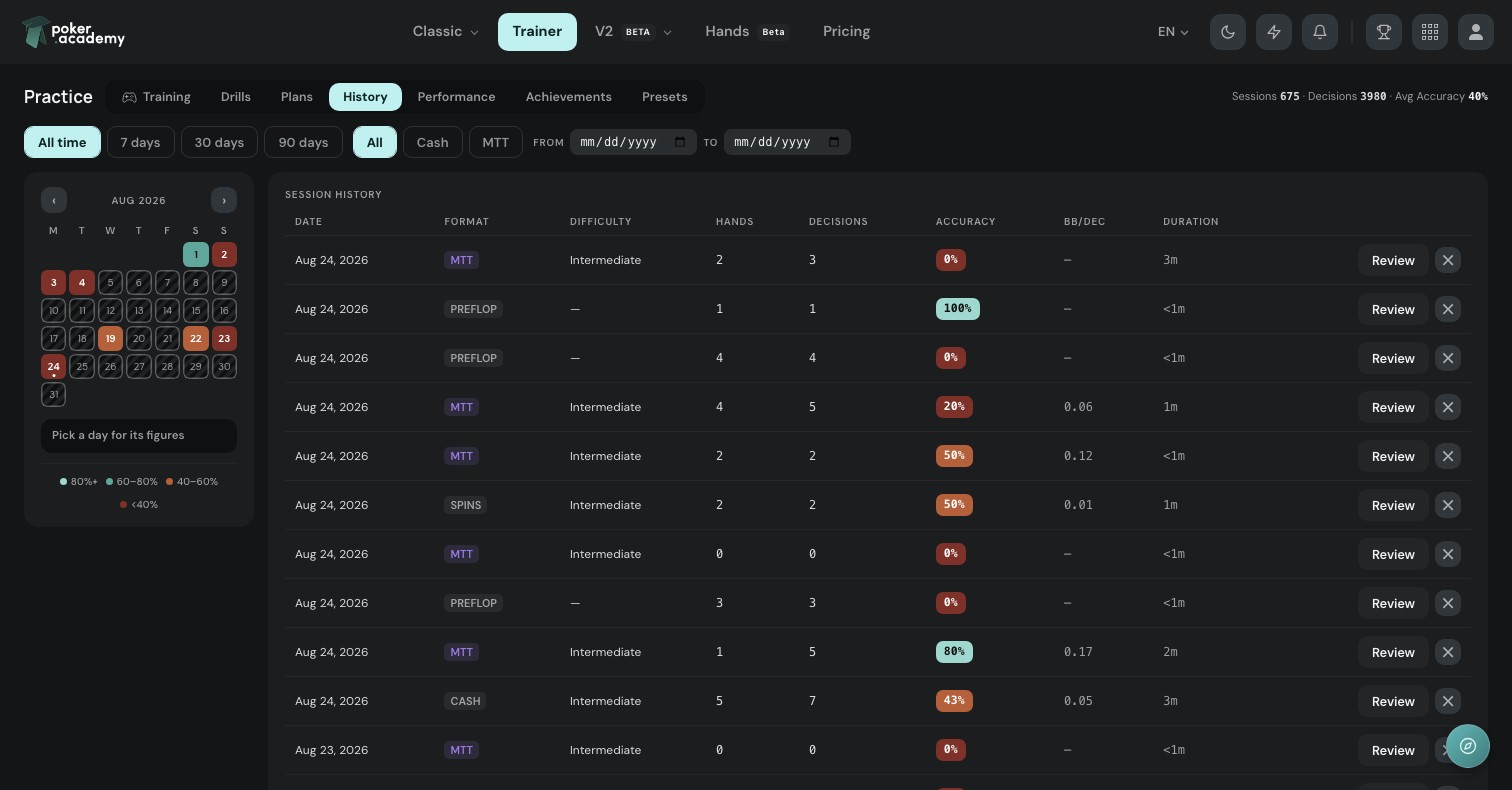 Session history, thousands of sessions deep
The whole 13×13 of what the solver does at that node, every combo in the range, next to the decision you made. It is one click from a hand you misplayed six weeks ago.
 The matrix at the selected decision
Progression
Sessions earn XP, and thirty achievements unlock as you go. None of it rates how good you are. It records the hours you put in, which is the one part of poker you fully control.
It is also the part of the trainer that is not about a single hand, and the reason people come back on the evenings when they do not feel like studying.
From the brand film, 2023.
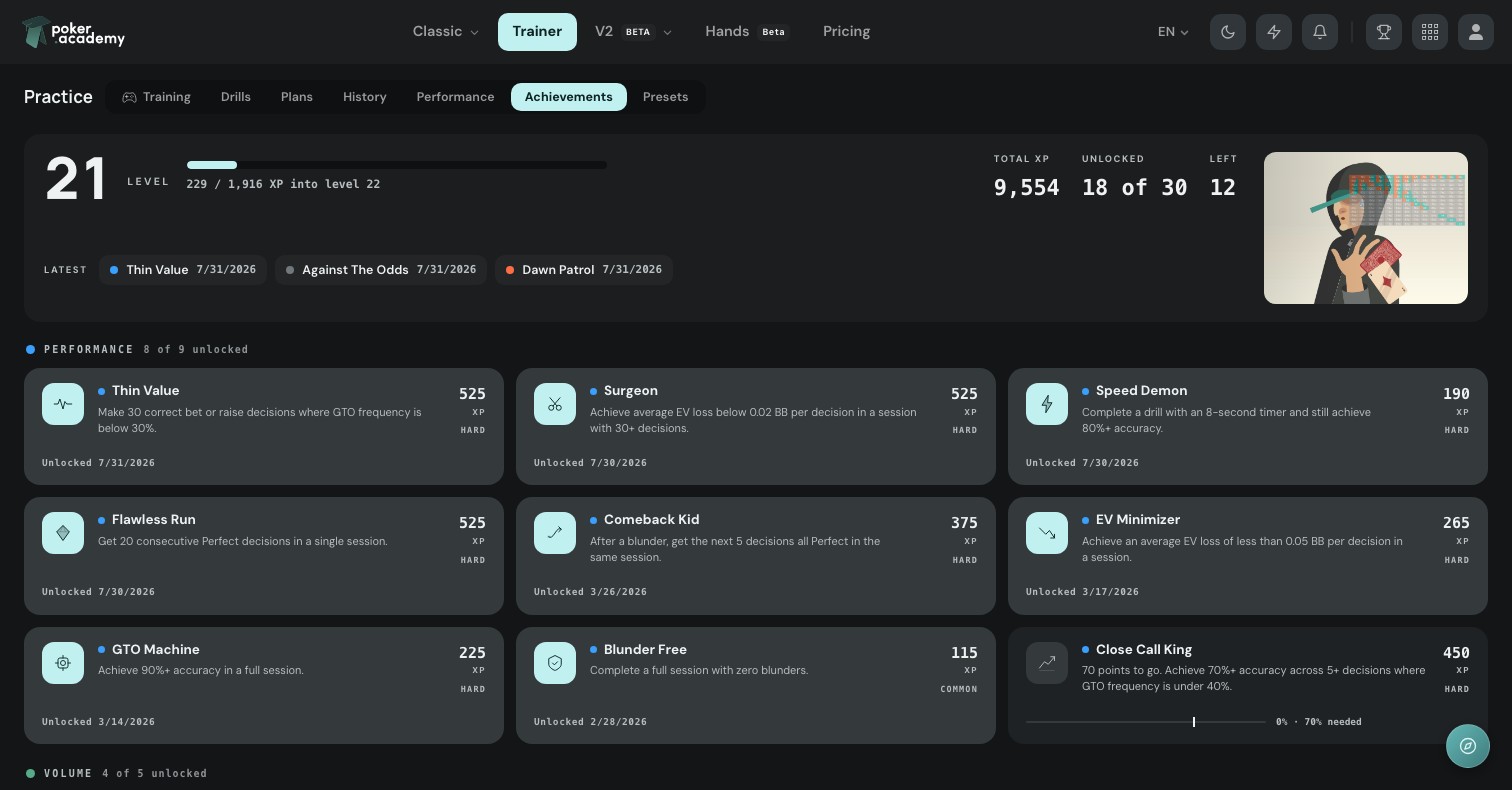 Level and XP above, thirty achievements below, twenty-four of them unlocked on this account
Full Hand Trainer
Pick a format, set the depth, play the hands out and read the review. That is the whole loop, and it takes about fifteen minutes.
Start Free TrialCancel in 2 clicks, no fee.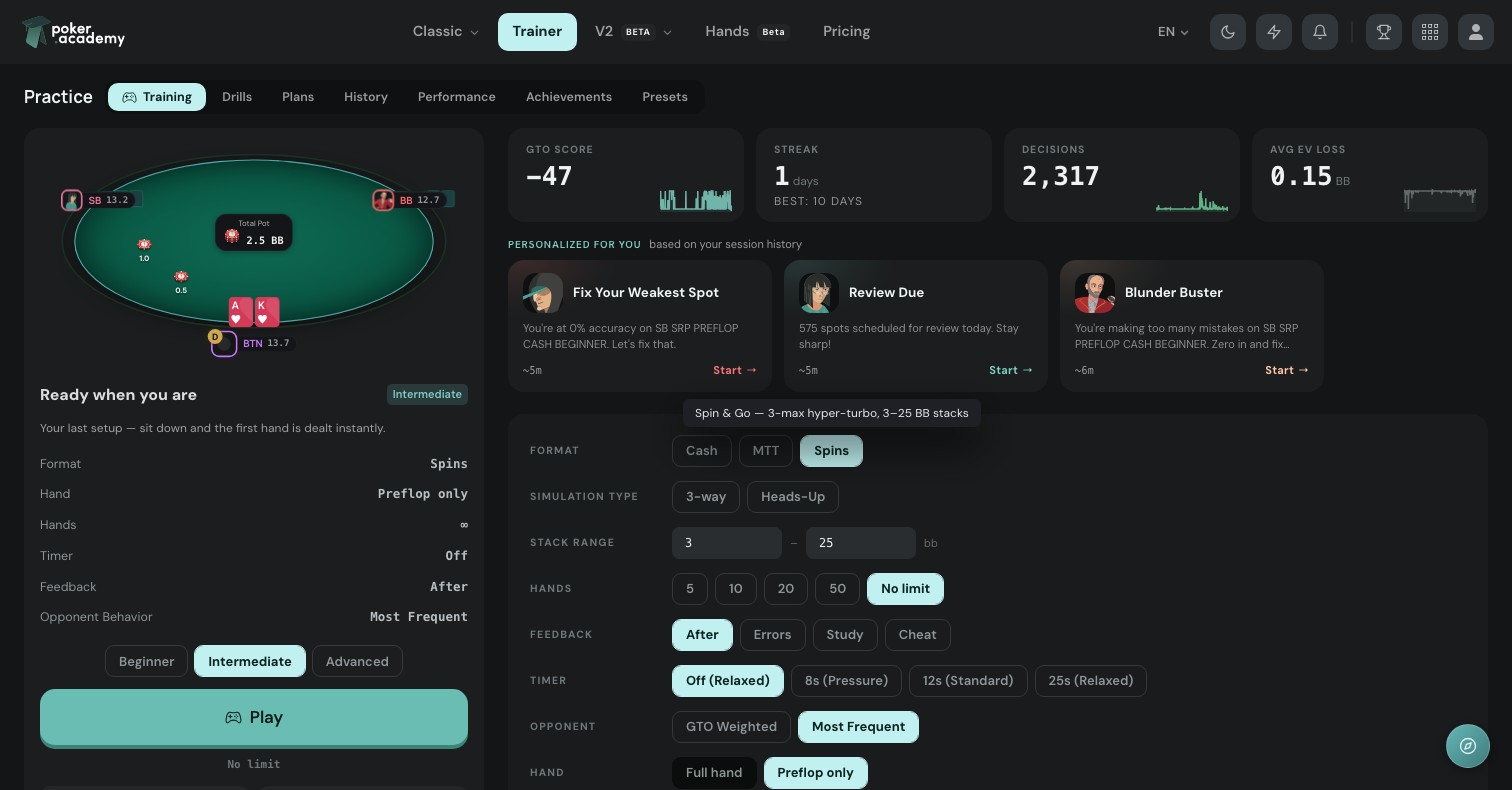 The cockpit opens on your last setup, so the first hand is one press away
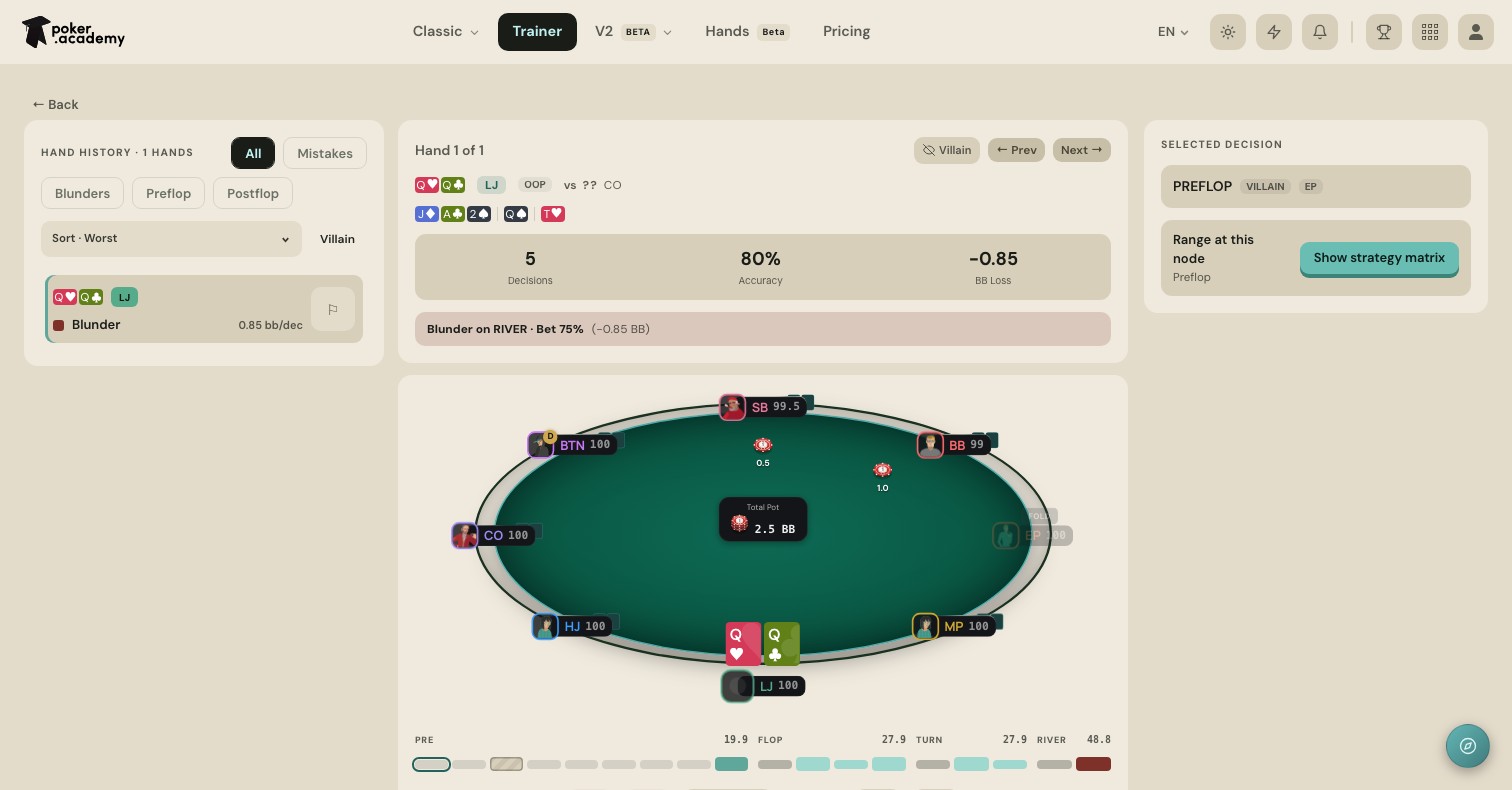 One hand, decision by decision: the solver’s frequencies, what you did and what it cost
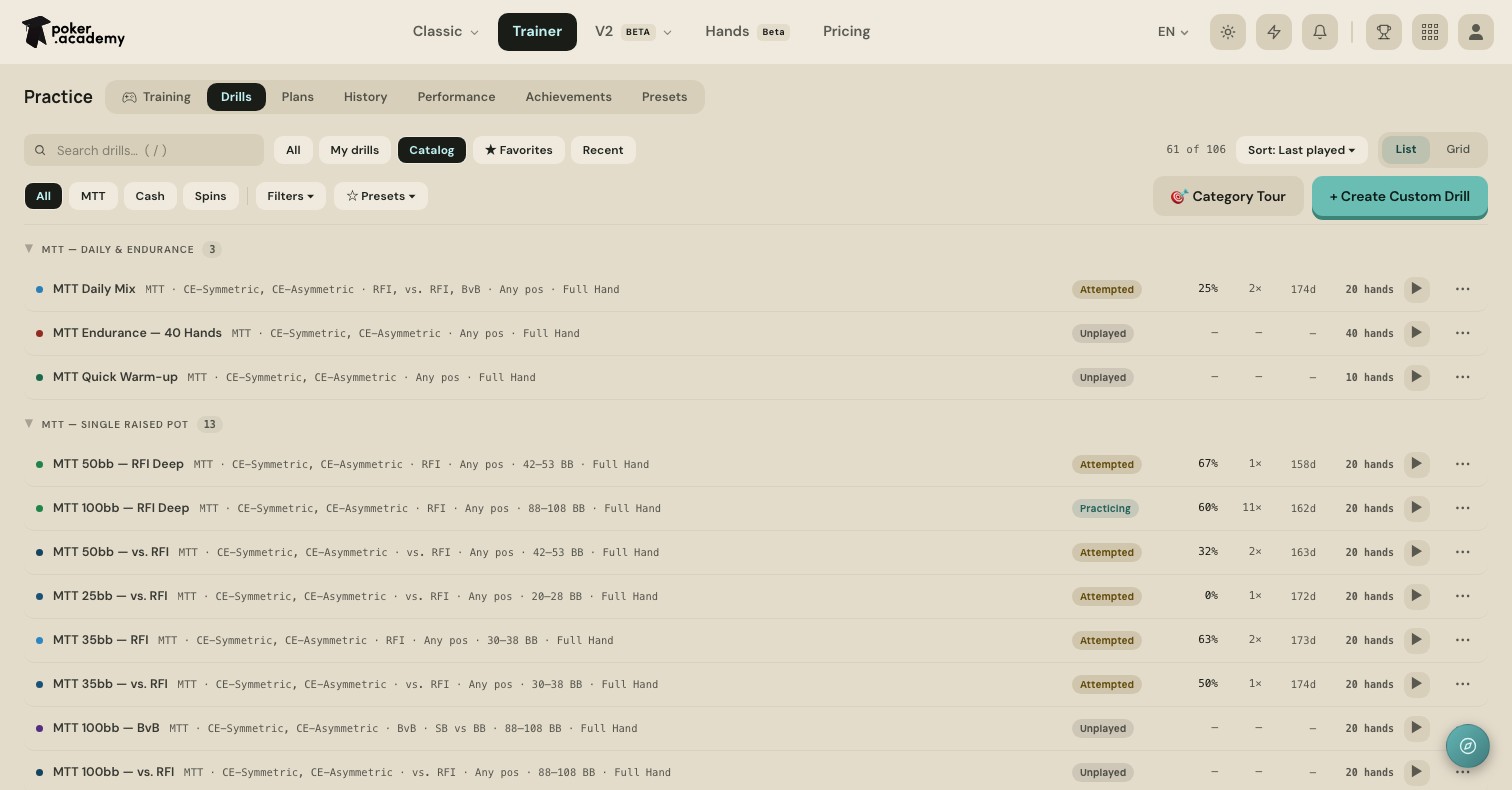 The catalog, grouped by spot, with your own drills one chip away
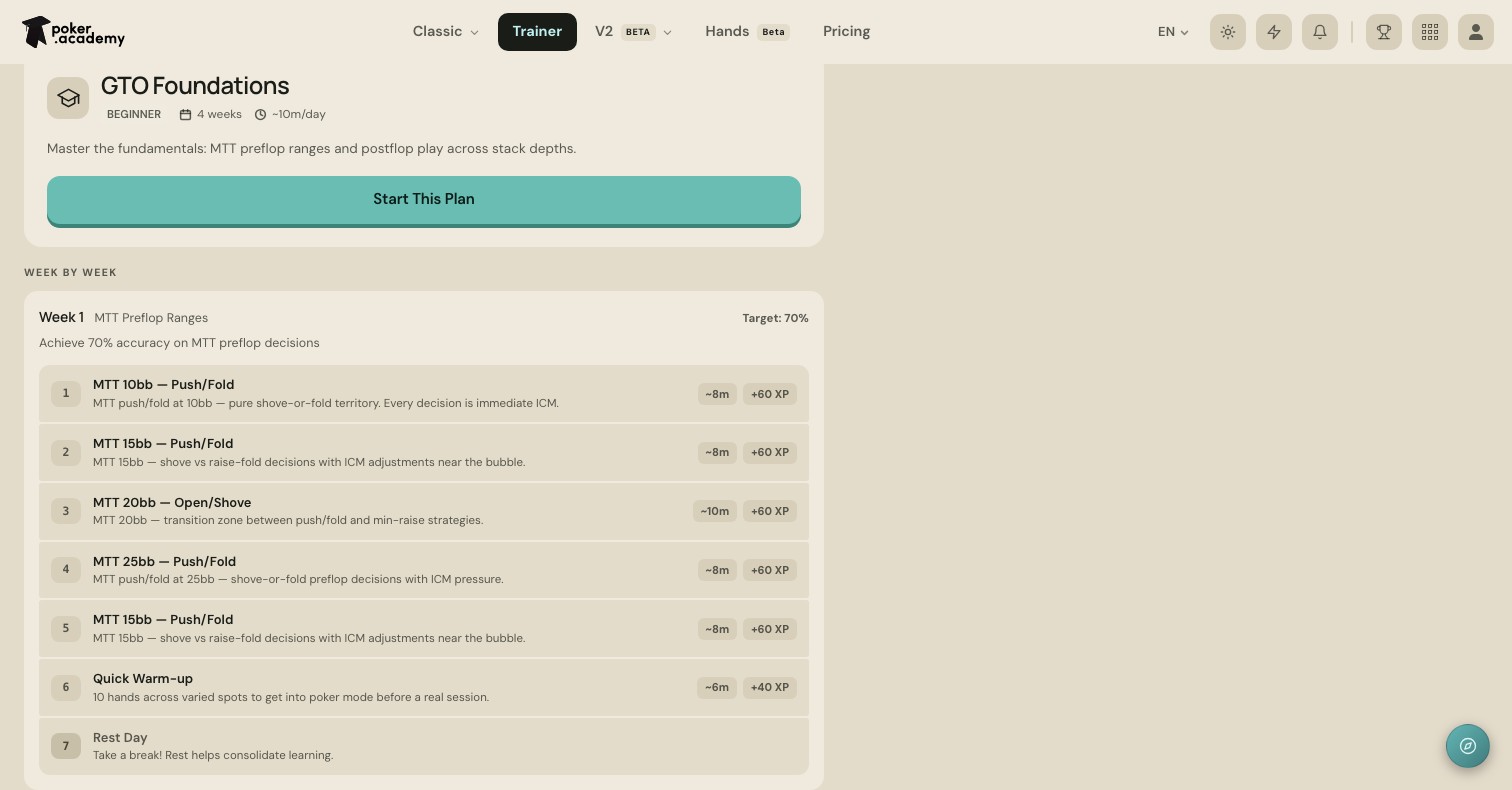 Week 1 of 4, the day strip, and this week session by session
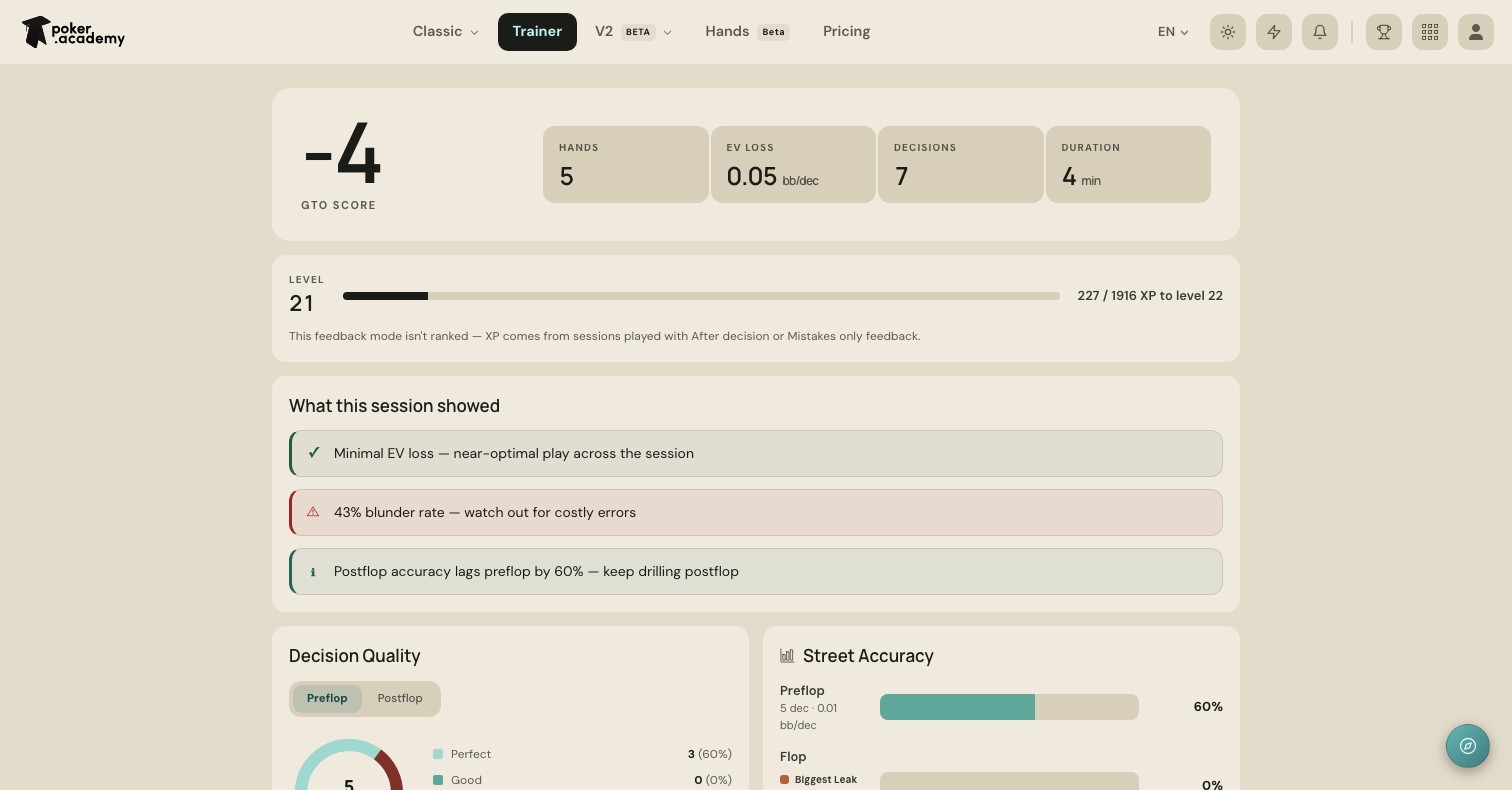 Score, hands, bb per decision, and the per-street split
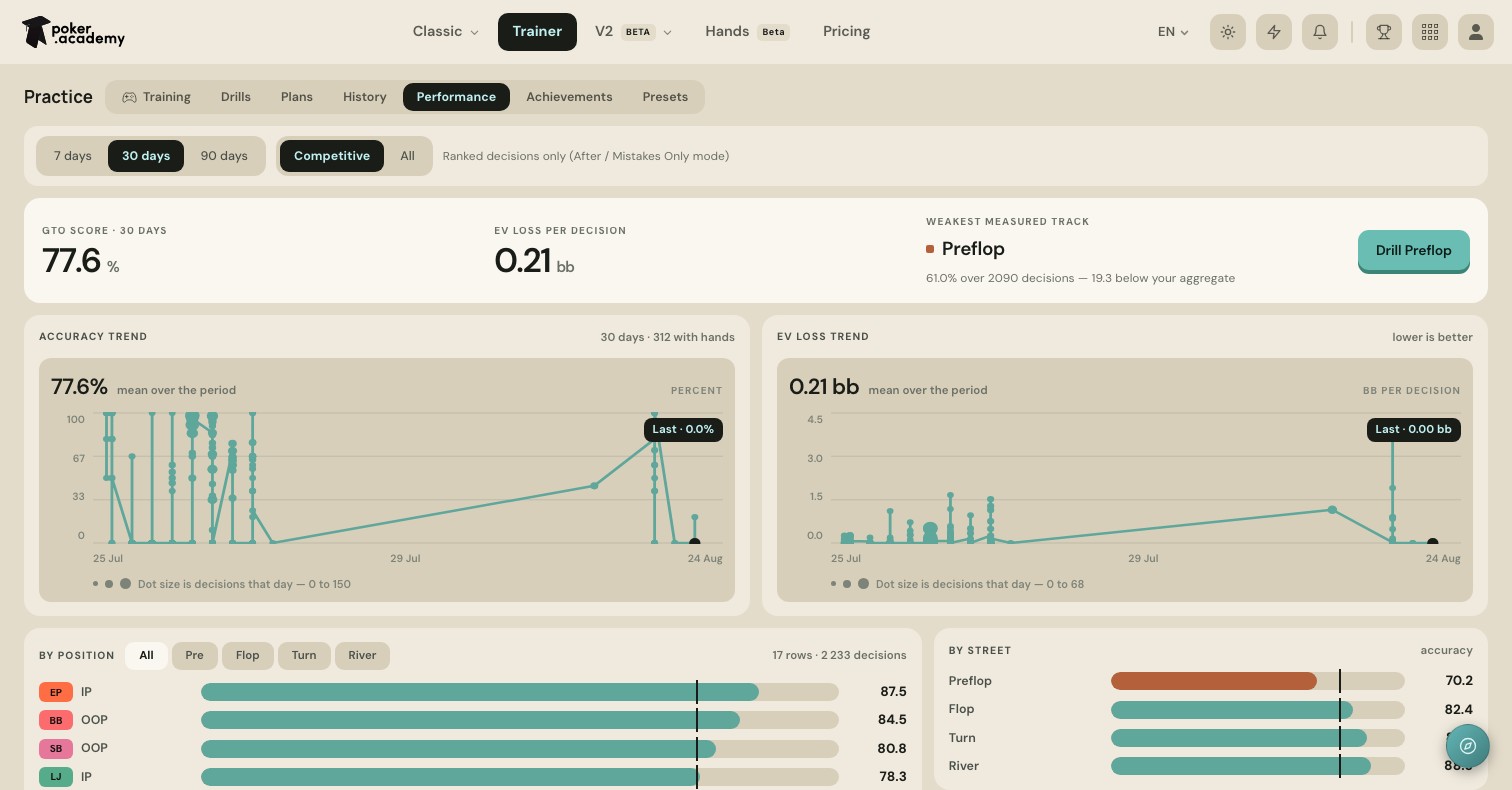 Trends, position breakdown, per-street accuracy
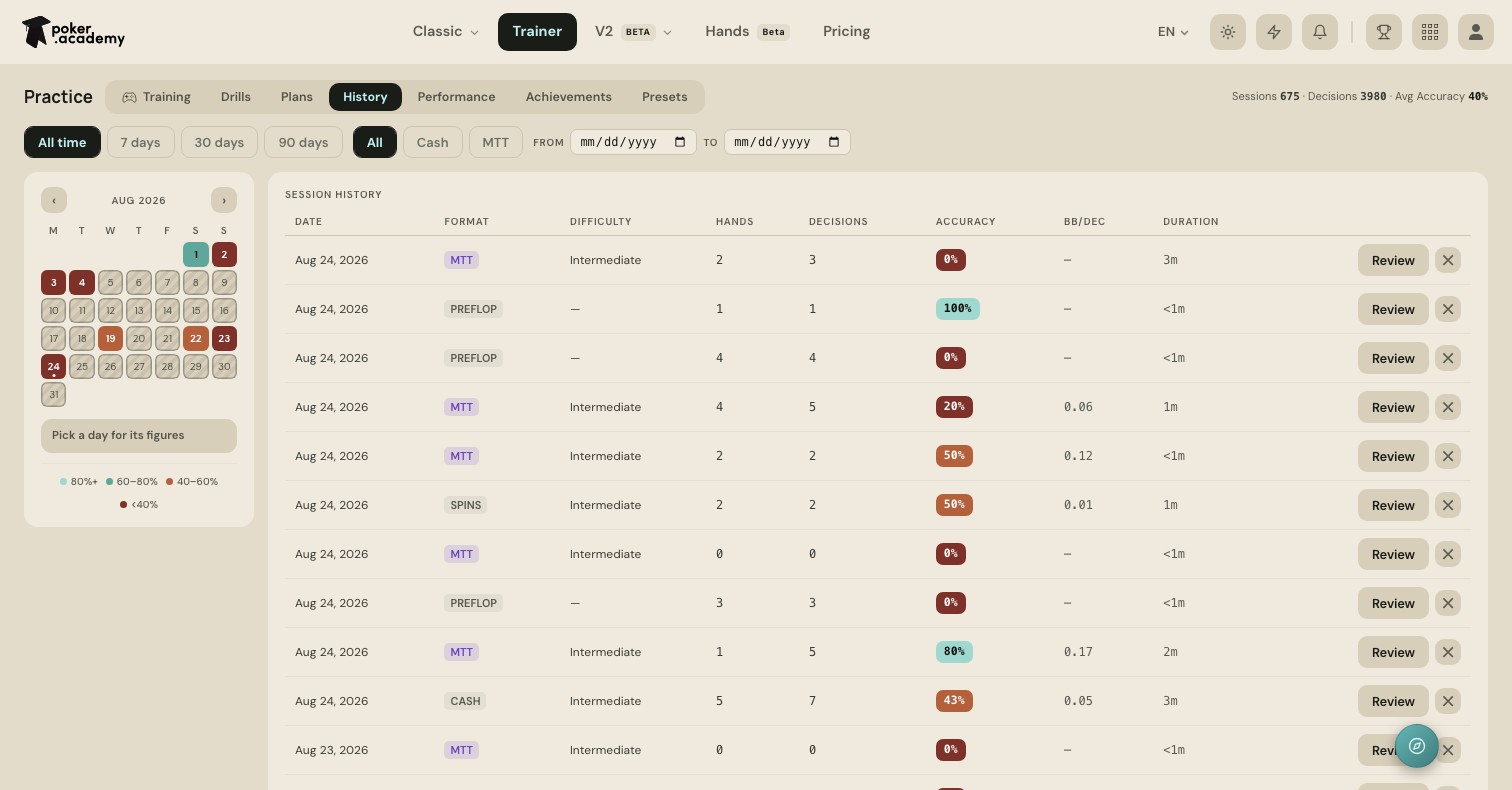 Session history, thousands of sessions deep
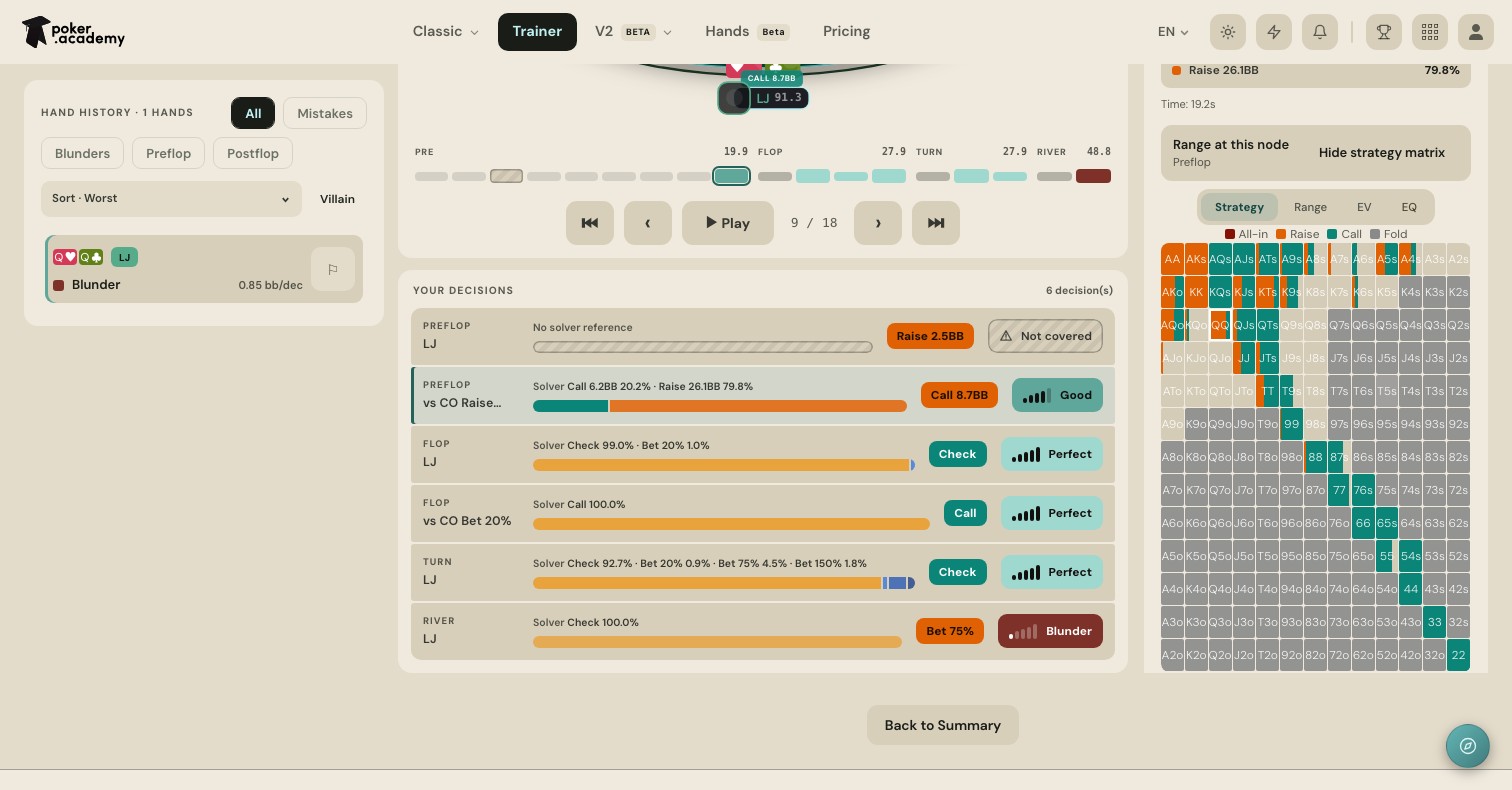 The matrix at the selected decision
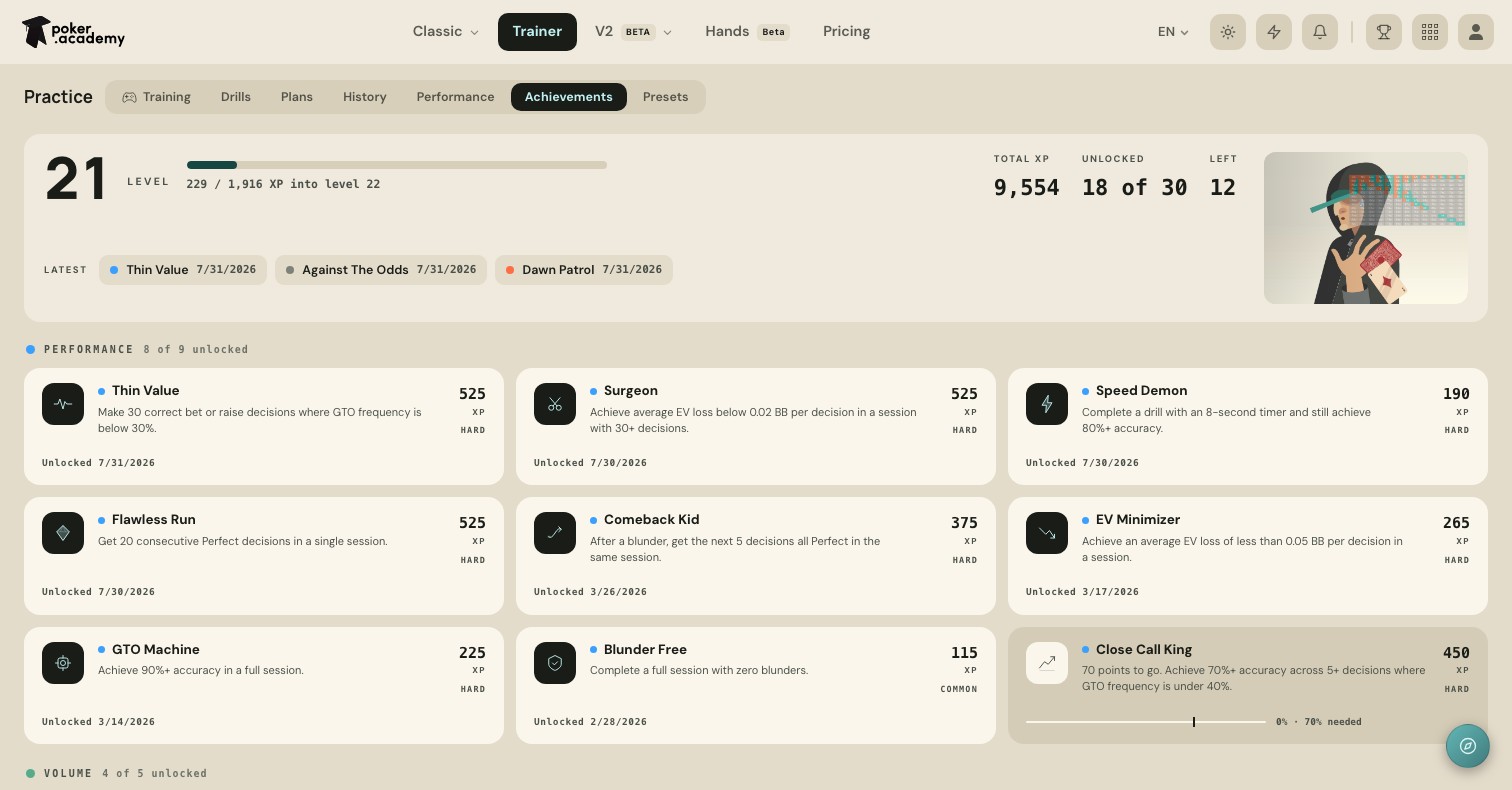 Level and XP above, thirty achievements below, twenty-four of them unlocked on this account
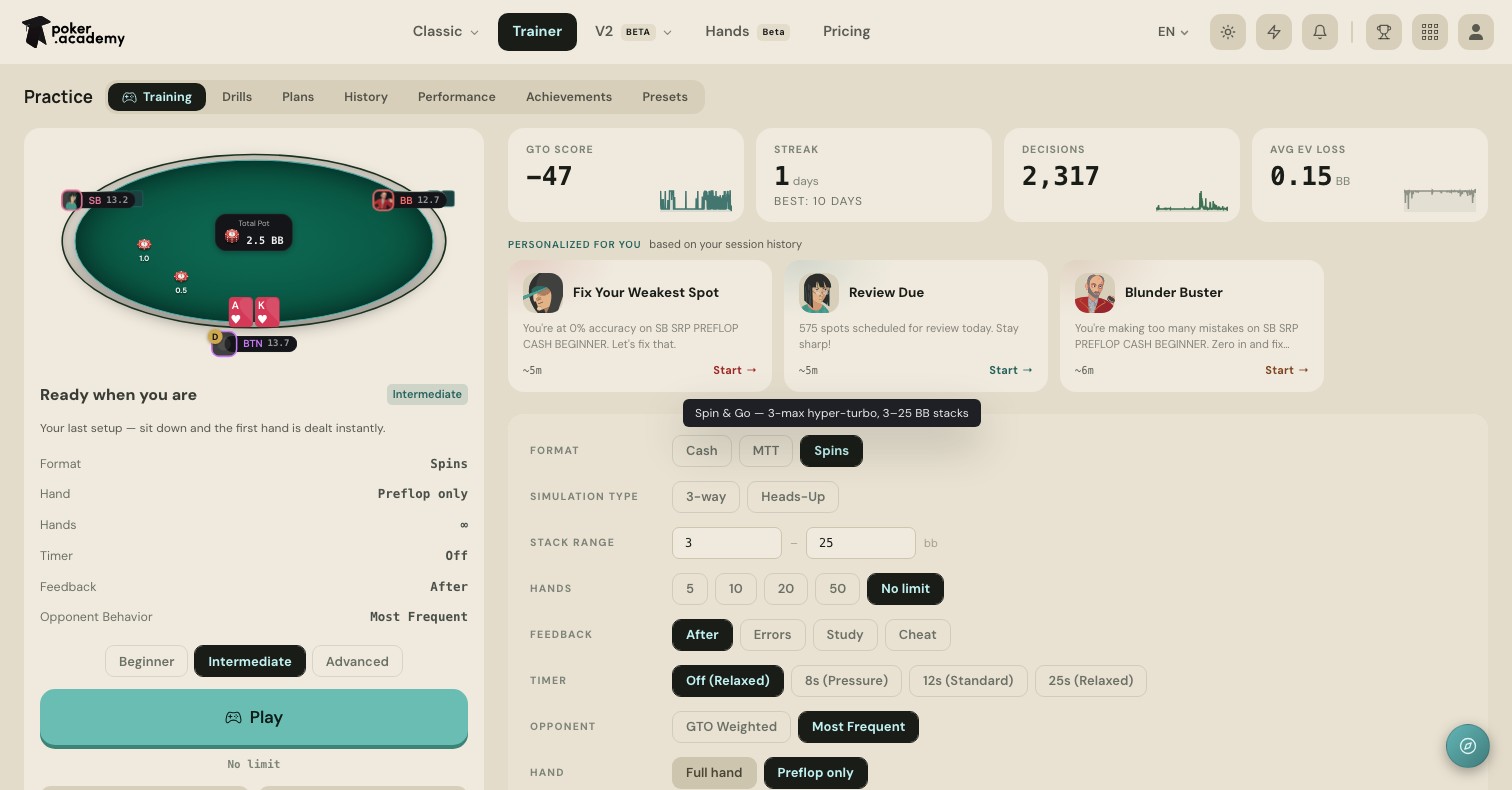 The cockpit opens on your last setup, so the first hand is one press away