
Poker ranges and RFI: how to open from every position
 Jan Przysucha
Founder of Poker Academy. Writes the product guides and updates on this blog.
Updated· first published ~9 min read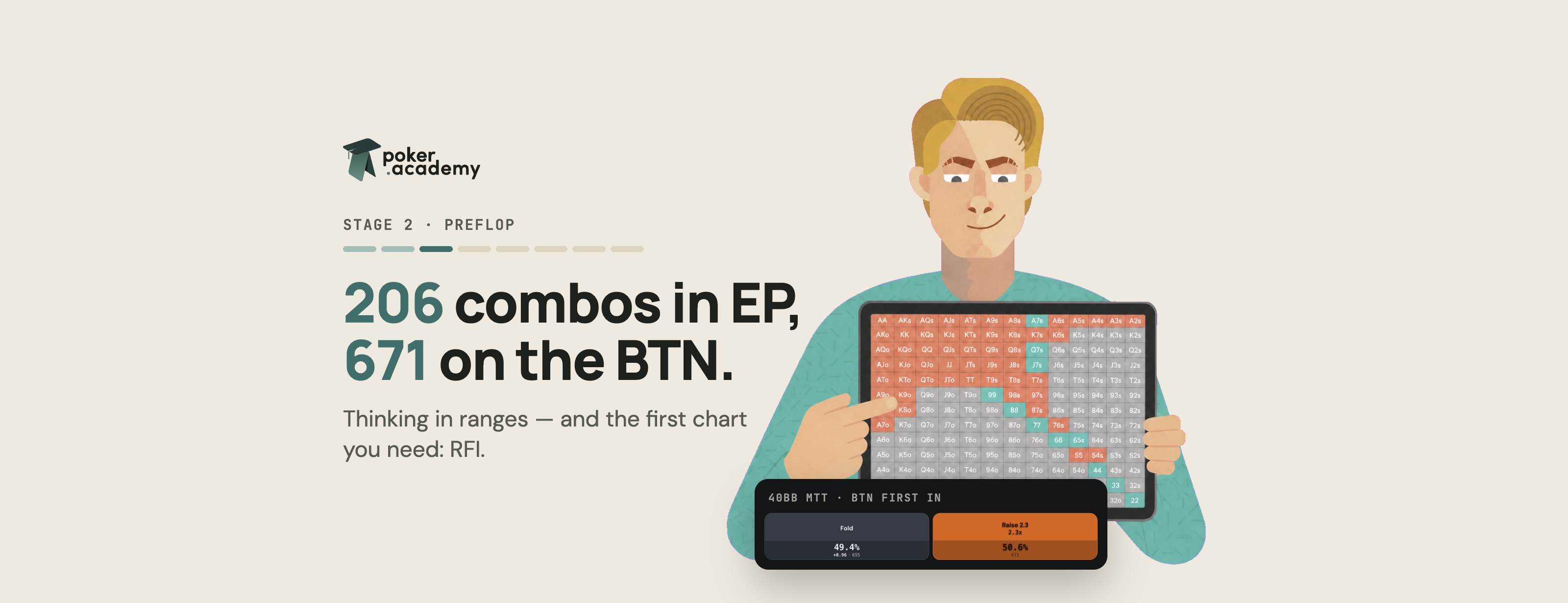
This is the first lesson of stage 2 of the Poker Academy study path. Stage 0 covered how a hand works and what the seats are called, and how to write a starting hand down. Here you stop deciding hand by hand and start deciding range by range, which changes more about how you think at the table than anything else in the path.
Then we build the first range you actually need: the one for the most common spot in poker, where everybody before you has folded.
A range is an answer for all 1,326 hands at once
There are 1,326 ways to be dealt two cards, and they collapse into 169 classes: 13 pairs, 78 suited combinations and 78 offsuit ones. A pair is 6 combos, a suited hand 4, an offsuit hand 12.
A range is what you do with every one of them in one specific spot. You decide the whole list in advance, for that seat, at that stack depth, in that format, instead of asking whether you would raise A♠︎K♦︎ here.
A solver works the same way. It never asks whether a hand is good. It asks what to do with each of my 1,326 hands when my opponent also has 1,326 hands and plays them well, so what comes out is always a whole range.
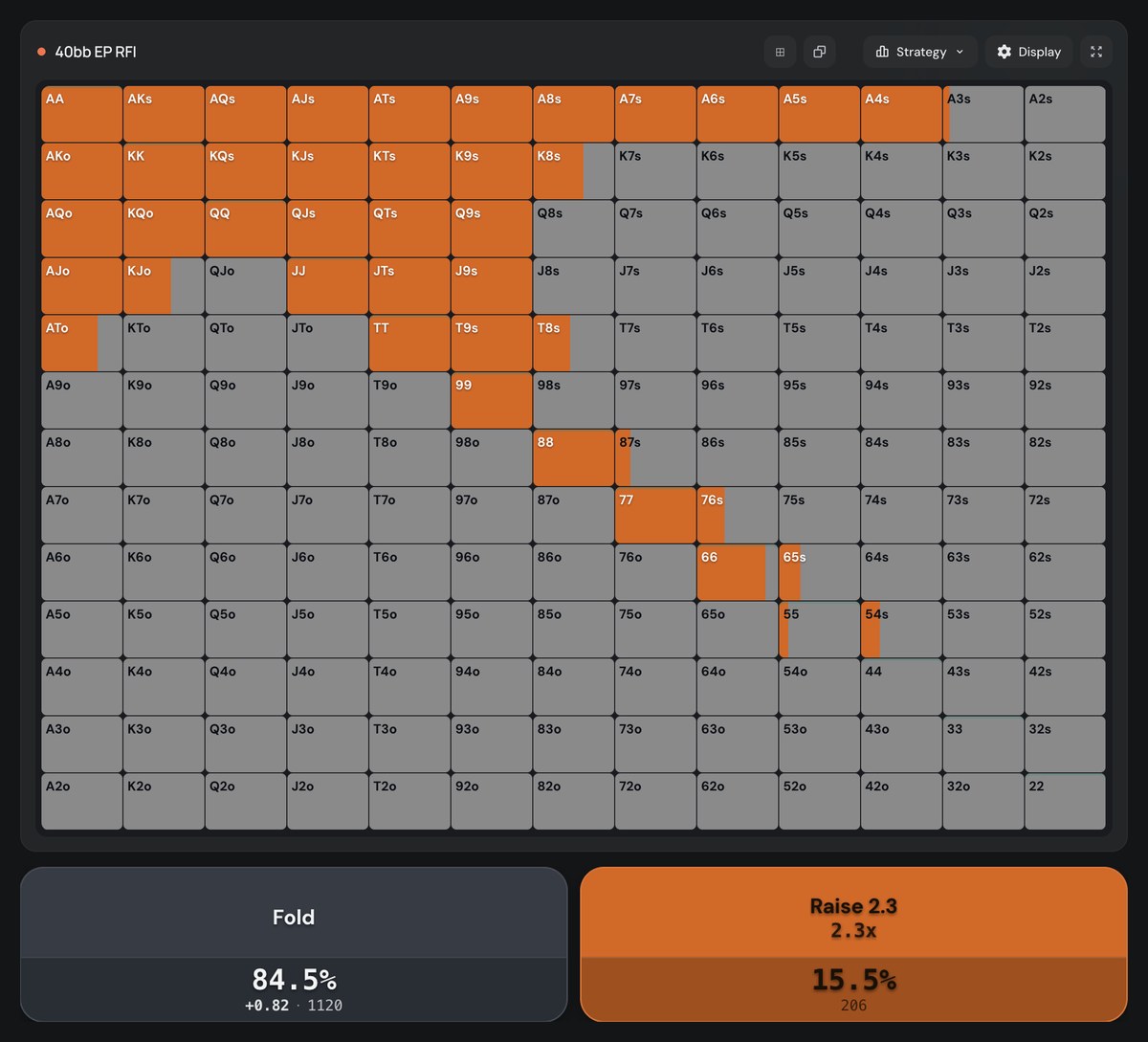
The tiles under the grid carry the count. 206 combos raise, 1,120 fold, and 206 + 1,120 = 1,326:
How a range percentage is built, EP 40bb 9-handed MTT
So “EP opens 15.5%” means 206 specific combinations out of 1,326.
How to read the 13×13 grid
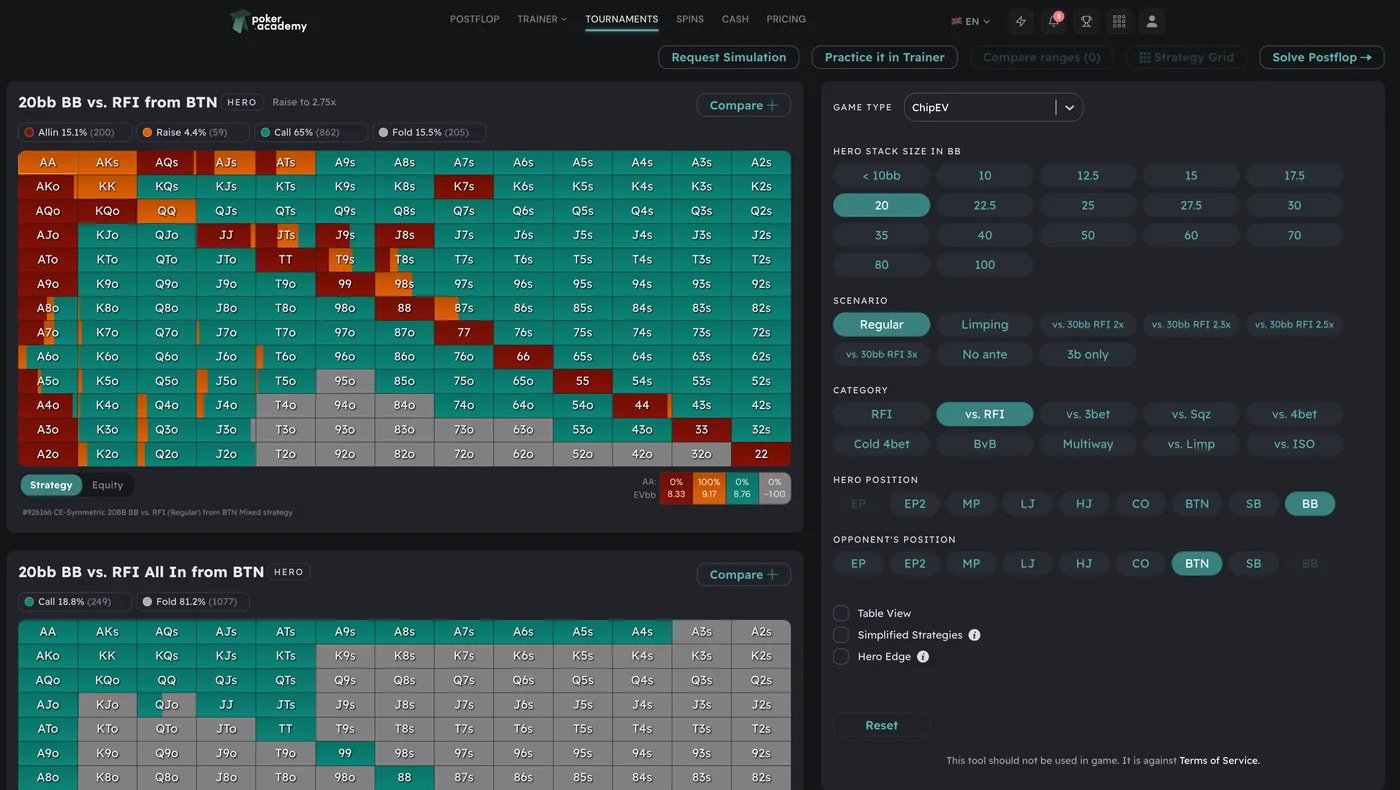
The grid is the standard way to draw a range, and the app draws it like every other chart you will meet:
- the diagonal from AA down to 22 is the pairs, 6 combos each,
- above the diagonal are the suited hands, 4 combos each: AKs, T9s, 76s,
- below it are the offsuit ones, 12 combos each: AKo, KJo, 98o.
Colour shows the action. Orange is a raise, dark red an all-in, teal a call or a limp, grey a fold. The shape of the orange block is the range.
A cell that is part orange and part grey is a mixed strategy: the solver plays that class one way some of the time and the other way the rest of the time. More on that below.
RFI: the range for “everyone folded to me”
RFI stands for raise first in. You use it when nobody has put money in voluntarily yet: the blinds are posted, the ante (if any) is posted, and every player before you has folded.
Learn it first, because every other preflop spot starts from it. A 3-bet answers an open. A squeeze answers an open plus a call. A cold 4-bet answers a 3-bet against an open. If you don’t know what the opener had, you can’t even ask those questions properly.
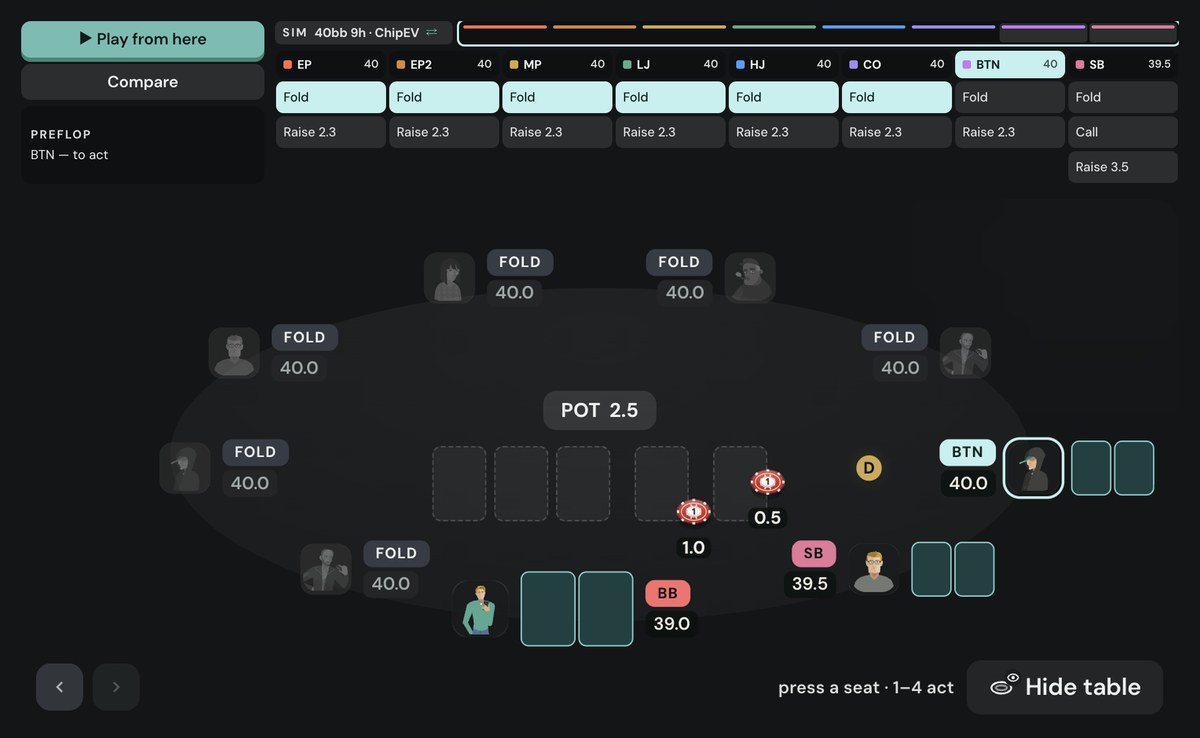
Look at what is already in the middle: 2.5bb that nobody owns. Most of what follows comes back to that number.
Position: the whole ladder in one picture
Here is what happens to the RFI range as you move around the table. The middle column counts the players who still act behind you. The range depends on that count, whatever the seat is called.
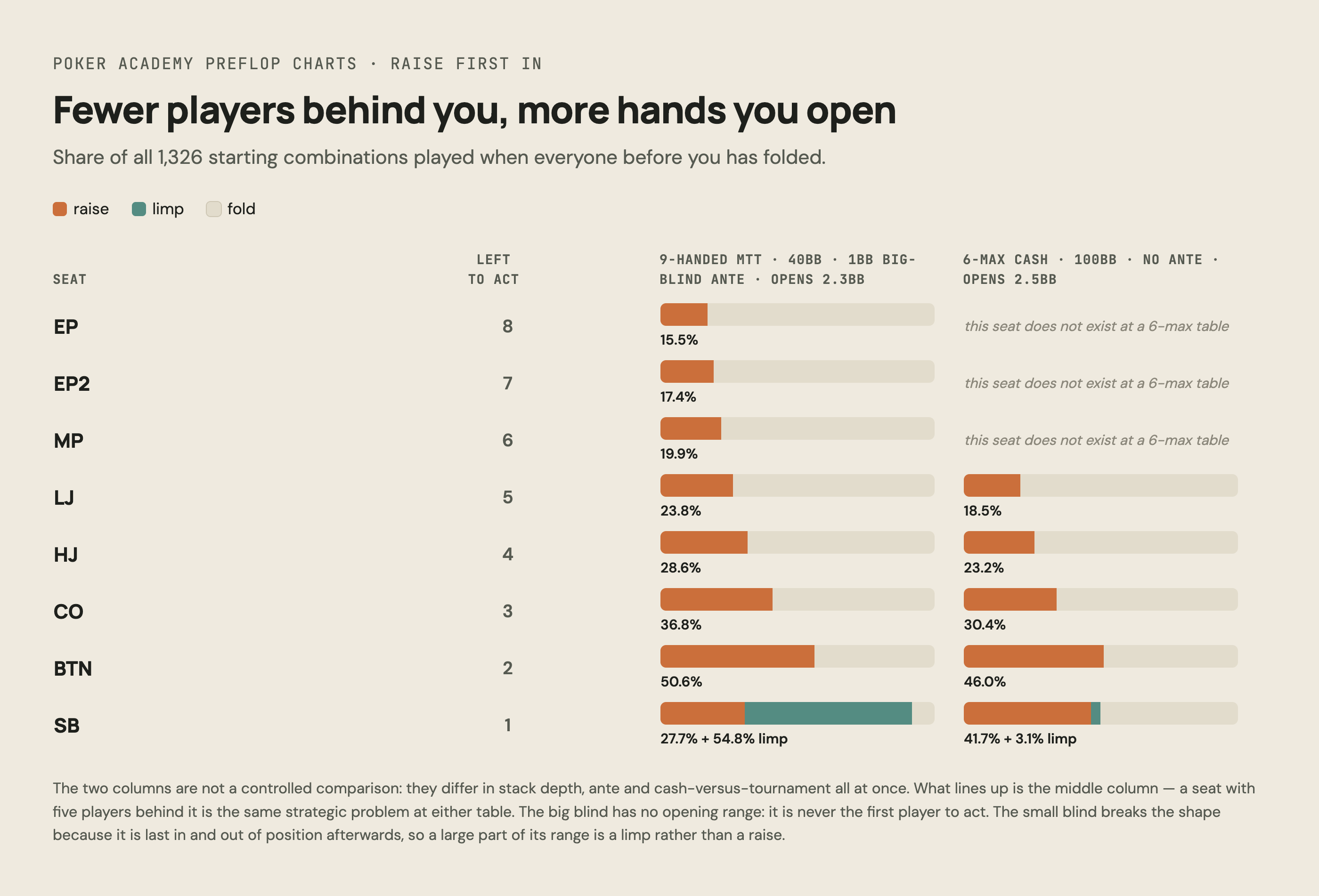
In the 9-handed tournament the range goes from 15.5% in EP to 50.6% on the button. That is more than three times as many hands, with the same cards and the same stack. In the 6-max cash game it goes from 18.5% in the lojack to 46.0% on the button.
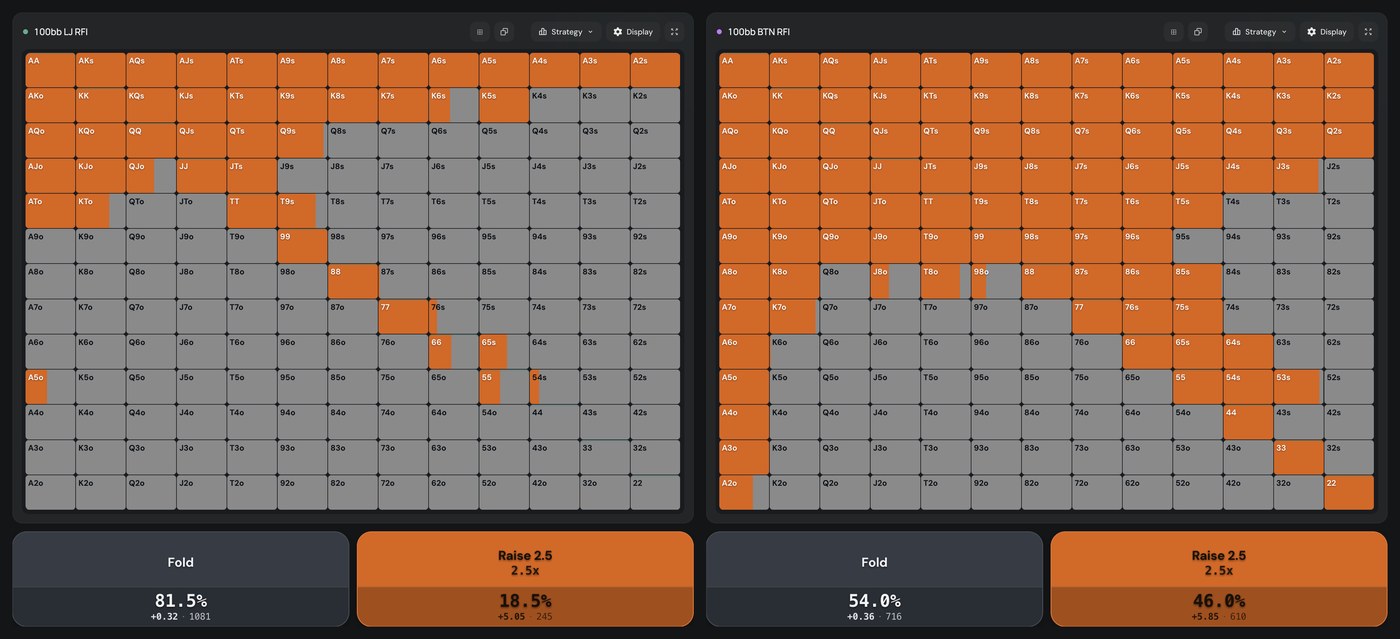
Two separate things cause it. With eight players behind you in EP, far more of them can wake up with a better hand than the two behind you on the button. And if the button gets called, it acts last on every later street; no other seat is guaranteed that.
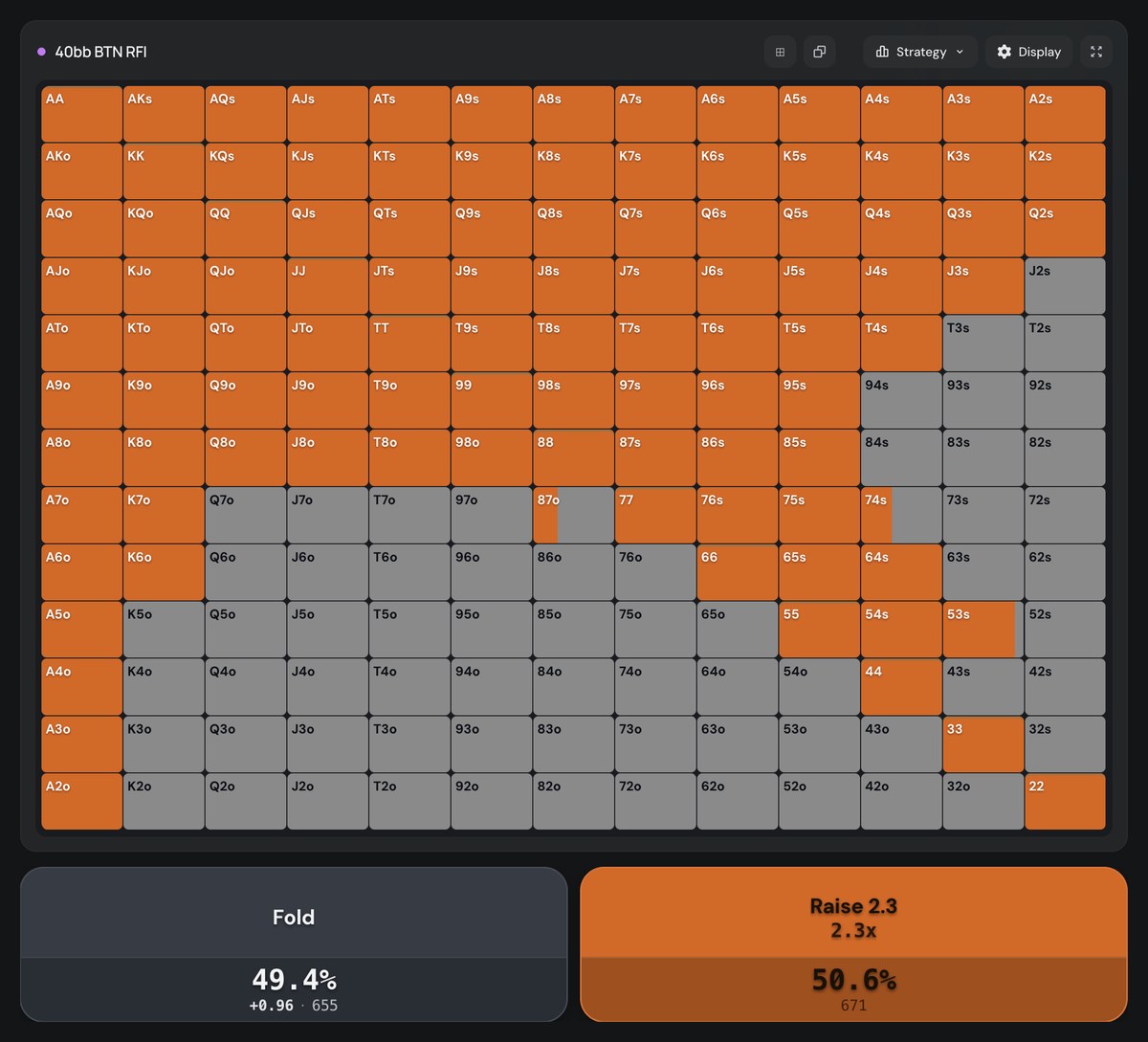
You can see it hand by hand. In that 9-handed 40bb tournament, 22 is a pure fold from EP and a pure open from the button. So is J♥︎8♥︎. So is A♠︎9♦︎. The cards didn’t change.
Play this spot instead of reading about it
Start Free TrialThe trainer deals the situations this article describes and grades every decision you make. Try it free for 3 days.
Why the price, not the cards, sets the width
Hand strength explains less here than arithmetic does.
Take the button above. It risks 2bb to win the 2.5bb already in the middle. Assume, pessimistically, that the raise only makes money when everyone folds. Then it breaks even if they fold this often:
Break-even fold frequency, 2bb open into a 2.5bb pot
Now take the ante away. The same 2bb raise is attacking 1.5bb:
The same open with no ante: the pot is only 1.5bb
Same cards, same seat, same raise, and the break-even bar moves from 44.4% to 57.1%. That is why a tournament range is wider than a cash range at the same seat.
Both numbers are a floor. They assume you lose your 2bb every time you get called, while in reality you still play the hand. The break-even formula and basic poker math lessons cover this kind of calculation.
What the ante does, measured
I tested that with two solver runs: the same 9-handed table, the same 20bb stacks, the same 2bb open. The only difference is whether a 1bb big-blind ante is posted.
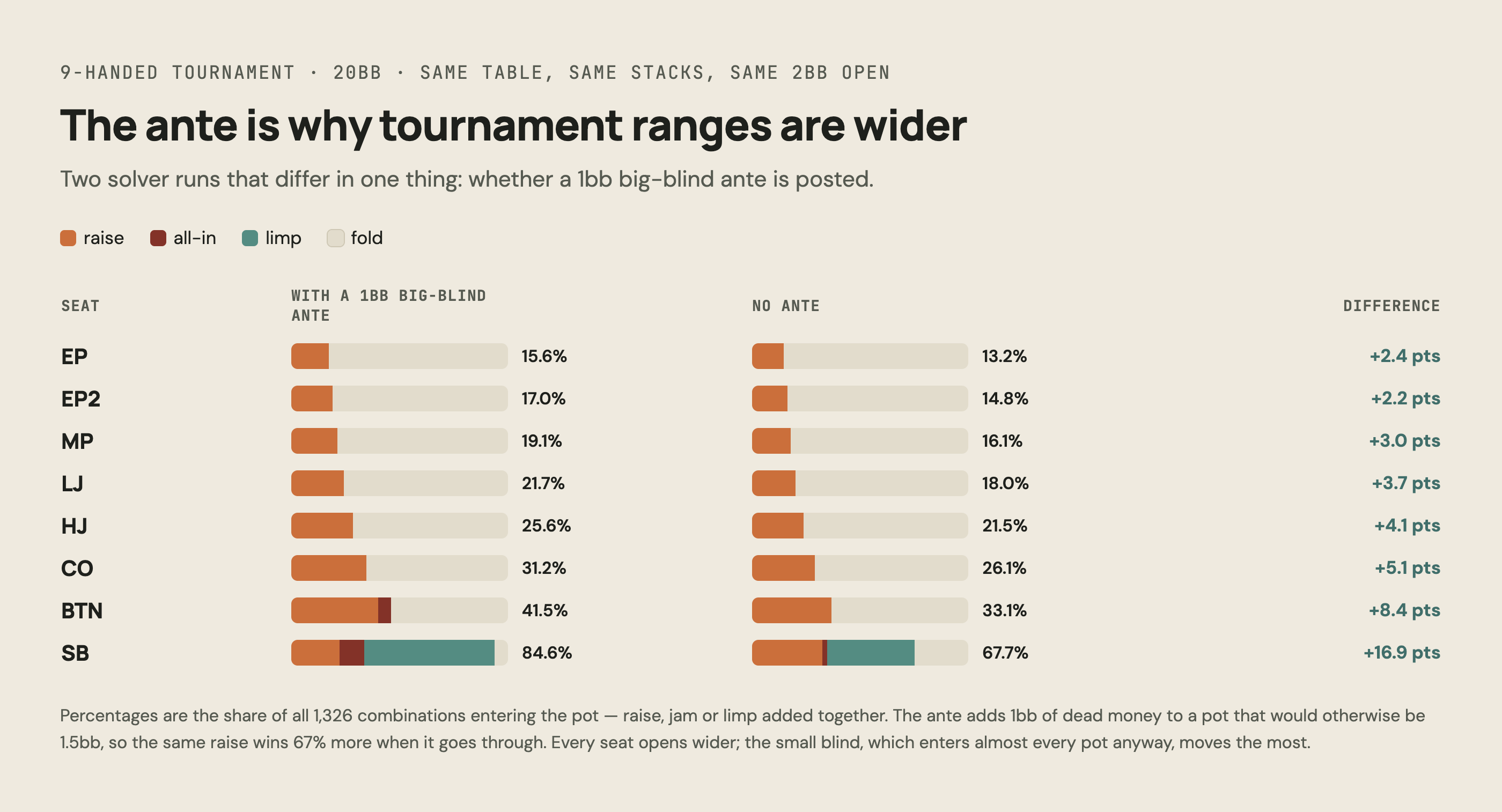
Every seat opens wider. The button goes from 33.1% to 41.5%, the cutoff from 26.1% to 31.2%, EP from 13.2% to 15.6%. If you take one thing from a tournament chart, take this: the ante format is part of what the chart is. A no-ante range and a big-blind-ante range are different charts. The BB ante lesson covers the format itself.
What stack depth does
Stack depth changes the range, and below about 25bb it changes the action too.
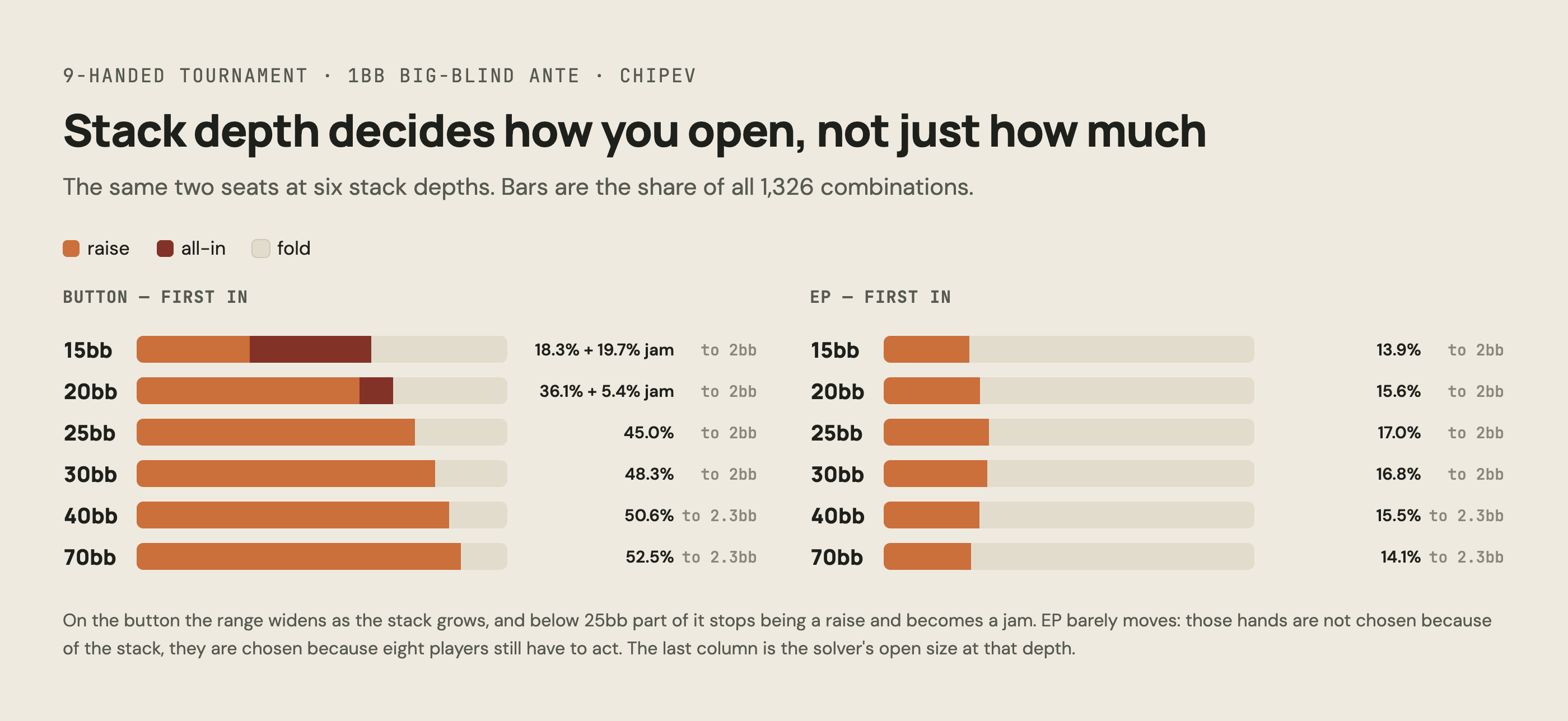
At 15bb the button opens 18.3% and jams another 19.7%. From 25bb up the jam disappears and it is a plain raise with 45 to 52% of hands. EP barely moves: 13.9% at 15bb, 15.5% at 40bb, 14.1% at 70bb. The eight players behind choose those hands, and the stack has little say.
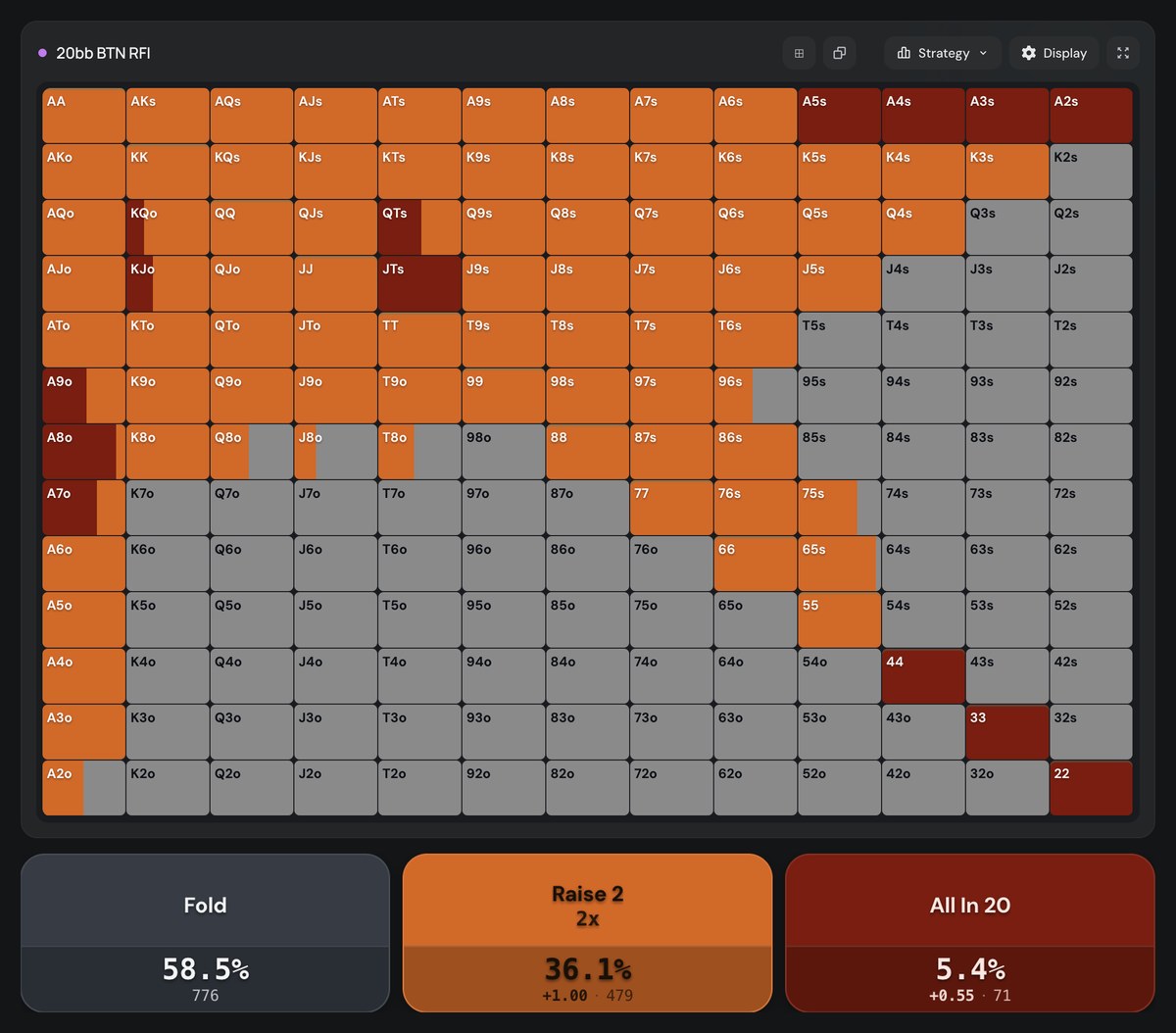
Look at which hands the button jams at 20bb. The strongest ones raise small and keep the pot playable. The pure jams are A5s, A4s, A3s, A2s, JTs and 44, 33, 22, with A8o jamming 89% of the time and KQo 21.5%. Hands that flop badly but don’t want to be folded out go all in. The full short-stack picture gets its own lesson: how to play 10, 15 and 20bb.
How big should the open be?
The size is part of the chart. The solver picks it together with the range, and in the sims above it came out like this:
- 9-handed MTT, 40bb: 2.3bb from every seat except the small blind, which opens to 3.5bb.
- 9-handed MTT, 15 to 30bb: 2bb, the smallest raise the rules allow, from every seat but the small blind. The small blind opens 2.5 to 3.3bb depending on depth.
- 6-max cash, 100bb: 2.5bb, and 3.5bb from the small blind.
Shorter stacks open smaller, and the small blind opens bigger because it will be out of position for the whole hand. Copy the size the chart is drawn for. A 15.5% EP range at 2.3bb and the same 15.5% at 3bb are two different strategies, and only one of them was solved.
Mixed cells
Most of a chart is a plain yes or no. In that 40bb EP range, 32 of the 169 classes are a pure raise, 125 a pure fold, and only 12 are mixed: 68 combos out of 1,326, about 5%.
Those 12 are the border. 66 raises 84.5% of the time, A♦︎T♣︎ 69.5%, K♥︎J♠︎ 58.5%, 7♠︎6♠︎ 34.0%, 5♠︎4♠︎ 23.5%. In the 100bb 6-max cash game the lojack’s border sits on 66 at 45.1% and 55 at 42.2%, close enough to a coin flip that either decision costs almost nothing.
Two practical notes. You can’t mix at the table by feel, so the usual advice is to pick the higher-frequency action, stay consistent, and use the border cells as the cheapest places to deviate against a specific opponent. And a solved range is a numerical approximation, so two neighbouring border cells can differ by a few percent for no reason worth reading into. For what mixing is actually for, see what GTO means.
Opening is half the decision
An opening range is the set of hands still worth playing after somebody behind you answers, and somebody often does.
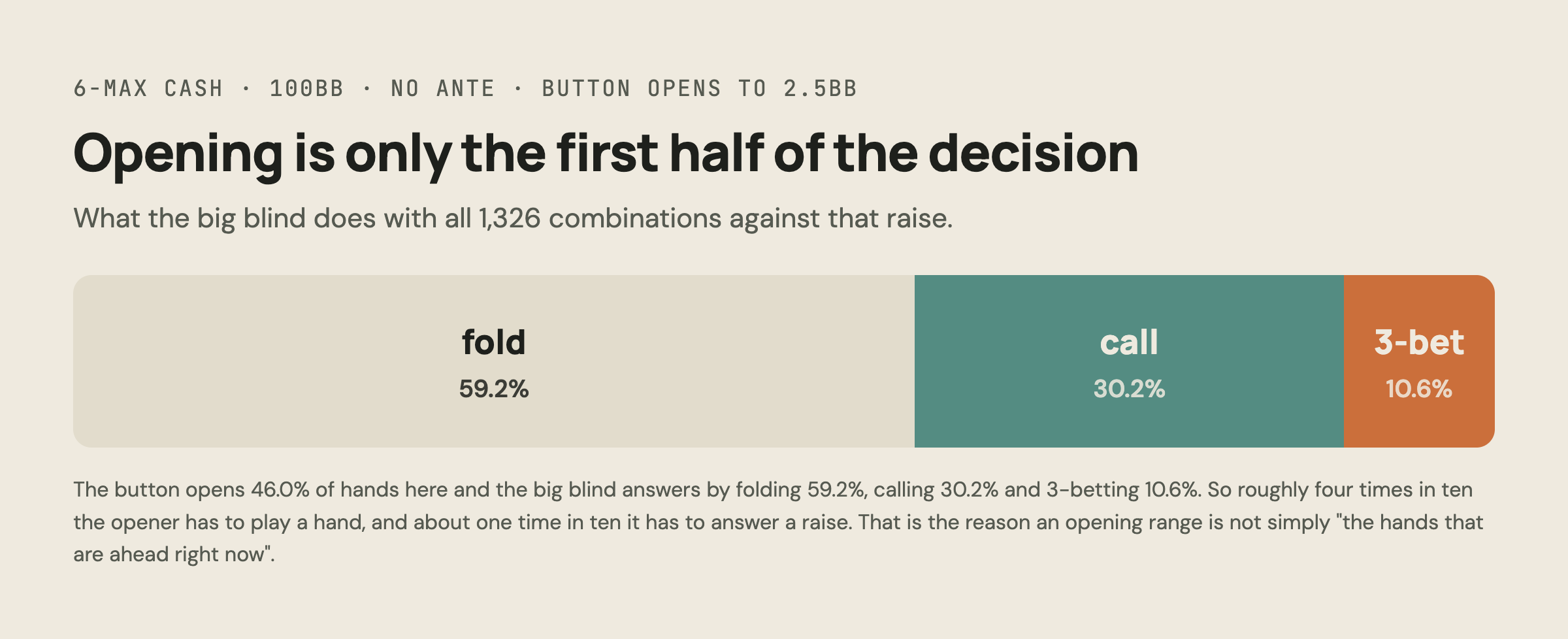
In that 6-max cash spot the button opens 46.0% and the big blind folds 59.2%, calls 30.2% and 3-bets 10.6%. A little over four times in ten your open gets played back at, and about one time in ten you face a raise.
The next two lessons pick up from there: what a 3-bet is and how to build a 3-betting range, and how to defend the big blind, the seat on the other side of every chart on this page.
How to actually use this
Four things, in this order.
- Learn one chart at a time. Start with the button and the cutoff: you open from them most, so a mistake there repeats most often.
- Always name the chart in full. “BTN 40bb, 9-handed, 1bb big-blind ante” is a chart. “Button range” isn’t.
- Learn the borders. AA and 32o need no study; the 12 mixed cells and the hands just outside them are where the money is.
- Then stop reading and play the spots. Recognising a spot on a clock is a different skill from recognising it on a chart.
Everything on this page is a live screen in the app. Open the same sim, change the seat, change the stack, switch the ante on and off, and watch the orange block grow and shrink. It is the fastest way I know to stop memorising ranges and start predicting them.
Cheers! 🙂
Keep reading
All posts
Poker Academy
Stop guessing preflop.
1,500,000+ GTO preflop solutions. Try them free for 3 days.
Start Free TrialCancel anytime.