
How to play pocket pairs from the big blind at 25bb
 Filip PedzichUpdated· first published ~8 min read
Pocket pairs look simple. You have a made hand, so you play it. In the big blind at 25bb the same 22 is a call against one opener, an all-in against another and a fold against a third. Pairs from JJ down cause most of the confusion.
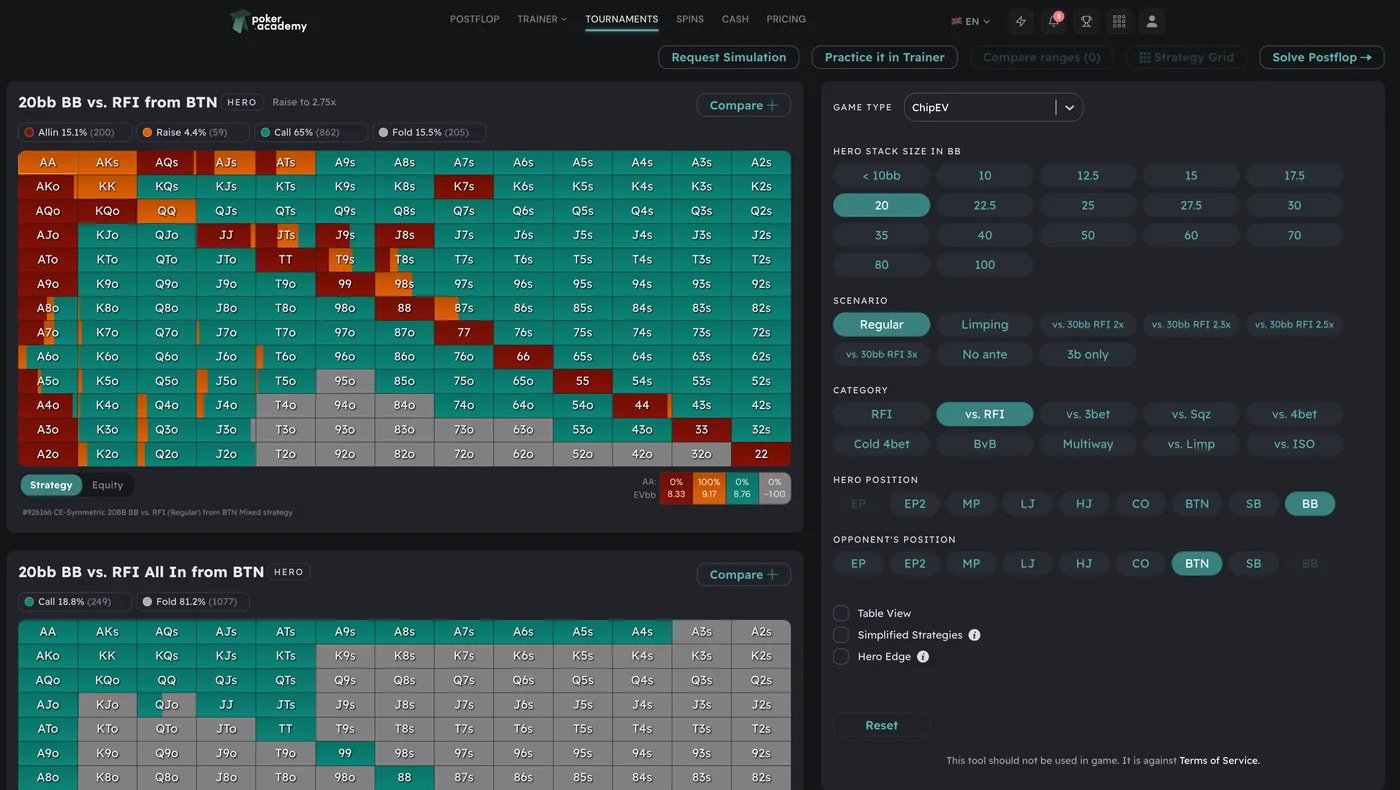
This article goes through every pocket pair in the big blind at 25 big blinds, against four openers: early position, the hijack, the button and the small blind. All numbers come from the Poker Academy preflop solver, in one spot family: MTT, chipEV, 9-handed, 1bb big-blind ante, 25bb stacks. The early and late seats open to 2bb, the small blind opens to 3bb. I show the spots the way they look in the app, so you can open them yourself.
chipEV means every chip is worth the same. Near the money bubble or at a final table that stops being true, and ICM makes calling off your stack more expensive, so the calling ranges get tighter. I don’t have ICM numbers for these spots, so treat everything below as the chipEV baseline.
The whole picture in one table
This is the solver’s action for every pair against every opener. A cell with one word is a pure action (90% or more); a split cell shows the two biggest parts.
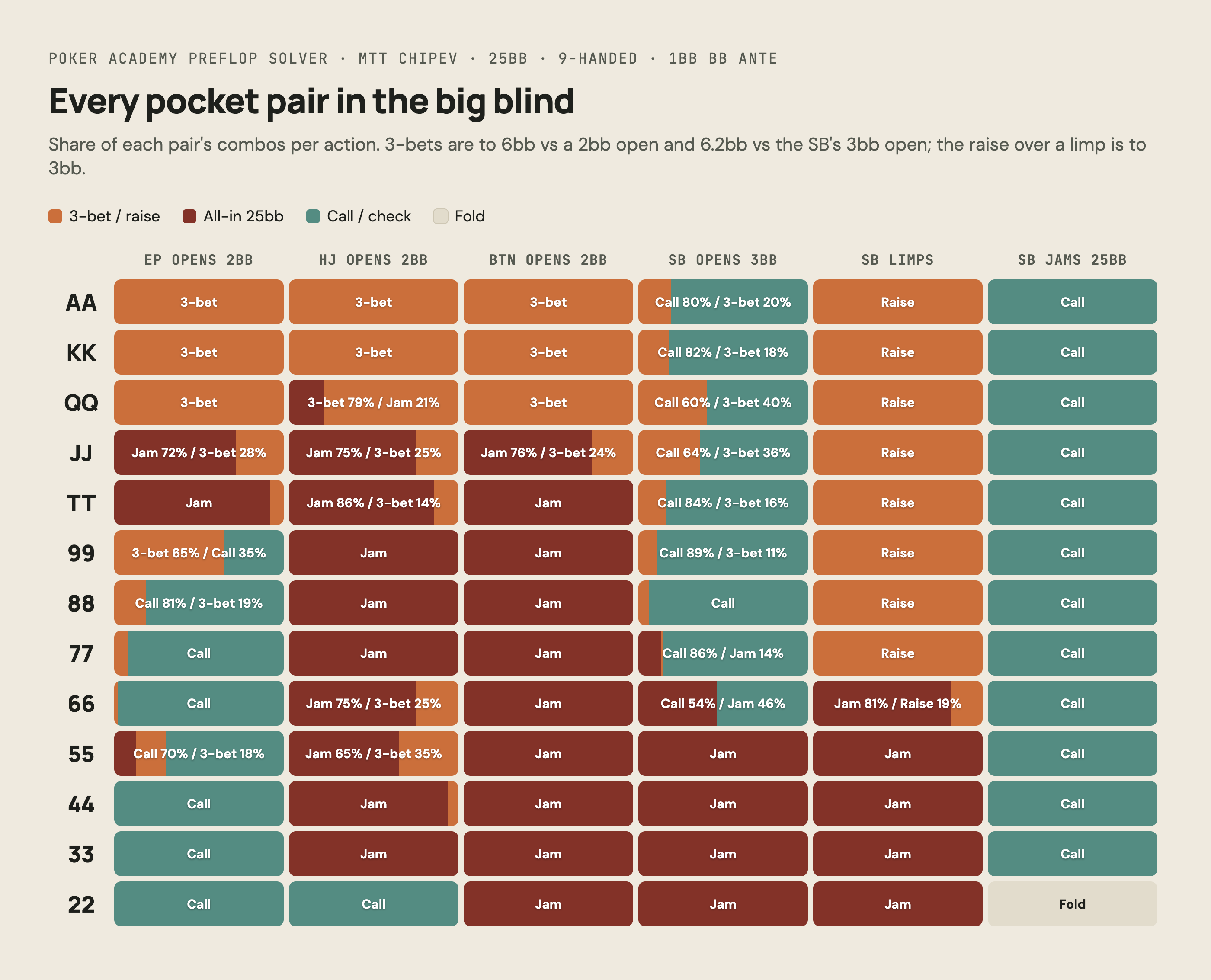
- AA–QQ almost never jam. They 3-bet small against the early and late opens and mostly call against the small blind.
- JJ–TT are the main all-ins against 2bb opens, with a small 3-bet part.
- 99–55 change the most. Against EP 88–55 mostly call and 99 mixes; against the HJ and the button they jam.
- 44–22 call EP, jam the button, jam the small blind open. 22 is the only pair that calls the HJ.
The pattern behind it is the opener’s width: the wider the range you are facing, the more your middle and small pairs want the chips in now. EP opens 17.0% of hands, the HJ 27.8%, the button 45.0%.
Against early position: call the small pairs
EP opens a tight 17.0% and has every pair from 66 up in it. The big blind closes the action and gets a good price, so it calls a lot: 64.5% of all hands. The table in the app shows the price directly:
Pot odds: BB vs a 2bb EP open
The pot before your call is the 2bb raise, the 0.5bb small blind, your 1bb blind and the 1bb ante. You add 1bb more.
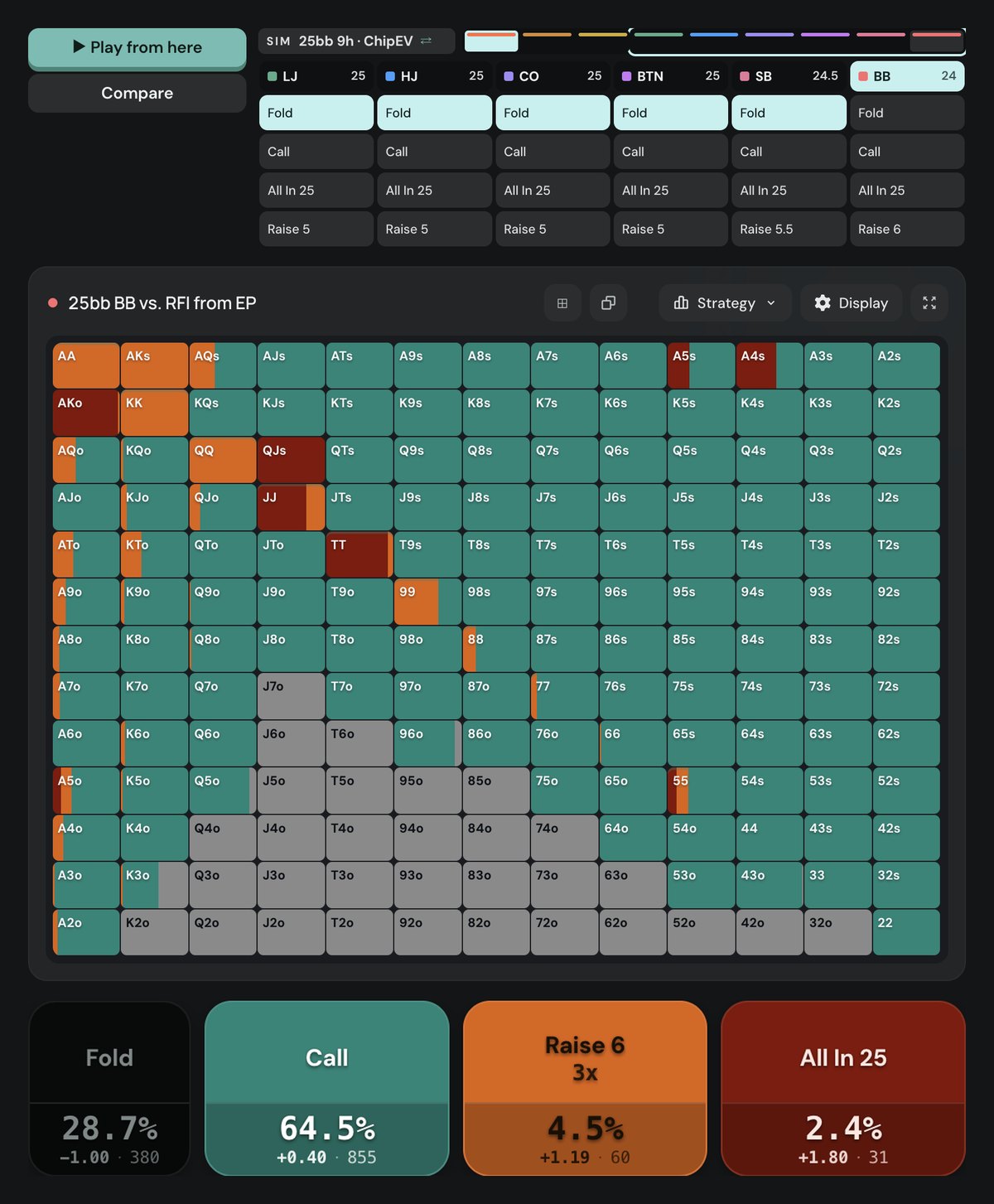
- AA, KK, QQ: 3-bet to 6bb, 100%.
- JJ: jam 72%, 3-bet 28%. TT: jam 92%.
- 99: 3-bet 65%, call 35%. 88: call 81%, 3-bet 19%.
- 77–22: call. 55 mixes in some jams and 3-bets.
Why not jam 77 here? A 25bb jam risks your whole stack against a tight 17% range that holds every pair from 66 up, while a call costs 1bb and keeps the pot small. The solver’s EV for 22 shows the same thing: call −0.15bb, 3-bet −0.41bb, fold −1.00bb (chipEV, counted from the start of the hand, so folding loses your big blind). Calling is worth 0.85bb more than folding.
Against the hijack: most pairs jam
Move the opener three seats closer to the button and the picture flips. The HJ opens 27.8%, and the big blind jams 25bb with 99, 88, 77, 44 and 33 between 94 and 100% of the time. 66 and 55 jam 75% and 65%, and 3-bet the rest of the time. 22 is the one pair left calling.
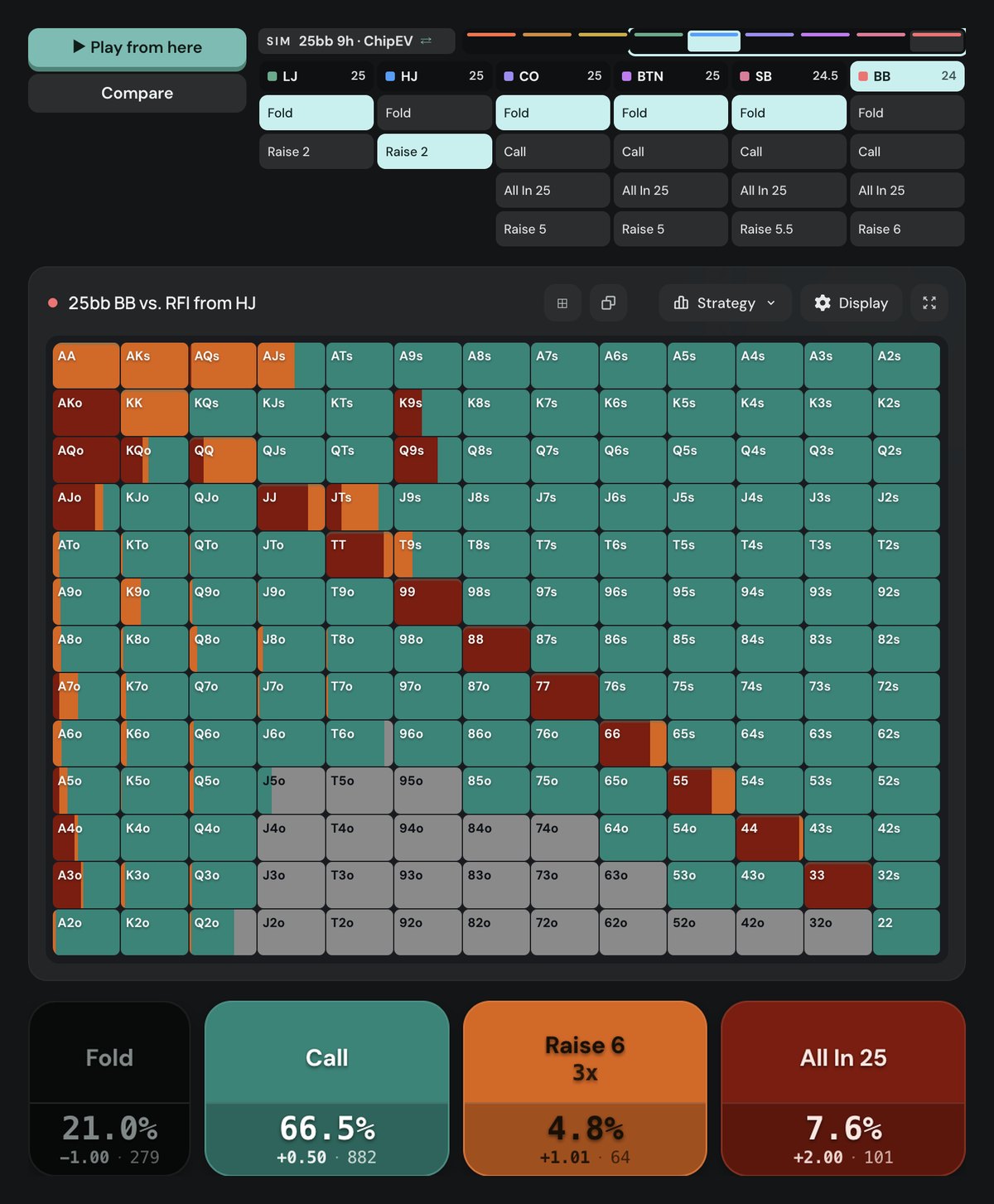
The top of the range is almost the same as against EP: AA and KK 3-bet small, QQ 3-bets 79% and jams 21%, JJ and TT jam about 75 to 86% of the time.
Against the button: every pair from TT down jams
The button opens 45.0% of hands. Against that range the big blind jams 13.8% of all hands, and it includes every pair from TT to 22, pure. JJ jams 76% and 3-bets 24%. AA, KK and QQ 3-bet to 6bb.
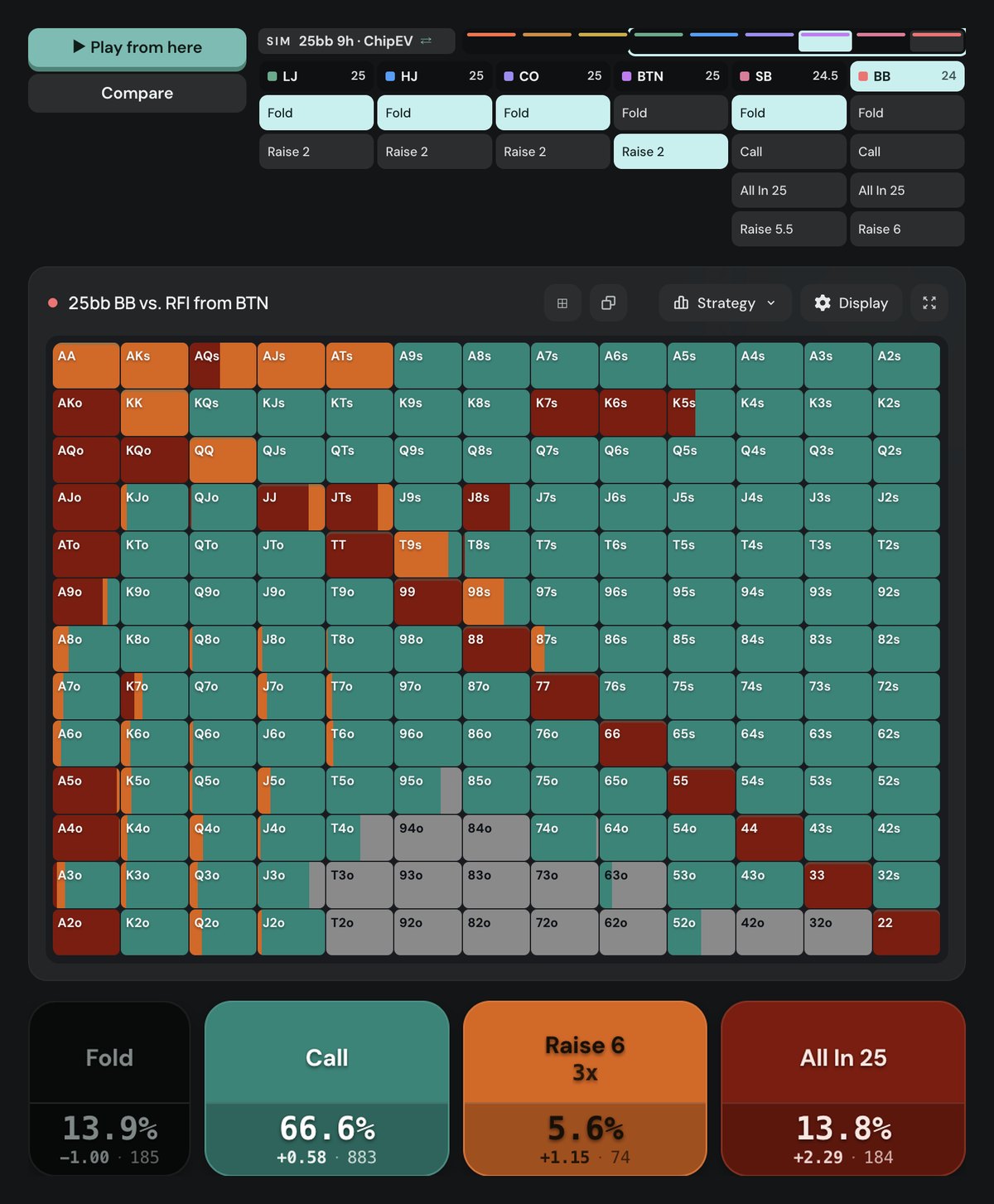
My reading of it: a wide opener has to fold most of its range to a jam, and when it calls with two overcards your pair is still roughly a coin flip. A small pair needs both of those, the fold equity and the showdown value. By the way, the button itself folds 33 and 22 at this depth: in the solver, opening them is worth less than folding (33 −0.02bb, 22 −0.09bb).
Blind versus blind
The small blind plays three different ways at this depth: it limps 50.5% of hands, raises to 3bb with 29.0% and jams 3.9%. Each one needs a different answer.
The SB opens to 3bb
Now you are in position for the rest of the hand, and the price is worse than against a 2bb open:
Pot odds: BB vs a 3bb SB open
The big pairs mostly call: AA 80%, KK 82%, 88 94%, with the rest 3-bet to 6.2bb. The small pairs go the other way. 55, 44, 33 and 22 jam 100%, 66 jams 46% and 77 14%.
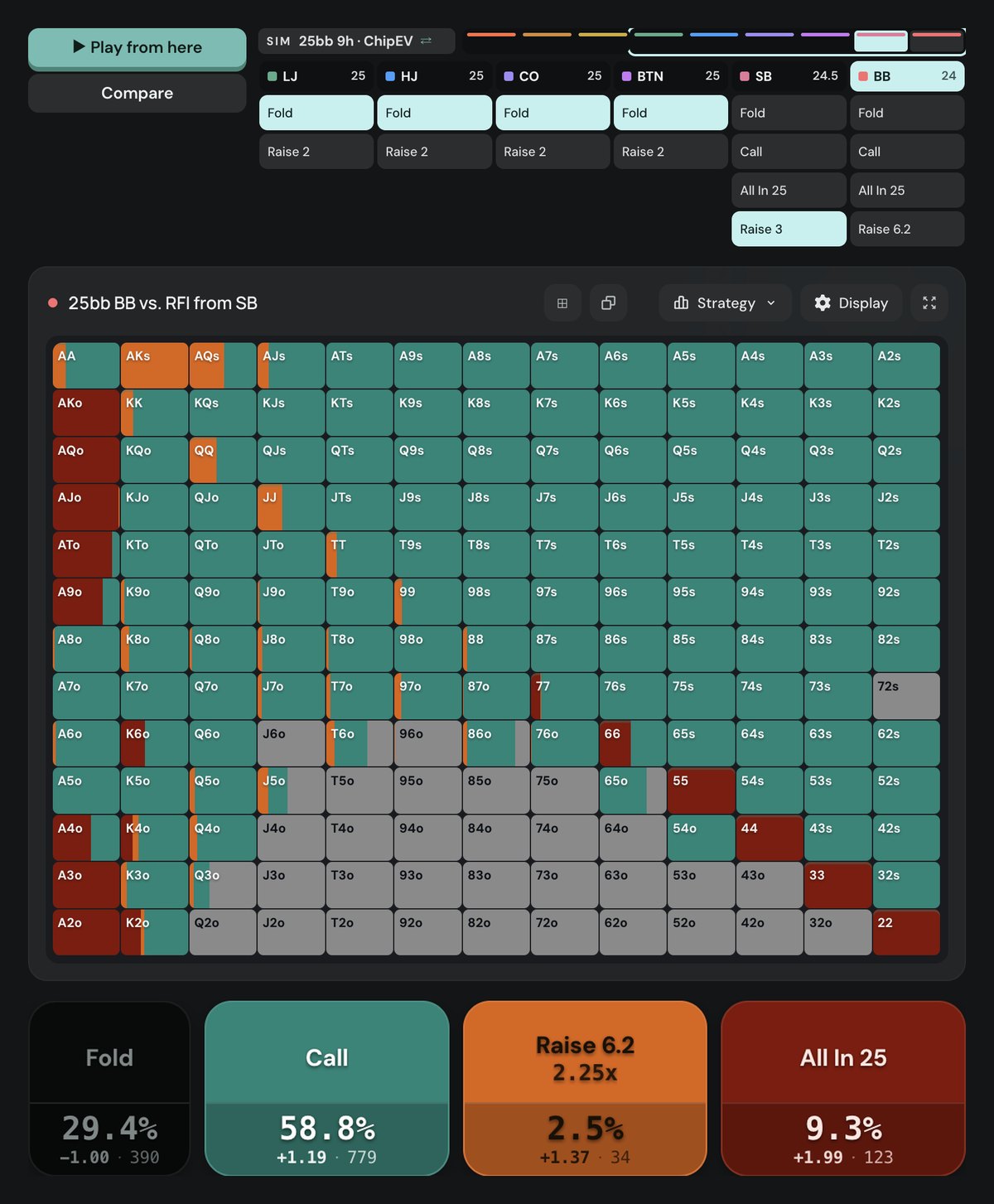
With 22 the gap is clear in the solver’s EV: jam +0.13bb, call −0.19bb. The next section shows why a call is so poor for small pairs here.
The SB limps
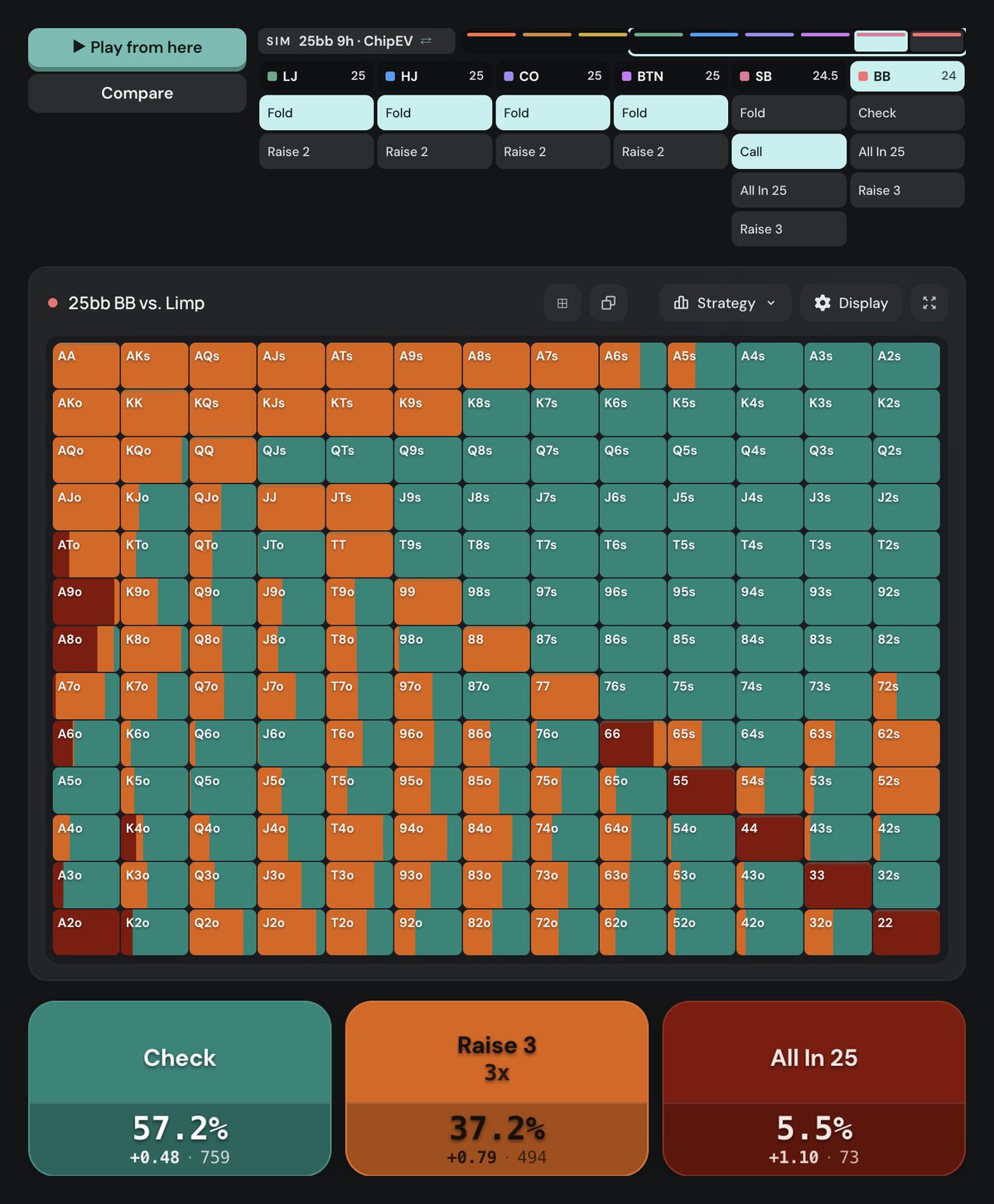
Against a limp there is nothing to call. You check or raise. The solver raises to 3bb with 77 and every pair above it, jams 66 81% of the time and jams 55–22 100%. It never just checks a pair.
The SB jams 25bb
You call 24bb more into a 27bb pot (25bb jam, your 1bb blind, 1bb ante), so you need 24 ÷ 51 = 47.1% equity against the jam. The SB jams only 3.9% of its hands, and 33 and 22 are part of that range. The big blind calls with every pair from AA to 33 and folds 22.
Set mining: the maths
The classic reason to call with a small pair is to flop a set, so here is how often that lands. You hold two of the four cards of your rank, so two are left among the 50 unseen cards (ignoring the opponent’s cards):
Flopping a set or better with a pocket pair
That is 11.5% for a set plus 0.24% for quads. The other 88.2% of the time you see a flop with a small pair and usually overcards on the board. Pure set mining breaks even when the sets win enough to pay for all the misses:
Set mining break-even (fold every miss)
W is what you win from the opponent after the flop when you hit. Plug in the two spots:
- Against the 2bb EP open: call 1bb, pot 4.5bb. You need 7.5 − 4.5 = 3.0bb extra. EP has 23bb behind, so that is easy.
- Against the 3bb SB open: call 2bb, pot 5bb. You need 15.0 − 5 = 10.0bb extra, from a player with 22bb behind. That is 45% of their stack, every time you hit.
Why implied odds are thin at 25bb
Implied odds are the chips you expect to win later on top of the pot now. They are large when stacks are deep and the call is small: in a 100bb cash game you can call a raise and still have a whole stack to win. At 25bb there are two limits.
- The ceiling is low. The most you can win after the flop is what the opponent has left, 22 to 23bb here. As soon as the call gets bigger, the share of that stack you need grows fast, from 3bb to 10bb in the two spots above.
- You don’t collect it every time. The opponent doesn’t always have a hand that pays off, and sometimes your set loses. The break-even above assumes you win W every time you hit, so the real number you need is higher. This part is a heuristic, not solver output.
So at 25bb small pairs rarely live on sets alone. They call when the price is very cheap (1bb against a tight EP range, where they also have some showdown value) and they jam when the opener is wide enough to fold. The solver’s move from call to jam as the opener gets wider is that trade.
Mistakes I see most with pocket pairs
- Jamming AA–QQ. The solver 3-bets them small against every 2bb open and mostly flats the SB’s 3bb open.
- Calling 99–33 against a late open. Against the HJ and the button they are mostly all-ins at 25bb.
- Set mining against the small blind. The call needs 10bb back from 22bb every time you hit; 55–22 jam instead.
- Calling a SB jam with 22. The SB’s jam range is tiny and includes 33.
- Using chipEV charts on the bubble. ICM makes calling off 25bb more costly, so the calling ranges get tighter.
If you want to go further, open the same spots at 20bb and 30bb in the app and watch where the pairs switch from call to jam. That switch point moves with the stack, and it is the thing worth remembering.
Cheers! 🙂
Poker Academy
Stop guessing preflop.
1,500,000+ GTO preflop solutions. Try them free for 3 days.
Start Free TrialCancel anytime.