
40bb 3-bet all-in from the small blind: chipEV vs ICM ranges
 Filip PedzichUpdated· first published ~8 min read
40 big blinds feels like a lot of room. You can open, 3-bet small, flat and still play poker after the flop. So moving all-in with 40bb over a single open sounds reckless. The solver disagrees, a little. It does jam 40bb from the small blind, with a thin slice of hands, and which slice depends on who opened and on how the tournament pays.
I pulled the spots straight from the Poker Academy preflop solutions. ChipEV: CE-Symmetric, 9-handed MTT, everyone 40bb, 1bb big-blind ante, 2.3bb opens. ICM: three 9-handed 40bb sims with a classic ante (0.12bb per player, 1.08bb in total) and 2.25bb opens, at 100, 50 and 20 players left. Percentages are shares of all 1,326 starting hands unless I say otherwise.
The maths of a 40bb jam
The CO opens to 2.3bb and the button folds. The pot is 2.3 + 0.5 + 1 + 1 = 4.8bb. If you jam from the small blind, you put in 39.5bb more to win those 4.8bb when everyone folds.
A jam with no equity when called
In the chipEV sim the big blind folds 93.4% of hands to that jam and the CO folds 78.3% of its opening range. Together that’s 0.934 × 0.783 = 73.1% (ignoring card removal), well short of 89.2%. So a 40bb jam is never a pure bluff. It needs hands that do fine when they get called, and it has to take equity away from hands that would otherwise see a flop.
SB vs CO: 1.8% jams
Against a CO open the small blind folds 72.6%, calls 14.4%, 3-bets to 8bb with 11.3% and jams 1.8% of hands. The jam is not the top of the range: AA, KK and QQ 3-bet small.
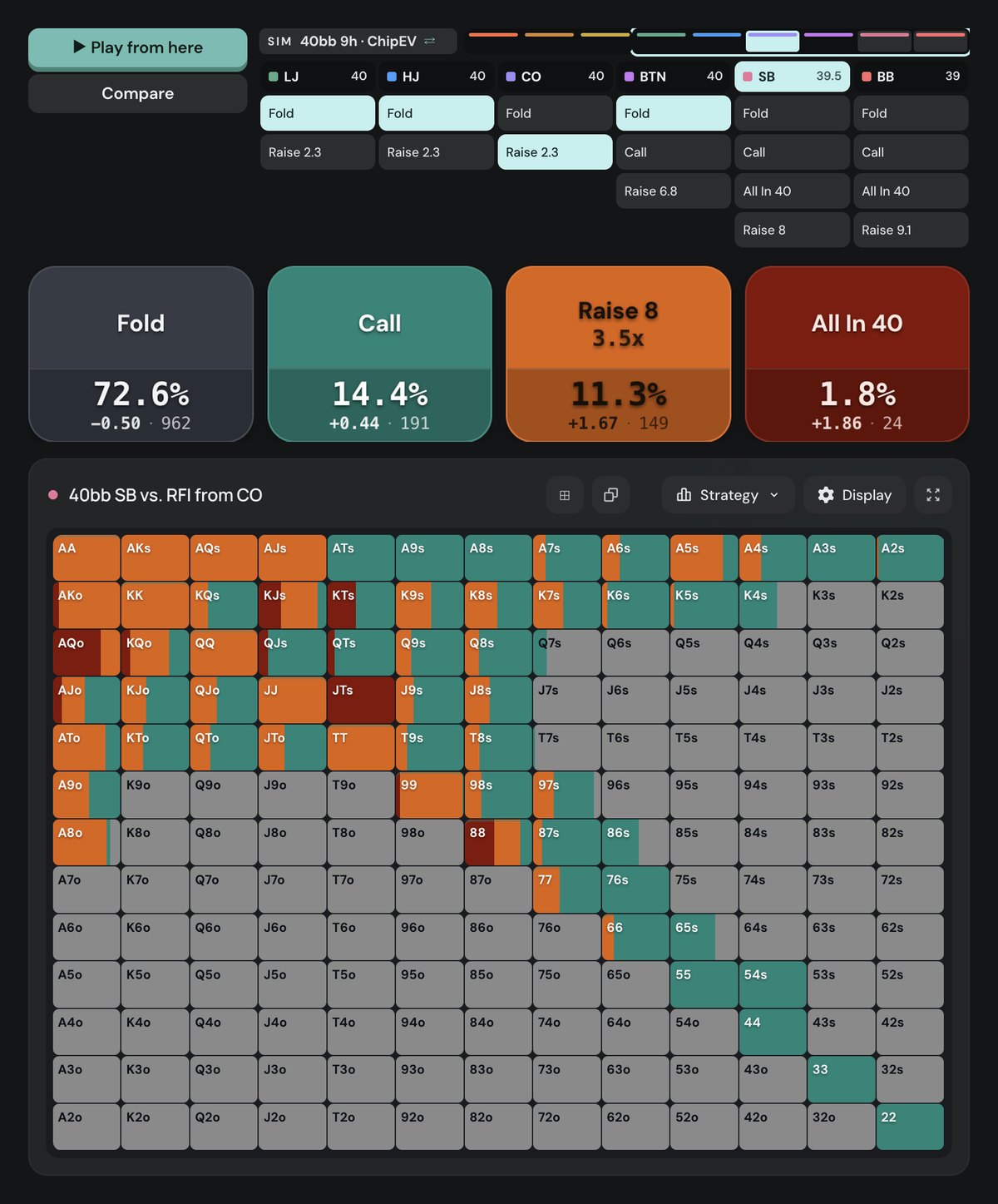
The hands that jam, with their all-in frequency:
- Always: JTs (100%).
- Most of the time: AQo (71%).
- Part of the time: 88 (44%), KTs (42%), KJs (32%).
- A little: QJs 14%, AJo 13%, KQo 12%, QTs 11%, AKo 8%, 99 6%.
My reading, as a heuristic: these hands have decent equity against a calling range but are awkward after a small 3-bet, facing a 4-bet shove or a big pot out of position. JTs is the only pure jam here.
How the CO answers the jam
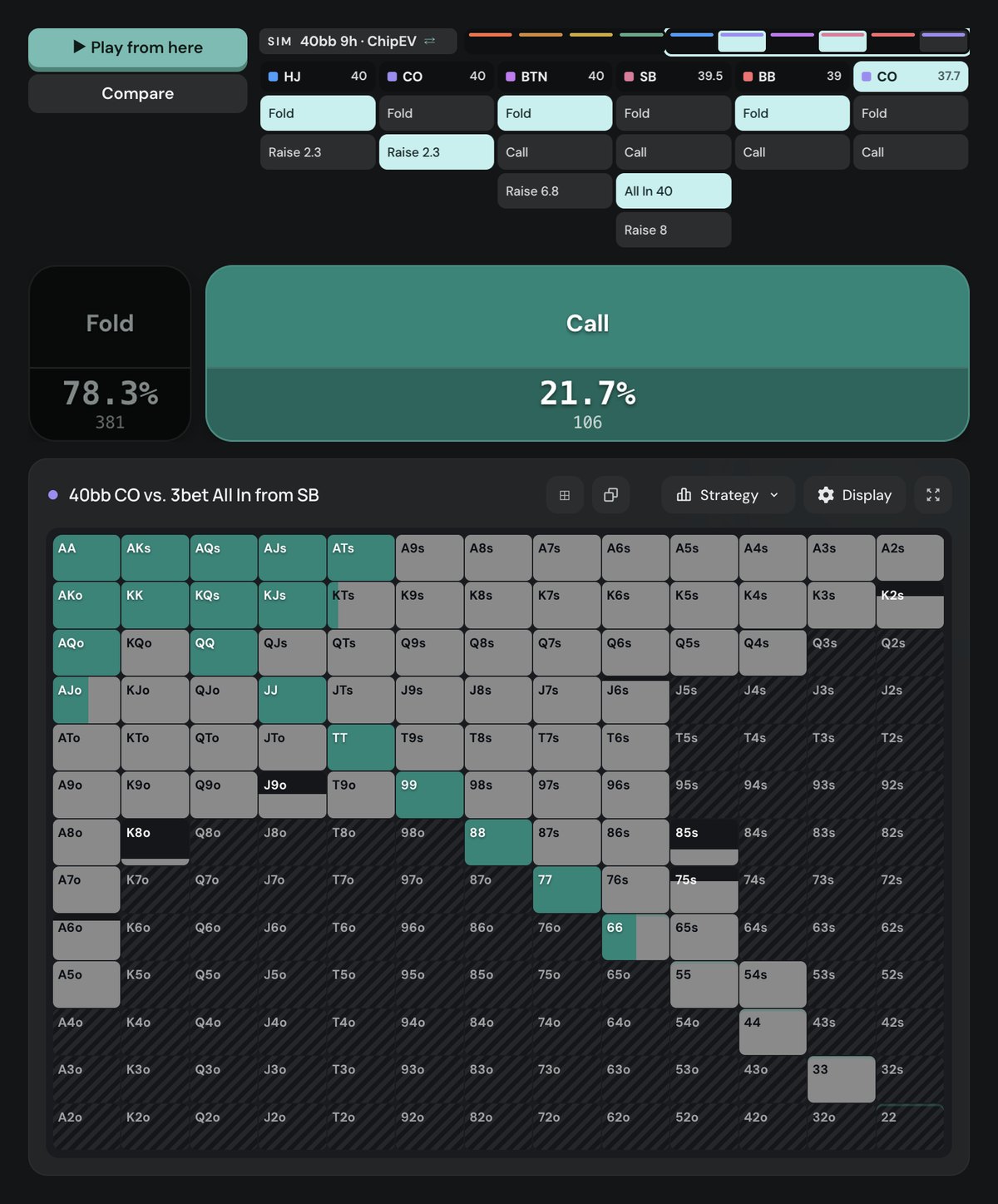
The CO is getting a price: 37.7bb to call into a 44.3bb pot.
CO calls the 40bb jam
It still folds most of its opening range. The CO opens 36.8% of hands at 40bb and calls the jam with 21.7% of that range: AA–77 (66 half the time), AKs–ATs, AKo, AQo, KQs, KJs, AJo about half the time and KTs a little. Everything else folds. The app shows it on the node itself, including the pot odds.
SB vs BTN: 4.1% jams
Against a button open the small blind jams more than twice as often: 4.1% of hands, with 13.0% 3-bets to 8bb, 11.6% calls and 71.4% folds.
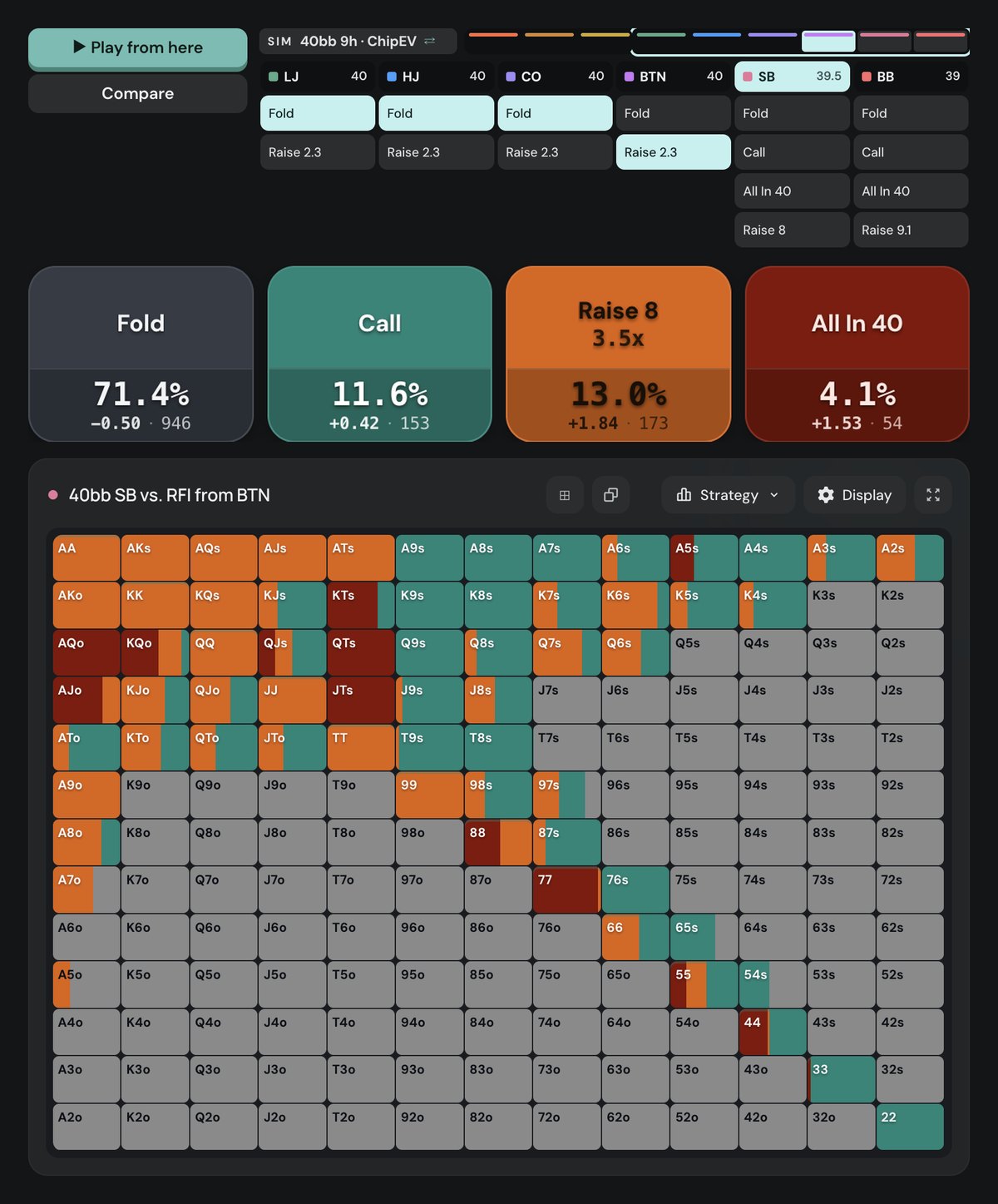
- Always: AQo, QTs, JTs (100%), 77 (96%).
- Most of the time: KTs, AJo (74%), KQo (55%), 88 (52%).
- Part of the time: 44 (42%), A5s (35%), 55 and QJs (24%).
The opener is what widens it, not the stack: that is 40bb in both spots. The button opens 50.6% of hands and the CO 36.8%, so the button’s range is wider and weaker. It folds a similar share of it to the jam (79.0% against 78.3%) and calls with 21.0% of it. My reading: the button’s calls come out of a weaker opening range, so more medium pairs and broadways have enough to jam.
Play this spot instead of reading about it
Start Free TrialThe trainer deals the situations this article describes and grades every decision you make. Try it free for 3 days.
What ICM does to the same spot
ChipEV counts chips. ICM counts prize money, and in a tournament the chips you lose are worth more than the chips you win. The ICM sims here use a 30-place payout: 1st gets 19.2% of the prize pool, 2nd 13.8%, 3rd 10.38%, down to 1.85% for 10th to 13th and 1.12% for 24th to 30th. Each has the whole table at 40bb; the rest of the field has other stacks, and the average across all players left is 35bb. The app labels them by field size left: 50% (100 players, 70 from the money), 25% (50 players, 20 from the money) and 10% (20 players, already in the money).
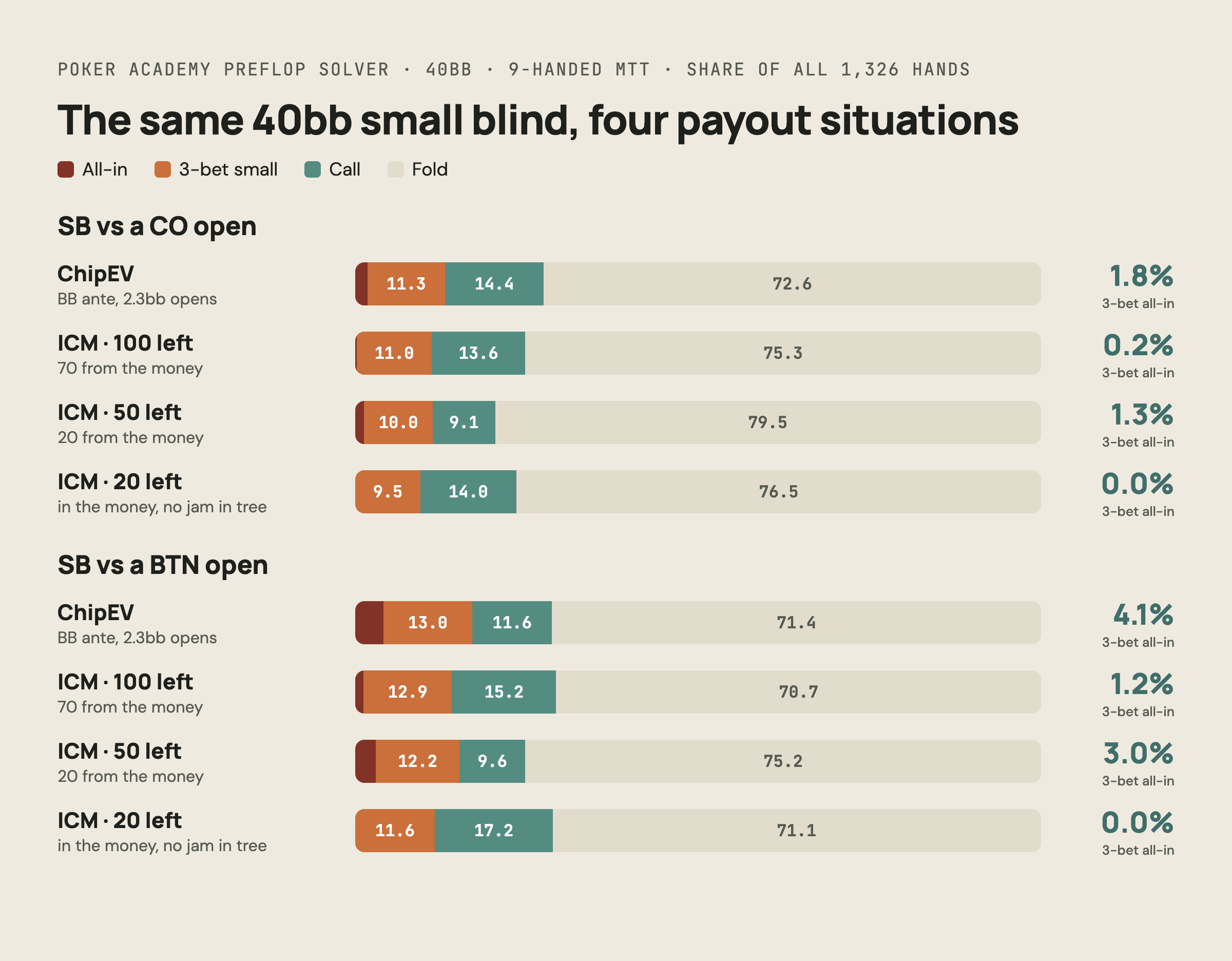
| 40bb SB, all-in / 3-bet small / call / fold | vs CO open | vs BTN open |
|---|---|---|
| ChipEV | 1.8 / 11.3 / 14.4 / 72.6 | 4.1 / 13.0 / 11.6 / 71.4 |
| ICM, 100 left | 0.2 / 11.0 / 13.6 / 75.3 | 1.2 / 12.9 / 15.2 / 70.7 |
| ICM, 50 left | 1.3 / 10.0 / 9.1 / 79.5 | 3.0 / 12.2 / 9.6 / 75.2 |
| ICM, 20 left | – / 9.5 / 14.0 / 76.5 | – / 11.6 / 17.2 / 71.1 |
Percent of all hands. A dash means the tree has no all-in option in that sim.
In both ICM sims that offer the jam it comes out smaller than in chipEV, and it doesn’t shrink in a straight line: with 50 left it’s bigger than with 100 left.
20 left: the chipEV jams become calls
In the money, with 20 players left, the solution has no small blind all-in at all. One honest note: this sim’s tree only gives the small blind fold, call and a 3-bet to 7.6bb, so the solver never tested the jam and turned it down. What you can read from it is what happens to the hands that jammed in chipEV:
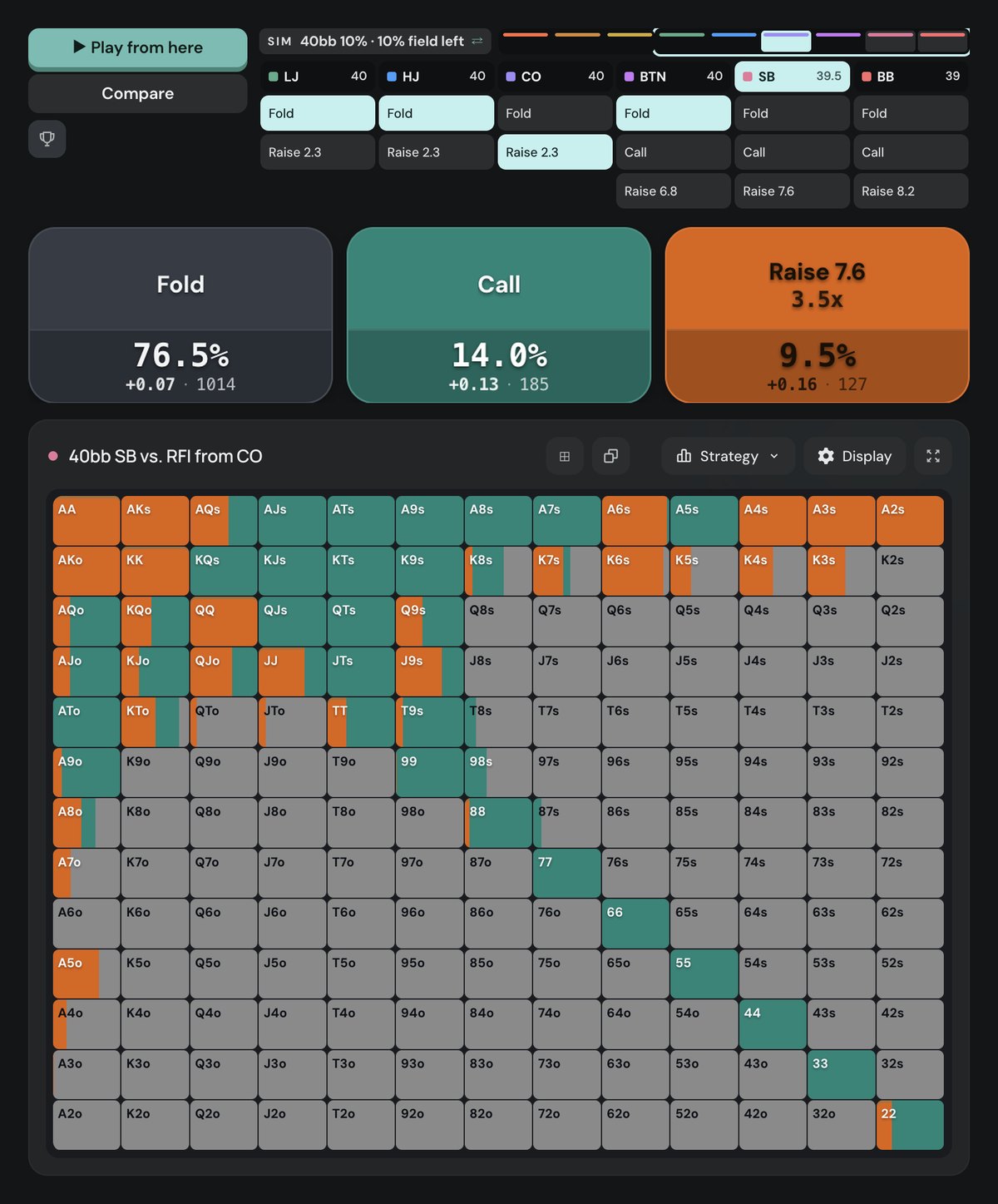
- JTs, KJs and KTs call 100%.
- 88 calls 93% and 3-bets 7%.
- AQo calls 75% and 3-bets 25%.
Against the button it’s the same picture: JTs, QTs, KTs, 88, 77 and 44 call every time, while AQo, AJo and KQo split between a call and a 3-bet to 7.6bb. An earlier version of this post said the all-ins “switch to almost pure calls”. For the CO spot that holds, in the same sim. It just wasn’t the solver turning the jam down.
50 left: the callers tighten more than the jammer
With 50 players left, 20 from the money, the jam is back: 1.3% against the CO and 3.0% against the button. That’s more than at 100 left. The reason sits on the other side of the table.
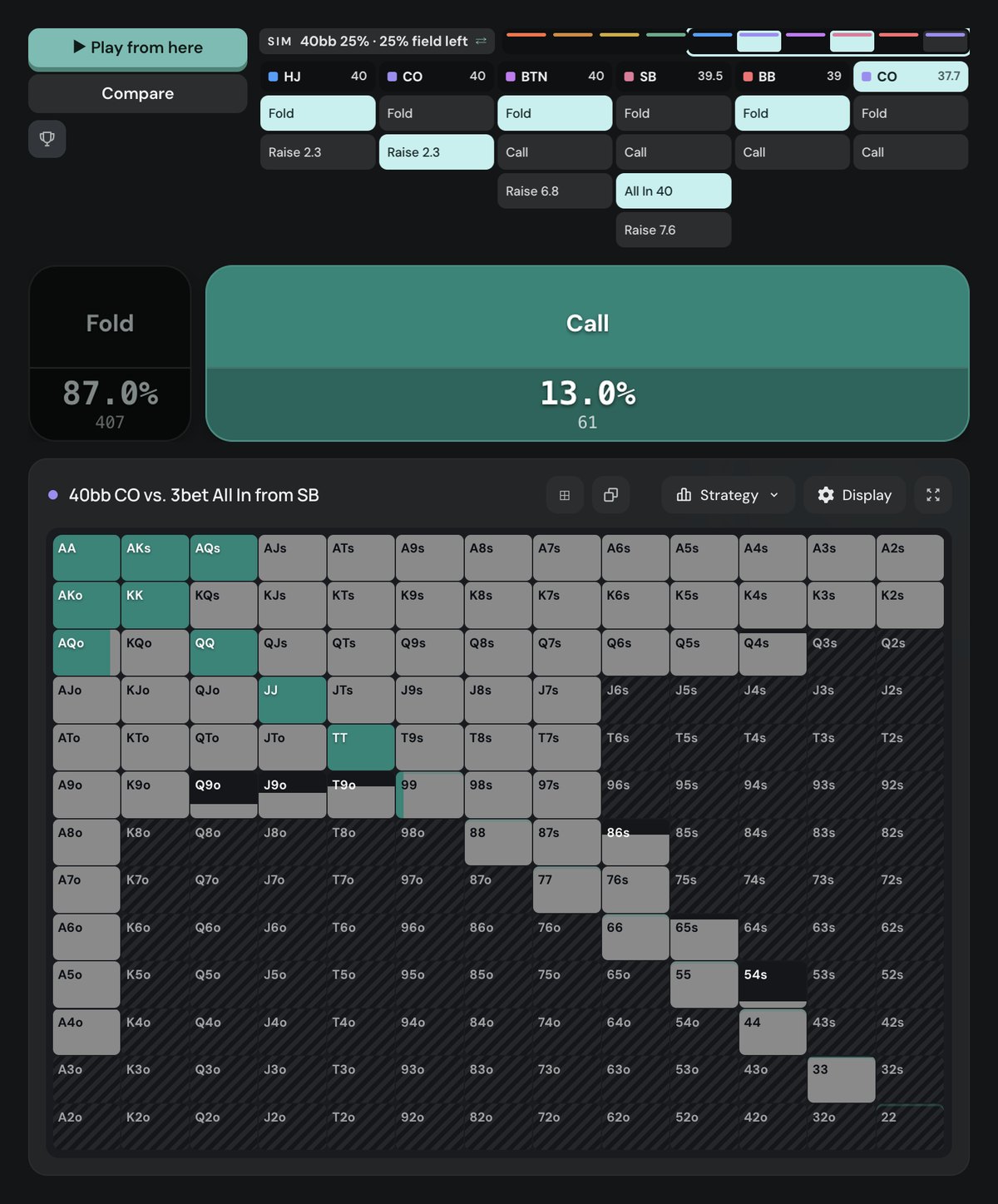
Near the bubble the CO calls the jam with only 13.0% of its opening range, against 21.7% in chipEV: AA–TT, AKs, AQs, AKo and AQo most of the time. The big blind folds 96.2%. With both players folding, the jam wins the pot right away 83.7% of the time, against 73.1% in chipEV.
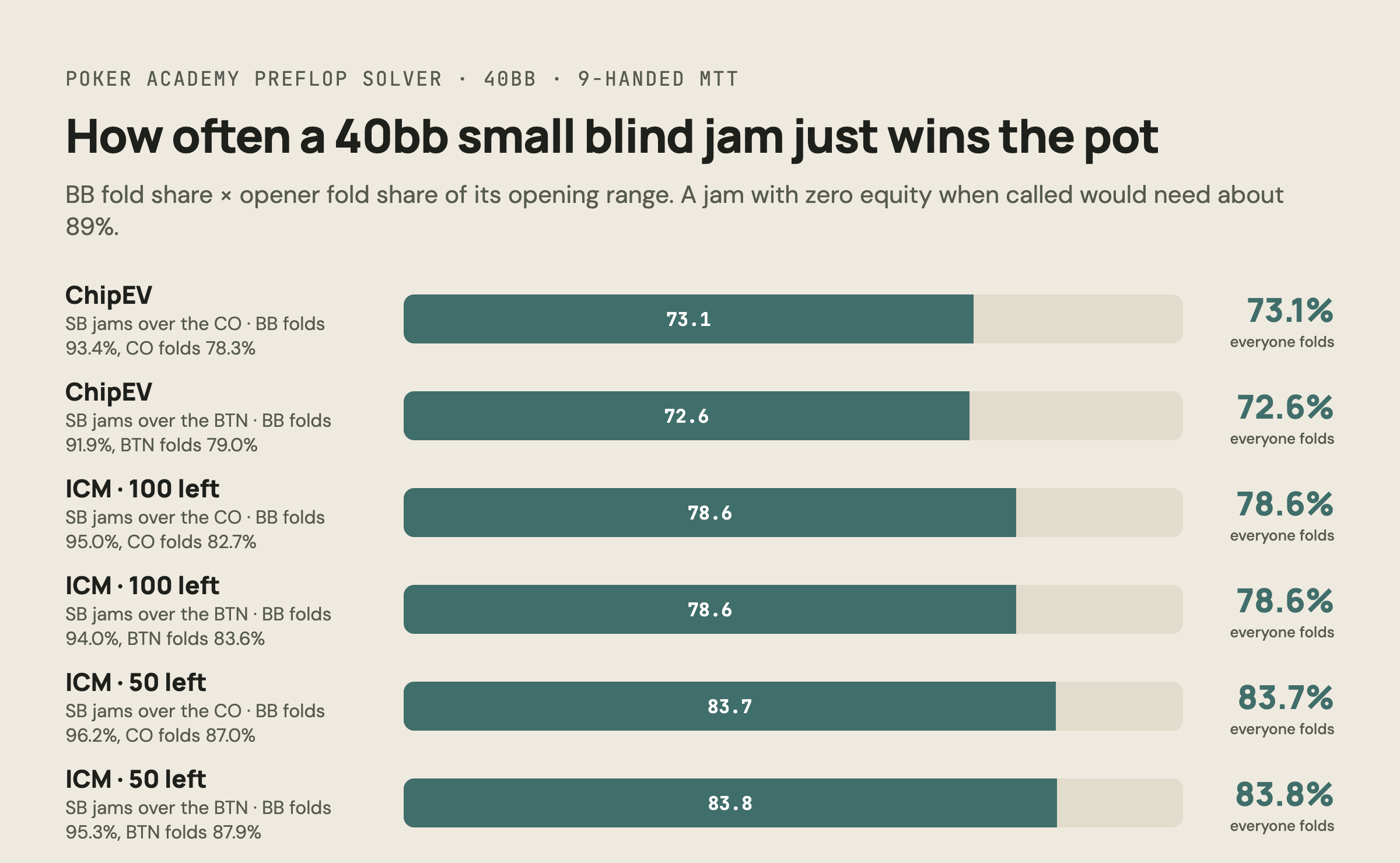
In ICM the small blind loses more prize equity when it gets called, but it gets called much less. Against the button that trade is good enough for a clear jam range:
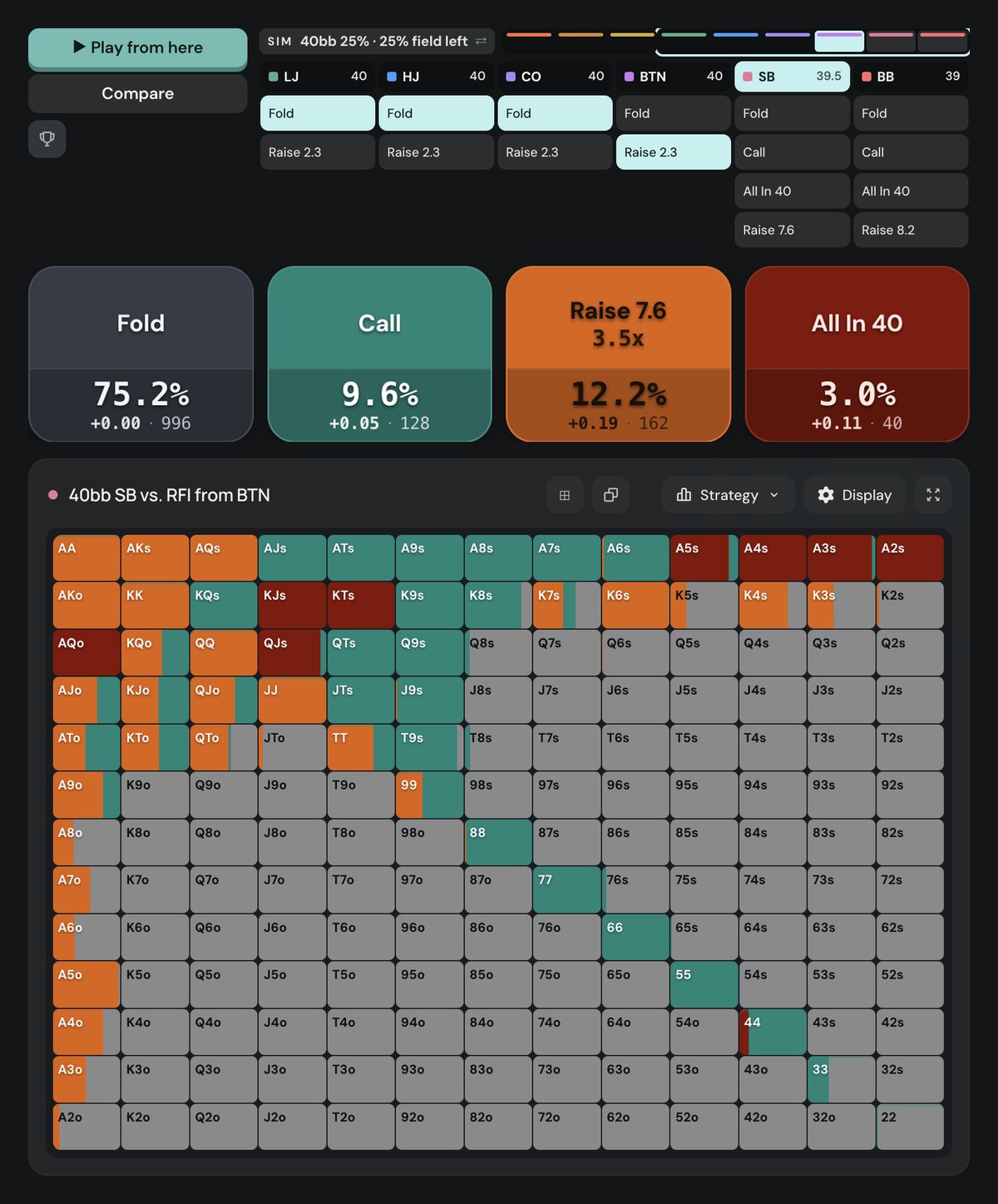
- Always: A4s, A2s, KJs, KTs, AQo (100%), A3s (95%), QJs (92%), A5s (86%).
- Mostly gone: the pairs (44 jams 14%). 77 and 88 now call, and JTs and QTs call too.
The jam range moves from pairs and connected broadways towards suited aces. My reading, as a heuristic: an ace blocks the calling range (AA, AK, AQ), and a hand like A4s still has some equity when it does get called. A small pair would rather see a cheap flop than put its tournament life on a flip.
With 100 left the jam is small: 0.2% against the CO (KJs 33%, AQo 10%) and 1.2% against the button (KJs 78%, KTs 67%, AQo 50%, QTs 47%). The CO calls 17.3% of its opening range there, so the fold equity sits between chipEV and the bubble.
So, is 40bb too big to 3-bet all-in?
- No, but it’s a small play. 1.8% of hands against a CO open and 4.1% against a button open in chipEV.
- It’s not your best hands. AA, KK and QQ 3-bet small. Jams are hands like JTs, AQo, KTs and medium pairs.
- The opener matters, the stack is the same. The button opens 50.6% and gets jammed more.
- ICM shrinks the jam at 100 and 50 left, and the 20-left sim doesn’t offer it at all.
- Near the bubble, watch the caller. When openers call a jam much tighter, the jam comes back with suited aces.
None of this is a rule to memorise hand by hand. The mix changes with the ante, the open size and the payouts, so look up the spot that matches your tournament.
Cheers! 🙂
Keep reading
All posts
Poker Academy
Stop guessing preflop.
1,500,000+ GTO preflop solutions. Try them free for 3 days.
Start Free TrialCancel anytime.