
ICM and uneven stacks: why tournament ranges change when the stacks do
 GioUpdated· pub. ~11 min read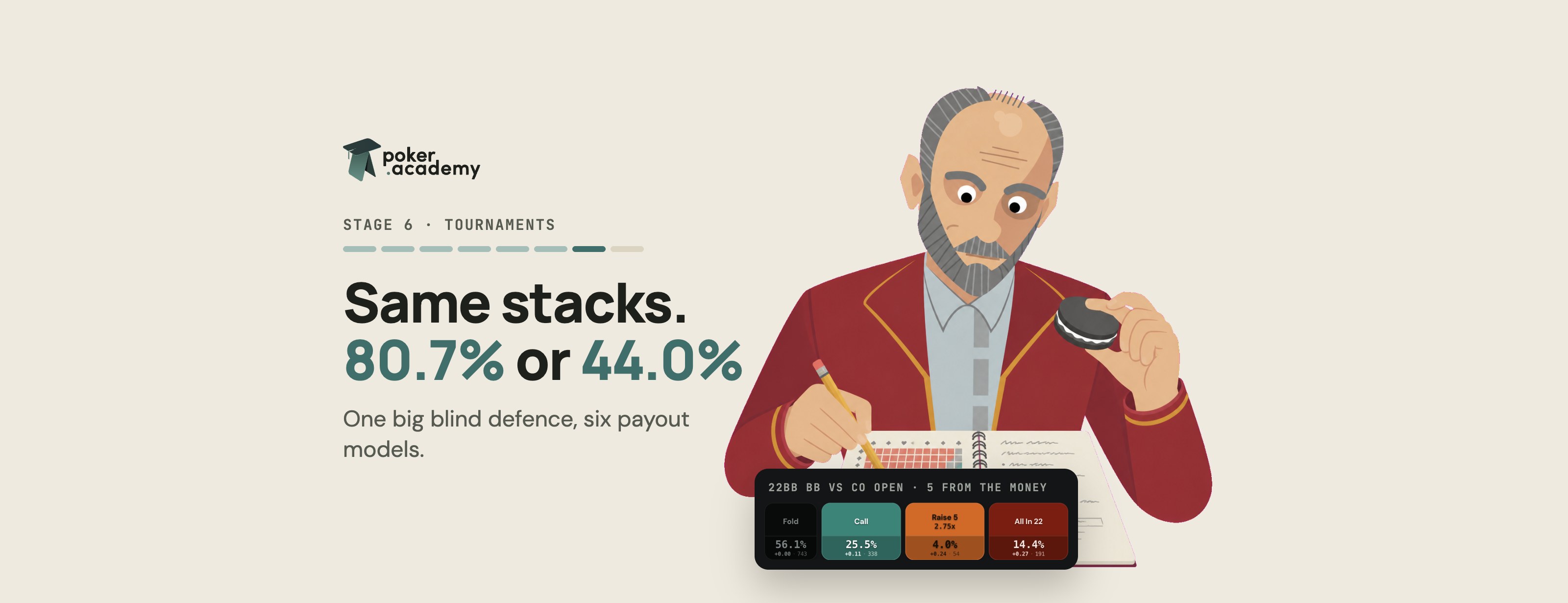
Three years ago I wrote that tournament ranges change once you stop looking at chips: uneven stacks change them, and so does how far the field is from the money. That was true and I gave you no numbers to prove it. Here are the numbers.
Everything below comes from the Poker Academy preflop solutions. The centre of the article is one spot solved six times: an 8-handed MTT table with stacks 18 · 42 · 54 · 38 · 32 · 12 · 6 · 22 big blinds, a regular ante of 0.125bb from each of the eight seats (1bb in the pot, not a big-blind ante), the cutoff min-raising to 2bb, the button and small blind folding, and the big blind with 22bb deciding what to do. The stacks never move. Only the payout model does: once as pure chipEV, then as ICM with 100, 50, 35, 30 and 20 players left in a 200-runner field that pays 30 places.
What ICM actually computes
ChipEV counts chips — cEV. It assumes a chip you win is worth exactly as much as a chip you lose. In a cash game that is true. In a tournament it is not, because you cannot cash out chips — you can only convert them into a finishing place, and the places pay a fixed ladder. What you actually win is money, $EV, and that is what ICM measures.
The Independent Chip Model turns a stack into money with one assumption: your chance of finishing first equals your share of the chips, and after the winner is removed, the same rule decides second place among the rest. That is the Malmuth–Harville version, and it is what the app uses.
Here is a constructed three-handed example, worked out exactly. Three players are left of a €10,000 prize pool paying €1,920 / €1,380 / €1,038 — the top three rungs of the ladder these simulations actually use. Stacks are 50,000 (A), 30,000 (B) and 20,000 (C).
A finishes first
A finishes second — B wins, or C wins
Third is whatever is left: 100 − 50 − 33.93 = 16.07%. Multiply by the prizes:
A’s equity in money
Do the same for B and C and you get €1,431 and €1,312. The three add up to €4,338, which is exactly the money still on the table — a good check that the arithmetic is right.
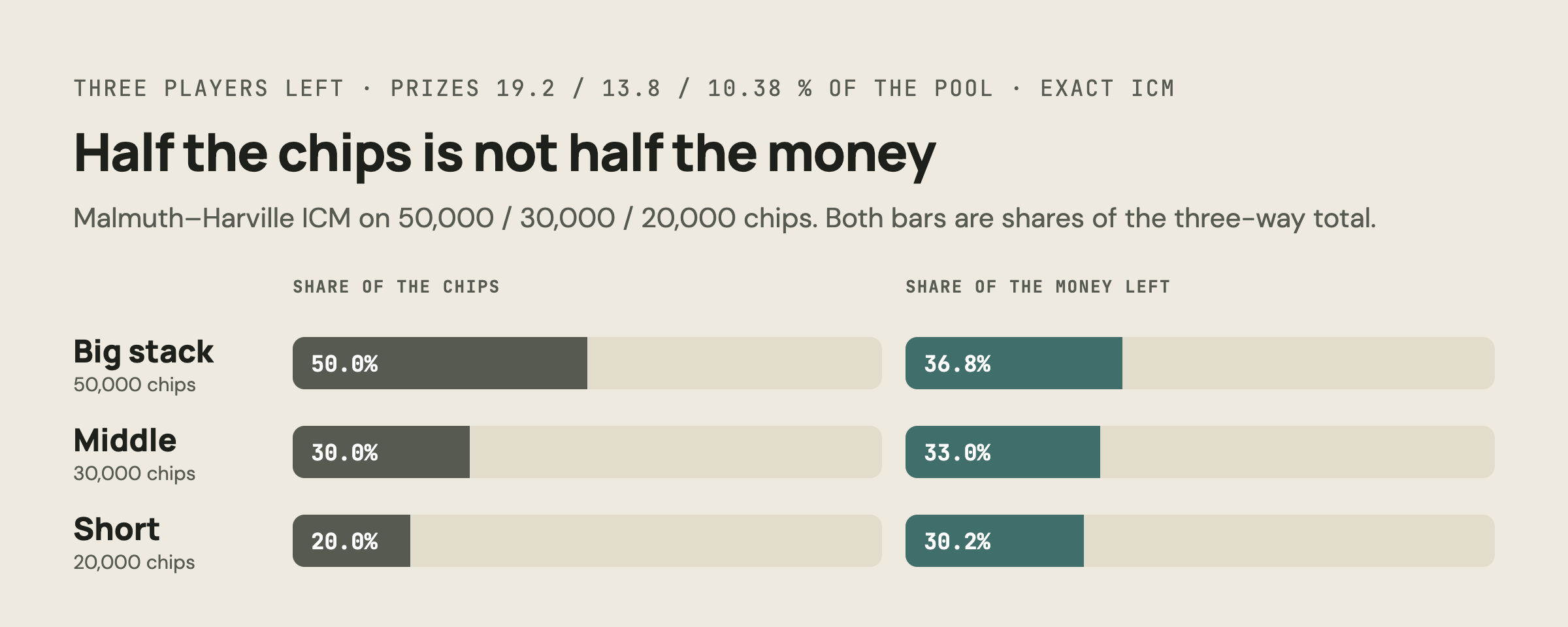
That gap is the whole subject. A holds 50% of the chips and 36.8% of the money. C holds 20% of the chips and 30.2% of the money. Chips you have already won are worth less than their face value, and chips you might still win are worth less again.
Bubble factor and risk premium
Now make A and C play a flip for C’s 20,000. Run ICM on each outcome.
- A wins: stacks 70/30, C takes third for €1,038. A’s equity becomes €1,758.
- A loses: stacks 30/30/40. A’s equity becomes €1,415.
- A right now: €1,595.
So A gains €162.96 by winning and loses €180.06 by losing. Those two numbers are what a bubble factor is:
Bubble factor
Equity needed to break even
In chips the flip is breakeven at 50%. A needs 52.5%, so A pays a risk premium of 2.5 points. Run the same three lines for C, who is risking its whole tournament life while A risks 40% of its stack, and C’s bubble factor is 1.40 — it needs 58.3%.
Add those two: 52.5 + 58.3 = 110.8%. Only one of them can win the flip, so the numbers cannot both be met. An even-money all-in between these two players loses money for both of them. Nobody is doing anything wrong; the payout ladder is simply taking 10.8 points out of the middle. That is the thing the old article was reaching for when it said “winning is not as important as losing part of our stack”, and it is worth saying with a number instead.
The app does this arithmetic for whatever sim you have open. The ICM tab in the combos panel shows your seat’s share of the chips, its share of the prize pool, the bubble factor for the pairing you are looking at, and the whole payout ladder.
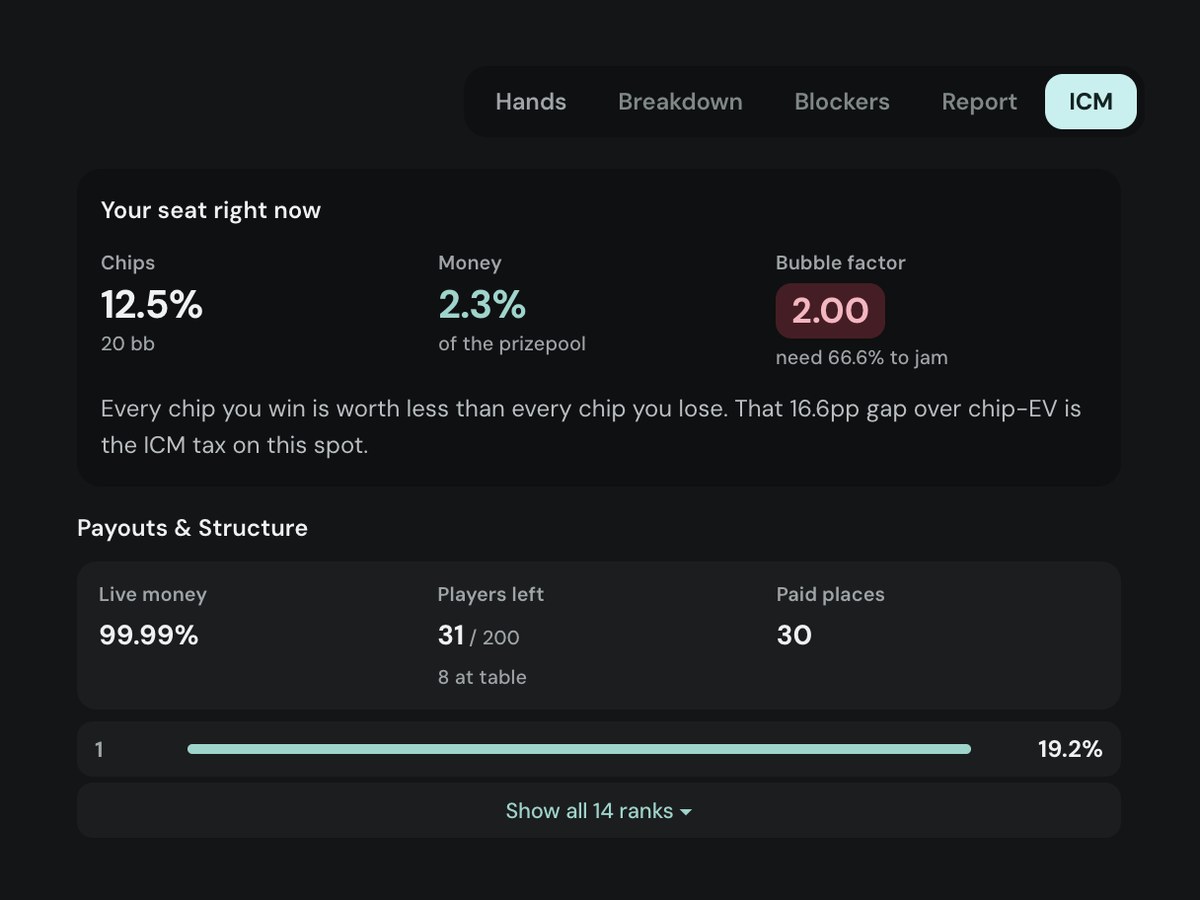
On that bubble — one player from the money, everyone on 20bb — the bubble factor is 2.00 and you need 66.6% equity to put your stack in, not 50%. That is a 16.6-point risk premium. The final-table sim with the same stacks and eight players left carries 1.746, which asks for 63.6%. Both figures ship with the simulation; they are not my estimates.
One spot, six payout models
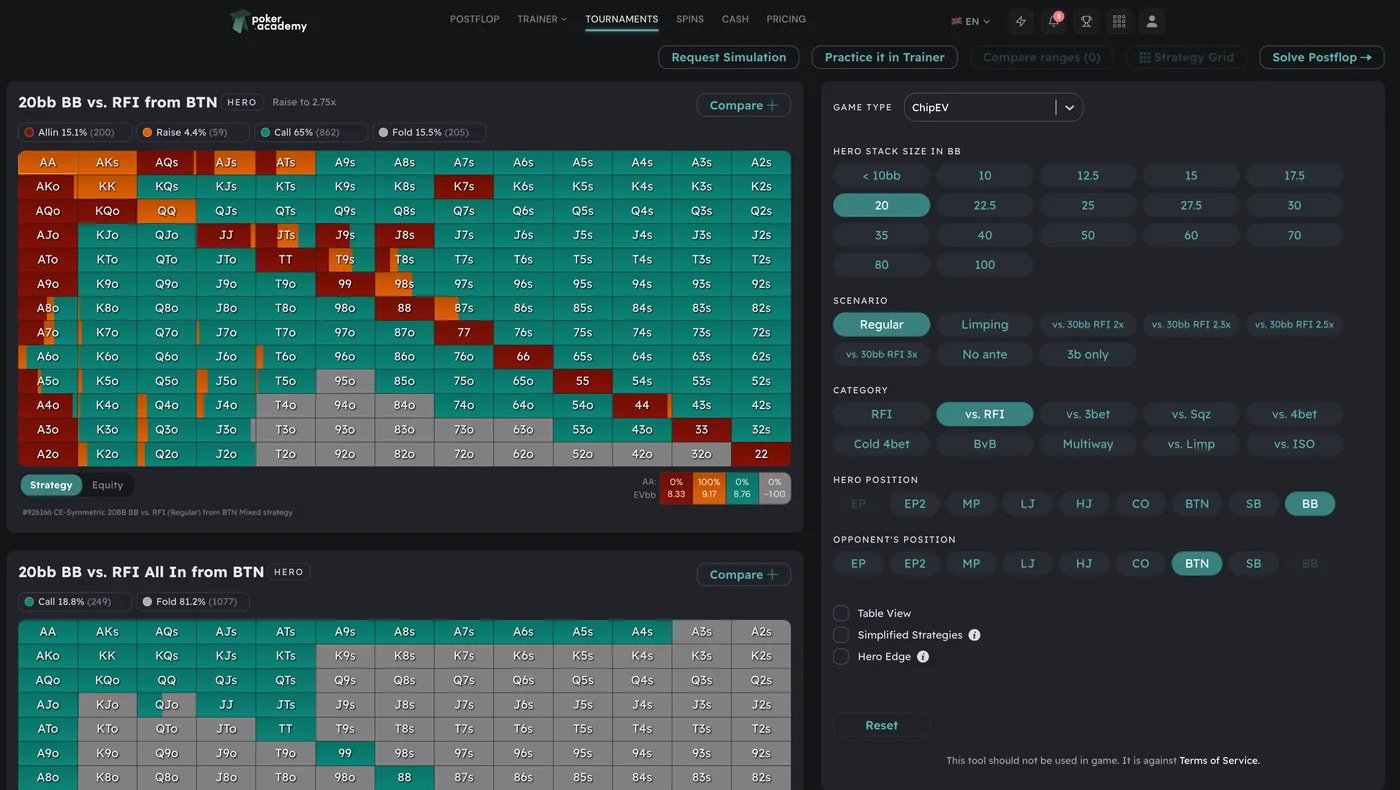
Back to the eight stacks. The cutoff opens to 2bb, the button and the small blind fold, and the big blind with 22bb has 1bb to call into a 4.5bb pot — pot odds of 1/5.5, or 18.2%. Those numbers are identical in all six solutions. This is what the big blind does with them.
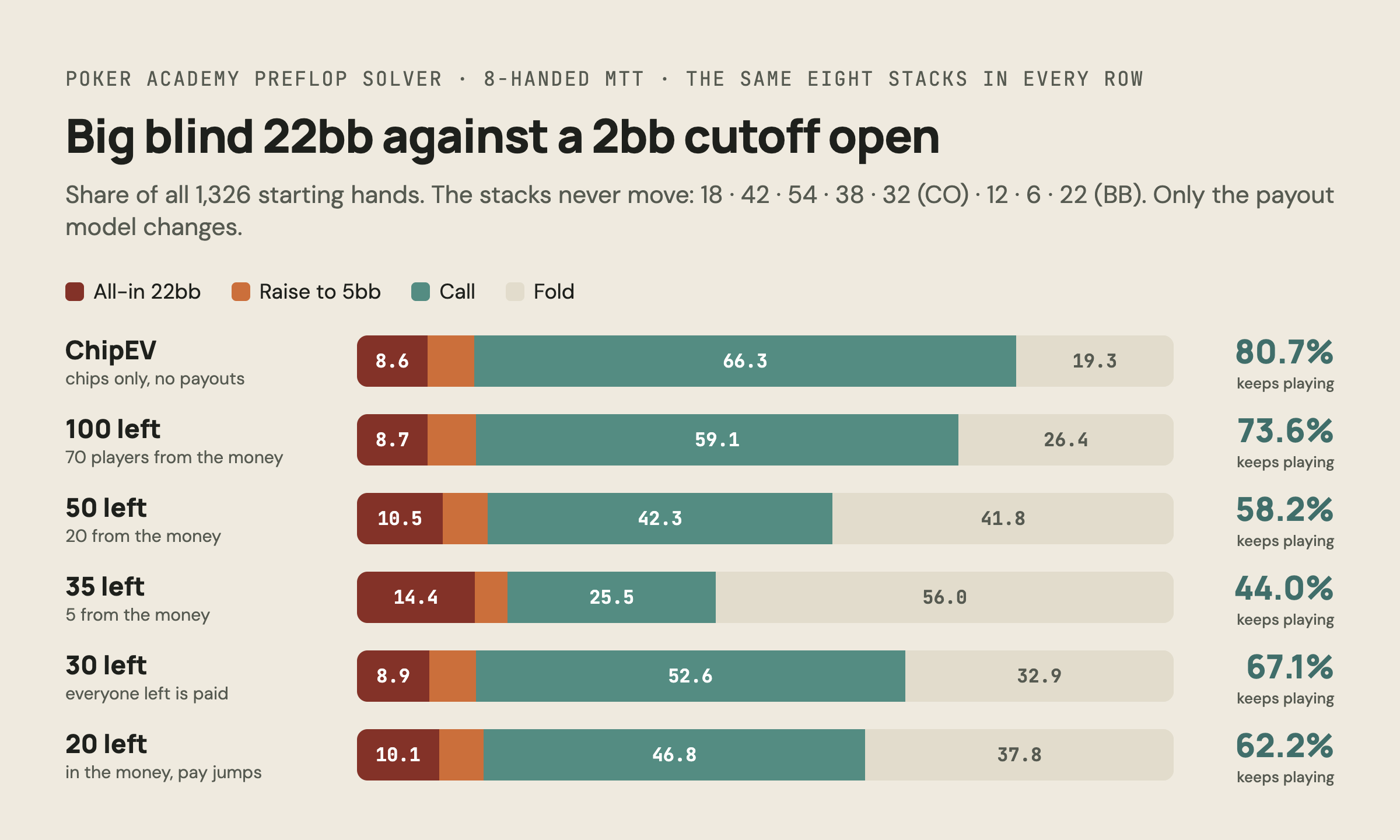
Table · 6 columnsbreaks the measure
| Payout model | All-in 22bb | Raise to 5bb | Call | Fold | Keeps playing |
|---|---|---|---|---|---|
| ChipEV — chips only | 8.6 | 5.8 | 66.3 | 19.3 | 80.7% |
| ICM · 100 left (70 off the money) | 8.7 | 5.9 | 59.1 | 26.4 | 73.6% |
| ICM · 50 left (20 off) | 10.5 | 5.5 | 42.3 | 41.8 | 58.2% |
| ICM · 35 left (5 off — the bubble) | 14.4 | 4.0 | 25.5 | 56.0 | 44.0% |
| ICM · 30 left (everyone is paid) | 8.9 | 5.7 | 52.6 | 32.9 | 67.1% |
| ICM · 20 left (pay jumps) | 10.1 | 5.4 | 46.8 | 37.8 | 62.2% |
Percent of all 1,326 starting hands. In combos: the big blind keeps playing 1,070 combos for chips and 583 combos five off the money.
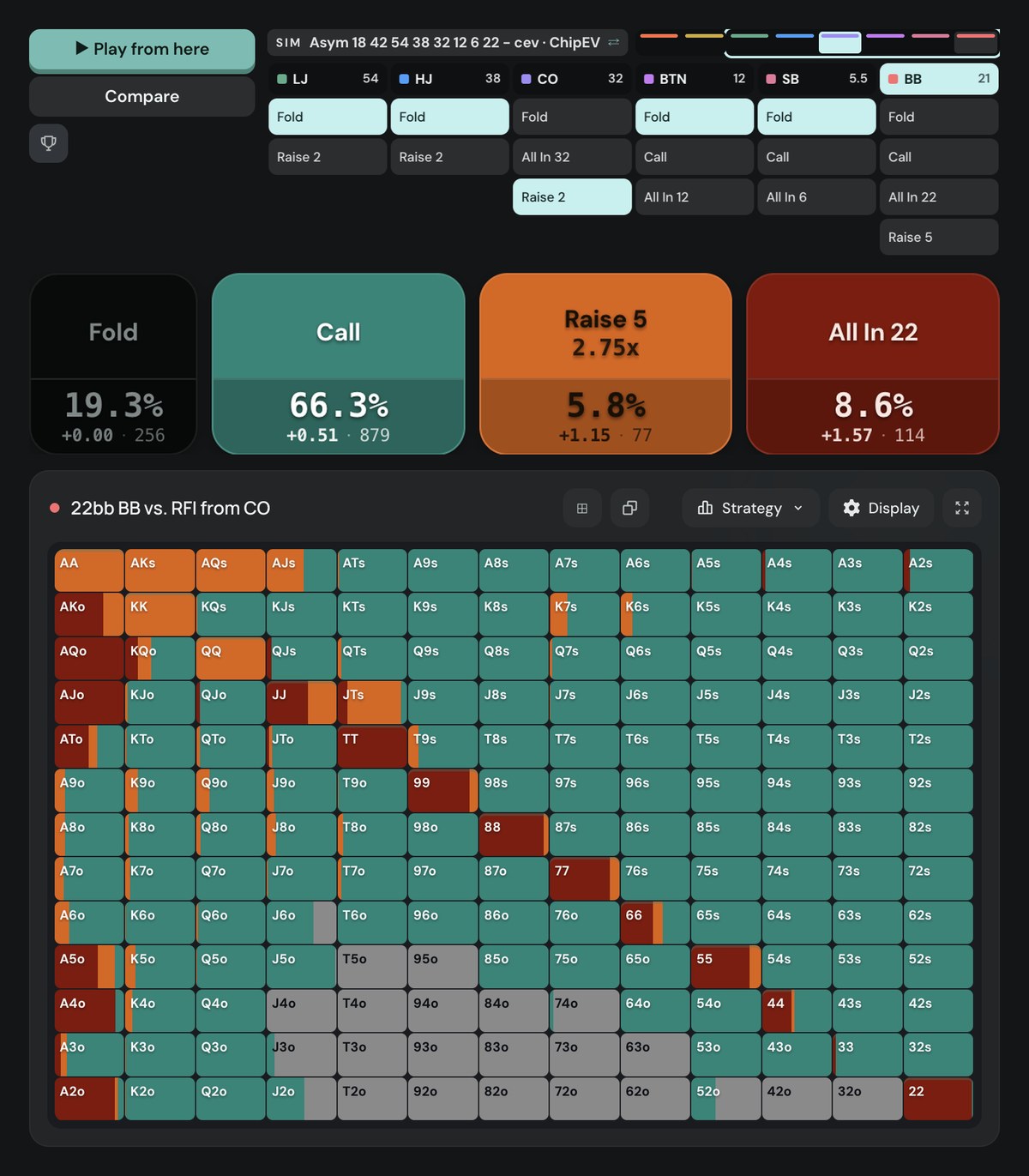
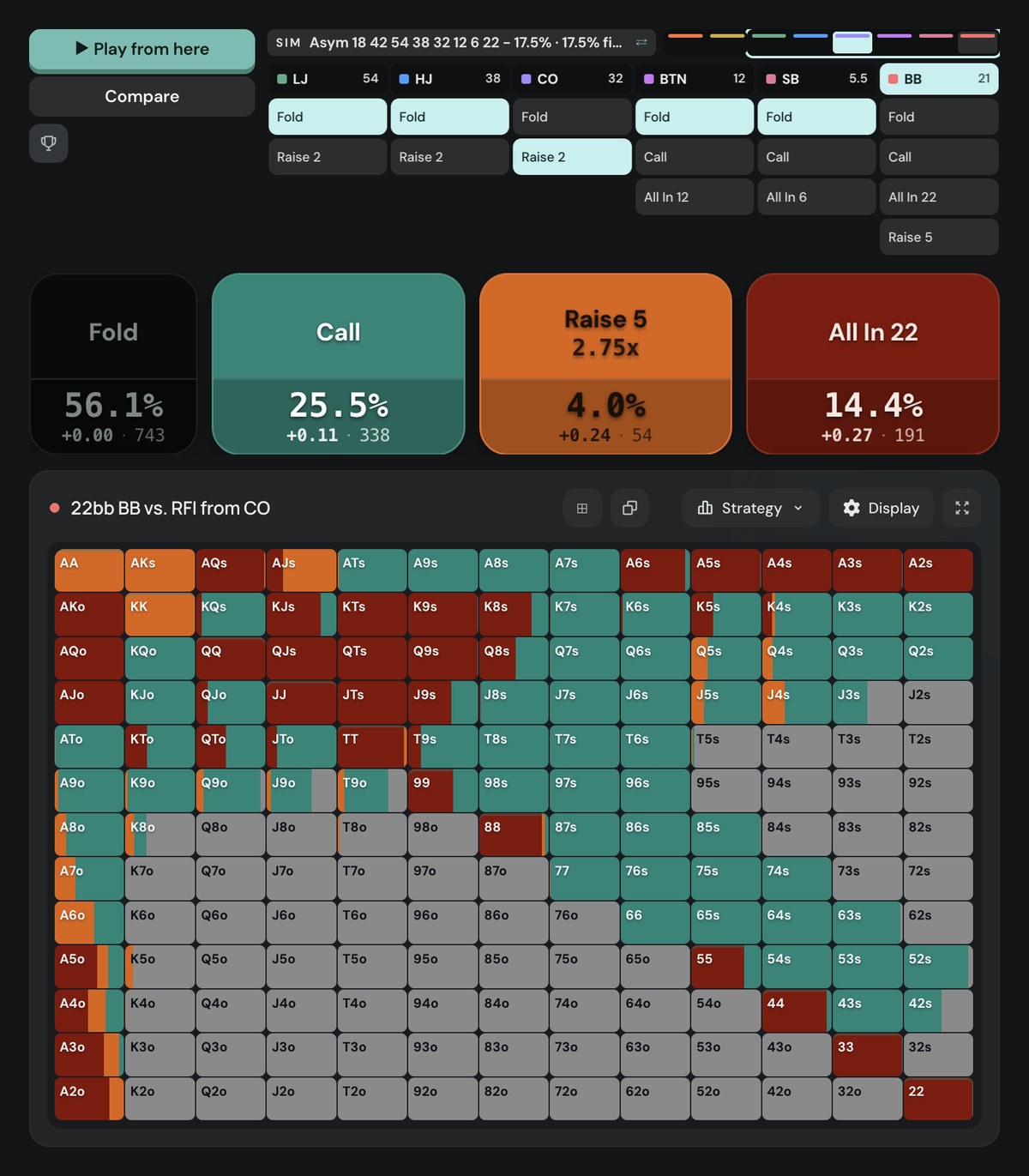
436 combos — 47 hand classes — are a 90%-plus defence for chips and a fold five from the money. They are the hands you would expect: offsuit broadways that miss (K7o, Q6o, J5o), weak suited gappers (T4s, 94s, 83s), offsuit connectors (98o, 76o, 65o). At 18.2% pot odds you call almost anything with chips. My reading: with a prize ladder behind you, a marginal flop out of position is not worth what it costs when it goes wrong.
The part that surprises people is the jam. It gets bigger on the bubble, not smaller: 14.4% against 8.6%, 191 combos against 114. QQ, JJ, AKo, AQo, AJo, JTs, KTs, QJs and the small suited aces all move all-in rather than call or raise small. The reason is on the other side of the table.
I measured what the cutoff does when the big blind jams 22bb over its open, weighting by the hands it actually opened with. For chips, the cutoff folds 68.1% of its opening range. Five off the money, it folds 79.0%. The big blind is being paid more to take the pot away, and taking the pot away is the one line that never has to see a flop.
The bubble is a peak, not a slope
Read the table from the top and defence falls: 80.7, 73.6, 58.2, 44.0. Then it jumps back up to 67.1 with 30 players left, and settles at 62.2 with 20 left. ICM pressure is not “deeper in the tournament, tighter”. It peaks where busting costs the most, which is the last hand before everybody gets paid.
With 30 left the bubble has just burst — 30 places pay, 30 players remain, so every one of them has already locked a cash. The money at stake stops being “cash or nothing” and becomes the gap between the rungs, which is much smaller. With 20 left, the pay jumps start to bite again and the range tightens a little.
The symmetric sims say the same thing at 20bb apiece, 8-handed, same ladder: five off the money the big blind defends 45.9%, one off the money 49.0%, and at the final table with eight left and every place paying a real jump, 41.1%. The final table is the tightest of the three, and in my experience it is also where people are most willing to gamble.
What the opener does
The old article said the ranges “do not really change”, and looking only at first-in ranges that is almost defensible. The cutoff opens 31.1% of hands for chips and 30.1–30.8% in four of the five ICM runs. The change is in how, not how much.
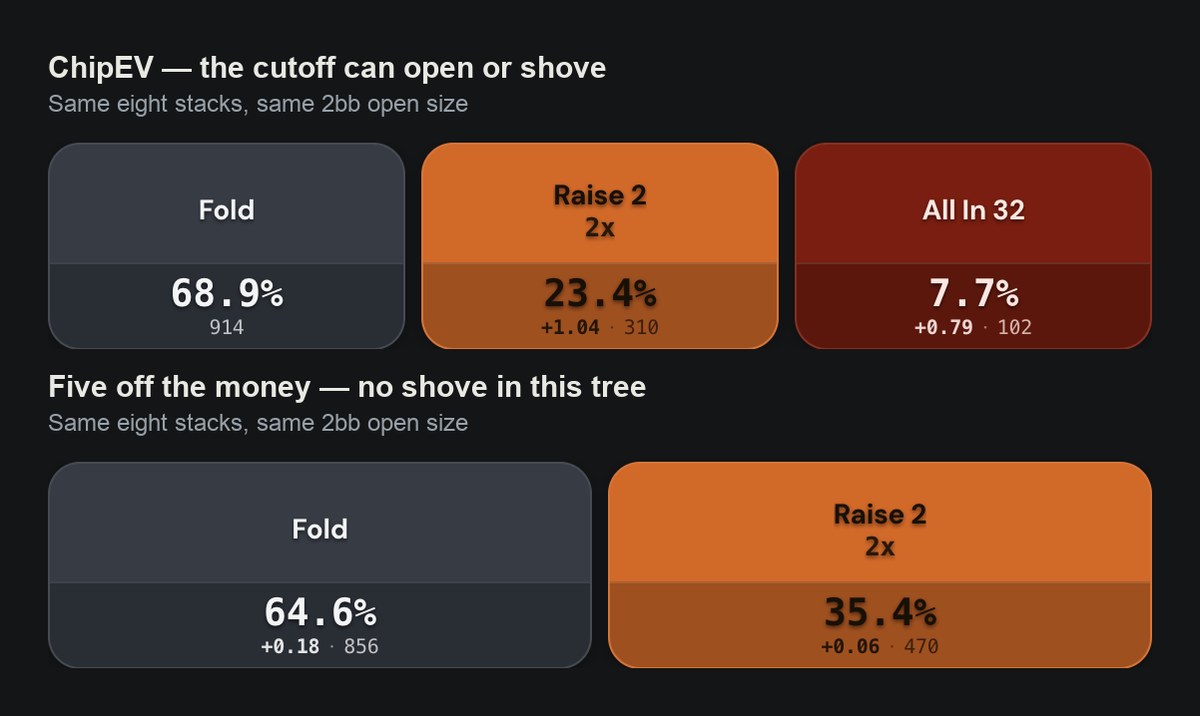
For chips the cutoff mixes a 2bb open with a 7.7% shoving range. Under ICM the shove is smaller in every run that offers it — 5.5% with 100 left, 2.4% with 50, 2.9% with 30 and 1.5% with 20 — and the small open grows to take its place. That fits the maths: a shove risks 32bb to win 2.5bb, and risk is what a payout ladder taxes.
The bubble run opens the widest of all six, 35.4%, and that is the piece I would not read too hard. Its tree has no all-in at this node at all, so the raise absorbs everything. What is safe to say is that it opens at least as wide as chipEV while the players behind it defend far tighter — stealing gets better exactly when calling gets worse.
Uneven stacks, with no ICM anywhere
ICM is only half of the story the old series told. The other half was that stacks around the table matter even in a pure chipEV solution, and that one is easier to show than to believe.
Two chipEV sims, 8-handed, 1bb ante. The cutoff has 42bb and the big blind 54bb in both, so the effective stack is 42bb in both. The button has 18bb in both. The only differences are the small blind — 32bb in one, 12bb in the other — and an early seat that has already folded.
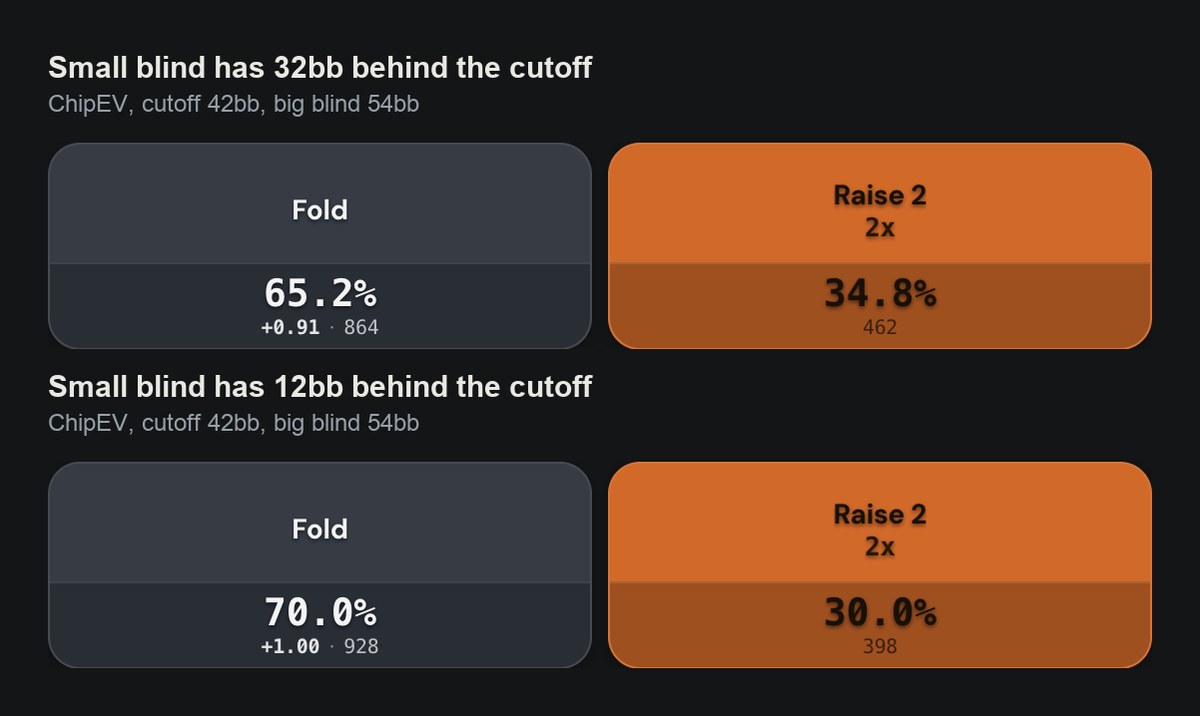
The cutoff opens 462 combos against the deeper small blind and 398 against the 12bb one — 64 combos, 4.8 points of range. My reading, as a heuristic: a 12bb small blind is a cheaper and more willing re-shover than a 32bb one, and the cutoff answers by opening tighter.
The knock-on effect reaches the big blind, even though by the time it acts both of the seats that differ have already folded. It still defends differently — 82.3% against the wider opening range, 79.3% against the tighter one — and the only thing that changed at its decision is the range the cutoff arrives with. That is the mechanism behind the old claim that the rest of the table matters. Your neighbours do not change your cards. They change the range you are up against.
Three points of range is small enough that it is worth asking whether it is just solver noise. It is not: the catalogue happens to contain two independent runs of one identical configuration, and they agree to 0.1 of a point — the cutoff opens 33.00% in one and 33.05% in the other, the big blind defends 74.37% and 74.27%. Anything above a couple of tenths of a point in these comparisons is a real difference.
What I would take to the table
- Look up the stage, not just the stack. The same 22bb big blind against the same 2bb open defends 80.7% of hands for chips and 44.0% five from the money. No amount of chart memorising covers that.
- The pressure peaks on the bubble and drops the moment it bursts. 44.0% with 35 left, 67.1% with 30 left. Deeper is not automatically tighter.
- Tight defence and a wider jam go together. When opponents fold 79% instead of 68% to your all-in, the fold equity comes back even as the calling range disappears.
- A bubble factor is a number, so use it as one. 2.00 means you need 66.6% to put your stack in, not 50%. The ICM tab prints it for the spot you are looking at.
- Stacks behind you matter before anyone acts. A 12bb small blind costs the cutoff 64 combos of opening range, and the big blind feels it second-hand.
None of this is a rule to learn hand by hand. The ante, the open size and the payout ladder all move these numbers, so the useful habit is to open the solution that matches the tournament you are in and look at the same spot twice — once for chips, once for money.
Cheers! 🙂
Related posts
More in Mindset

Poker Academy
Stop guessing preflop.
1,500,000+ GTO solutions. Free 3-day trial.
Start Free TrialCancel anytime.