
Big blind defence in poker: pot odds, blind vs blind and limped pots
 Filip PedzichUpdated· first published ~9 min read
You play more hands from the big blind than from any other seat. You already have 1bb in the pot, you close the action, and almost every open you face gives you a discount. That makes it the seat where a small leak costs the most, in both directions: fold too much and you bleed blinds, call too much and you bleed chips after the flop.
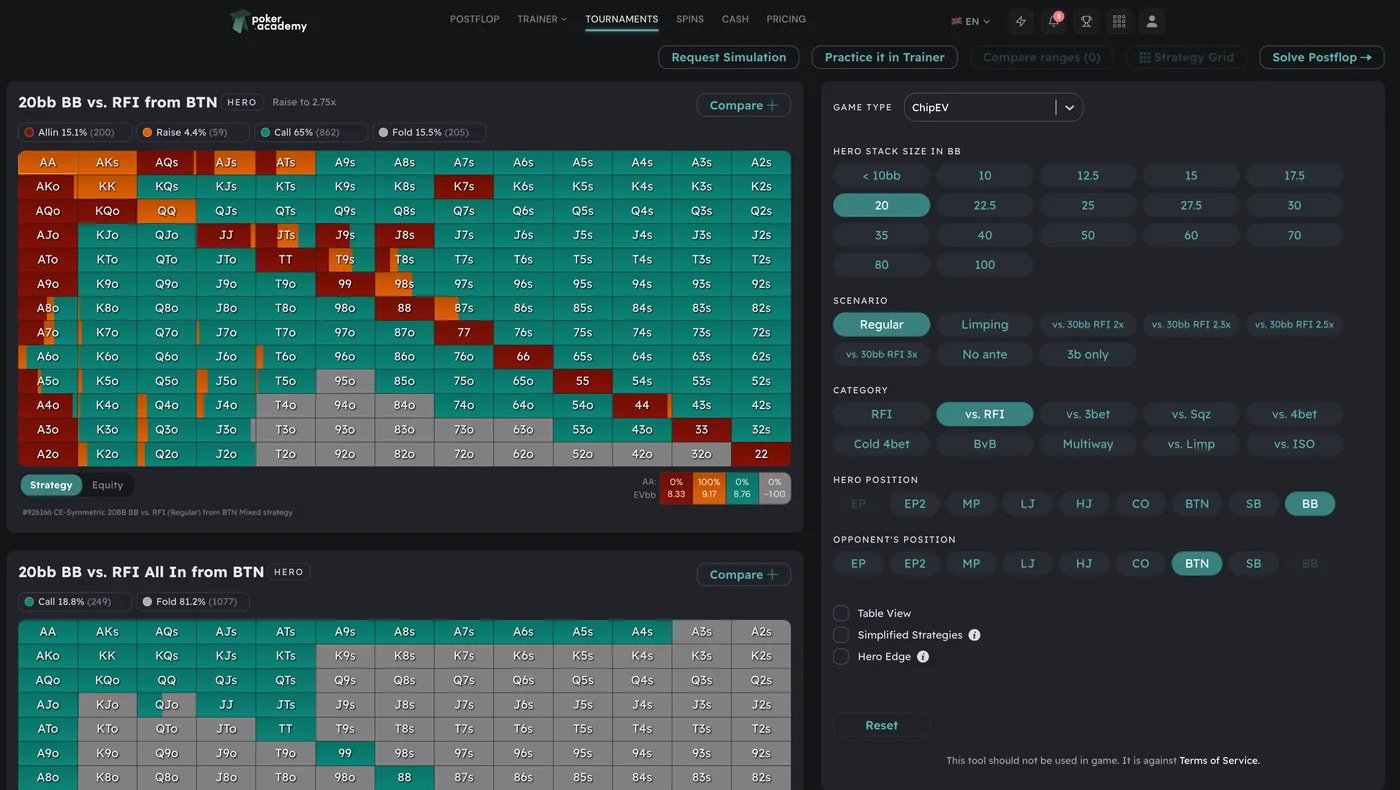
This guide shows how wide the big blind defends, using solver charts from Poker Academy. Two games, so you can hold them side by side: a 40bb tournament (CE-Symmetric, 9-handed, 1bb big-blind ante, chipEV, no ICM) and a 100bb cash game (6-max NL50 on GG, no ante, with rake). Every screenshot is the Browse screen of the app, so you can open the same spots yourself.
Start with the price
The big blind is the only seat that gets a price on every open. You already paid 1bb, so you only add the difference. The app prints this under the table as pot odds: what you call, divided by the pot after your call.
In the 40bb tournament everyone from EP to the button opens to 2.3bb. If the button opens, you call 1.3bb into a pot of 4.8bb (2.3 from the button, 0.5 small blind, your 1bb blind and the 1bb ante):
BB vs a 2.3bb button open · 40bb MTT
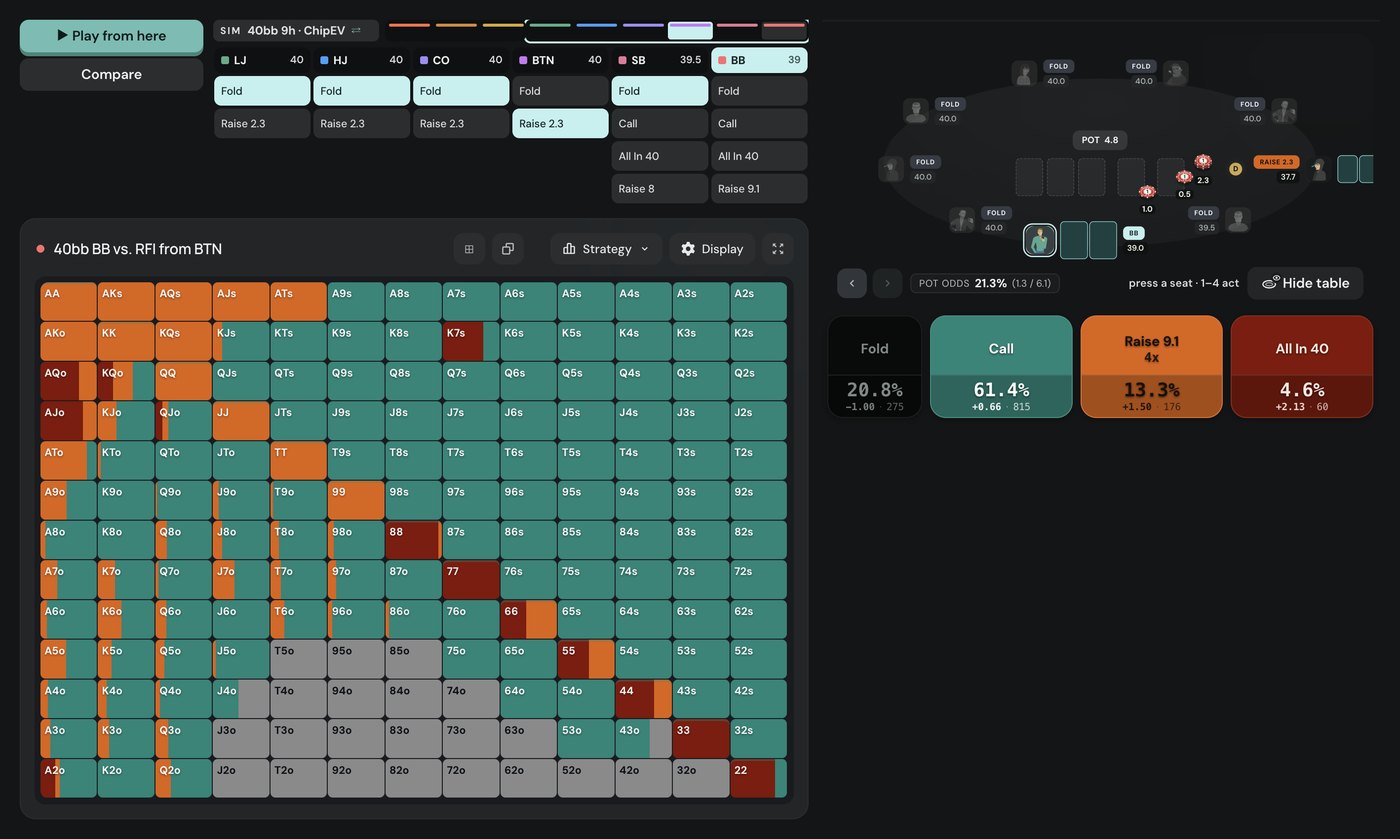
You need 21.3% equity to break even on the call if the hand went straight to showdown. It never does: you play the flop out of position and you won’t realise all of your equity, so treat the price as a floor. It still explains the chart: the solver folds only 20.8% of hands, calls 61.4%, raises to 9.1bb with 13.3% and jams 4.6%.
What folds is the offsuit trash: 23 hand classes such as T5o, 95o, J4o, 84o, 73o and 32o. Every suited hand continues. The raises are mostly AA to 99, AKs to ATs, KQs and AKo. The all-ins are mostly small pairs (88, 77 and 55 down to 22) plus AQo and AJo, often mixed with a call.
Same price, different range: EP vs button
The price is only half the question. When EP opens to the same 2.3bb, your pot odds are the same 21.3%, and the solver folds 49.3% of hands, more than twice as many.
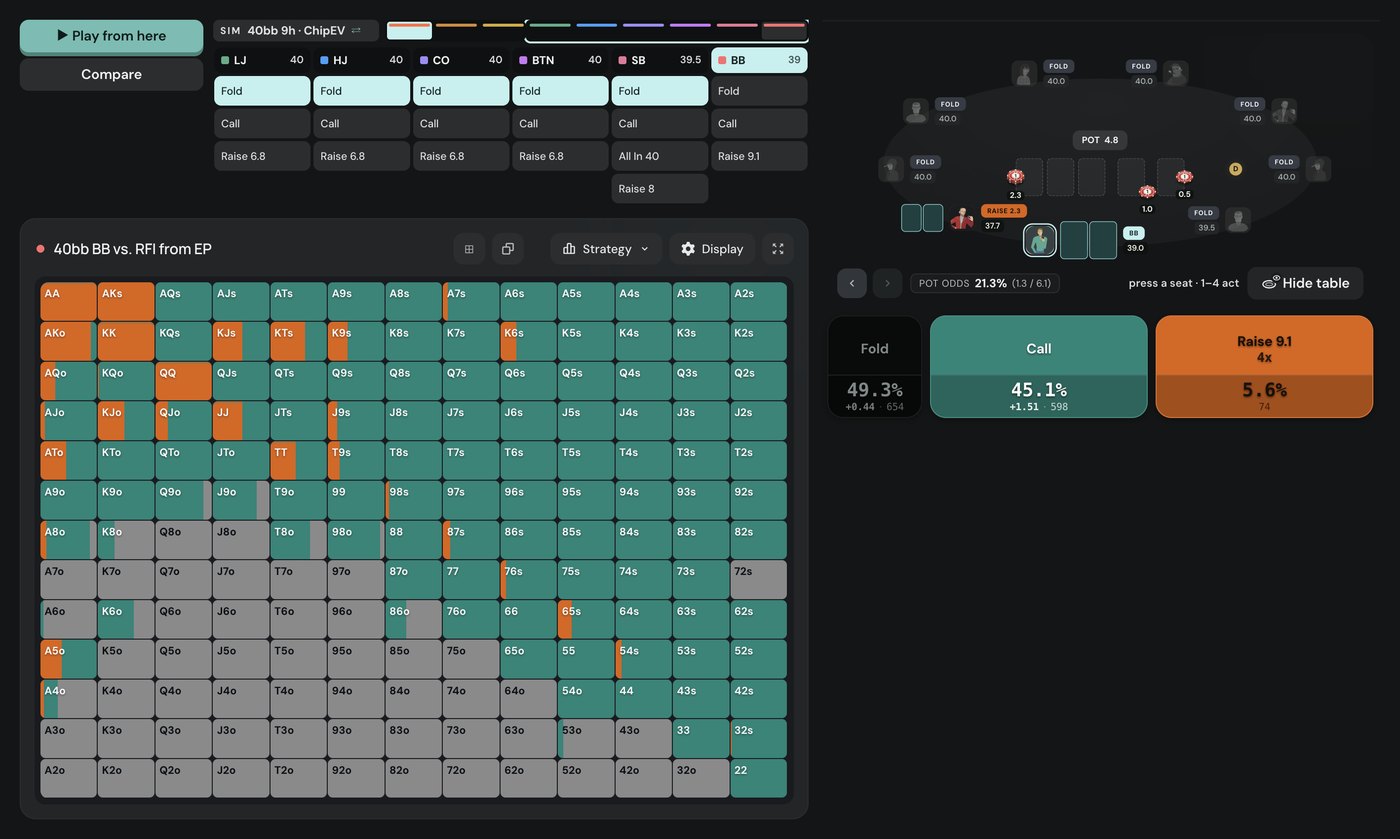
The difference is the range you are up against. EP opens with eight players still behind it at a 9-handed table, so that range is much stronger than a button open. Weak offsuit aces like A7o to A2o (except A5o), K8o and Q8o now fold. Your equity drops and the price stays the same. That is why a pot-odds number on its own never tells you what to fold. Ask who opened.
Bigger open, worse price: the small blind raise
Blind vs blind is the spot where most big-blind mistakes happen. In this simulation the small blind plays a lot of hands and raises to 3.5bb when it raises. Now you call 2.5bb into a pot of 5.5bb:
BB vs a 3.5bb small blind raise · 40bb MTT
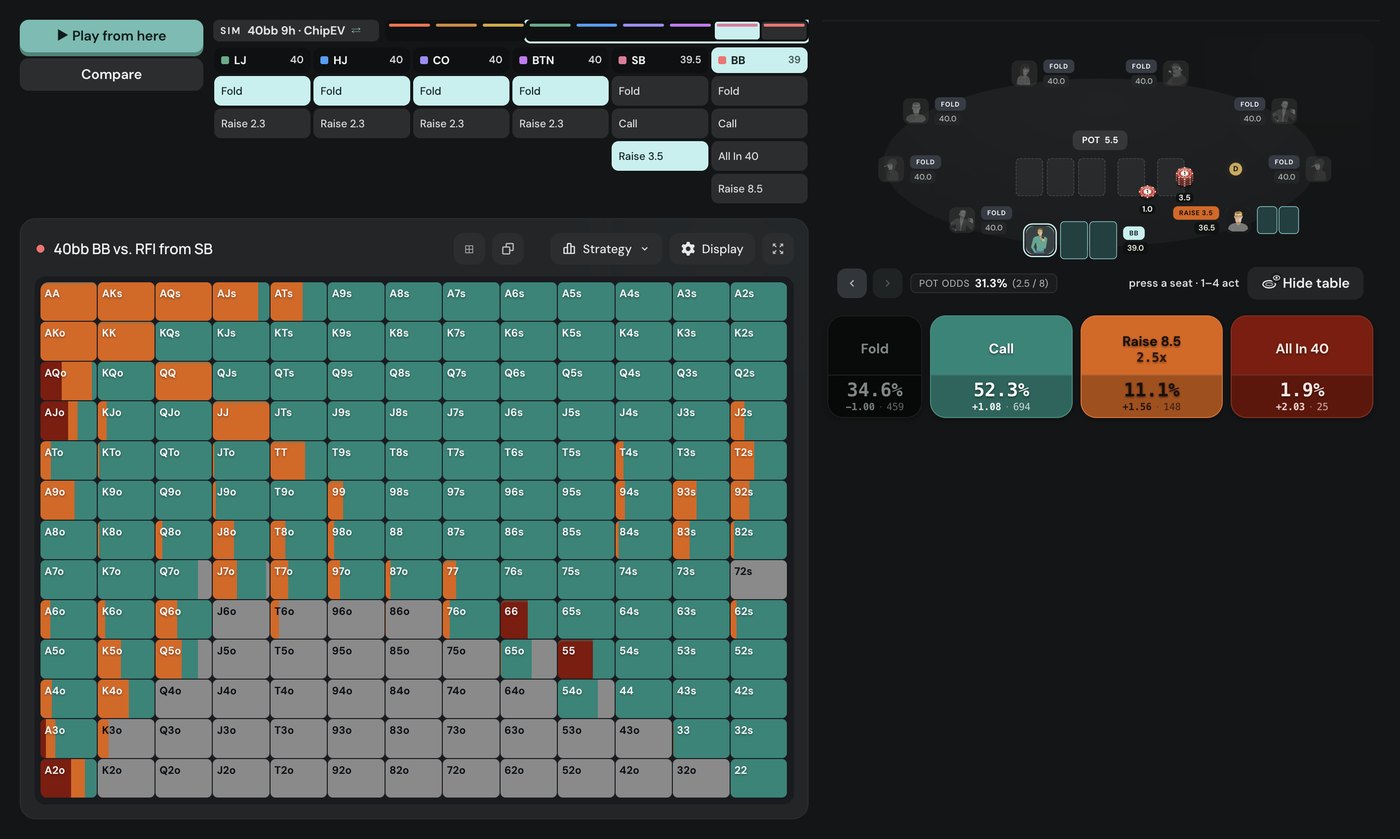
You need 31.3% instead of 21.3%, and the chart tightens with it: the solver folds 34.6% of hands. Calls are still the main play at 52.3%. The raise to 8.5bb takes 11.1% (mostly AA to TT, AKs to ATs, AKo and AQo) and a few hands jam.
The folds are offsuit again: J6o, T6o, 96o, 86o and weaker hands like T5o, 85o, Q4o, K3o and 32o. Suited hands continue, with one exception in this chart: 72s folds. I checked the same spot at 25bb and 30bb in the same format and the result is the same, every suited hand defends except 72s. So “defend all your suited hands against the small blind” is close, but it isn’t a rule, and it breaks in the cash game below.
The ante changes the price
Everything above includes a 1bb big-blind ante. That ante is dead money in the middle, and it makes every call cheaper. Without it, the same 3.5bb small blind raise at 40bb would cost you:
Play this spot instead of reading about it
Start Free TrialThe trainer deals the situations this article describes and grades every decision you make. Try it free for 3 days.
Same raise without the ante, arithmetic only
The app also has the same 30bb tournament with and without the ante, which shows what that does to a real range. The button opens to 2bb in both:
BB vs 2bb button open · 30bb with 1bb BB ante
BB vs 2bb button open · 30bb, no ante
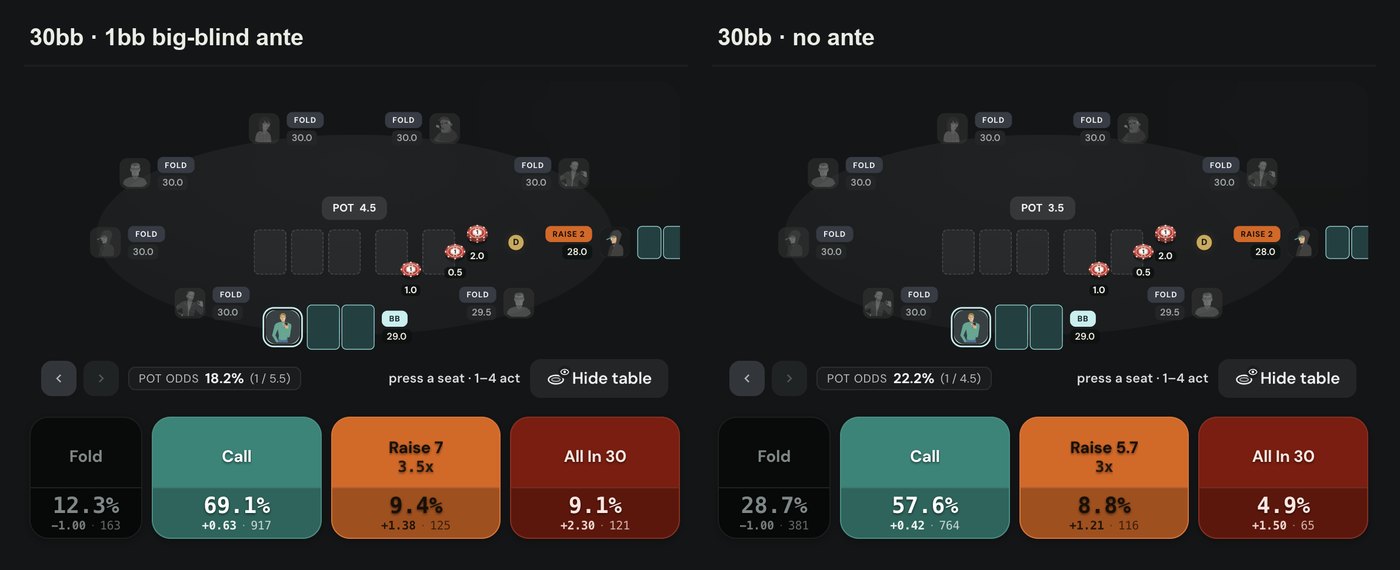
With the ante the big blind folds 12.3%. Without it, 28.7%. Two things happen at once: the price gets worse (22.2% instead of 18.2%), and the button opens fewer hands (38.8% of hands instead of 48.3%), so its range is stronger. When you study a chart, check the ante first. A no-ante chart used in a big-blind-ante tournament will make you fold far too much.
When the big blind jams
At 40bb the all-in is a small part of the strategy, and it grows as stacks get shorter. Against the small blind’s raise at 30bb (same format, 1bb ante), the solver jams 5.3% of hands: AQo, AJo, ATo, the small pairs 55 to 22 and A2o, while it calls 55.9% and folds 32.0%.
This all-in is a 3-bet jam, a re-shove over a raise. It is not an isolation raise; you isolate over a limp. My reading of why these hands jam (not solver output): they have decent equity when called but play badly out of position for 30bb deep, and an all-in wins the pot outright when the small blind folds.
When the small blind limps
A limp changes the big blind’s job completely. Checking is free, so there is nothing to fold and no pot odds to count. In the 40bb tournament the small blind completes more than half of its hands (54.8%), raises 27.7% and folds 17.4%. Facing that limp, the big blind raises to 3.5bb with 44.1% of hands and checks 55.9%.
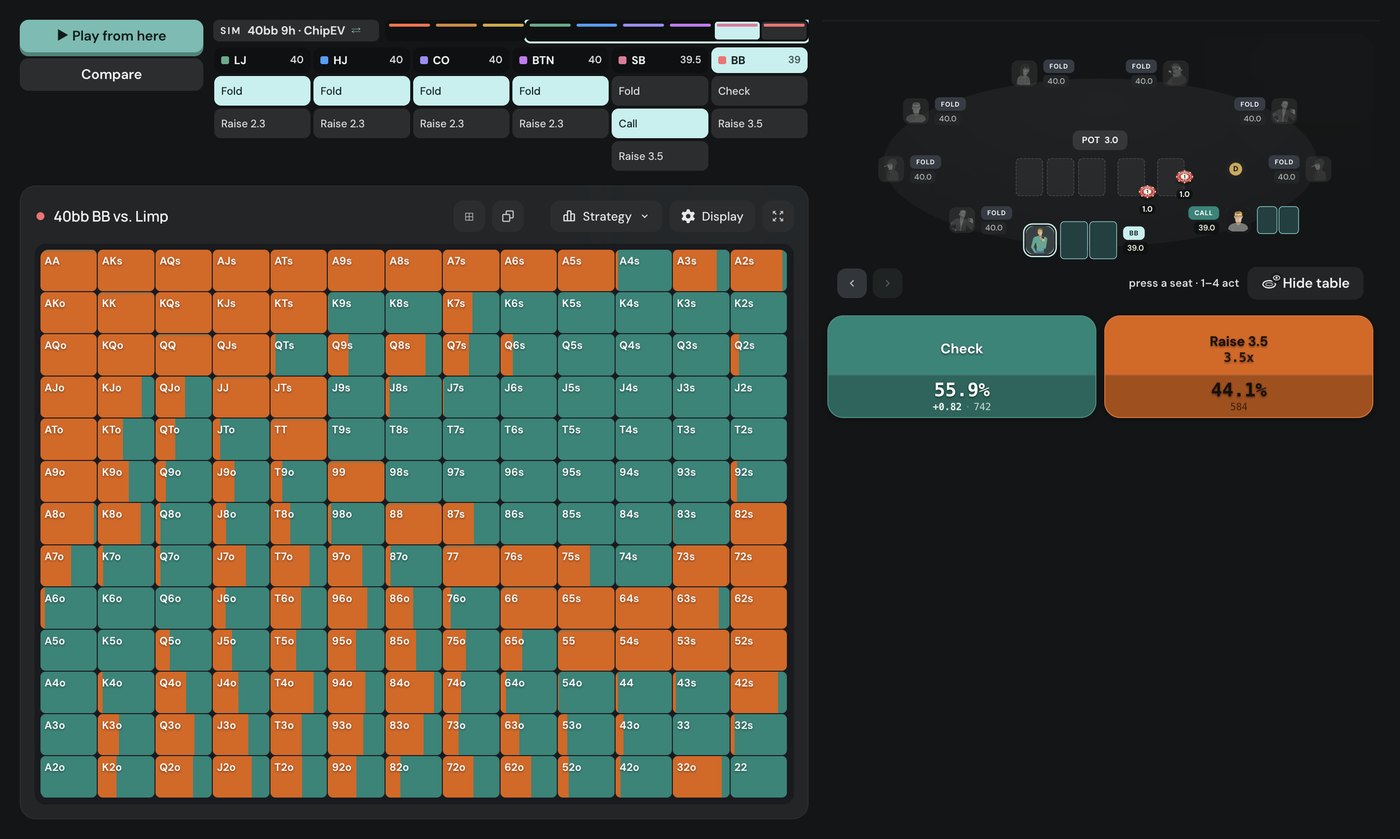
Look at the offsuit hands. The strong ones raise (AKo down to A7o, KQo, KJo, QJo). The middle ones check: KTo, QTo, JTo, T9o and most weak offsuit aces from A6o down. And then a lot of the worst hands raise again: Q2o, J2o, T2o, 92o, 72o, 62o and 32o. That is a polarised raise: the best hands for value, the worst hands as bluffs, and the hands with some showdown value check.
The bluffs make sense once you picture the alternative. 72o checked back rarely wins at showdown. As a raise it can win the pot right away against the part of the limping range that folds. Many hands are mixed in this chart, so read the percentages as well as the colour of each square.
The cash game: 100bb, no ante
Now the same three spots in a 100bb cash game (6-max, NL50 GG): no ante, deep stacks, and rake in the simulation. The button opens to 2.5bb, so you call 1.5bb into a 4bb pot:
BB vs a 2.5bb button open · 100bb cash
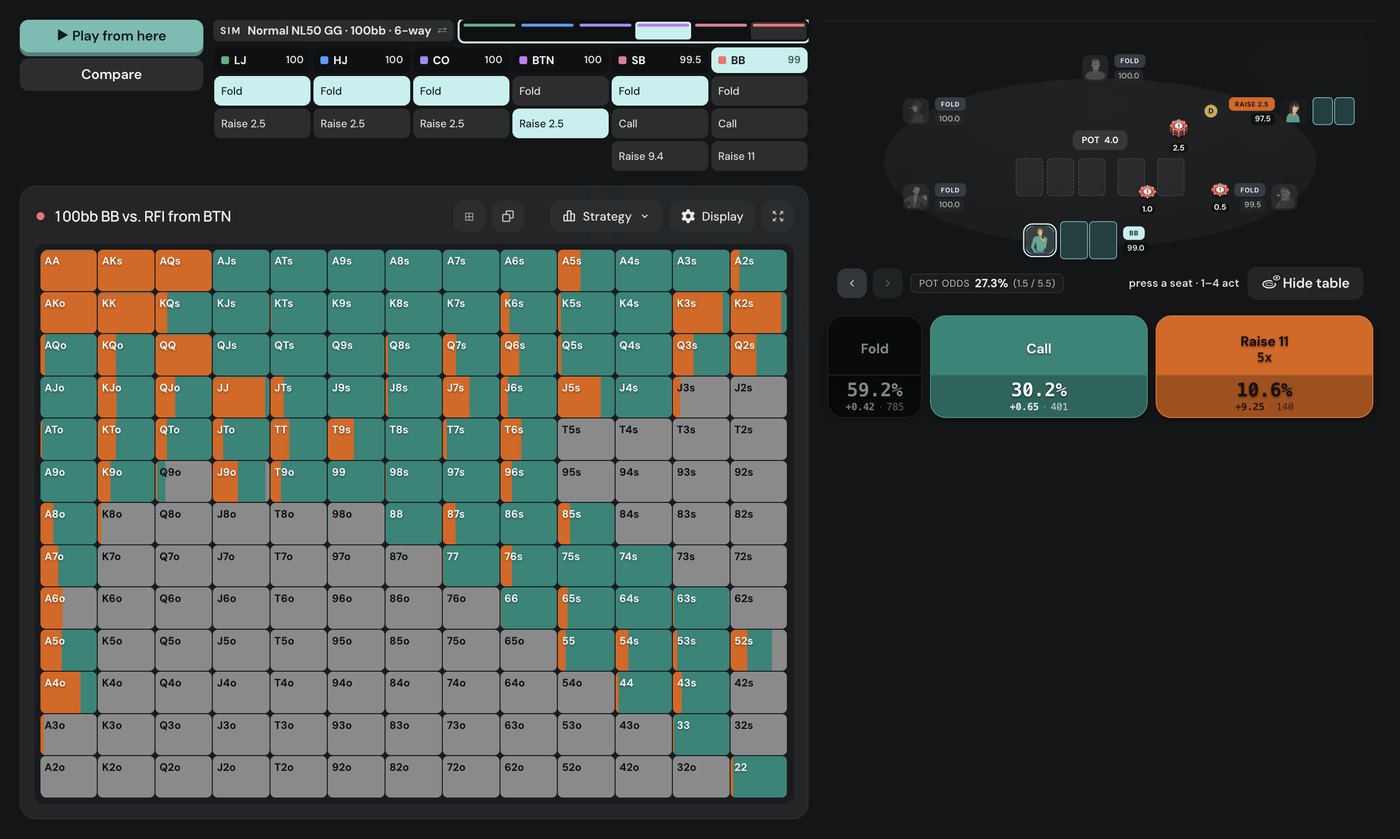
The big blind folds 59.2% of hands here, against 20.8% in the 40bb tournament. The price is worse (27.3% instead of 21.3%), there is no dead ante, and 100bb deep you play three more streets out of position. The folds now include plenty of suited hands: T5s to T2s, 95s to 92s, 84s to 82s, 73s, 72s, 62s, 42s and 32s. The raise to 11bb takes 10.6%, and there are no all-ins at this depth.
Blind vs blind in the cash game, the small blind raises to 3bb and almost never limps (3.1% of hands). You call 2bb into a 4bb pot:
BB vs a 3bb small blind raise · 100bb cash
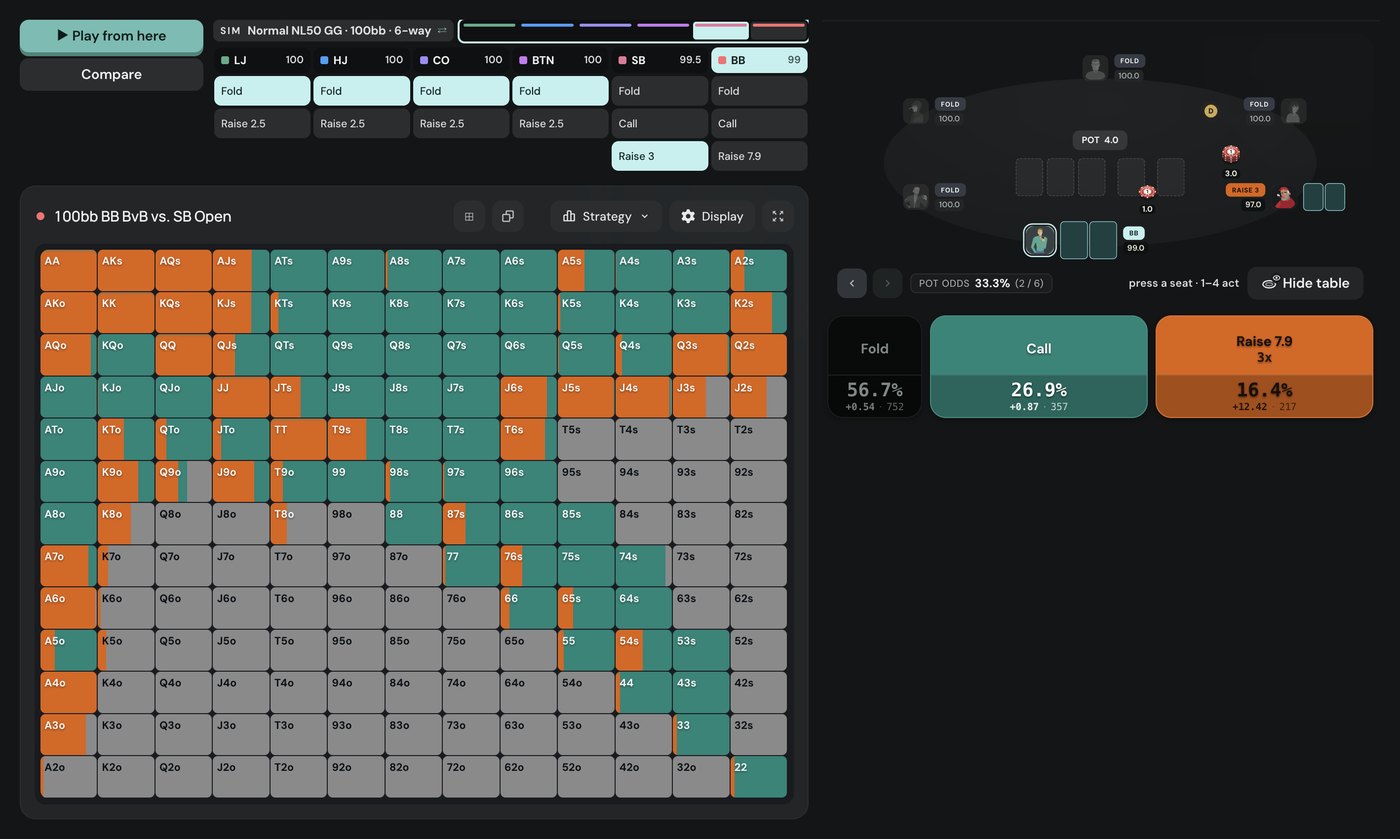
Fold 56.7%, call 26.9%, raise 16.4%. The 3-bet is bigger here than against the button (16.4% against 10.6%), and it includes low suited hands like J6s to J2s, Q3s and Q2s next to the value hands AA to TT, AKs to AJs and AKo, AQo.
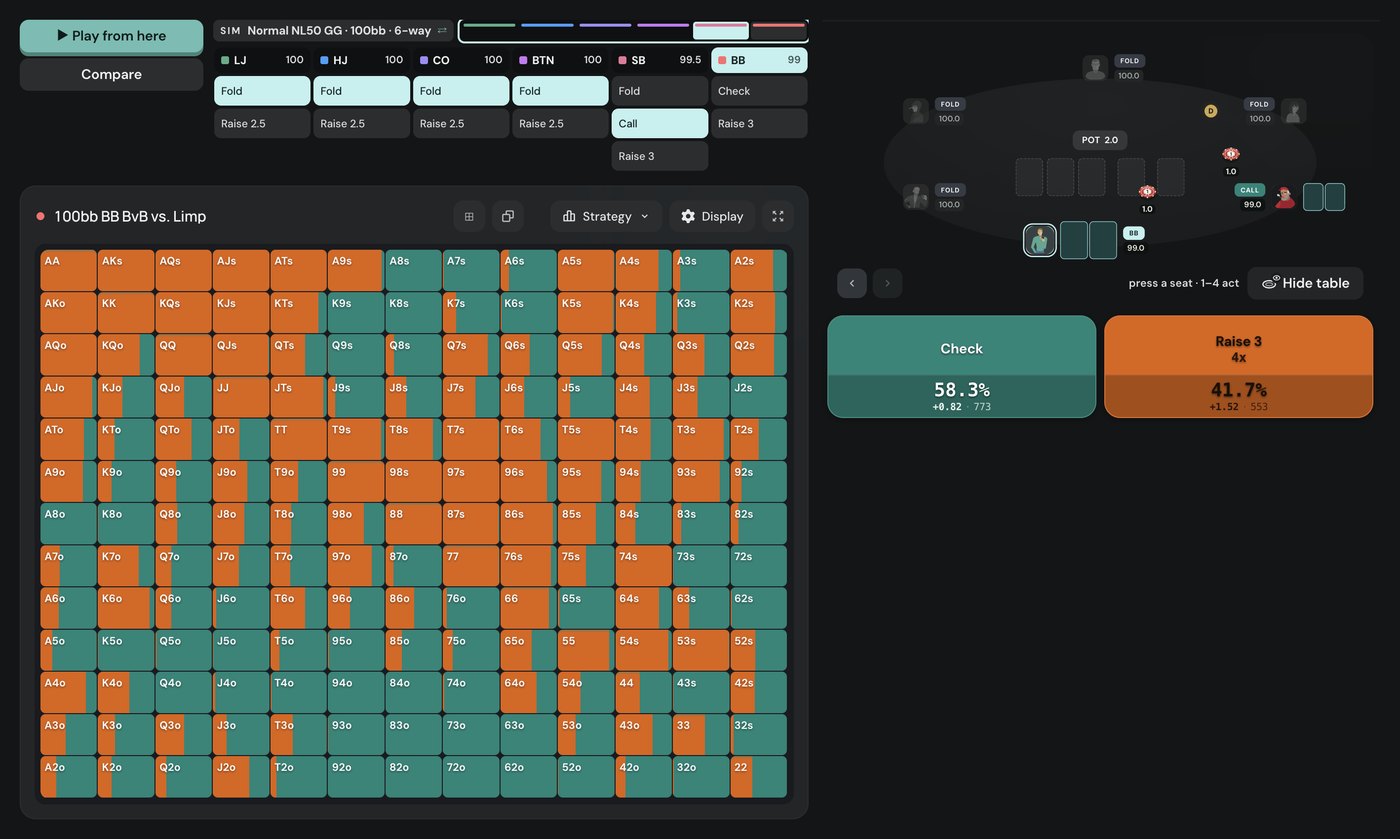
Against a limp the cash big blind raises to 3bb with 41.7% and checks 58.3%, close to the tournament split. The suited raises reach far down: A5s, A4s, A2s, K5s, K4s, K2s, Q7s to Q2s and T8s to T2s mostly raise, while hands like A8s, A7s, K9s and J9s mostly check. The offsuit part is less cleanly polarised than at 40bb: 72o and 32o check here.
Five things to take away
- Read the price first. The app shows pot odds for every open: 21.3% against a 2.3bb button open at 40bb, 31.3% against a 3.5bb small blind raise.
- Then read the range. The same 21.3% price means fold 20.8% against the button and 49.3% against EP.
- Check the ante. At 30bb the big blind folds 12.3% against a button open with a 1bb BB ante and 28.7% without one.
- Cash is tighter. 100bb deep with no ante, the big blind folds 59.2% against a button open, weak suited hands included.
- A limp is a raise-or-check spot. About 42% to 44% raises in both games, and the tournament raise is polarised in its offsuit hands.
None of these numbers transfers blindly to your game. They depend on stack depth, the ante, the table size and the open size. Open the spot you actually play in the charts, then drill it until you stop thinking about it.
Cheers! 🙂
Keep reading
All posts
Poker Academy
Stop guessing preflop.
1,500,000+ GTO preflop solutions. Try them free for 3 days.
Start Free TrialCancel anytime.